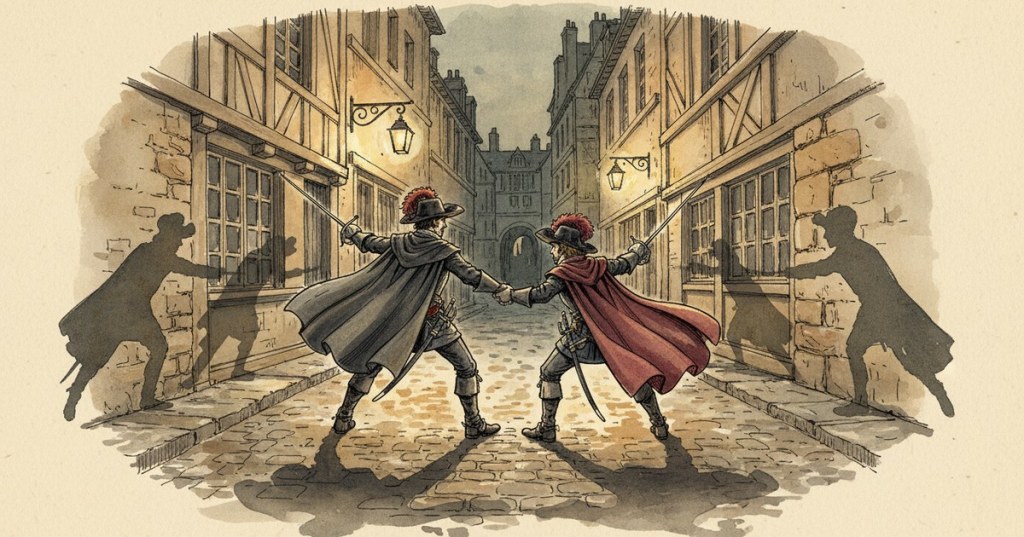
There is a moment, somewhere in the first fifty pages of The Three Musketeers, when a young Gascon with an ugly horse and an uglier temper manages to schedule three separate duels with three separate men before noon on the same day — and then discovers that all three are friends. Any other writer would have turned this into a disaster. Dumas turns it into the founding of a brotherhood. That whiplash — catastrophe becoming camaraderie in a single paragraph — is the whole engine of the book, and nobody has ever done it better.
We think we know this story. The films have made sure of that: swashbuckling, capes, a few sword fights, Porthos being loud. But the novel is something stranger and more furious than any of its adaptations have admitted. It is a book about loyalty tested to breaking point, about political power and who it actually crushes, about a woman (Milady de Winter) who is easily the most dangerous intelligence in France — and who the heroes ultimately murder for it. If you came to The Three Musketeers through Hollywood, you have been lied to, pleasantly, for years. The real thing is wilder, darker, funnier, and more morally uncomfortable than any movie had the nerve to show you.
The question is whether you can get to the real thing. Most English translations have stood between you and Dumas like a well-meaning chaperone — correct, a little stiff, quietly draining the energy from a prose style that in the original runs like a man late for a duel. This new translation is the argument that you don’t have to settle for that anymore.
The Man Who Wrote Faster Than History Could Keep Up
Alexandre Dumas was born in 1802 in Villers-Cotterêts, a provincial town north of Paris, the son of a general and the grandson of a Haitian enslaved woman named Marie-Cessette Dumas, whose surname his father took. That lineage mattered — it shaped how Dumas was received, dismissed, and eventually written out of the literary canon that his contemporaries grudgingly admitted he dominated. He arrived in Paris at twenty with almost nothing: a letter of introduction, a gift for penmanship, and an appetite for theatre, history, and argument that never once dimmed.
He taught himself to write by reading everything. He crashed the Romantic movement just as it was cresting, watched Victor Hugo storm the Comédie-Française with Hernani, and understood immediately what the age wanted: drama, sensation, color, speed. His plays made him famous first. Then, in 1844, two things happened almost simultaneously: The Three Musketeers began its serialization in Le Siècle, and The Count of Monte Cristo began in Journal des Débats. Within twelve months, he had written two of the most-read novels in the history of French literature. He was doing it, by his own account, while running a salon, directing a theatre, entertaining half of Paris, and spending money at a rate that alarmed everyone who watched.
He worked with collaborators — Auguste Maquet most famously on the Musketeers novels — and this has been used against him ever since, as though collaboration were a form of cheating rather than the normal condition of serialized popular fiction in the 1840s. What Maquet provided was historical scaffolding: the research, the period detail, the document in the Bibliothèque nationale that seeded the idea. What Dumas provided was everything else: the dialogue, the pace, the characters who leap off the page still breathing. No one reading Athos’s scene with Milady at the inn — arguably the most quietly devastating confrontation in the entire novel — has ever wondered who actually wrote it.
Four Men, One Impossible Standard of Friendship
The Three Musketeers does something that very few adventure novels have ever managed: it makes you believe in the friendship before it earns it. D’Artagnan arrives in Paris broke and ridiculous, and within two chapters he is fighting alongside men he met hours ago as though they have known each other for a decade. It should feel false. It doesn’t, because Dumas understands that some alliances are legible the moment they form — that certain people recognize each other instantly, and that recognition is its own kind of intimacy. The book is, underneath everything else, a study in what it means to be the kind of person others will run toward trouble alongside.
But Dumas is too honest a novelist to leave it there. Each musketeer carries a private grief that the camaraderie doesn’t cure — only, occasionally, lightens. Athos drinks because of a wound so old he can barely name it. Aramis wants God and keeps choosing pleasure instead, with a scholar’s ability to justify anything. Porthos wants status with the same naked hunger he’d be mortified to admit. These are not decorative character details. They are the load-bearing walls. And when Milady de Winter enters the novel — cool, brilliant, and catastrophically wronged by the very men the book is asking you to cheer for — Dumas quietly places a crack in the foundation that he never quite bothers to repair. He doesn’t want it repaired. He wants you to feel it.
Why This Translation, and Why Now
Every generation of readers deserves a Three Musketeers that doesn’t make them work against the prose to get to the story. Older English versions — some of them produced in the Victorian era by translators who treated Dumas’s propulsive rhythm as something to be calmed down — have given generations of readers an experience closer to a museum diorama than to a novel. The language sits behind glass. This new translation removes the glass. The dialogue runs fast and natural. The action sequences have the kinetic clarity they have in French — you always know where everyone’s sword is. And the novel’s considerable humor, which is often the first casualty of a cautious translation, arrives intact: dry, sudden, and perfectly placed.
The paperback edition includes a translator’s note and a short historical preface that locates the novel in its actual moment — Louis XIII’s France, Richelieu’s shadow over everything, a kingdom that ran on patronage and whispered favors — without turning the book into homework. You get enough context to understand the stakes. Then you get out of the way and let Dumas run. That is, ultimately, the only correct approach to this novel. It has been making readers miss sleep for a hundred and eighty years. This translation earns its place in that lineage.
Somewhere in the second half of this book, d’Artagnan will do something that costs him more than he bargained for, and the four men will end up on the wrong side of a wall at dawn, with enemies on three sides and an argument about honor that could only happen between people who have staked everything on each other. You will not want to put it down. The eighteenth century read it that way. The nineteenth did too. There is no good reason for the twenty-first to be any different.
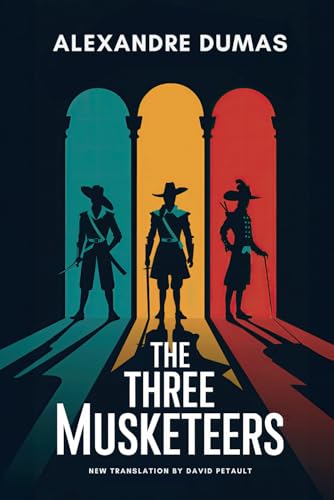
The Three Musketeers : A New Translation in Modern Accessible English
by Alexandre Dumas
Buy PaperbackMore from Alexandre Dumas
This post contains affiliate links. As an Amazon Associate, we earn from qualifying purchases.
 Classics Retold