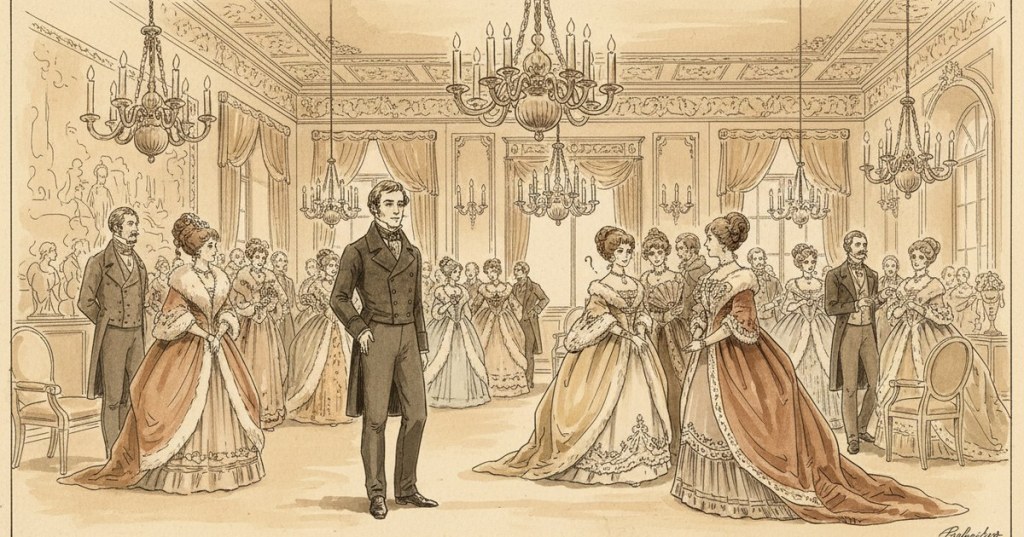
Imagine you want to write a novel about a genuinely good person. Not a saint in a stained-glass window, not a moral exemplar dispensing wisdom from a comfortable distance — a real, breathing, utterly good human being dropped into a world that runs on money, appetite, and performance. Now imagine that such a person, by their sheer goodness, destroys nearly everyone they touch. That is the trap Dostoevsky set for himself in the winter of 1867, broke and gambling-addicted in Geneva, writing The Idiot in frantic serialized installments while his debts compounded and his infant daughter died. He called it the hardest thing he had ever attempted. He called it, privately, a failure. He was wrong on the second count, and the first only makes the novel more extraordinary.
Prince Lev Myshkin arrives in St. Petersburg on a train from Switzerland, returning to Russia after years abroad being treated for epilepsy. He has almost no money, almost no social armor, and absolutely no capacity for pretense. He says what he means. He remembers the face of a woman he saw in a photograph and immediately tells her she has suffered. He refuses to lie to spare anyone’s feelings — not out of cruelty, but because it simply does not occur to him. In a society built on elaborate performances of status and desire, he walks around like an open wound. Within days, two women are in love with him. A man wants to murder him. A family has been upended. And Myshkin, who intended nothing except kindness, watches it all spiral toward catastrophe with the helpless clarity of someone who can see exactly what is happening but cannot stop it, because stopping it would require him to be someone other than who he is.
This is not a parable about goodness being punished. It is something far more uncomfortable than that. It is a novel about the cost of being truly seen — and the violence that cost extracts from everyone involved.
The Man Who Bet His Life on a Character
Dostoevsky had been obsessed with the problem for years. In his notebooks: “The positively good and beautiful man.” That phrase appears and reappears like a splinter he couldn’t work out. He had tried it before — in earlier sketches, in secondary characters — and knew it resisted fiction the way water resists a fist. Beautiful goodness is static. Drama requires friction. Every previous attempt had either produced a prig or a phantom.
What saved The Idiot — what made Myshkin possible — was the epilepsy. Dostoevsky knew epilepsy from the inside. He had been having seizures since his twenties, possibly since the traumatic arrest and mock execution in 1849, when he stood in front of a firing squad in Semyonovsky Square and was reprieved at the last moment by a theatrical imperial messenger. He described the aura before a grand mal seizure as a moment of such total harmony, such absolute rightness with the universe, that he would have traded years of his life not to lose it. Myshkin has these moments too. They are the key to his character: a man who has genuinely touched some absolute, pre-social goodness, and who carries it back into ordinary life where it cannot survive — where it becomes legible only as strangeness, as idiocy.
He finished the novel in 1869 with none of the satisfaction he had hoped for. “I did not succeed in expressing even one-tenth of what I wanted,” he wrote to his niece. But readers recognized something in it immediately. Turgenev, who disliked Dostoevsky personally, admitted the scenes with Nastasya Filippovna — the ruined woman who tears money from a fireplace to humiliate the man who bought her — were unlike anything else in Russian literature. He was right. They still are.
A Demolition Disguised as a Drawing-Room Novel
What The Idiot does, structurally, is use the conventions of the 19th-century social novel against themselves. There are dinner parties and marriage proposals and scandals and estates. There is a romantic triangle — a quadrangle, really — that would be at home in Trollope or Turgenev. But Dostoevsky keeps breaking the frame. Characters give speeches that go on too long, that double back on themselves, that admit things people in novels are not supposed to admit. Myshkin tells a story about a public execution — guillotine, France, Dostoevsky’s own memory from Paris — in such precise, suffocating detail that the room goes quiet in a way that feels physically wrong for a drawing-room scene. The novel keeps doing this: placing you in the expected container and then filling it with something that won’t fit.
Nastasya Filippovna is the other center of gravity, and she is one of the great female characters in all of Russian literature — which means she has often been underread as a victim. She is not a victim. She is the smartest person in most rooms she enters, and she knows it, and she hates herself for what was done to her before the novel begins with a clarity that functions like a weapon. Her relationship with Myshkin is not a romance. It is two people who see each other completely, and that mutual recognition is what makes it impossible. He pities her with a pity so total it approaches love. She knows the difference. The novel knows the difference. That distinction — between pity and love, between witnessing suffering and relieving it — is where The Idiot does its real philosophical work.
Why This Translation
The history of The Idiot in English is a history of choices made under competing pressures — fidelity to the Russian sentence structure that can feel meandering to modern ears, or fluency that sometimes shaves off the roughness Dostoevsky needs. The novel is not polished. Its power comes partly from its haste, its instability, the way it lurches forward like a man who knows he’s running out of time. This new paperback translation restores that quality: the dialogues feel inhabited rather than translated, the long monologues build pressure rather than dissipating it, and Myshkin’s particular manner of speech — candid, slightly off-rhythm, disarmingly direct — finally sounds like a voice rather than an approximation of one. If you have only encountered The Idiot in older English versions, you have not quite met it yet. Pick this one up. Some books need to be re-encountered, and this is one of them.
—
Imagine you want to write a novel about a genuinely good person. Not a saint in a stained-glass window, not a moral exemplar dispensing wisdom from a comfortable distance — a real, breathing, utterly good human being dropped into a world that runs on money, appetite, and performance. Now imagine that such a person, by their sheer goodness, destroys nearly everyone they touch. That is the trap Dostoevsky set for himself in the winter of 1867, broke and gambling-addicted in Geneva, writing The Idiot in frantic serialized installments while his debts compounded and his infant daughter died. He called it the hardest thing he had ever attempted. He called it, privately, a failure. He was wrong on the second count, and the first only makes the novel more extraordinary.
Prince Lev Myshkin arrives in St. Petersburg on a train from Switzerland, returning to Russia after years abroad being treated for epilepsy. He has almost no money, almost no social armor, and absolutely no capacity for pretense. He says what he means. He remembers the face of a woman he saw in a photograph and immediately tells her she has suffered. He refuses to lie to spare anyone’s feelings — not out of cruelty, but because it simply does not occur to him. In a society built on elaborate performances of status and desire, he walks around like an open wound. Within days, two women are in love with him. A man wants to murder him. A family has been upended. And Myshkin, who intended nothing except kindness, watches it all spiral toward catastrophe with the helpless clarity of someone who can see exactly what is happening but cannot stop it, because stopping it would require him to be someone other than who he is.
More from Fyodor Dostoevsky




This post contains affiliate links. As an Amazon Associate, we earn from qualifying purchases.
 Classics Retold