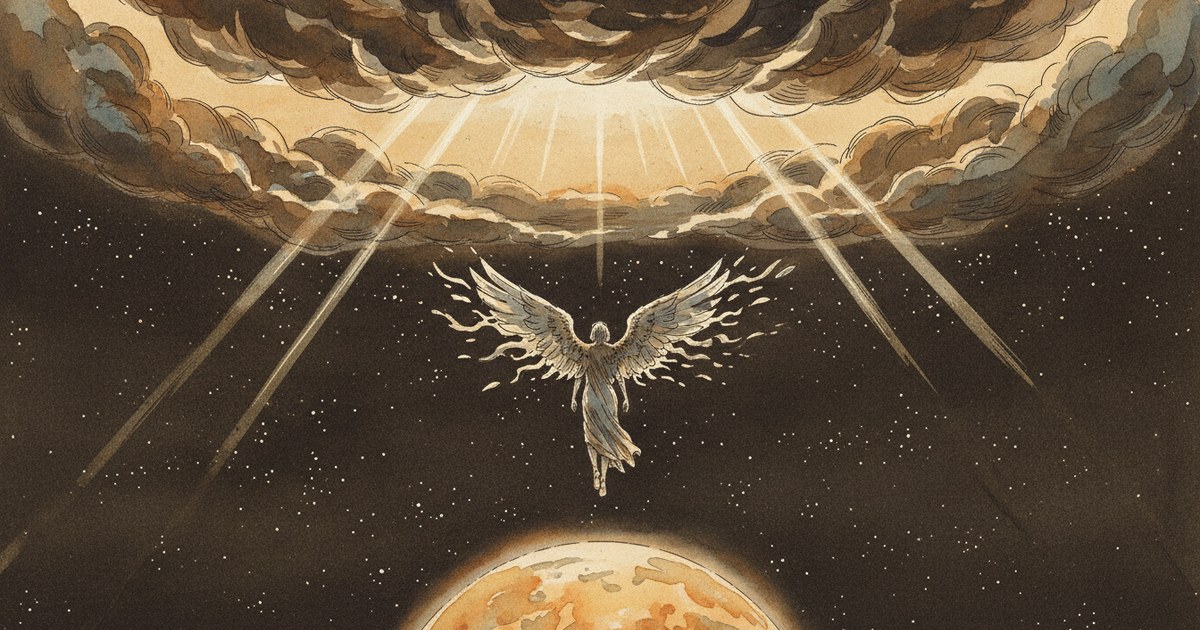
Satan wakes on a burning lake, his wings singed, his pride intact, and his first move is to check the geography of his own ruin. He doesn’t lament; he calculates. He looks at the “dismal situation waste and wild,” the “regions of sorrow, doleful shades, where peace and rest can never dwell,” and he decides that “the mind is its own place, and in itself can make a Heav’n of Hell, a Hell of Heav’n.” This is not the voice of a mythological abstraction. It is the voice of a political revolutionary who has just watched his coup fail and is already planning the insurgency. It is the most cinematic opening in the history of the English language, a wide-angle shot of a cosmic disaster that zooms in until we are staring directly into the eyes of the most charismatic villain ever written.
For most readers, however, this cinematic scale is obscured by a fog of Latinate syntax and seventeenth-century inversions. We are told John Milton wrote the definitive English epic, but we approach it like a chore, a linguistic mountain to be climbed rather than a story to be inhabited. We get lost in the “thee” and “thou,” the convoluted sentence structures that stretch for sixteen lines before hitting a verb, and the dense thicket of classical allusions. We abandon the poem in Book II, somewhere between the council in Pandemonium and the gates of Hell, convinced that Milton is “important” but ultimately unreadable. This is a tragedy of translation—not from another language, but from an older version of our own.
The truth is that Paradise Lost is the most psychologically complex work in our canon. It is a story about the anatomy of a grudge, the weight of unintended consequences, and the agonizing process of losing everything and trying to find a reason to keep going. When Milton wrote that he intended to “justify the ways of God to men,” he wasn’t just writing a theological treatise. He was writing a survival manual. To understand why it reads with such desperate, muscular urgency, you have to understand the man who was sitting in the dark, dictating it to his daughters.
The Blind Secretary of a Fallen Republic
John Milton did not write Paradise Lost from a position of comfort or academic detachment. He wrote it as a defeated man, a wanted man, and a man who had literally lost his sight in the service of a failed revolution. During the English Civil War, Milton wasn’t just a poet; he was the Latin Secretary for Oliver Cromwell’s Commonwealth. He was the chief propagandist for the regime that executed King Charles I. He spent a decade writing fierce, brilliant defenses of regicide and republic, straining his eyes over flickering candles until, by 1652, the world went completely black.
Then came the Restoration of 1660. The monarchy returned, Milton’s friends were executed or driven into exile, and the “Good Old Cause” he had sacrificed his health for was dismantled overnight. He was briefly imprisoned, his books were burned by the common hangman, and he retreated into a quiet, dangerous obscurity. It was in this silence and darkness that he composed over ten thousand lines of blank verse, carrying the poem in his head and waiting for his “amanuensis” to arrive each morning so he could “be milked,” as he put it.
This biographical context is the engine of the poem. When Milton describes Satan’s rebellion against a “celestial tyranny,” he is channeling the fire of his own republicanism. When he describes the crushing weight of defeat and the temptation to “reign in Hell” rather than “serve in Heaven,” he is interrogating the very impulses that led his own political movement to its ruin. The poem is a massive, polyphonic argument between his theological devotion to God and his visceral, human understanding of the rebel. He didn’t make the Devil the most interesting character by accident; he made him interesting because he knew exactly what it felt like to believe you were on the side of justice and end up in the fire.
The Wall of the Grand Style
If the story is so vital, why do so many people bounce off the page? The problem lies in what critics call the “Grand Style.” Milton wanted to create a language that felt as massive as his subject matter. He deliberately mimicked the structure of Latin, placing adjectives after nouns and delaying the main action of a sentence to create a sense of mounting tension. In 1667, this felt revolutionary and majestic. In 2026, it often feels like reading through a brick wall. The sheer density of the verse can act as a barrier to the psychological intimacy of the characters.
Most modern readers are looking for the “cinematic” Milton—the poet who can describe the War in Heaven with the scale of a Christopher Nolan epic and the interiority of a prestige drama. They want to see the moment Eve looks at her reflection in the water for the first time, or the way Adam’s heart sinks when he realizes the woman he loves has doomed them both. When the language is too archaic, these moments lose their sharpness. We need a version that preserves the iambic pentameter—the heartbeat of English poetry—while clearing away the linguistic cobwebs that make the meaning feel remote.
The goal of a modern reading guide isn’t to “dumb down” Milton, but to restore the clarity he intended. Milton was a populist at heart; he wrote in English, not Latin, because he wanted his message to reach the “fit audience, though few.” He wanted to be understood. A great translation of Paradise Lost for the contemporary reader is one that lets the narrative momentum take center stage, allowing the reader to feel the velocity of Satan’s fall without tripping over the syntax.
Navigating the Editions: Which One to Carry?
For the serious student or the casual reader, the choice of edition is the difference between a transformative experience and a decorative one. The Penguin Classics edition, edited by John Leonard, is the gold standard for academic rigor. Its footnotes are exhaustive, providing a masterclass in seventeenth-century theology and classical reference. If you want to know exactly which obscure Greek myth Milton is referencing on line 450 of Book IV, this is your book. However, the sheer volume of notes can interrupt the flow of the poem, turning a narrative experience into a research project.
The Oxford World’s Classics edition offers a similar level of scholarship but with a slightly more streamlined presentation. It is an excellent choice for those who want a portable, reliable text that respects the original spelling and punctuation. But again, these editions are designed for the classroom. They assume a level of patience with archaic language that many modern readers, used to the directness of contemporary prose, simply do not possess. They provide the map, but they don’t always clear the path.
This is where the edition linked below enters the conversation. It is built on a different philosophy: that Paradise Lost should be as readable as a high-stakes novel. This edition doesn’t just reprint the 1674 text; it offers a modern English translation that maintains the rhythmic integrity of Milton’s blank verse while updating the vocabulary and untangling the most complex inversions. It treats the poem as a living document, prioritizing the emotional beats and the narrative arc. It is the version for the reader who wants to stay up late to find out what happens next in the Garden, rather than the reader who needs to pass a midterm.
Why the edition linked below is the 2026 Choice
We live in an age of visual storytelling and psychological deep-dives. We are obsessed with anti-heroes, tragic falls, and the gray areas of morality. Paradise Lost is the ancestor of all these tropes, but it requires a gateway. the edition linked below serves as that bridge. By clarifying the language, it allows the modern reader to appreciate Milton’s incredible technical skill—the way he uses sound to mimic the clashing of armor or the whispering of a snake—without getting bogged down in “ye” and “hath.”
This edition is particularly effective at highlighting the relationship between Adam and Eve. In more archaic versions, their dialogue can feel stiff and formal. In this modern translation, their love—and their eventual, devastating argument after the Fall—feels shockingly contemporary. You realize that Milton wasn’t just writing about the “First Couple”; he was writing about the complexities of partnership, the burden of shared guilt, and the grace required to forgive someone who has changed your life for the worse. If you have ever felt that Milton was too “heavy” for you, this is the version that will change your mind.
For those ready to experience the epic in its most accessible and powerful form, the modern English translation provided in the edition linked below of Paradise Lost is the essential starting point. It strips away the pretense and leaves you with the raw, muscular poetry of a man who saw the end of the world and decided to write a way back to the light.
Is Paradise Lost hard to read?
The original seventeenth-century text can be challenging due to its complex sentence structures and archaic vocabulary. However, the story itself is a fast-paced narrative filled with action and psychological drama. Using a modern translation like the edition linked below makes the poem as accessible as a contemporary novel while preserving the famous rhythm of Milton’s verse.
Is Satan actually the hero of the poem?
This is one of the most famous debates in literature. While Milton’s stated goal was to “justify the ways of God,” he gave Satan the most compelling dialogue and the most relatable motivations in the first half of the book. Many readers find Satan more interesting because he represents the human struggle with pride, ambition, and the pain of loss, whereas God can feel more abstract and remote.
Do I need to be religious to enjoy Paradise Lost?
Not at all. While the poem is based on the Biblical story of the Fall, it functions as a work of epic fantasy and psychological realism. You can appreciate it as a study of power, rebellion, and the human condition in the same way you might appreciate The Iliad or The Lord of the Rings. Its influence on Western culture—from Frankenstein to Star Wars—is so vast that it’s worth reading simply for its literary impact.
What is the “War in Heaven” and is it in the book?
Yes, the War in Heaven is a central set-piece in the poem, occurring in Book VI. It describes the literal physical battle between the loyalist angels and Satan’s rebel forces. Milton describes it with immense scale, featuring celestial artillery, mountain-throwing, and a three-day conflict that culminates in the Son of God driving the rebels into the abyss. It is perhaps the most spectacular action sequence in all of English poetry.

You must be logged in to post a comment.