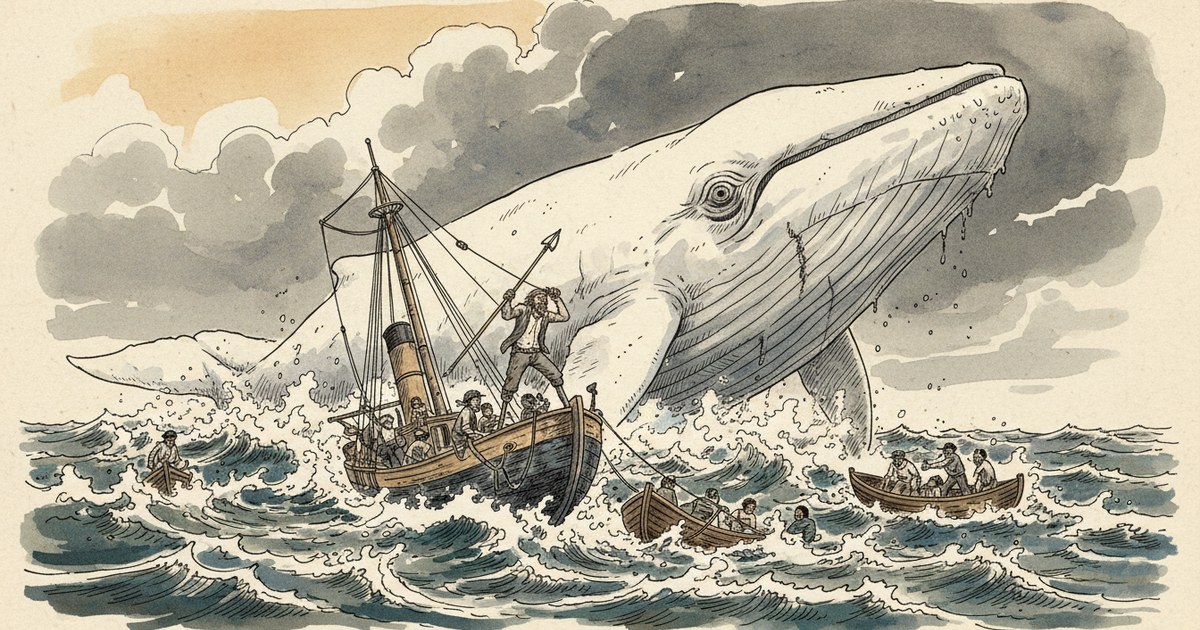
Somewhere in the middle of the Atlantic, a one-legged captain drives a nail through a gold coin and into the mainmast of his ship. The coin is the prize for the first man to sight the white whale. But Ahab does not do this to motivate his crew. He does it because he needs witnesses. He is about to say something that no man in 1851 could say in church, in print, or in polite company: that the universe is a mask, that whatever moves behind it does not love us, and that he intends to punch through.
That speech — “All visible objects, man, are but as pasteboard masks” — is the real thesis of Moby-Dick. Not the chase. Not the whale. The nail going into the wood. Melville wrote this book to make an argument about God, and the argument is that there is nothing there — or worse, something there that does not care. The whale is not a symbol of nature’s indifference. The whale is the face of whatever refuses to be understood, the blankness Ahab cannot accept and cannot stop hunting.
The book was a disaster when it came out. Reviewers called it a curiosity. It sold fewer than four thousand copies in Melville’s lifetime, earned him roughly fifty dollars in royalties, and helped persuade him to abandon fiction entirely. He spent his last decades as a customs inspector on the New York docks. The most radical theological novel in American literature was written by a man the culture then proceeded to ignore for forty years. He died before the revival. He never knew.
The Sailor Who Came Back With Too Much to Say
Herman Melville was twenty years old when he shipped out on a whaling vessel, not for adventure but because his family had gone bankrupt and there was nothing else. His father had died when Melville was twelve, leaving debts and a household that had to be dismantled piece by piece. The sea was not a romantic choice. It was the only open door. What Melville found there — the brutality of the whale hunt, the strange democracy of men thrown together from a dozen nations, eighteen months without land — gave him the raw material for the rest of his life’s work.
He jumped ship in the Marquesas Islands in 1842 and lived for several weeks among the Typee, a tribe with a reputation, among sailors, for cannibalism. He was not eaten. He was, by his own account, treated well. That experience produced his first two books, Typee and Omoo, adventure narratives that made him briefly famous. The public wanted more South Seas escapism. Melville wanted to write something that would crack the surface of the world. The tension between those two desires runs through everything he produced afterward.
The friendship that unlocked Moby-Dick was with Nathaniel Hawthorne. They met in 1850, the summer Melville was already deep into a draft of the whale book, and something in Hawthorne’s willingness to look at the dark — at guilt, at ambiguity, at the absence of consolation — gave Melville permission to go further than he had planned. He expanded the manuscript, added the philosophical machinery, turned what might have been a sea adventure into a sustained argument. He dedicated the finished book to Hawthorne. The friendship cooled shortly after. Melville’s letters from those years read like dispatches from a man who had said too much and could not take it back.
The failure of Moby-Dick broke something in him. Pierre, the novel he wrote next, is furious and nearly unreadable — a deliberate assault on the readers who had misunderstood him. After that, silence, then shorter fiction, then the customs house. The late poems. The manuscript of Billy Budd, unfinished on his desk when he died. He spent forty years living with what he had made, knowing it had not landed, not knowing that it would eventually be recognized as the central work of American literature. That knowledge — the certainty of having written something true and the equal certainty that no one had heard it — shaped the bitterness that runs under every page he wrote after 1851.
What the Whiteness Is Actually Doing
Moby-Dick contains chapters on cetology, on the mechanics of rendering blubber, on the history of whale oil as an economic commodity. Readers who bounce off the book usually bounce here. This is a mistake. The technical chapters are not digressions. They are the scaffolding of Melville’s argument: that the world is made of specific, material things, and that any metaphysics worth having has to pass through the specific and the material before it earns the right to generalize. When Ishmael spends six pages on the precise color of the whale’s skin, he is not padding. He is insisting that you look directly at the thing before you decide what it means.
The chapter titled “The Whiteness of the Whale” is where the book’s theology becomes explicit. Ishmael catalogs everything that makes white terrifying rather than pure: the white bear, the white shark, the white shroud of the Antarctic. His conclusion is that whiteness is frightening not because it signals something malevolent but because it signals nothing at all — it is the color of absence, of the void behind appearances. This is not nihilism as despair. It is nihilism as honest observation. Melville is saying: I looked, and this is what I found. He is not asking you to feel better about it.
Against this backdrop, Ahab becomes comprehensible rather than simply mad. His rage is not irrational. It is the only rational response to the situation as he understands it: that something took his leg and that something does not care. The hunt is not revenge in any ordinary sense. It is a theological argument conducted with a harpoon — a refusal to accept the universe’s indifference without at least making the indifference acknowledge that someone was there to notice it. He will not look away. That is both his heroism and his ruin.
What Ishmael survives to tell is not a story of triumph or redemption. He floats on a coffin. The entire crew is gone. The whale is gone. Ahab punched through the mask and found nothing behind it, and the nothing swallowed him whole. Ishmael is left with the account — which is to say, with the book you are holding. The act of bearing witness is the only thing the novel finally endorses. Not answers. Not victory. The willingness to stay in the room while the argument is made.
The Translation Landscape
Spanish readers have had access to Moby-Dick for nearly a century, and the translation history reflects the shifting priorities of each era. The most influential Spanish version has long been Enrique Pezzoni’s Argentine translation, first published in the 1960s. Pezzoni was a serious literary critic and his translation is genuinely scholarly — attentive to Melville’s biblical cadences, careful with the cetological vocabulary, faithful to the long Latinate periods that give Ishmael’s narration its weight. It remains available in several editions and is the version most commonly assigned in Latin American universities. Its limitation is precisely its strength: the register is elevated, occasionally archaic, and the reading experience can feel like approaching a monument rather than a living book.
The Penguin Clásicos edition, which circulates widely in Spain, draws on a translation more attuned to Castilian readers and smooths some of Melville’s deliberate roughness in the service of fluency. For a general reader encountering the book for the first time, it is serviceable. But the smoothing costs something. Melville’s prose is not elegant in the way that word is usually meant — it is powerful, ungainly, capable of sudden beauty in the middle of long technical passages. A translation that makes it flow evenly has made a choice about what the book is, and that choice shapes what the reader encounters.
Several other versions exist in print, most of them Spanish peninsular translations from the mid-twentieth century that have aged variably. What distinguishes the better Spanish translations of Melville is not vocabulary precision alone but the willingness to preserve his tonal instability — the way the prose can shift in a single paragraph from documentary flatness to pulpit rhetoric to something close to lyric. That instability is not a flaw. It is the book’s nervous system.
the edition linked below is positioned differently: a modern Spanish translation aimed at readers who want the full force of the original without the archival patina of versions that are themselves now sixty years old. Where Pezzoni’s translation is a classic in its own right, this edition prioritizes immediate contact with the text — the sense that the argument Melville is making is being made now, to you, in language that has not been insulated by time. The theological urgency that makes the book matter does not require period diction. It requires clarity.
Why This Translation Earns Its Place
The test of any Melville translation is the Quarterdeck scene. When Ahab drives the nail and delivers his argument to the crew, the rhetoric needs to feel dangerous — not elevated, not theatrical, but actually threatening, the way a real person saying an unsayable thing in a real room feels threatening. A translation that makes the speech sound like literature has already failed. It needs to sound like someone losing patience with the universe. the edition linked below holds that register. The sentences do not perform their profundity. They assert it and move on, the way Ahab does.
For Spanish-language readers coming to the book for the first time, or returning to it after a version that left them cold, this translation offers what the original offers: a book that is difficult in the right ways and accessible in the ways that matter. The cetology chapters are still long. Ahab is still inexorable. The coffin is still waiting. But the argument arrives whole, with the nail already in the wood and the gold coin catching the light. the edition linked below is available here — for readers ready to look directly at the blankness and not flinch.
¿Es Moby-Dick realmente tan difícil de leer?
It is long and uneven by design, not by accident. The cetological chapters — on whale anatomy, blubber, oil — are deliberate, and once you understand what Melville is doing with them (building the physical world before dismantling it philosophically), they become part of the experience rather than obstacles to it. The narrative line involving Ahab, Ishmael, and the hunt is as propulsive as any sea thriller written in the nineteenth century. Most readers who have struggled with the book encountered it in a translation or edition that did not prepare them for what kind of book it is. It is not a novel in the conventional sense. It is a sustained argument in narrative form. Read it that way and the difficulty becomes the point.
¿De qué trata realmente Moby-Dick?
The surface story is a whaling voyage that ends in catastrophe. The real subject is the question of whether the universe is indifferent to human suffering or actively hostile to it — and whether, in either case, rage is a legitimate response. Ahab believes the white whale is the physical embodiment of whatever refuses to be understood, and he intends to kill it. Ishmael, the narrator, is not sure Ahab is wrong about the whale, but he watches what the certainty costs. The book is a theological argument conducted at sea, with harpoons, and it does not resolve. That is not a failure of the novel. That is its honesty.
¿Por qué fracasó Moby-Dick cuando se publicó?
The 1851 readership wanted Melville to keep writing South Seas adventure — the accessible, entertaining mode of his first two books. Moby-Dick gave them something else entirely: a book that used the adventure framework to make an argument about God that was, at the time, unspeakable in polite American culture. Reviewers did not know what to do with it. Some praised the whale-hunting detail and found the philosophical machinery intrusive. Others were simply baffled. The book sold poorly, Melville’s reputation collapsed, and he spent the last forty years of his life in obscurity. The twentieth-century revival, led in part by D.H. Lawrence and Lewis Mumford, recognized what the nineteenth century had missed: that the book was ahead of its moment by about fifty years.
¿Necesito haber leído otras obras de Melville para disfrutar de Moby-Dick?
No prior Melville is required. The novel is self-contained and Ishmael establishes the world fully from the first page. What helps is knowing, going in, that the book will not behave like a conventional nineteenth-century novel — that the digressions are structural, that the narrator’s reliability is part of the subject, and that the ending is not a resolution but a remainder. Come to it as you would come to an argument: with attention and without the expectation of being comforted.
Also worth reading

Frequently Asked Questions
Why did Melville choose a whale as his symbol for challenging God?
Whales in the 19th century represented the most powerful and mysterious force in nature that man regularly encountered. By making the white whale both beautiful and terrible, Melville created a perfect stand-in for a God who could be simultaneously worshipped and cursed. The whale’s whiteness specifically evoked both purity and the terrible blankness of an indifferent universe.
What couldn’t Ahab say in 1851 that Melville was trying to express?
Ahab voices the heretical idea that if God allows suffering and evil, then God himself might be evil or indifferent to human pain. This was literary blasphemy in antebellum America, where questioning divine goodness could end careers and social standing. Melville used Ahab’s madness as cover to explore these forbidden theological questions.
Is Ahab speaking for Melville himself?
Melville gives Ahab the philosophical ammunition but not his endorsement. The novel shows Ahab’s quest as both magnificent and destructive, suggesting Melville understood the appeal of defying cosmic injustice while recognizing its futility. Melville wrote the rebellion he couldn’t live.
How did contemporary readers react to the book’s religious themes?
Most reviewers in 1851 either missed the theological rebellion entirely or dismissed the book as too strange and philosophical. The few who caught Melville’s meaning were often scandalized, with some calling it “immoral” and “irreligious.” This critical rejection contributed to Melville’s literary obscurity during his lifetime.


You must be logged in to post a comment.