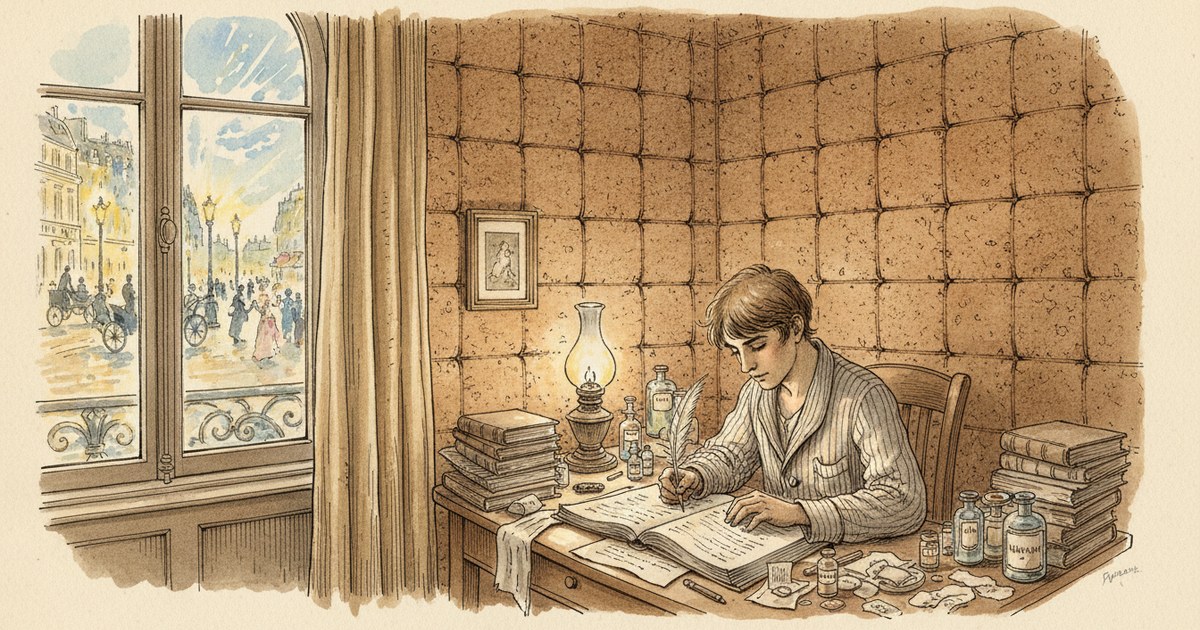
In 1909, Marcel Proust sat down in a cork-lined bedroom in Paris and began writing a sentence. It ran for several pages. He was describing the experience of waking up, of not knowing where or when you are, of feeling the whole architecture of identity collapse and slowly reassemble itself from nothing but sensation. By the time he died in 1922, he had written 3,000 pages and had not quite finished. The sentence, in a sense, was still going.
Swann’s Way is the first volume of that sentence. It begins with a man lying in the dark, half-asleep, and it ends with him standing in the street remembering a love affair that destroyed his youth and noticing, with the cold precision of a surgeon, that the woman was not even his type. Everything in between is an argument about time — not time as a calendar records it, but time as the nervous system does: associative, recursive, occasionally merciless. The thesis Proust is running is audacious: that voluntary memory lies, that the past is only genuinely recovered when the body is ambushed by it, and that literature is the only instrument sensitive enough to catch this happening in real time.
That is what makes Swann’s Way unlike anything else in the canon. Not its length. Not its famous sentences. Its argument.
The Man Who Built a Cathedral to Stay Indoors
Proust was born in 1871 to a prominent Paris physician father and a Jewish mother whose family connections opened doors into the upper bourgeoisie. He was brilliant, asthmatic, socially ravenous, and constitutionally unsuited to health. His childhood summers in Illiers — fictionalized as Combray — gave him the landscape of Swann’s Way: the church, the two walks, the hawthorns in bloom, the kitchen smell of a house where time moved differently than in Paris. When his mother died in 1905, he began a grief-driven retreat that accelerated into the cork-lined room on Boulevard Haussmann. He had the room lined to keep out noise and dust. He worked at night. He barely left.
The isolation wasn’t eccentricity for its own sake. Proust needed silence because he was attempting something that required absolute concentration: to reconstruct, with total fidelity, the precise texture of consciousness moving through time. His asthma forced him inward; his grief demanded it stay there. The result is a novel written from the inside of a mind that has nothing left to do but remember — and has learned, through suffering, to distrust everything memory presents without the body’s confirmation.
What the biographical record also shows is how ferociously social Proust had been before he retreated. Through the 1890s he haunted the salons of the Faubourg Saint-Germain, cultivating friendships with aristocrats, artists, and socialites with the same systematic devotion he later gave to prose. He attended the premiere of Pelléas et Mélisande. He fought a duel, badly, over a newspaper squib. He was present at the height of the Dreyfus Affair and watched his own social world split along antisemitic lines that cut close to home. None of this was wasted. The Guermantes, the Verdurins, the entire ecosystem of performance and snobbery in the novel — Proust assembled it from live specimens, observed over decades with a naturalist’s patience and a wounded insider’s eye.
He died of pneumonia in November 1922, correcting proofs in bed. The final volumes were published posthumously. He had spent the last years of his life writing death — his narrator’s slow understanding that time had passed and could not be recovered except in the one way that mattered, which was this: the book itself.
What the Madeleine Actually Does
Everyone knows the madeleine. What most people don’t know is that Proust uses it as a trap. The narrator dips a madeleine into lime-blossom tea, and something unlocks — not a postcard memory, not a nostalgic haze, but a full sensory resurrection so complete it produces joy disproportionate to any deliberate act of remembering. He spends several pages analyzing why. He is not being indulgent. He is making his case: that the past locked in involuntary memory is the only past that remains entirely real, and that the self who recovers it is, for that moment, standing outside time. The madeleine is not a warmth-and-cookies moment. It is a philosophical proof-of-concept.
The rest of Swann’s Way tests and complicates the proof. The Combray section, written in the long loose rhythms of total recall, gives us childhood as a place where the geometry of two afternoon walks still structures the whole moral universe. “Swann in Love,” the novella nested inside the novel, shifts tense and distance to show us Swann’s obsession with Odette from close enough to feel the shame of it — a man applying the machinery of aesthetic appreciation to a woman who returns none of it, watching himself do it, unable to stop. What Proust shows in that section, with a flatness that verges on cruelty, is that romantic suffering is a form of solipsism: Swann is not in love with Odette, he is in love with his own capacity to suffer over Odette. The reader recognizes this. The recognizing is uncomfortable.
What is easy to miss, first time through, is the structural cunning behind the madeleine episode’s placement. It comes early, before Combray has been described at all — which means that everything which follows, all two hundred pages of hawthorns and church steeples and Aunt Léonie’s bedroom, arrives as the content of that unlocked memory. We are not reading a novel that occasionally stops for flashbacks. We are inside the flashback from almost the first page. Proust has arranged it so that the reader experiences involuntary memory rather than simply being told about it — the sensation of a whole lost world rushing back, warm and complete, delivered not by effort but by a cup of tea.
The World Proust Was Writing About — and Against
To read Swann’s Way without knowing what Belle Époque Paris looked and smelled like is to miss half its tension. The world Proust depicts is one of extraordinary social rigidity dressed up as elegance: aristocratic families whose names opened every door, bourgeois families desperate to pass through those doors, and artists and aesthetes like Swann hovering uncomfortably between both worlds. Proust knew this system from both sides. His father was respected but not noble; his mother was Jewish in a city where that still cost something. He watched people perform their social identities with the anxious precision of actors who know they can be written out of the play.
The Dreyfus Affair — the 1894 military scandal in which a Jewish officer was falsely convicted of treason, dividing France into bitterly opposed camps for over a decade — runs underneath the novel like a fault line. Proust was a Dreyfusard, one of the early signatories of Émile Zola’s open letter demanding justice. Several of the aristocratic characters in the cycle are implicitly or explicitly anti-Dreyfusard, and the reader who knows this watches Proust’s narrator navigate their drawing rooms with a doubled awareness: enchanted by the glamour, clear-eyed about the ugliness beneath it. The social comedy is never quite detached from the social indictment.
How the Sentences Actually Work
The reputation of Proust’s sentences precedes them so noisily that many readers brace for difficulty before they’ve read a word. The reality is more interesting than the warning. A Proustian sentence doesn’t drift; it accumulates. It begins with an observation, then qualifies that observation, then notices what the qualification implies, then follows that implication somewhere unexpected, and then, having arrived somewhere no shorter sentence could have reached, closes. The length is the point — not as an aesthetic preference but as a mimetic strategy. Consciousness doesn’t move in short declarative bursts. It moves exactly the way those sentences do.
A useful test case is the passage where the narrator describes the church at Combray. It begins as architectural description and ends as a meditation on time — the building old enough to have absorbed centuries of the town’s life into its stones, so that looking at it feels like looking at duration itself made solid. The sentence carrying this idea runs through several subordinate clauses that keep adjusting the angle of approach, each one getting slightly closer to something that a direct statement couldn’t capture. By the end, you have not been told what the church means. You have experienced the process of working it out. That is the technique in miniature. Multiplied across 3,000 pages, it becomes something that changes how you read everything else.
Why This Translation (translated by David Petault)
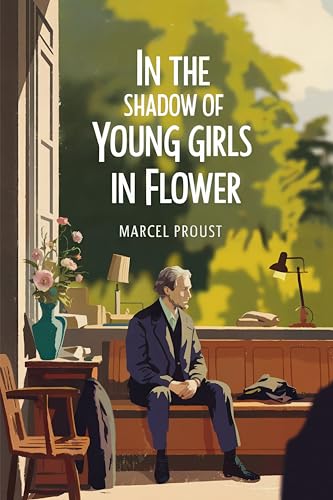
Translation is the central problem with Proust in English. The sentences need to hold their shape — their long, breath-consuming, subordinate-clause-stacking shape — without collapsing into parody or ironing themselves into clarity Proust never intended. The translation we recommend takes those sentences seriously as formal objects, preserving their characteristic rhythm while keeping them navigable for a reader encountering Proust for the first time. If you’ve been putting Proust off because you’re not sure you have the patience, this is the edition to start with — and it’s available here in paperback.
The translation question matters more for Proust than for almost any other novelist in the European canon, because the style is the argument. Earlier English versions — C.K. Scott Moncrieff’s celebrated rendering, revised by Terence Kilmartin and then D.J. Enright — are magnificent in their own right but carry the slightly elevated, slightly formal diction of their respective periods. They can make Proust feel more ceremonial than he is in French, where the long sentences exist against a conversational baseline that keeps them from feeling monumental. The edition featured here is calibrated for a contemporary English reader: the syntax stays long and sinuous where it needs to, but the diction breathes, and the occasional flash of dry wit — Proust is funnier than his reputation suggests — lands cleanly rather than being buried under period upholstery.
A word on the patience question: you don’t need more of it than usual. You need a different kind. Proust doesn’t ask you to endure; he asks you to slow down to the speed of a mind actually thinking. Once you match that speed, the length stops being a problem. The only difficulty is that when it’s over, ordinary prose feels slightly impoverished by comparison.
Also worth reading
Further reading: More books by Marcel Proust · Explore French Literature
What is the best English translation of Swann’s Way (In Search of Lost Time Vol. 1)?
For readers approaching Proust for the first time, a modern accessible translation of Swann’s Way is the strongest choice. Unlike older Victorian-era renderings that preserve the opacity of the original French syntax at the expense of readability, this new translation prioritizes clarity without sacrificing the novel’s famous lyrical depth. The long, sinuous sentences are kept intact but made navigable, so the prose breathes rather than baffles. Readers who previously bounced off Proust’s opening pages often find this version the one that finally lets them through.
Is Swann’s Way (In Search of Lost Time Vol. 1) worth reading in 2026?
Yes — arguably more so now than in previous decades. Proust’s central preoccupation, the way memory shapes identity and distorts time, maps directly onto contemporary anxieties about attention, nostalgia, and what we lose when we stop being still. The Combray section alone, with its meditation on involuntary memory triggered by the madeleine, reads less like a literary curiosity and more like a precise phenomenological report on the modern mind. A clean, modern translation removes the period-piece friction and lets the novel’s psychological acuity hit without delay.
How does Swann’s Way (In Search of Lost Time Vol. 1) compare to Pleasures and Days: A New Translation?
Both belong to the same Proustian world, but they serve different purposes. Pleasures and Days is early Proust — a collection of sketches, prose poems, and short fiction that reads as a rehearsal for the grand themes he would later develop in full. Swann’s Way is where those themes crystallize into sustained narrative: obsessive love, social performance, the architecture of memory. Readers who want to understand what Proust was building toward should start with Swann’s Way. Pleasures and Days rewards those who return to it after finishing the larger work, when its sketches can be read as seeds rather than standalone pieces.
What should I read after Swann’s Way (In Search of Lost Time Vol. 1)?
If you want to stay inside Proust’s seven-volume cycle, the next step is Within a Budding Grove. But if you’re ready to shift from interior monologue to plot-driven momentum, two titles from the classicsretold.com catalog translate that appetite into immediate satisfaction. The Three Musketeers: A New Translation in Modern Accessible English delivers everything Swann’s Way withholds — pace, action, camaraderie — in a version stripped of archaic diction. Alternatively, The Hunchback of Notre-Dame: A New Translation in Modern Accessible English offers the same nineteenth-century French literary milieu as Proust but through Hugo’s architectural spectacle and social fury. Both are available in editions edited specifically to keep modern readers reading.


You must be logged in to post a comment.