Before there was a novel, before there was a play, before Dumas wrote a single duel and Hugo drafted a single barricade, there was a girl eating a pomegranate seed in the underworld. She didn’t know what she was starting. Neither did we, for a few thousand years. But that moment — Persephone’s choice, or non-choice, or catastrophe, depending on which version you read — is where Western storytelling begins: a character trapped between two worlds, two mothers, two definitions of home, and no clean exit. Every plot you have ever loved is running that same engine.
That’s not rhetoric. It’s grammar. Greek mythology is the grammar of Western narrative, the syntax beneath everything that followed. Homer’s women wait and scheme and grieve on a scale that Shakespeare borrowed wholesale. Ovid metabolized the same stories into verse so precise that Renaissance painters copied his sentence structures onto canvas. When Hugo’s Fantine falls, she falls in the shape of a Greek suppliant. When Balzac’s women maneuver through Parisian drawing rooms, they are running Hera’s playbook. The mythology didn’t influence the tradition — it is the tradition, dressed in different centuries.
Which means that a child who learns these stories young doesn’t just learn mythology. She learns to read. She learns the underlying architecture of conflict, consequence, and character that every serious author since Homer has been reworking. And she learns it at the age when patterns stick — when a story heard at ten becomes an instinct at thirty.
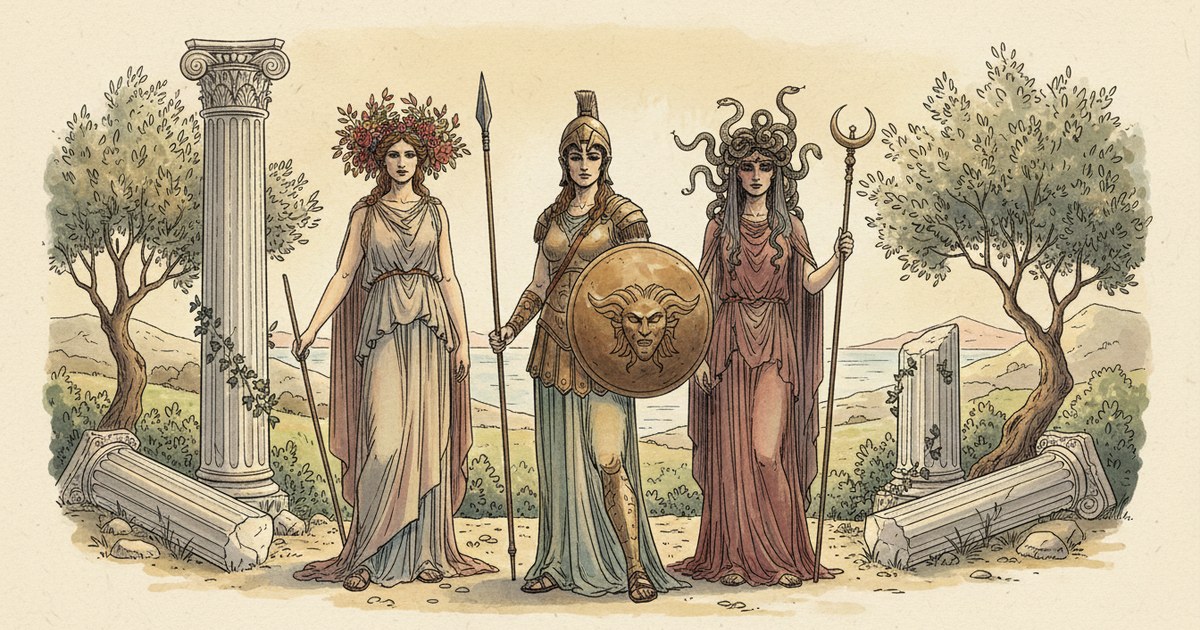
Female Heroes of Greek Mythology by Rockridge Press gathers 51 of those stories, filtered specifically through the figures who have always driven the best of them: the women. That editorial choice is not a modern imposition. These are not retrofitted heroines. Persephone, Aphrodite, Medusa — these women have been at the center of Greek mythology since the beginning, and the stories in this collection restore them to that position rather than decorating it. Rockridge Press, known for producing accessible educational content for young readers, made a deliberate structural decision here: each story is self-contained enough for a single sitting but connected enough that a child reading straight through begins to see the web — how Aphrodite’s interference causes Psyche’s suffering, how Athena’s judgment echoes across multiple myths, how the same divine rivalries produce different human casualties each time. That architecture is not accidental. It mirrors the way the original myths circulated, in clusters and cycles rather than isolated episodes.
Persephone: The Story That Invented Plot
Start with Persephone because her story is, structurally, everything. A young woman is taken. The world goes cold. A mother’s grief becomes climate. A daughter negotiates a partial return. And the whole cycle repeats, every year, forever — which means the story doesn’t end, it revolves. That’s not just mythology. That’s the first act-break, the first ticking clock, the first story that understood seasons as metaphor.
What makes the Persephone myth particularly valuable for a young reader is how deliberately it resists a single villain. Hades took her; Demeter grieves her; Zeus permitted it; Hermes retrieved her. The pomegranate seeds are still debated — did she eat willingly? Did she know what it meant? The story holds all of that ambiguity without resolving it, which is exactly how the best fiction works. A child who sits with Persephone’s story learns early that motivation is complicated, that outcomes are not the same as justice, and that the most interesting question is usually not what happened but why it mattered.
The collection’s handling of Persephone is worth noting for what it doesn’t do: it doesn’t resolve the seed question for the reader. The event is presented with enough detail that a child has to make up her own mind about whether those seeds were accident, defiance, or something harder to name. That refusal to tidy the ending is a significant pedagogical choice. Most children’s retellings of myth sand down the moral ambiguity because it is assumed children cannot hold it. This one assumes they can, which means the child reading it is being treated, from the first story forward, as someone capable of sitting with discomfort — and that is precisely the capacity that serious reading later requires.
Aphrodite: Power Without Armor
Aphrodite is the figure most likely to be misread by a child who hasn’t been properly introduced to her — and most likely to reveal something important to one who has. She is routinely flattened into a symbol of vanity or beauty-as-weakness. The actual mythology is considerably more unsettling. Aphrodite caused the Trojan War. She brokered Paris’s judgment by offering him Helen, knowing full well what would follow. She manipulated gods and mortals with equal indifference. She is dangerous not despite her domain but because of it — desire is the oldest lever, and she controls it absolutely.
For a reader of adult literary fiction, Aphrodite is preparation for every femme fatale, every ambiguous enchantress, every character whose power operates below the surface of official authority. She teaches children that influence is not always loud. It doesn’t arrive with a sword. Sometimes it arrives as a gift, and the gift is a trap, and the trap was sprung before you saw it coming — which is the mechanism of half the novels ever written.
Consider what the Aphrodite and Psyche story does in this collection specifically. Psyche is set an impossible series of tasks — sort a mountain of seeds, fetch water from a river guarded by dragons, descend into the underworld — and she accomplishes them not through strength but through unexpected help and, crucially, through persistence in the face of what appears to be pure malice from a goddess with nothing better to do. The story is about endurance under institutional power, and the institution here wears a beautiful face. A child reading that version of Aphrodite is not learning about vanity. She is learning about how authority operates when it has no obligation to be fair — which is a lesson worth having before you are old enough to encounter it in a workplace or a court or a novel by Kafka.
Medusa: What the Monster Remembers
The version of Medusa that most children inherit is a monster slain by a hero. Perseus gets the sword, the shield, the winged sandals, the severed head. The story is framed as his. But Medusa’s own story — the one that begins before Perseus, the one that explains how she became what she became — is the one that matters most to a reader in training.
She was transformed. Whether by punishment or by curse or by the cold arithmetic of divine politics depends on the source, but the key fact is that her monstrosity was not original. Something was done to her, and then she was blamed for it, and then she was killed for it. That sequence — transformation, stigma, destruction — appears in serious literature constantly, from Valjean’s brand to Emma Bovary’s ruin to every character who is punished twice, once by circumstance and once by the people who could have helped. A child who learns Medusa’s full story learns to ask, before judging any villain, what happened first.
The ancient sources are not uniform on Medusa’s origin — Ovid gives her the fullest transformation narrative in the Metamorphoses, while earlier Greek sources treat her monstrosity as simply given. What this collection does, usefully, is present the transformation version, which means the child meets Medusa as a person before she meets her as a creature. That sequencing changes everything. By the time Perseus arrives with his mirrored shield, the reader is already holding two frames at once: the hero’s triumph and the victim’s end. That double vision is not comfortable. It is also not optional if you want to read serious literature honestly. The best adult novels — the ones worth reading twice — demand exactly that kind of split attention, the ability to understand a character’s logic and still see what it costs.
The Question of Tone: How These Stories Are Told
A collection covering 51 myths for readers aged 8 to 12 faces an immediate structural problem: Greek mythology contains sexual violence, familial murder, divine cruelty, and consequences that no modern children’s publisher would present without careful handling. The question is not whether to acknowledge darkness — sanitized mythology is bad mythology, and children know it — but how to frame it so that the weight lands without the graphic detail overwhelming the meaning.
This collection threads that needle by keeping the focus on consequence and character rather than event. The violence is not absent, but the camera, so to speak, cuts before it lingers. What remains after each story is not an image of what happened but a question about what it meant. A child reading about Medusa understands that something terrible was done to her; she doesn’t need a clinical account to feel the injustice of it. This is, incidentally, exactly how the best literary fiction handles trauma — Toni Morrison doesn’t describe everything, and neither does this book. The reader’s imagination is engaged rather than bypassed, which means the story takes up residence rather than just passing through.
Why Mythology Before Novels
There’s a specific argument for introducing mythology before long-form fiction, and it isn’t about difficulty or age-appropriateness. It’s about scale. Greek myths operate at the level of archetype — they show you the stripped-down skeleton of a story before the flesh of realism gets added. A child who reads about Persephone before she reads about Anna Karenina already understands the architecture of a woman caught between two irreconcilable worlds. A child who knows Aphrodite before she encounters Becky Sharp already knows what calculated charm looks like when it’s honest about itself. The myths don’t simplify the novels. They illuminate them.
And specifically the female myths matter here, because Western literary tradition has a long history of placing women at the center of its most important stories while crediting men with their telling. Restoring these figures to their proper function — as agents, as architects of consequence, as the characters whose choices set the world in motion — is not a revisionist project. It’s an accurate one. The Trojan War begins with three goddesses and a golden apple. The Odyssey is structured around Penelope’s patience as much as Odysseus’s cleverness. The women were always load-bearing. A book that makes that visible to an eight-year-old is doing something genuinely useful.
There is also a practical argument that tends to get overlooked in discussions about reading development: mythological literacy is cumulative in a way that isolated novel-reading is not. A child who reads one novel has read one novel. A child who reads fifty connected myths has absorbed a system — a set of relationships, recurring figures, cause-and-effect chains that span generations and genres. When she later encounters a reference to Cassandra in a political essay, or a Medusa allusion in a poem, or a character described as acting like Penelope, she has a referent. She is already inside the conversation rather than standing at the door trying to decode the handshake. That kind of cultural fluency is not trivial. It is part of what distinguishes a reader who understands what she reads from one who merely processes it.
For the adult reader of this site — someone who already understands what it means to encounter a novel that rearranges how you see the world — the question about this book is simple: what would you have read differently if you’d known the grammar first? What would Hugo’s fallen women have meant to you earlier if you’d already sat with Persephone? What would Dumas’s scheming courtiers have revealed faster if you’d already watched Aphrodite work a room?
Give a child this book and you are not giving her mythology. You are giving her the foundation on which every serious piece of literature she will ever encounter was built. That’s a different kind of gift.

This post contains affiliate links. As an Amazon Associate, we earn from qualifying purchases.
Frequently Asked Questions
Is this book appropriate for children who haven’t read mythology before?
Yes — it’s specifically designed as an entry point. The stories are told cleanly, without assuming prior knowledge, and the language is calibrated for readers aged 8 to 12. A child coming in cold will find the stories accessible; a child who has some familiarity will find them usefully expanded.
Does the book cover darker elements of Greek mythology?
Greek mythology is not tame, and a book that erased all difficulty would be doing a disservice to the material. This collection handles the darker elements with age-appropriate framing — the violence and consequence are present but not gratuitous. The emphasis is on character and meaning, which is where the best mythological retellings have always put it.
Why focus specifically on female figures rather than the full pantheon?
Because the female figures are consistently the most structurally important and the most frequently marginalized in popular retellings. Focusing this collection on 51 women is an editorial decision that also happens to be a corrective one — it centers the characters whose agency most directly drives the mythology’s major narratives.
How does mythology help children read adult fiction later?
Myths operate at the level of archetype — they show the skeleton of a story before realistic detail obscures it. A child who learns the mythological patterns early arrives at serious adult fiction already fluent in its underlying structures: the tragic arc, the corrupted gift, the character undone by the one thing she cannot give up. Those patterns appear in every major novel in the Western canon. Learning them young means reading that canon, eventually, with recognition rather than bewilderment.
Which figures from the book are covered beyond the well-known goddesses?
The collection extends well past the Olympian inner circle to include figures like Atalanta, the huntress who outran every suitor until a golden apple slowed her down; Circe, whose island appearances in the Odyssey barely scratch what her own mythology contains; and Cassandra, whose curse — to tell the truth and never be believed — makes her one of the most narratively precise figures in all of Greek myth. Those lesser-known stories are often the richest ones for a young reader, precisely because they arrive without the weight of prior expectation.
How does this book compare to D’Aulaires’ Book of Greek Myths for the same age group?
D’Aulaires’, published in 1962, remains a beautifully illustrated introduction to the full pantheon and is still worth having on the shelf. The meaningful difference is editorial focus: D’Aulaires’ covers the mythology broadly, with male and female figures given roughly equal page time according to their traditional prominence, which means Zeus and Heracles loom large. Female Heroes of Greek Mythology inverts that priority, which makes the two books genuinely complementary rather than redundant — one gives the wide view, the other gives the corrected one.
You must be logged in to post a comment.