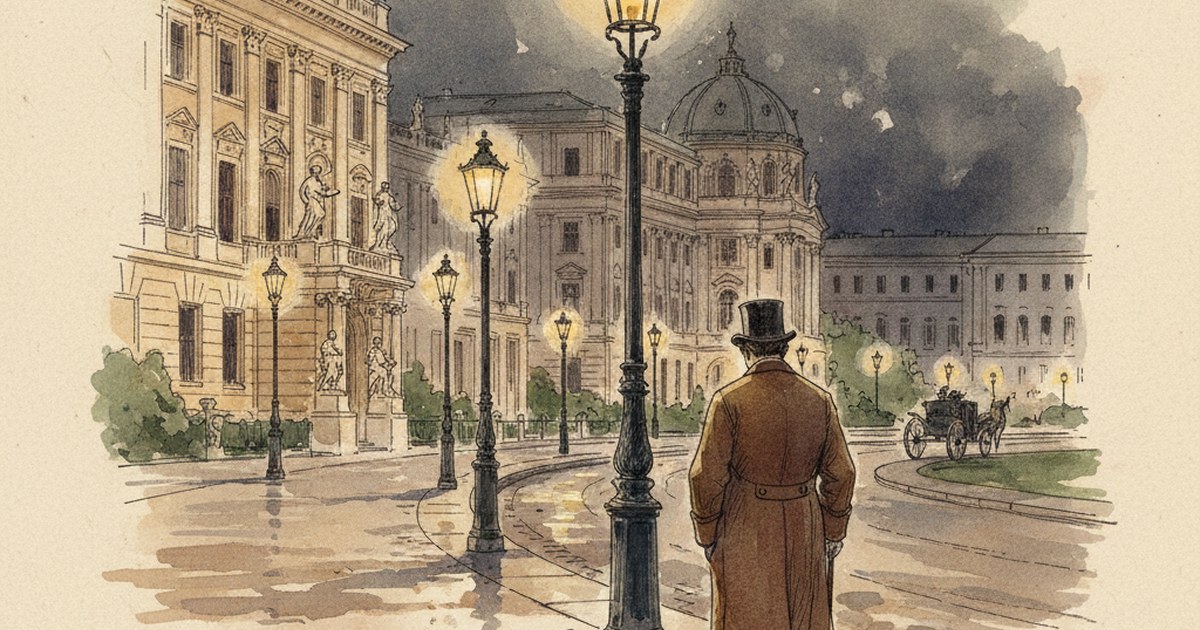
In the winter of 1900, a young man in a good overcoat walked the length of the Ringstrasse and felt, with the particular certainty of the gifted and the young, that he was standing at the center of the world.
Vienna at the turn of the century was not merely a city. It was a proposition — the argument, made in stone and music and coffee and lamplight, that civilization was a permanent achievement, that the long work of culture had arrived somewhere worth arriving. The Ringstrasse itself was the proposition made architectural: that boulevard of imperial ambition, lined with museums and opera houses and parliament buildings dressed in Hellenistic robes, announcing that this city, this empire, this Europe had inherited antiquity’s mantle and intended to wear it well. Stefan Zweig, twenty years old, a poet by vocation and a bourgeois by birth, walked its length and believed every word of it.
He would spend the next four decades watching the argument collapse. And he would spend those same decades writing — furiously, tenderly, obsessively — as though the act of description could hold the thing described in place a little longer. It could not. But what he left behind is something rarer than preservation: it is testimony, the account of a man who loved a world, watched it die, and had the literary gifts to say what exactly was lost.
The Republic of Letters, and Its Most Famous Citizen
By 1930, Stefan Zweig was the most translated author in the world. Not the most celebrated in any single country — that crown belonged, depending on the season, to Thomas Mann or to Romain Rolland — but across languages, across borders, across the precisely the range of European and South American cultures he had spent his life cultivating, no one moved more copies. The novellas sold in Paris and São Paulo and Warsaw and Tokyo. The biographical essays — what he called his “spiritual portraits” of historical figures — were read by people who had never opened a history book and would not have described themselves as readers of biography. He had found the tone that the age wanted: intimate but not sentimental, erudite but not pedantic, morally serious without the hectoring quality that makes moral seriousness exhausting.
The friendships he accumulated read like the roster of a civilization’s greatest achievement. He corresponded with Rainer Maria Rilke for years, two Austrians writing to each other in a German so careful it was practically a private dialect. He visited Auguste Rodin in Meudon and wrote about the sculptor’s workshop with an attention so precise you can still smell the clay. He and Romain Rolland maintained a friendship that survived the First World War, two pacifists writing across the lines of a conflict that made pacifism feel like either cowardice or sainthood depending on which side of the Rhine you stood. With Sigmund Freud, his older contemporary in Vienna, he shared a reverence for the interior life, for the proposition that what happens in the mind is as consequential as anything that happens in the street.
What bound all of these relationships was a shared faith — and it was, at bottom, a faith — in what Zweig called the European idea. Not a political program, not a bureaucratic arrangement, but a cultural reality: the sense that a writer in Vienna and a writer in Paris and a writer in Prague were, at some level, citizens of the same republic. They read the same books, argued about the same ideas, moved through the same coffeehouses when they visited each other’s cities. He was, in the fullest sense, a European writer — not Austrian, not German-speaking, but something that the twentieth century would systematically set about destroying: a man whose identity was constituted by culture rather than nation.
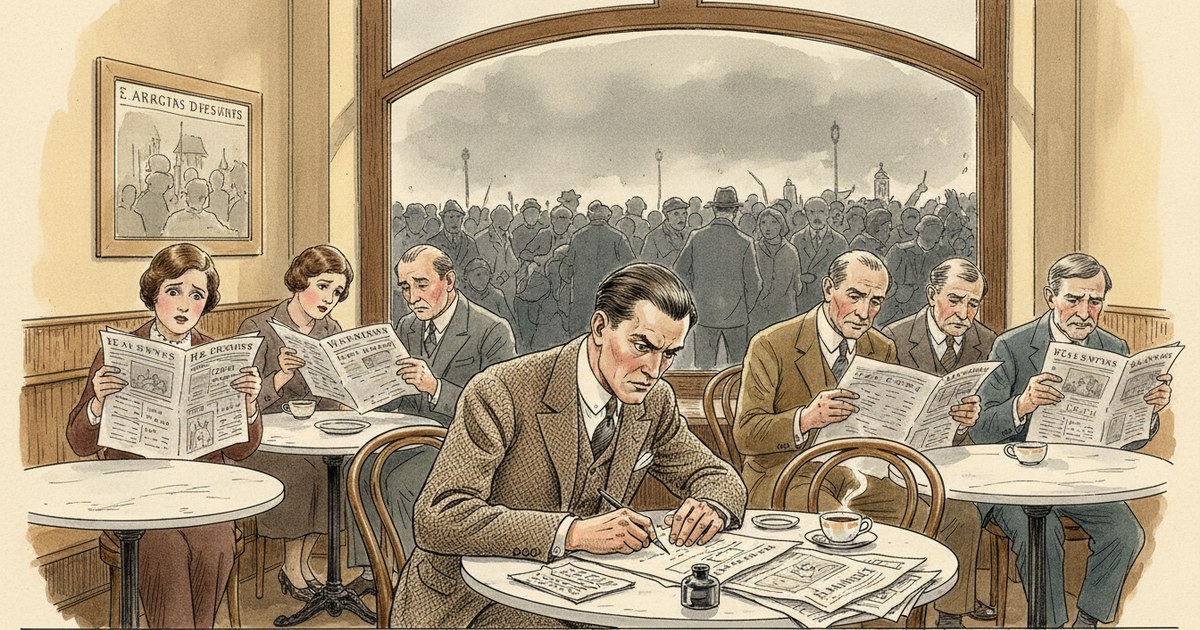
The Viennese coffeehouse was, for Zweig, the physical embodiment of this ideal. He understood it the way that later generations would understand the internet: as an infrastructure for a particular kind of sociability, a place where you could sit for four hours over a single coffee, read every newspaper in six languages, and encounter the sculptor, the journalist, the philosopher, and the politician at adjacent tables. The coffeehouse was classless in a way that Austrian society was not — or rather, it performed the suspension of class distinctions with enough theatrical conviction that the performance became, for a few hours each afternoon, a reality. It was also radically international. In the Café Landtmann or the Central, the question of which nation had produced you was less interesting than the question of what you had read recently and what you thought about it.
Zweig’s own work was animated by precisely this spirit. His biographical essays — on Erasmus, on Mary Queen of Scots, on Magellan, on Mary Baker Eddy — were not conventional biographies in any academic sense. They were acts of imaginative identification, attempts to inhabit another consciousness across the distances of time and language. He was drawn consistently to figures who stood at the intersection of history and private experience, to people whose inner lives were thrown into violent relief by the events surrounding them. Erasmus, who watched the Reformation tear apart the humanist project he had devoted his life to, was in many ways Zweig’s mirror: the intellectual who believed in reason and persuasion and watched power prove them inadequate.
The World That Ended
January 30, 1933. Adolf Hitler became Chancellor of Germany, and Stefan Zweig’s world — the specific, irreplaceable, painstakingly constructed world he had spent his life inhabiting — began its final movement.
The speed of the collapse was, in retrospect, astonishing. Within weeks, his books were being removed from German libraries. Within months, the intellectual culture of central Europe had been subjected to a kind of surgical removal, with Jewish writers and artists and academics extracted from the body politic with a thoroughness that was itself a kind of negative tribute to their centrality. Zweig had been, all his adult life, so thoroughly assimilated into European literary culture that his Jewishness had seemed, to him and to most of his correspondents, a biographical fact rather than a defining identity. The Nazis corrected this misapprehension with characteristic brutality.
He left Austria in 1934, before the Anschluss made leaving compulsory, and settled in Bath — of all places, Bath, that most Georgian of English cities, a place of limestone crescents and conducted orderliness that must have felt, after Vienna, like living inside a very well-maintained museum exhibit. He worked there, writing the libretto for Richard Strauss’s opera Die Schweigsame Frau, but the collaboration became its own small scandal when the Nazi authorities insisted that Zweig’s name be removed from the program. Strauss, choosing the opera over the friendship, eventually complied. It was a minor betrayal in a decade of catastrophic ones, but it had the particular sting of the personal.
London, then Bath, then New York — the geography of exile has its own grammar, and Zweig was learning it word by word. He understood, before many of his contemporaries were willing to admit it, that the world he had known was not merely threatened but already over — that the question was not whether the Europe of the Ringstrasse and the Café Central would survive, but whether anything of it could be carried forward into whatever came next. The autobiography he was writing in these years, The World of Yesterday, was composed in that spirit: not as a memoir in the usual sense, not as an account of a life that continued, but as a monument to a civilization in the process of its own demolition.
He arrived in Brazil in 1940, settling eventually in Petrópolis, a mountain town outside Rio de Janeiro that the Portuguese royal family had once used as a summer retreat from the coastal heat. It was, in its way, another place of displaced grandeur, another city that had once been at the center of something and now existed in the pleasant irrelevance of the postimperial. Zweig worked there, completed The World of Yesterday, continued the essay on Montaigne he had been writing for years. He was fifty-nine years old, in good health, professionally productive, living in a country that was not at war and had no immediate intention of becoming so. By any external measure, he had survived.
On the night of February 22, 1942, he and his wife Lotte took lethal doses of barbiturates and lay down together to die. They were found the following afternoon, arranged on the bed with a composure that suggested the act had been considered and prepared. The note he left was addressed to his friends in Brazil — not to posterity, not to the literary world, but to the specific people who had shown him kindness in a country not his own — and it explained, with characteristic lucidity, that he was ending his life not from hopelessness about his personal circumstances but from exhaustion at watching the world he belonged to be destroyed. He was, he wrote, too tired to begin again.
The distinction matters. This was not a man brought low by failure or obscurity or the ordinary cruelties that literary careers can inflict. He was, at his death, still widely read, still respected, still capable of work he believed in. What had been destroyed was not his career but his civilization — the community of readers and writers and artists across whose network of relationships his identity had been constituted. Without that network, the work itself felt, to him, like speaking into a room from which everyone had left. He was not wrong. The Europe he described in The World of Yesterday was already an archaeological site, and he was old enough to know it.
What the Books Hold
It is tempting — and not entirely inaccurate — to read Zweig’s suicide as the last paragraph of his autobiography, the gesture that completed the argument the book had been making. He had lived through the world he described; he chose not to outlive it. But this reading, for all its elegance, does a disservice to the actual work, which is neither an elegy nor a suicide note but something more demanding and more generous: a sustained act of attention to human experience, offered in the belief that such attention is worthwhile regardless of what happens to the civilization that produces it.
The novellas — Letter from an Unknown Woman, The Royal Game, Amok, Beware of Pity — are extraordinary pieces of narrative engineering, stories that move with the propulsive efficiency of plot while carrying, in their interiors, a weight of psychological observation that belongs to a much slower literary tradition. The chess story in particular, written in his final years, has about it the quality of a last testament: a tale of a man who survives imprisonment by retreating entirely into the life of the mind, learning chess from a smuggled book, playing both sides against each other until the interior game threatens to consume him. It is the story of intellectual civilization as a form of resistance, and it was written by a man who had spent a decade watching intellectual civilization fail to resist anything.
What has brought him back to readers in recent years — the new translations, the reissued collections, the renewed critical interest — is not nostalgia for the Belle Époque, though a certain nostalgia is probably inevitable. It is, rather, the particular quality of his prose attention: the sense that human experience, rendered with sufficient care and honesty, yields something that outlasts the historical moment that produced it. The coffeehouse is gone. The Ringstrasse still stands, but the empire it was built to celebrate is a century in the ground. The republic of letters — that informal, idealistic, cosmopolitan network of writers and readers that Zweig devoted his life to — exists now only in fragments and approximations.
But the books remain. They sit on the shelf with the patient authority of all good writing, waiting for the reader who needs to be told that there was once a world where culture was taken seriously as a form of human achievement, where the life of the mind was understood to be as consequential as any other kind of life, where a young man in a good overcoat could walk the length of a great boulevard and feel, not without justification, that he was at the center of something worth being at the center of. That world is gone. What Zweig left behind is the most precise account we have of what it felt like to inhabit it — and to watch it end.
Read Zweig in a Translation That Does Him Justice
The Stefan Zweig Collection brings together his finest novellas and biographical portraits in a modern English translation that preserves his musicality without the stiffness of the Victorian-era versions.

Frequently Asked Questions
Who is “the young man in the good overcoat” the author describes walking the Ringstrasse?
The figure is left deliberately unnamed in the opening passage, functioning less as a biographical subject than as a composite type — the confident, cultivated European who believed in 1900 that progress was irreversible. The author uses this anonymous walker to set up the central irony: that certainty would not survive the century he was just entering.
What does the author mean when he calls Vienna “a proposition”?
He means that fin-de-siècle Vienna was not just a place but an argument — a claim, built into its architecture, coffeehouses, and concert halls, that Western civilization had achieved something durable. The book then tracks how systematically that argument was refuted over the following five decades.
Is “The Man Who Saw Europe Die” structured as a biography, a history, or something else?
The book sits between genres: it uses one life as a lens to focus a broader historical collapse, moving between personal memoir and political chronicle as the century darkens. Readers who expect a conventional biography will find the historical analysis intrudes constantly — and that intrusion is the point.
How much does the author rely on primary sources versus retrospective accounts of this period?
The opening sections draw heavily on diaries, letters, and contemporaneous journalism from Vienna circa 1900, giving the early chapters their ground-level texture. As the narrative moves toward 1914 and beyond, the author increasingly works from retrospective memoirs, a shift he acknowledges creates a different kind of knowledge — shaped by what survivors already knew had been lost.

You must be logged in to post a comment.