Tag: English literature

  • Mary Shelley Was Nineteen. It Shows.

    Mary Shelley Was Nineteen. It Shows.

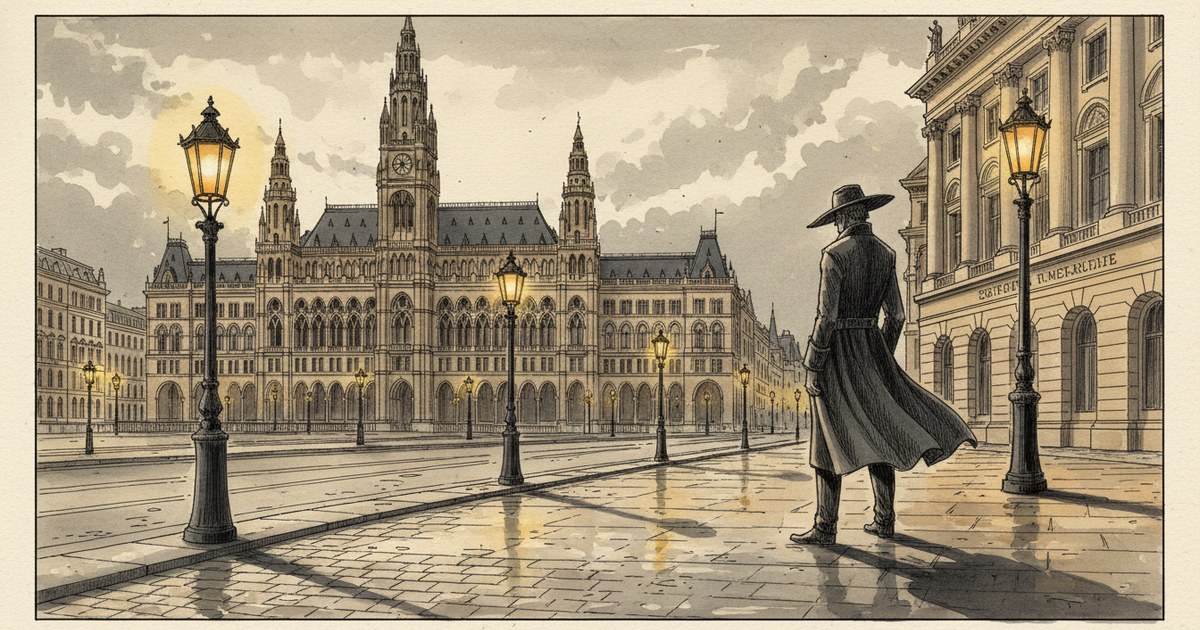
    Search “Ringstrasse” today and the results come back immediately: the Kunsthistorisches Museum in its Italian Renaissance skin, the Burgtheater playing neoclassical grandeur, the neo-Gothic Rathaus spiking the skyline like a cathedral that forgot what century it was born in. Vienna’s imperial boulevard is one of the most photographed urban projects in Europe — and one of the most misunderstood. Visitors walk it and see ambition, sweep, the confidence of empire. What they are actually walking through is the architecture of anxiety: a civilization so uncertain of its own modernity that it dressed everything in costumes ransacked from dead civilizations and called it progress. Someone had already written the manual for this. She was eighteen years old, and she finished the draft in 1817.

    Recommended Edition

    Frankenstein — Mary Shelley

    Frankenstein — Mary Shelley
    Modern English translation

    Kindle →
    Paperback →

    Mary Shelley’s Frankenstein was published in 1818, thirty-nine years before Franz Joseph I signed the decree demolishing Vienna’s medieval walls and ordering the construction of the Ringstrasse. The novel is not a ghost story or a monster story. It is a story about what happens when you assemble something from borrowed parts and pretend the stitching doesn’t show — and then have the audacity to call your creation new. Every stone of the Ringstrasse is a suture. The Ringstrasse is Frankenstein’s creature, built at imperial scale.

    That argument sounds provocative until you actually walk the boulevard and the novel together. Then it feels obvious — which is perhaps the most useful thing a great book can do. Make the thing you were already looking at suddenly legible.

    Geneva, 1816: The Summer That Made the Monster

    The year before Mary Shelley began writing in earnest was the year the sky turned wrong. Mount Tambora had erupted in April 1815, sending enough ash and sulfur into the atmosphere to drop global temperatures and eliminate summer across the Northern Hemisphere. In 1816, crops failed across Europe and North America. The skies over Lake Geneva were apocalyptic — lurid, chemically strange, the kind of sunsets that looked painted by someone who had never seen a sunset. Mary Godwin, not yet Shelley, was nineteen that summer, living with Percy Bysshe Shelley, twenty-four, at the Villa Diodati near Geneva alongside Byron and his physician Polidori. They read ghost stories aloud by firelight. Byron proposed that each of them write one.

    What Mary brought to that challenge was not just imagination but immersion. The galvanism debates were live and scandalous: Luigi Galvani had published his experiments on frog legs in 1791, demonstrating that electrical current could animate dead muscle. Giovanni Aldini, his nephew, had taken the show public — applying galvanic current to the body of an executed criminal at Newgate Prison in 1803, making the jaw clench, the eye open, the fist rise. These were not fringe spectacles. They were serious scientific theater, and the question underneath them was serious: what is the difference between matter and life? What exactly does lightning do to a frog, and how far can you take the principle? Percy Shelley had read the natural philosophers obsessively. That summer, the ideas were in the air along with the Tambora ash, and Mary absorbed both. Victor Frankenstein is not a madman. He is the smartest person in his lecture hall, following the logic of his era to its conclusion.

    She never lets him off the hook for that. The crime in Frankenstein is not ambition — it is abandonment. Victor builds his creature and then recoils from it. The monster’s fury is not born from evil. It is born from being made, and then being left.

    Franz Joseph’s Creature: The Ringstrasse as Architectural Frankenstein

    In December 1857, Emperor Franz Joseph issued a decree dissolving Vienna’s old city walls and opening the space for what would become one of history’s most deliberate acts of urban theater. The Ringstrasse was not a city growing; it was a city being assembled to specification. What followed over the next four decades was a controlled raid on the architectural past: Theophil Hansen designed the Parliament building in the Greek Revival style, borrowing democracy’s visual language for an empire that was not one; Heinrich von Ferstel’s Votivkirche plundered French Gothic for its soaring twin spires; Gottfried Semper and Carl von Hasenauer clothed the Kunsthistorisches Museum in Italian Renaissance grandeur to house collections the Habsburgs had accumulated from every corner of a continent. None of these styles were native. All of them were selected, as Victor Frankenstein selected his materials, for what they signified — for the aura they could transfer.

    Hans Makart was the Ringstrasse’s painter in the same way that Semper was its architect: both were producing something enormous, theatrical, and historically composite, each canvas and façade a demonstration that the right arrangement of borrowed references could produce the impression of inherent authority. Makart’s studio became a social institution; his paintings, vast and operatic, were events. They were also, in retrospect, the ideology made explicit — the belief that grandeur could be assembled from the correct ingredients rather than grown from something real. The Ringstrasse’s most honest building might be the Rathaus, its neo-Gothic façade rising over a city with no medieval civic tradition to justify it, a borrowed spine for a body that was something else entirely. Frankenstein’s creature had a borrowed nervous system too. It could feel everything. It could not be claimed.

    The Knife That Saves, the System That Destroys

    While the Ringstrasse was going up, something equally extraordinary was happening a few kilometers away at the Vienna General Hospital — the Allgemeines Krankenhaus — which had become by the mid-nineteenth century the most advanced medical institution in the world. The Vienna School of Medicine was drawing physicians from across Europe and America to learn pathological anatomy, to look inside the body with a precision that had no precedent. Theodor Billroth performed the first successful gastrectomy there in 1881, removing two-thirds of a patient’s stomach and reattaching the remainder to the small intestine. The patient lived. The knife, in skilled hands, could do things that looked like creation.

    But the same institution had, a generation earlier, destroyed Ignaz Semmelweis. Semmelweis had noticed in the 1840s that the mortality rate from childbed fever was dramatically lower in the ward staffed by midwives than in the ward staffed by physicians who had come directly from performing autopsies. He proposed that the physicians were carrying something — what we now call pathogens — on their hands. He was ignored, mocked, forced out, and eventually committed to a mental asylum, where he died in 1865 at fifty-seven, possibly from the same infection he had spent his career trying to prevent. The system did not lack the intelligence to hear him. It lacked the will to bear the implication — that the people doing the healing were also doing the harm. Frankenstein already knew this. Victor is not evil. He is a man who cannot tolerate the full consequences of what he has done, and so he runs, and the running is what turns creation into catastrophe. Semmelweis saw too clearly. The institution’s response was the same as Victor’s: it looked away.

    The Vienna Medical School and Victor Frankenstein are not an analogy. They are the same story, playing out in different registers — the story of what happens when a system built around mastery encounters the thing mastery cannot fix, which is the consequences of mastery itself.

    Why This Translation Changes Everything

    Most readers who bounce off Frankenstein are bouncing off the register, not the novel. The archaic syntax, the Romantic effusions, the layers of framing narration — Walton writing letters, Victor narrating to Walton, the creature narrating to Victor — can feel like obstacles before the reader gets to what the book actually is, which is a philosophical thriller of devastating precision. The Classics Retold edition strips the archaic drag without flattening the prose into something generic. What comes through, finally, is Victor’s rationalizations in their full, self-serving clarity — you can watch him construct his innocence in real time — and the creature’s chapters, which are the most extraordinary thing in the novel. The creature speaks in complete paragraphs. It argues. It cites its own experience as evidence. It is more articulate than anyone who has ever feared it, and this translation lets that eloquence land without the reader having to fight the sentence structure to get there. The frame narrative, which is easy to dismiss, becomes in this edition what it always was: a reminder that this is a story being told and retold, and that every telling involves selection, omission, the possibility of self-deception. You finish it thinking about what Victor left out.

    Frequently Asked Questions

    What does the Ringstrasse have to do with Frankenstein?

    The Ringstrasse — Vienna’s imperial boulevard built between 1857 and 1900 — was an act of assembly rather than growth. Its architects deliberately mixed neo-Gothic, neo-Renaissance, and neo-Baroque styles, constructing an identity from borrowed historical fragments. Mary Shelley’s Frankenstein, written forty years before the first stone was laid, described exactly this impulse and its consequences: the creature built from assembled parts is not the horror. The horror is what the creator refuses to acknowledge about what he has made.

    Did the Shelleys ever visit Vienna?

    Percy and Mary Shelley travelled through continental Europe in 1814 and again in 1816. Mary’s journals mention passing through Austria, though the Ringstrasse didn’t yet exist — Franz Joseph’s decree demolishing Vienna’s medieval walls came in 1857, four decades after Frankenstein was published. What the Shelleys would have seen was the late Habsburg baroque: the predecessor culture the Ringstrasse simultaneously celebrated and replaced.

    Is Frankenstein gothic horror or science fiction?

    Both — and the tension between those categories is what keeps the novel alive. The gothic framework (isolation, transgression, the return of what cannot be buried) is the emotional architecture. The science fiction premise (galvanism, reanimation, the medical frontier) is the intellectual engine. The Ringstrasse era was caught in the same bind: obsessed with both aesthetic grandeur and scientific progress, it embodied the same unresolved contradiction Shelley had diagnosed in 1818.

    Which edition of Frankenstein is best for a first read?

    For a first read, the Classics Retold edition is the most direct route into the novel — the archaic register is modernized without flattening the prose, so Victor’s rationalizations and the creature’s eloquence both land cleanly. If you want scholarly apparatus, the Oxford World’s Classics edition has the best editorial notes on the scientific background. The Penguin Classics edition is the standard academic text. But for the experience of the novel as a novel, the Classics Retold edition is where to start.

    This post contains affiliate links. As an Amazon Associate, we earn from qualifying purchases.

  • Milton Wrote Paradise Lost After His Revolution Failed

    Milton Wrote Paradise Lost After His Revolution Failed

    Milton wrote Paradise Lost blind, dictating it to his daughters every morning. He had fought for the English Revolution, served as Oliver Cromwell’s Latin Secretary, and watched the monarchy restored and his side defeated. He had been imprisoned. He had lost his sight. He wrote the greatest epic in the English language as an old man in defeat, and made Satan the most compelling character in it.

    That last fact is not incidental. It is the key to everything. The poem Milton chose to write in the wreckage of his life was not a lament, not a memoir, not a political tract — it was a cosmic epic about the first act of rebellion in history. And he gave the rebel the best lines.

    What Paradise Lost Is Actually About

    Paradise Lost is not, at its core, a poem about the Fall of Man. It’s a poem about the problem of heroism after a revolution fails.

    Satan is articulate, defiant, magnificent in his refusal to submit. His opening lines — “Better to reign in Hell than serve in Heaven” — have been quoted approvingly by people who have never read another line of the poem. Milton gives him the best speeches. He gives him the best imagery. He gives him interiority, tragedy, a psychology that Adam and Eve — the nominal protagonists — simply don’t have. Adam and Eve are obedient. Satan is interesting.

    This is not an accident. Milton knew exactly what he was doing.

    The poem asks a question that Milton could not answer cleanly: what do you do with your admiration for a rebel when the rebellion has failed and the old order has reasserted itself? Satan’s courage is real. His cause was wrong — or was it? Milton never quite lets you settle. The poem’s moral architecture is officially orthodox. Its emotional architecture is something else entirely.

    Who Milton Was

    John Milton (1608–1674) spent the most politically active years of his life not writing poetry but writing prose — pamphlets, polemics, defenses of the English Commonwealth. He wrote in defense of the execution of Charles I. He wrote against censorship (Areopagitica, still the most eloquent defense of free speech in English). He served as Latin Secretary to the Council of State under Cromwell, drafting official correspondence with foreign governments.

    When the monarchy was restored in 1660, Milton was briefly imprisoned. Some of his books were burned. He survived — partly through luck, partly through the intervention of friends — but the cause he had devoted his life to was finished. He was in his early fifties, blind, and politically defeated. Paradise Lost, begun in the 1650s and published in 1667, is the work he made out of that defeat.

    This is worth sitting with. The man who wrote the greatest defense of free expression in the English language spent his most productive decades not writing poetry. He had a calling — he said so himself, in his early notebooks, with the confidence of someone who knows what he is for — and he set it aside for twenty years because the political emergency seemed more urgent. When the emergency resolved in the worst possible way, he came back to the poem. Whatever Paradise Lost is, it is also a reckoning with what it costs to serve a cause.

    The World It Came From

    Paradise Lost was published in 1667, seven years after Charles II rode into London and the Puritan revolution collapsed. The men who had governed England in God’s name, who had executed a king and declared a Commonwealth, were suddenly traitors, fanatics, or worse — embarrassments. Some were executed. Some fled. Milton, protected by his fame and his blindness and the quiet advocacy of Andrew Marvell, was released after a few months in prison and allowed to live out his life in obscurity. The Restoration was not merely a political event. It was a total revision of what the previous twenty years had meant.

    The political reading of the poem is not a modern imposition. Milton’s first readers made it immediately. Satan, to those readers, was legible as the defeated cause — as Cromwell, as the godly party, as anyone who had staked everything on a vision of righteous power and lost. The ambiguity was the point. When your side loses, the question of whether the rebellion was heroic or catastrophic does not resolve cleanly. Milton lived inside that ambiguity for the rest of his life. The poem is where he worked it out — or tried to. Paradise Lost is a political poem wearing the costume of theology, and the costume is very good, but it was never meant to fool anyone entirely.

    Why People Quit — and How Not To

    The main barrier is the verse. Paradise Lost is written in blank verse — unrhymed iambic pentameter — and Milton’s sentences are long, inverted, and dense with classical allusions. The first book opens with a 26-line sentence. Readers trained on novels find this disorienting.

    The solution is to read it aloud, or listen to it. The poem was dictated and is meant to be heard. When you hear the rhythm — and especially when you hit the passages where Milton opens the throttle — the difficulty dissolves into music. The Librivox recording is free and adequate; the Naxos recording with Anton Lesser is excellent.

    The other solution is to read a prose modernization first. There are several good ones. They lose the music entirely, but they give you the story, the characters, and the argument — and once you have that, going back to the original verse is a different experience.

    One practical note: don’t stop to look up every classical allusion. Milton’s references to Mulciber and Pandemonium and the catalogue of fallen angels are spectacular, but you can follow the poem without parsing all of them. Read the footnotes selectively. The poem rewards patience more than it rewards scholarship.

    The Translation Problem

    “Translation” is a slight misnomer here — Paradise Lost is in English, but Early Modern English that can feel almost as foreign as another language to contemporary readers. The real question is whether to read the original verse or a modern prose version.

    The verse is the poem. A prose version of Paradise Lost is like a prose version of a Beethoven symphony — you get the themes and the structure, but you lose the thing that makes it what it is. That said, some readers find the prose version a useful on-ramp, and there’s no shame in using it that way.

    If you want the original, use the Penguin Classics edition edited by John Leonard — the notes are generous without being condescending, and Leonard’s introduction is one of the best short essays on the poem. If you want a prose modernization, Dennis Danielson’s Paradise Lost: A New Reading is the most respected.

    Where to Start

    Start with Book I. Don’t skip ahead to find Adam and Eve — you’ll miss the setup, and the setup is where Milton establishes Satan as a figure to be reckoned with. Read through Satan’s first speech (lines 84–124) at least twice. If that doesn’t hook you, the poem probably isn’t for you. If it does, you’ll read the rest.

    Books I and II are the most gripping. Books III and IV are slower. Books V through VIII contain the backstory and cosmology — necessary but dense. Books IX and X are where the action pays off. Books XI and XII are the most difficult for modern readers.

    If you stall, skip to Book IX (the Fall itself) and read through to the end, then go back and fill in what you missed.

    What People Get Wrong

    The most common misreading is that God is the hero of Paradise Lost. He isn’t — at least not in any way that feels earned on the page. Milton’s God is verbose, self-justifying, and oddly defensive. Satan, by contrast, is electric. William Blake put it plainly: Milton was “of the Devil’s party without knowing it.” Shelley agreed. Both were pointing at something real. The poem’s official theology says one thing; the poem’s imaginative energy says another. Readers who flatten it into a simple morality tale are missing the argument entirely.

    The second misreading is that Paradise Lost is primarily a religious poem for religious people. This is how it gets assigned and how it gets abandoned. But the poem’s central preoccupations are not theological in the narrow sense — they are about power and the psychology of those who refuse to accept it, about obedience and whether the demand for it is legitimate, about the seductions of rebellion. These are questions that anyone who has worked inside an institution, a government, a family, or a marriage will recognize immediately. The theology is the container. The contents belong to everyone.

    If You Liked This

    For readers who respond to Paradise Lost’s central problem — the attractiveness of the rebel, the moral ambiguity of legitimate authority — three books demand attention. Dostoevsky’s The Brothers Karamazov contains the Grand Inquisitor chapter, which is essentially Paradise Lost compressed into twenty pages: a figure of total institutional authority confronted by a Christ who refuses to play by the rules. Melville’s Moby-Dick is an explicit reworking of the same archetype — Ahab is Satan, the Pequod is Hell, and the white whale is an indifferent God that will not explain itself. And Philip Pullman’s His Dark Materials is a conscious rewrite of Paradise Lost from Satan’s point of view, with an Eve who gets to choose on her own terms. All three ask the same question Milton asked and didn’t fully answer: what if the rebel was right?

    Frequently Asked Questions

    Is Paradise Lost worth reading?

    Yes, without qualification. It is one of the handful of works in English that genuinely changed what the language could do, and its central argument — about rebellion, authority, and the psychology of defeat — has never been answered. The difficulty is real but manageable. The payoff is permanent.

    How long does it take to read Paradise Lost?

    The poem runs to about 10,500 lines across twelve books. A careful first reading takes most people between fifteen and twenty-five hours spread over two to four weeks. The Naxos audio recording with Anton Lesser runs approximately eleven hours.

    Is Paradise Lost difficult to understand?

    The verse syntax is genuinely demanding — Milton’s sentences are long, inverted, and built on classical models. The story itself is not difficult. A good annotated edition (the Penguin Leonard) handles most of the allusions. Reading aloud or listening to a recording removes most of the remaining difficulty.

    What is the best modern translation of Paradise Lost?

    For the original verse with strong editorial support, the Penguin Classics edition edited by John Leonard is the standard recommendation. For readers who want prose first, Dennis Danielson’s modernization is the most respected. A modern English edition designed for readers coming to the poem for the first time is also available on Amazon.

    Recommended Edition
    Paradise Lost — John Milton
    Modern English translation
    Kindle →Paperback →
  • Milton Made Satan the Hero

    Milton Made Satan the Hero

    Satan wakes on a burning lake, his wings singed, his pride intact, and his first move is to check the geography of his own ruin. He doesn’t lament; he calculates. He looks at the “dismal situation waste and wild,” the “regions of sorrow, doleful shades, where peace and rest can never dwell,” and he decides that “the mind is its own place, and in itself can make a Heav’n of Hell, a Hell of Heav’n.” This is not the voice of a mythological abstraction. It is the voice of a political revolutionary who has just watched his coup fail and is already planning the insurgency. It is the most cinematic opening in the history of the English language, a wide-angle shot of a cosmic disaster that zooms in until we are staring directly into the eyes of the most charismatic villain ever written.

    For most readers, however, this cinematic scale is obscured by a fog of Latinate syntax and seventeenth-century inversions. We are told John Milton wrote the definitive English epic, but we approach it like a chore, a linguistic mountain to be climbed rather than a story to be inhabited. We get lost in the “thee” and “thou,” the convoluted sentence structures that stretch for sixteen lines before hitting a verb, and the dense thicket of classical allusions. We abandon the poem in Book II, somewhere between the council in Pandemonium and the gates of Hell, convinced that Milton is “important” but ultimately unreadable. This is a tragedy of translation—not from another language, but from an older version of our own.

    The truth is that Paradise Lost is the most psychologically complex work in our canon. It is a story about the anatomy of a grudge, the weight of unintended consequences, and the agonizing process of losing everything and trying to find a reason to keep going. When Milton wrote that he intended to “justify the ways of God to men,” he wasn’t just writing a theological treatise. He was writing a survival manual. To understand why it reads with such desperate, muscular urgency, you have to understand the man who was sitting in the dark, dictating it to his daughters.

    The Blind Secretary of a Fallen Republic

    John Milton did not write Paradise Lost from a position of comfort or academic detachment. He wrote it as a defeated man, a wanted man, and a man who had literally lost his sight in the service of a failed revolution. During the English Civil War, Milton wasn’t just a poet; he was the Latin Secretary for Oliver Cromwell’s Commonwealth. He was the chief propagandist for the regime that executed King Charles I. He spent a decade writing fierce, brilliant defenses of regicide and republic, straining his eyes over flickering candles until, by 1652, the world went completely black.

    Then came the Restoration of 1660. The monarchy returned, Milton’s friends were executed or driven into exile, and the “Good Old Cause” he had sacrificed his health for was dismantled overnight. He was briefly imprisoned, his books were burned by the common hangman, and he retreated into a quiet, dangerous obscurity. It was in this silence and darkness that he composed over ten thousand lines of blank verse, carrying the poem in his head and waiting for his “amanuensis” to arrive each morning so he could “be milked,” as he put it.

    This biographical context is the engine of the poem. When Milton describes Satan’s rebellion against a “celestial tyranny,” he is channeling the fire of his own republicanism. When he describes the crushing weight of defeat and the temptation to “reign in Hell” rather than “serve in Heaven,” he is interrogating the very impulses that led his own political movement to its ruin. The poem is a massive, polyphonic argument between his theological devotion to God and his visceral, human understanding of the rebel. He didn’t make the Devil the most interesting character by accident; he made him interesting because he knew exactly what it felt like to believe you were on the side of justice and end up in the fire.

    The Wall of the Grand Style

    If the story is so vital, why do so many people bounce off the page? The problem lies in what critics call the “Grand Style.” Milton wanted to create a language that felt as massive as his subject matter. He deliberately mimicked the structure of Latin, placing adjectives after nouns and delaying the main action of a sentence to create a sense of mounting tension. In 1667, this felt revolutionary and majestic. In 2026, it often feels like reading through a brick wall. The sheer density of the verse can act as a barrier to the psychological intimacy of the characters.

    Most modern readers are looking for the “cinematic” Milton—the poet who can describe the War in Heaven with the scale of a Christopher Nolan epic and the interiority of a prestige drama. They want to see the moment Eve looks at her reflection in the water for the first time, or the way Adam’s heart sinks when he realizes the woman he loves has doomed them both. When the language is too archaic, these moments lose their sharpness. We need a version that preserves the iambic pentameter—the heartbeat of English poetry—while clearing away the linguistic cobwebs that make the meaning feel remote.

    The goal of a modern reading guide isn’t to “dumb down” Milton, but to restore the clarity he intended. Milton was a populist at heart; he wrote in English, not Latin, because he wanted his message to reach the “fit audience, though few.” He wanted to be understood. A great translation of Paradise Lost for the contemporary reader is one that lets the narrative momentum take center stage, allowing the reader to feel the velocity of Satan’s fall without tripping over the syntax.

    Navigating the Editions: Which One to Carry?

    For the serious student or the casual reader, the choice of edition is the difference between a transformative experience and a decorative one. The Penguin Classics edition, edited by John Leonard, is the gold standard for academic rigor. Its footnotes are exhaustive, providing a masterclass in seventeenth-century theology and classical reference. If you want to know exactly which obscure Greek myth Milton is referencing on line 450 of Book IV, this is your book. However, the sheer volume of notes can interrupt the flow of the poem, turning a narrative experience into a research project.

    The Oxford World’s Classics edition offers a similar level of scholarship but with a slightly more streamlined presentation. It is an excellent choice for those who want a portable, reliable text that respects the original spelling and punctuation. But again, these editions are designed for the classroom. They assume a level of patience with archaic language that many modern readers, used to the directness of contemporary prose, simply do not possess. They provide the map, but they don’t always clear the path.

    This is where the Classics Retold edition enters the conversation. It is built on a different philosophy: that Paradise Lost should be as readable as a high-stakes novel. This edition doesn’t just reprint the 1674 text; it offers a modern English translation that maintains the rhythmic integrity of Milton’s blank verse while updating the vocabulary and untangling the most complex inversions. It treats the poem as a living document, prioritizing the emotional beats and the narrative arc. It is the version for the reader who wants to stay up late to find out what happens next in the Garden, rather than the reader who needs to pass a midterm.

    Why the Classics Retold Edition is the 2026 Choice

    We live in an age of visual storytelling and psychological deep-dives. We are obsessed with anti-heroes, tragic falls, and the gray areas of morality. Paradise Lost is the ancestor of all these tropes, but it requires a gateway. The Classics Retold edition serves as that bridge. By clarifying the language, it allows the modern reader to appreciate Milton’s incredible technical skill—the way he uses sound to mimic the clashing of armor or the whispering of a snake—without getting bogged down in “ye” and “hath.”

    This edition is particularly effective at highlighting the relationship between Adam and Eve. In more archaic versions, their dialogue can feel stiff and formal. In this modern translation, their love—and their eventual, devastating argument after the Fall—feels shockingly contemporary. You realize that Milton wasn’t just writing about the “First Couple”; he was writing about the complexities of partnership, the burden of shared guilt, and the grace required to forgive someone who has changed your life for the worse. If you have ever felt that Milton was too “heavy” for you, this is the version that will change your mind.

    For those ready to experience the epic in its most accessible and powerful form, the modern English translation provided in the Classics Retold edition of Paradise Lost is the essential starting point. It strips away the pretense and leaves you with the raw, muscular poetry of a man who saw the end of the world and decided to write a way back to the light.

    Is Paradise Lost hard to read?

    The original seventeenth-century text can be challenging due to its complex sentence structures and archaic vocabulary. However, the story itself is a fast-paced narrative filled with action and psychological drama. Using a modern translation like the Classics Retold edition makes the poem as accessible as a contemporary novel while preserving the famous rhythm of Milton’s verse.

    Is Satan actually the hero of the poem?

    This is one of the most famous debates in literature. While Milton’s stated goal was to “justify the ways of God,” he gave Satan the most compelling dialogue and the most relatable motivations in the first half of the book. Many readers find Satan more interesting because he represents the human struggle with pride, ambition, and the pain of loss, whereas God can feel more abstract and remote.

    Do I need to be religious to enjoy Paradise Lost?

    Not at all. While the poem is based on the Biblical story of the Fall, it functions as a work of epic fantasy and psychological realism. You can appreciate it as a study of power, rebellion, and the human condition in the same way you might appreciate The Iliad or The Lord of the Rings. Its influence on Western culture—from Frankenstein to Star Wars—is so vast that it’s worth reading simply for its literary impact.

    What is the “War in Heaven” and is it in the book?

    Yes, the War in Heaven is a central set-piece in the poem, occurring in Book VI. It describes the literal physical battle between the loyalist angels and Satan’s rebel forces. Milton describes it with immense scale, featuring celestial artillery, mountain-throwing, and a three-day conflict that culminates in the Son of God driving the rebels into the abyss. It is perhaps the most spectacular action sequence in all of English poetry.

    Recommended Edition

    Paradise Lost

    Paradise Lost — John Milton
    Modern English translation

    Kindle →
    Paperback →