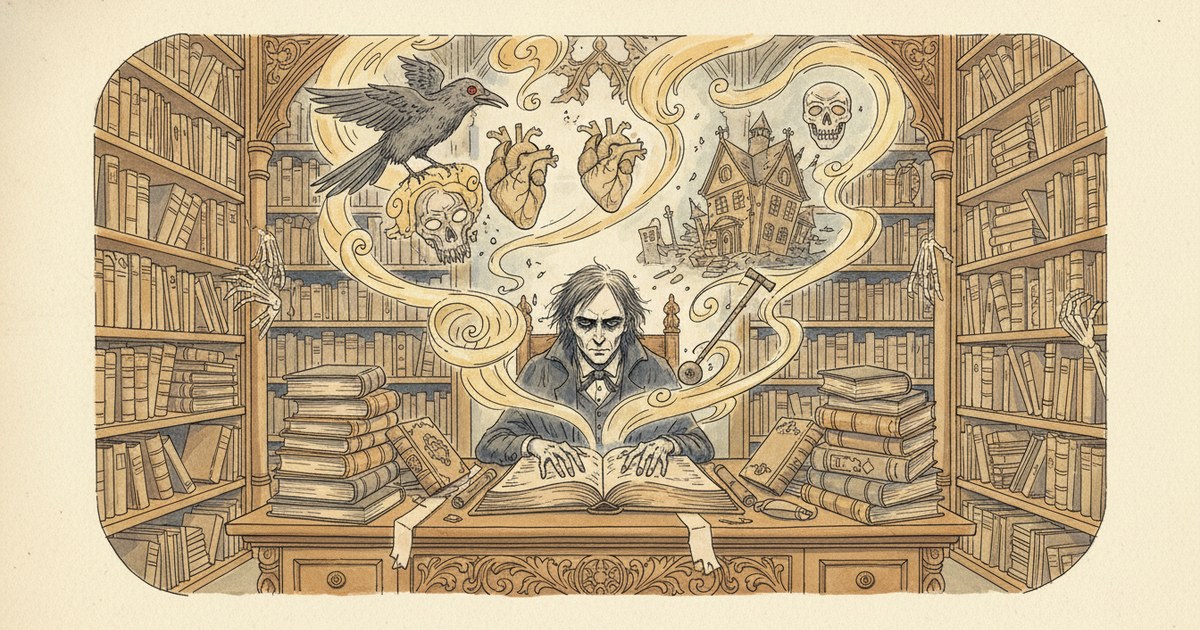
The narrator of “The Tell-Tale Heart” does not want you to think he is mad. In fact, he insists that his nervousness has only sharpened his senses—specifically his hearing. He can hear “all things in the heaven and in the earth,” and “many things in hell.” This is the terrifying premise of Edgar Allan Poe’s most famous study in obsession: a man who decides to murder an old man not for greed, not for revenge, but because of the “vulture eye,” a pale blue eye with a hideous veil over it. The technical precision with which Poe describes the murder—the lantern beam falling like a single spider’s thread upon that eye—is so controlled that it makes the narrator’s underlying insanity feel all the more claustrophobic. It is a masterclass in the economy of dread.
For too long, Poe has been relegated to the status of a gothic curiosity, a writer of “spooky” tales best suited for October reading or high school anthologies. This reputation is a disservice to one of the most rigorous stylists in the history of the English language. Poe’s prose is not merely atmospheric; it is mathematically precise. He did not stumble into horror; he engineered it. When we read Poe today, the challenge is often the “Victorian packaging”—the ornate, dusty editions with scrolled borders and fainting-maiden illustrations that make his work feel like a relic. To read Poe properly is to strip away the lace and find the cold, sharp blade of his logic underneath. The right edition doesn’t make Poe feel old; it reveals how dangerously modern he remains.
Poe’s insistence on total authorial control was likely a psychological defense against a life that was almost entirely characterized by abandonment and disorder. Born in 1809 to itinerant actors, he was orphaned before he was three. He was taken in, though never formally adopted, by John Allan, a wealthy tobacco merchant in Richmond whose relationship with Edgar was a decades-long war of mutual resentment. Poe was a man of immense talent and zero stability: he was expelled from the University of Virginia over gambling debts and later deliberately got himself court-martialed out of West Point to spite his foster father. He spent his adult life in a state of “chronic poverty,” a term that fails to capture the indignity of a man who invented the modern detective story while struggling to buy firewood.
The Architect of the Controlled Nightmare
His marriage to his first cousin, Virginia Clemm, when she was just thirteen, remains the most controversial footnote of his biography, but in the context of his work, it points to a desperate reach for domesticity in a life defined by loss. Every woman Poe loved died young of tuberculosis—his mother, his foster mother, his wife. This recurring tragedy manifests in his work not as a vague sadness, but as a specific, recurring obsession with the “death of a beautiful woman,” which he famously called the most poetical topic in the world. However, notice the way he writes about it. In “Ligeia” or “The Fall of the House of Usher,” the grief is not messy; it is architectural. The House of Usher doesn’t just fall because it’s haunted; it falls because its physical structure is a mirror of the family’s genetic collapse. Poe used the rigid constraints of the short story and the formal poem to contain a reality that was constantly bleeding out.
This biographical chaos produced a writer who was, ironically, the most influential editor and critic of his day. He was known as the “Tomahawk Man” for his “slashing” reviews, and he approached fiction with the same analytical rigor. He pioneered the “Philosophy of Composition,” arguing that a work of art should be written backward from its intended effect. When he sat down to write “The Raven,” he didn’t wait for a muse; he decided he wanted an emotional effect of “mournful and never-ending remembrance” and then calculated the rhythm, the length, and the refrain (“Nevermore”) to achieve it. This is the Poe we find in the best modern editions: the engineer of the soul, the man who understood that to truly terrify a reader, you must first be perfectly, coldly sober in your craft.
The “Classics Retold” selection of Poe’s work focuses on the texts where this precision is most visible. In “The Tell-Tale Heart,” the brilliance lies in the unreliable narrator. We are trapped inside a mind that is attempting to use logic to justify the illogical. The heartbeat that eventually drives him to confession is not a supernatural occurrence; it is the sound of his own guilt amplified by his “over-acute” hearing. It is a psychological thriller written decades before the term existed. Similarly, “The Fall of the House of Usher” uses atmosphere as a structural element. The “vacant eye-like windows” of the house and the “faintly luminous” atmosphere of the tarn are not just window dressing; they are the physical manifestations of the Usher siblings’ mental decay. Poe’s genius was in making the setting do the work of the character.
From the First Detective to the Red Death
Beyond the horror, Poe’s contribution to the “rational” tale is equally profound. In “The Murders in the Rue Morgue,” he invented the detective story and the “locked-room mystery” in one stroke. C. Auguste Dupin is the blueprint for Sherlock Holmes—a man of “analytic” power who solves crimes by identifying with the mind of the perpetrator. For Poe, the detective story was the ultimate expression of his belief in the power of the human mind to impose order on the most chaotic and “monstrous” of circumstances. It is the flip side of his horror: if the horror stories show the mind breaking, the detective stories show the mind triumphing. Both require the same clinical, detached prose.
Then there are the allegories of dread, most notably “The Masque of the Red Death.” Here, Poe’s prose becomes almost liturgical. The description of the seven colored rooms, ending in the black room with the blood-red windows and the ebony clock, is a countdown to the inevitable. Prince Prospero’s attempt to wall out the plague is the ultimate human folly—the belief that wealth and stone can protect us from our common mortality. The “Red Death” enters like a thief in the night, proving that there is no fortress thick enough to keep out the end. It is a short, sharp shock of a story that achieves in five pages what most novelists fail to do in five hundred: it creates a total, inescapable mood.
Finally, any serious Poe edition must reckon with his verse. “The Raven” and “Annabel Lee” are often dismissed as “jingly” because of their strong internal rhyme and insistent meter. But this is intentional. Poe believed that poetry should be “the rhythmical creation of beauty.” In “The Raven,” the repetitive, hypnotic rhythm is designed to simulate the circling, obsessive thoughts of the bereaved lover. In “Annabel Lee,” the fairy-tale cadence creates a deliberate contrast with the cold, sepulchral reality of the “kingdom by the sea.” When read in a clean, modern layout—free from the distracting gothic fonts and over-eager illustrations—the technical mastery of these poems becomes clear. They aren’t just poems; they are emotional engines.
Why the Right Edition Changes Everything
What does a modern reader actually need from an edition of Edgar Allan Poe? The irony is that the more “gothic” an edition looks, the harder it is to read Poe as a serious writer. We advocate for editions that prioritize a clean, unadorned text. Poe’s vocabulary is rich and occasionally archaic, so notes are helpful, but they should be sensible—clarifying his references to 19th-century science or forgotten poets without lecturing the reader on what to feel. The layout is equally important; Poe’s long, winding sentences and dense paragraphs need “white space” to breathe. When the text is cramped and the margins are narrow, the reading experience becomes as suffocating as one of his premature burials.
The “Classics Retold” edition of Poe’s selected works is curated to highlight this ruthlessly efficient side of his genius. By stripping away the ornamental baggage of the late 19th century, we allow the reader to see the “dangerous” Poe—the writer who was obsessed with the thin line between sanity and madness, between life and death, and between order and chaos. In this edition, you won’t find the “quaint and curious” Poe; you will find the writer who influenced everyone from Baudelaire to Dostoevsky to Stephen King. It is a selection that proves Poe wasn’t a man out of time, but a man who saw exactly where our modern anxieties were headed.
Reading Poe in a well-curated edition reveals the “unity of effect” he so prized. Every word is a brick in the wall he is building around you. If you have only ever known Poe through film adaptations or pop-culture references, the actual prose will surprise you with its clarity. He does not meander. He does not waste time. Whether he is describing the “heavy and lung-oppressive” air of a vault or the “singularly wild” logic of a detective, he is always moving toward a specific, pre-calculated end. This is why Poe matters: in a world that often feels chaotic and disordered, he offers the dark satisfaction of a nightmare that has been perfectly, brilliantly designed.
Is Poe’s writing difficult for a modern reader?
While Poe uses 19th-century vocabulary, his narrative drive is very modern. He invented the “short” story as we know it, focusing on a single, intense effect rather than sprawling subplots. The biggest hurdle is usually the initial “Victorian” density of his sentences, but once you adjust to the rhythm, the clarity of his logic makes the stories remarkably accessible and fast-paced.
Which story should I read first to “get” Poe?
“The Tell-Tale Heart” is the perfect entry point. It is short, intense, and showcases his obsession with the “unreliable narrator.” If you prefer logic over horror, start with “The Murders in the Rue Morgue,” which established the entire genre of detective fiction. Both stories demonstrate his ability to create a “unity of effect” within a few pages.
Why is he called the “inventor” of the detective story?
Before Poe’s “The Murders in the Rue Morgue” in 1841, there were stories about crime, but no stories about the *process* of detection. Poe created the “armchair detective” in C. Auguste Dupin, the eccentric genius who uses “ratiocination” (pure logical deduction) to solve a crime that baffles the police. This template was later adopted and refined by Arthur Conan Doyle for Sherlock Holmes.
Did Poe actually die of alcoholism or rabies?
Poe’s death in 1849 remains a mystery. He was found delirious in Baltimore, wearing someone else’s clothes, and died four days later without ever explaining what happened. While his literary rival, Rufus Griswold, spread rumors of chronic alcoholism to ruin Poe’s reputation, modern theories range from “cooping” (voter fraud kidnapping) to rabies, brain tumors, or carbon monoxide poisoning. The mystery of his death is, fittingly, as strange as his fiction.

You must be logged in to post a comment.