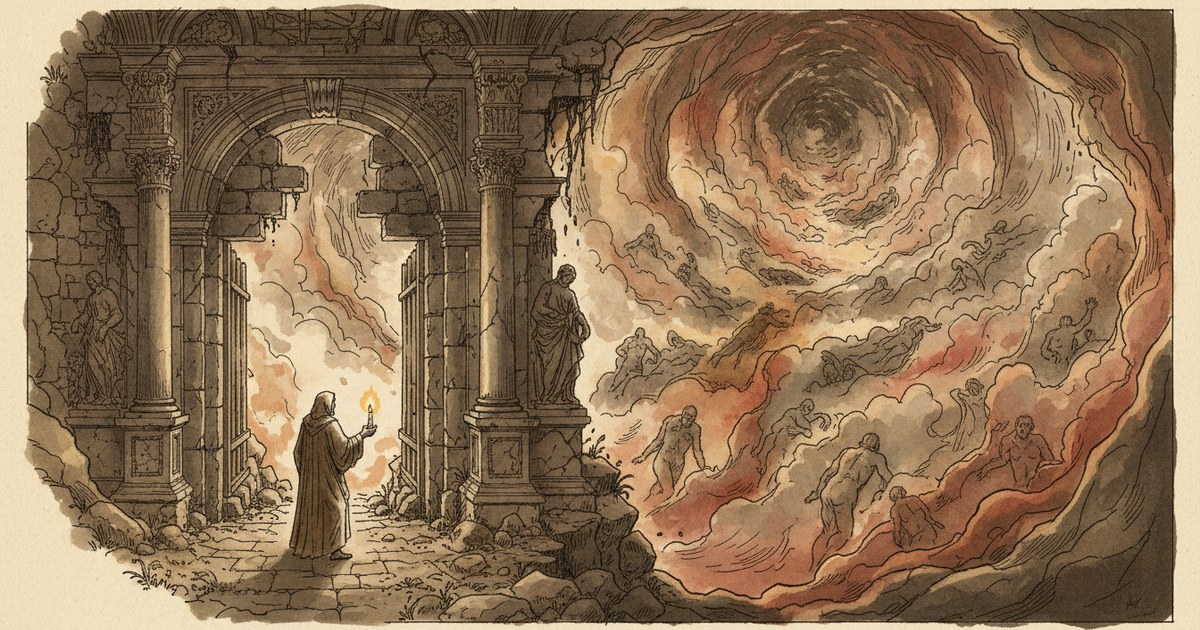
Dante Alighieri stands at the edge of a frozen lake, the very bottom of the universe, and he is shivering. It is not just the metaphysical chill of the Ninth Circle of Hell; it is the physical weight of the journey. To get here, he has climbed over the shaggy, frozen flanks of Lucifer himself. He has smelled the sulfur of the Malebolge and heard the wet, rhythmic thud of Farinata degli Uberti rising from a tomb of fire like a man who holds all of Hell in great scorn. Dante is not a ghost drifting through a dreamscape; he is a man with boots on the ground, breathing hard, checking his pulse against the silence of the damned.
The problem with most English translations of the Divine Comedy is that they forget the boots. They treat the poem as a cathedral of theology or a museum of medieval politics, forgetting that it is, first and foremost, a physical descent. When Dante enters the gate of Hell, he doesn’t just read the famous warning about abandoning hope; he hears a “tumult that resounds forever in that air timelessly stained.” He feels the sting of wasps and the grit of the sand. If a translation doesn’t make you feel the claustrophobia of the descent and the dizzying verticality of the climb, it has failed the poet.
The Divine Comedy is a journey of momentum. Dante did not write it to be studied in a vacuum; he wrote it to save his life and to burn his enemies. It is a work of high art born from the low dirt of political exile. To read it correctly is to move through the circles with the same urgency Dante felt when he realized he would never see the stone walls of Florence again. The best translation is the one that keeps you moving, refusing to let the heavy machinery of 14th-century Italian verse stall the engine of the narrative.
The Exile Who Turned Vengeance Into Light
Dante Alighieri did not set out to write the greatest poem of the Middle Ages from a comfortable study in Tuscany. He wrote it in the bitter shadow of a death sentence. In 1302, while serving as a diplomat in Rome, the political tides in Florence shifted. The “Black” Guelphs took power, and Dante, a leader of the “White” Guelphs, was charged with corruption and barratry. He was fined, his property was seized, and he was told that if he ever set foot in Florence again, he would be burned at the stake. He spent the rest of his life as a wanderer, eating the “salty bread” of others and climbing the stairs of patrons who viewed him as a useful intellectual ornament.
This biographical trauma is the furnace that forged the Comedy. When you read the Inferno, you are reading a hit list. Dante populates Hell with the very men who destroyed his life—popes, politicians, and neighbors who betrayed the city he loved. But the genius of the work is how he transforms this petty, personal vengeance into a universal architecture of justice. His exile forced him to look at the world from the outside, stripped of his status and his home. It turned a provincial politician into a cosmic cartographer. He wasn’t just writing about the afterlife; he was writing a map for a soul lost in a “dark wood,” which was his specific, agonizing reality in the years following his banishment.
Then there is Beatrice. She was not a wife or a long-term lover, but a girl he saw twice—once when they were nine, once when they were eighteen. Her death in 1290 shattered him. In the Vita Nuova, he promised to write of her “what hath never been written of any woman.” The Divine Comedy is the fulfillment of that promise. Beatrice is the gravity of the poem; she is the reason Dante endures the horrors of the pit and the rigors of the mountain. Every theological argument and every political rant in the poem is anchored by the physical memory of a woman’s face. A translation that loses this heartbeat of longing in favor of dry academic precision misses the point of Dante’s entire existence.
The Trap of the Terza Rima
The 14,233 lines of the Divine Comedy are written in terza rima—a demanding interlocking rhyme scheme (ABA, BCB, CDC) that Dante invented. In Italian, a language where almost every word ends in a vowel, this is natural, melodic, and propulsive. In English, a language that is “rhyme-poor” and consonants-heavy, terza rima is a death trap. Translators who try to force English into Dante’s exact structure often end up with “translationese”—clunky, inverted sentences and archaic word choices that exist only to satisfy the rhyme. They sacrifice the meaning and the “physicality” of the poem on the altar of its skeleton.
This is the fundamental translation problem. Do you prioritize the music or the movement? If you choose the music (the rhyme), you often lose the momentum. Blank verse, the unrhymed iambic pentameter of Shakespeare and Milton, is often a better fit for the English ear, providing a dignified structure without the forced gymnastics of rhyme. Prose translations offer the most literal accuracy but lose the “sacred” elevation of the work. The challenge for a modern curator is finding the version that honors the poetic impulse without letting the 14th-century mechanics stall the 21st-century reader’s experience of the journey.
Dante himself called the work a Comedy because it begins in darkness and ends in light, and because it was written in the “vulgar” tongue—the language of the people, not the Latin of the elite. He wanted to be understood. He used street slang, technical jargon from weavers and blacksmiths, and visceral descriptions of bodily functions. A translation that sounds too much like a Victorian hymn or a legal brief betrays Dante’s “vulgar” energy. We need a Dante who breathes, sweats, and swears, not one who is encased in the amber of “thee” and “thou.”
Mapping the Modern Contenders
For decades, John Ciardi’s translation was the standard for American students. Ciardi understood that terza rima was impossible in English, so he created a “rhymed-triple” version that captured the spirit of the tercets without the forced rigidity. His Inferno is gritty and fast-paced, though some readers find his 1950s sensibilities a bit dated today. Allen Mandelbaum’s version, appearing in the 1980s, offered a more “classical” feel—stately, accurate, and rhythmic. Mandelbaum is excellent for the reader who wants to feel the epic weight of the work, but his Dante can occasionally feel a bit more like a statue than a man in a hurry.
the edition linked below of the Divine Comedy approaches the text from a different angle. As curators, we asked: “How do we make the reader feel the cinematic scale of the poem?” Our modern accessible edition focuses on clarity and the “visual” momentum of the narrative. We strip away the linguistic clutter that often obscures Dante’s vivid imagery. When Dante describes the giant Antaeus picking him up and setting him down “like the mast of a ship,” we want you to feel the wind and the vertigo. We treat the poem not as a relic to be dusted, but as a script for a journey that is happening right now.
This version is designed for the reader who has always been intimidated by the footnotes. While the political squabbles of 1300s Florence are essential context, they shouldn’t stop the flow of the story. the edition linked below embeds that context into the rhythm of the verse, allowing the reader to experience the Comedy as Dante intended—as a gripping, high-stakes climb toward the stars. It prioritizes the “physicality” that defines the poem, ensuring that the momentum of the descent is never lost to the tercets.
Why the Classics Retold Selection?
The Divine Comedy is a massive undertaking, and the version you choose determines whether you finish the climb or get stuck in the mud of the Styx. We recommend the Classics Retold modern translation because it refuses to be boring. It recognizes that Dante was a man of action—an explorer of the soul who used the most vivid language available to describe the indescribable. This edition captures the “cinematic” feel of the three realms, making the complex theology feel as immediate as a heartbeat and the political vengeance as fresh as today’s headlines.
To experience the full arc of the journey from the depths of the pit to the final, blinding light of the Empyrean, we suggest starting with an edition that doesn’t require a PhD to navigate. You can find the edition linked below of The Divine Comedy in paperback, which serves as the perfect companion for your own descent into the circles of the afterlife. It is a guide built for movement, clarity, and the raw power of Dante’s original vision.
What is the best order to read the Divine Comedy?
You must start at the beginning with Inferno. While Purgatorio is often considered the most “human” and Paradiso the most beautiful, the narrative arc of the poem requires the physical and moral descent of Hell to make the subsequent climb meaningful. Dante’s transformation is a linear journey; skipping ahead is like starting a movie in the final act.
Do I need to know Italian history to understand the book?
While the poem is filled with Dante’s contemporaries and specific Florentine politics, a good modern translation will provide enough context within the text or through brief notes to keep you grounded. The universal themes—justice, love, betrayal, and the search for meaning—are powerful enough to carry the reader even if they don’t know every Guelph and Ghibelline by name.
Why is it called a “Comedy” if it’s about Hell?
In the 14th century, a “comedy” was simply a narrative that began in trouble and ended in a happy resolution (unlike a tragedy, which begins in high status and ends in ruin). Additionally, Dante wrote it in the “common” Italian tongue rather than the “tragic” and elevated Latin, making it a “vulgar” or common work accessible to the people.
Is the Divine Comedy purely a religious text?
No. While its framework is Catholic theology, the Comedy is equally a work of political philosophy, autobiography, and psychological exploration. It is a study of human nature under pressure. Even for non-religious readers, the poem’s insights into the “hells” we create for ourselves and the “mountains” we must climb to find peace remain some of the most profound in Western literature.

You must be logged in to post a comment.