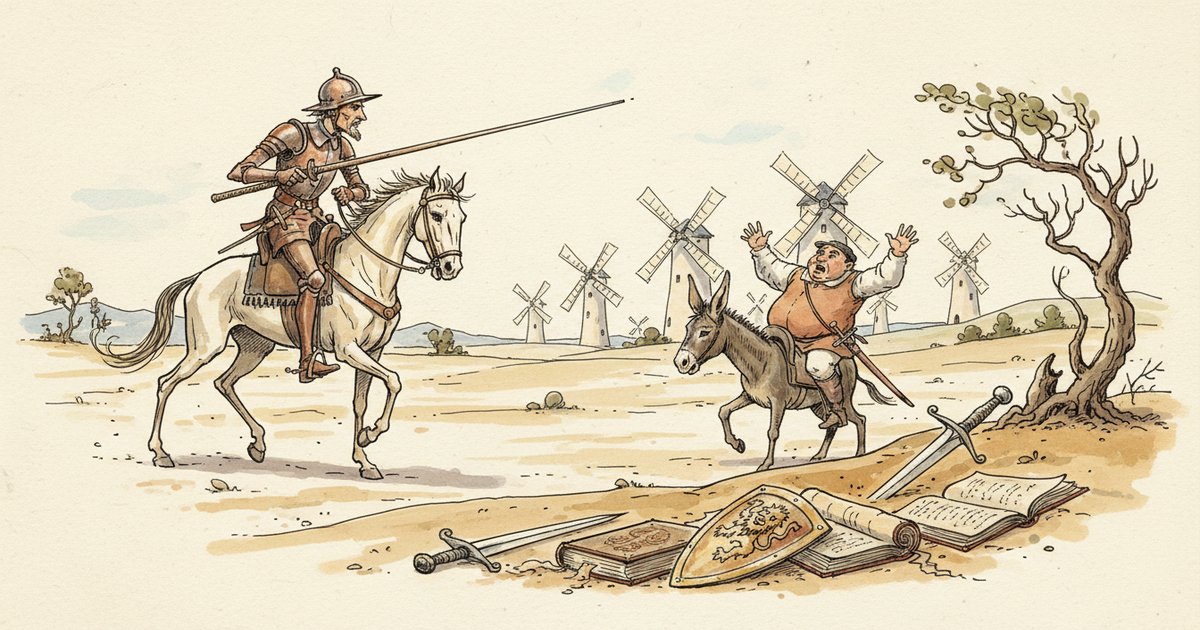
The story goes that Cervantes conceived Don Quixote in a cell. Not as metaphor — literally, in the Royal Prison of Seville, where he landed after a tax-collecting job went sideways and the accounts wouldn’t balance. He was in his late forties, repeatedly jailed, repeatedly broke, a veteran of Lepanto whose left hand had been ruined by an arquebus ball. He had tried playwriting. He had tried poetry. Nothing had worked. And then, in a cell, something clicked — a man who reads too many books and decides to become a knight, riding out into a world that has absolutely no use for him.
That origin matters. Don Quixote is not a comedy about a fool. It is a book written by a man who understood, from the inside, what it feels like to hold an idea of yourself that the world refuses to honor. The gap between who Alonso Quijano believes he is and what everyone around him sees — that gap is the whole novel. Cervantes didn’t observe that gap from a comfortable study. He lived it, then built a character around it and sent him out to windmills.
The book that resulted is routinely called the first modern novel, and the label is accurate in a way that usually gets buried under the prestige. What Cervantes actually invented was a story that knows it is a story — that plays with its own fictionality, that has characters read an earlier draft of themselves and complain about the characterization. In Part One alone, you get a priest and a barber staging an intervention by burning a man’s library. You get a hero who confuses a barber’s basin for a legendary helmet and goes to his grave certain he was right. That’s not quaintness. That’s a structural argument about how humans construct identity from narrative — written in 1605, still unresolved.
The Man Who Kept Failing Until He Didn’t
Cervantes fought at Lepanto in 1571, one of the largest naval battles in history, and took three gunshot wounds including the one that permanently disabled his left hand. He spent the next five years as a prisoner of Algerian pirates, during which he attempted escape four times. When he finally returned to Spain, he discovered that his country had moved on without him and his heroism had earned him nothing. He spent the following decades in minor administrative work, accumulating debt, entangled in legal trouble, watching younger writers succeed. He was in his late forties before he published anything of consequence. All of that — the gap between self-image and reality, the grinding bureaucratic humiliation, the experience of being at the mercy of institutions that don’t care about you — is in every chapter of Don Quixote, not as autobiographical confession but as structural pressure. It’s why the novel’s comedy always has something aching underneath it.
The other thing that shaped the book is what Cervantes was writing against. Spain in 1605 was drowning in chivalric romances — Amadís de Gaula, the Palmerín cycle, hundreds of knockoffs — and Cervantes had decided, with the particular fury of someone who’d tried and failed at other literary forms, that the genre was a lie. Don Quixote started as a short satirical piece and then expanded because the premise kept generating material. Every time Quixote rides out and the world refuses to cooperate, the joke deepens into something more uncomfortable. By the time Sancho Panza arrives — earthy, practical, loyal, entirely sane — the novel has two voices in permanent argument about what reality is, and neither of them wins cleanly.
A Book That Argues With Itself
What Part One actually does, across its fifty-two chapters, is demonstrate how stories colonize minds. Quixote doesn’t just believe he’s a knight; he has a hermeneutic system. When reality contradicts his expectations — when the giants turn out to be windmills — he doesn’t update his worldview, he explains the contradiction away: enchanters must have transformed them to deceive him. Cervantes gives him a completely coherent internal logic, and that’s what makes the satire cut. There’s a chapter where Quixote charges a group of travelers escorting a dead body, scatters them in terror, and then explains gravely that this is what knights do. The scene is slapstick on the surface and a portrait of ideological certainty underneath. No scene in the book lets you simply laugh without the laugh catching on something.
Sancho functions as the novel’s corrective and also its complication. He knows Quixote is mad. He follows him anyway, partly for the promised island governorship, partly because something in the madness is contagious — the possibility, however deluded, that an ordinary man from La Mancha might matter to the world. That tension between Sancho’s pragmatism and his growing attachment to Quixote’s vision is where the novel’s emotional weight lives. By the end of Part One, you’re not reading satire anymore. You’re reading about the cost of being the person in the room who sees things clearly while everyone around them is dreaming.
Why This Translation (translated by Alejo Cascadel)
The challenge with Don Quixote in English is that the novel’s comedy depends on register — Quixote speaks in archaic chivalric formality, Sancho in proverbs and common speech, and the narrator in ironic detachment — and most older translations flatten those distinctions into a uniform antique English that makes the whole thing feel like homework. This modern translation keeps the voices distinct and the pace alive, which means the windmill scene lands as it should, the debates between Quixote and Sancho feel like actual arguments, and the novel reads at the speed Cervantes intended — propulsive, surprising, funny in the way that serious things are funny when you’ve run out of other options. You can find it here.
Cervantes finished Part One at fifty-seven, having spent most of his adult life being defeated by circumstances he couldn’t control. What he built from that material is a novel about a man who refuses to accept the world’s verdict on him — and whether that refusal is heroic or pathetic is a question the book refuses to answer, because Cervantes knew, from experience, that the answer changes depending on which side of the cell door you’re standing on.
Also worth reading
What is the best English translation of Don Quixote Part 1 for modern readers?
For readers who want the full depth of Cervantes without the barrier of archaic prose, a modern English translation of Don Quixote Part 1 is the clear choice. Contemporary translations prioritize natural, flowing language while preserving the novel’s irony, humor, and literary complexity. Unlike 17th- and 18th-century renditions that can feel stiff or opaque to today’s readers, a modern accessible translation lets the story breathe — making Don Quixote’s delusions and Sancho Panza’s earthy wisdom land exactly as Cervantes intended.
Is Don Quixote Part 1 worth reading in 2026?
Don Quixote Part 1 is not a museum piece — it is a living novel about self-deception, idealism, and the stories we tell ourselves to make sense of the world. In 2026, when the line between curated identity and reality has never been blurrier, Don Quixote reads almost like social commentary written yesterday. The comedy holds, the pathos deepens with age, and its status as the first modern novel means every serious reader eventually arrives here. A clean modern English translation removes the only real obstacle: the language.
How does Don Quixote Part 1 compare to Don Quixote Part 2?
Part 1 is the wilder, more anarchic half — a series of comic misadventures driven by Don Quixote’s unshakeable delusions. Part 2, published ten years later, is more self-aware and philosophically rich; Cervantes even has characters who have read Part 1, creating a meta-fictional layer that was centuries ahead of its time. Most readers find Part 1 the more immediately entertaining entry point, while Part 2 rewards those who want to go deeper. Read them in order: Part 1 earns the emotional payoff that Part 2 delivers.
What should I read after Don Quixote Part 1?
If Don Quixote Part 1 sparked your appetite for landmark works of world literature in modern, readable English, two titles from the Classics Retold catalog make natural next steps. Noli Me Tángere (The Social Cancer): A New Translation by José Rizal offers the same blend of sharp satire and human drama, this time set against Spanish colonial Philippines — a novel that gets compared to Cervantes in its cultural weight and subversive wit. For something lighter in tone but equally canonical, Alicia en el país de las maravillas: Una nueva traducción revisits Carroll’s Alice through a fresh Spanish-language lens, a fitting companion for any reader drawn to classics retold with clarity and care.
You might also enjoy


This post contains affiliate links. As an Amazon Associate, we earn from qualifying purchases.


You must be logged in to post a comment.