The Writer Behind The Great Meaulnes
In the summer of 1905, a twenty-year-old student named Henri-Alban Fournier caught a glimpse of a young woman on the steps of the Grand Palais in Paris — pale dress, calm face, already walking away. He followed her. She turned, told him she was engaged, and disappeared into the crowd. He spent the next eight years trying to turn that afternoon into a novel. The woman’s name was Yvonne de Quièvrecourt. The novel became Le Grand Meaulnes. Fournier never stopped writing her name in his journals.
Fournier was born in 1886 in La Chapelle-d’Angillon, a small village in the Berry region of central France — flat, agricultural country where the horizon does strange things in late afternoon light. His parents were schoolteachers, and he grew up in a succession of rural schoolhouses, that particular world of chalk dust and bell schedules that saturates the novel’s opening chapters. He was a brilliant student but restless, oscillating between Paris’s literary circles — where he became close friends with Jacques Rivière, who would later edit the Nouvelle Revue Française — and the provincial countryside he couldn’t quite leave behind in his imagination. He published under the pen name Alain-Fournier.
He finished Le Grand Meaulnes in 1913. It was published in September of that year and immediately shortlisted for the Prix Goncourt, losing by one vote. A year later, France mobilized for war. Fournier was called up as an infantry lieutenant. On September 22, 1914 — less than six weeks into active combat — he was killed near Saint-Rémy-la-Calonne, leading his platoon through a wood. He was twenty-seven. His body wasn’t found until 1991, in a mass grave with his men. He left behind one complete novel.
The correspondence Fournier kept with Jacques Rivière — published after both men’s deaths — reveals just how deliberately he constructed the novel’s emotional logic. In one letter from 1910, three years before the book was finished, he describes his aim as writing something that would give the reader “the feeling of having lived for a moment the life that is most beautiful and most impossible to live.” That is not a young writer fumbling toward a theme. That is someone who already knows exactly what kind of wound he is trying to inflict, and is patiently sharpening the instrument. The letters also show how close the novel’s geography is to his own childhood: the schoolhouse where Seurel’s parents live and teach is drawn almost floor-plan-accurate from the one in Épineuil-le-Fleuriel where Fournier spent his boyhood, and which still stands today as a small museum to the novel.
What Makes The Great Meaulnes Still Matter
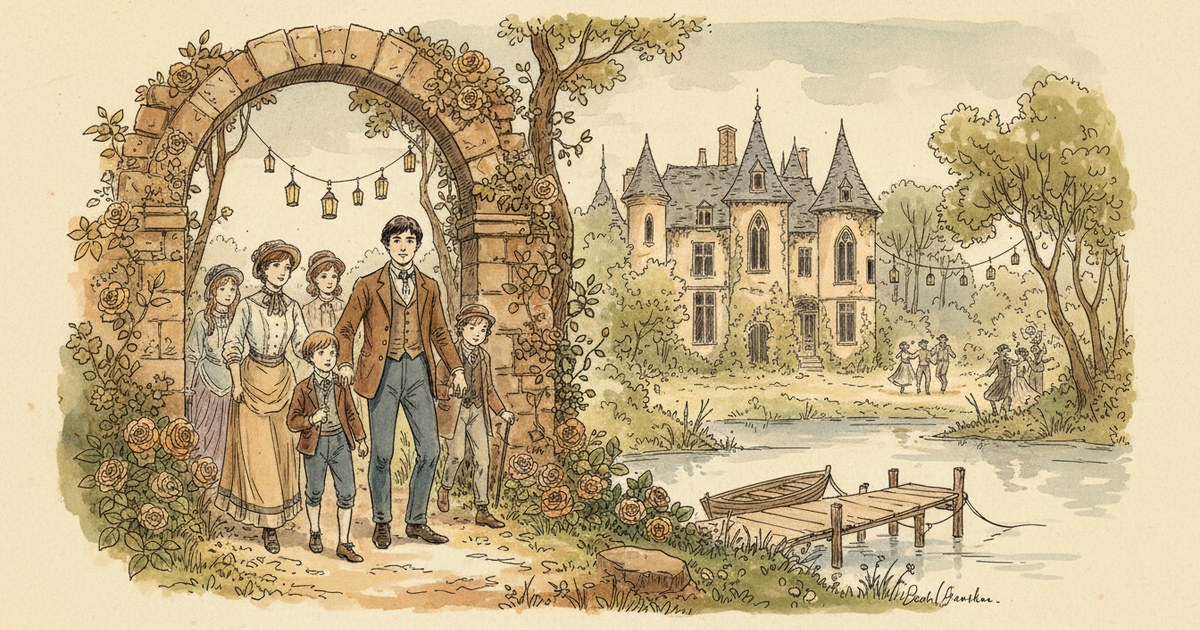
Le Grand Meaulnes — rendered here as The Great Meaulnes — opens in a village schoolhouse in the French countryside, where fifteen-year-old François Seurel narrates the arrival of a strange older boy named Augustin Meaulnes. Meaulnes promptly disappears into the countryside on a borrowed horse and cart, stumbles upon a crumbling estate where an inexplicable fête is underway — children in period costume, boats on a frozen pond, music from no clear source — falls in love with the daughter of the house, then loses everything when he finds his way back to ordinary life. The plot sounds like a fairy tale, but the novel’s real subject is the specific cruelty of growing up: the way adolescence promises a world of enchantment and then locks the door behind you. Fournier described it as a book about “the impossibility of recapturing what has been glimpsed once and lost.” That single sentence is the thesis of the entire twentieth century’s literature of longing.
What makes the novel strange and durable — more than a century after its publication — is its refusal to be fully realistic or fully fantastical. Meaulnes’s lost domain exists on actual roads, with actual distances, but no one can find it twice. Fournier’s Berry countryside feels enchanted not because magic is invoked but because the prose holds every ordinary detail — a frost-covered courtyard, a jacket borrowed for a party, the smell of a schoolroom stove — at the precise angle where memory starts to look like myth. The love story is real and doomed, the friendship between Seurel and Meaulnes is the most honest thing in the book, and underneath it all runs a grief that Fournier understood personally: the grief of a man who had already looked back.
The scene that crystallizes the novel’s method better than any other is Meaulnes’s first full night at the mysterious fête. He wakes in a strange bedroom in borrowed clothes — a child’s fancy-dress waistcoat that fits him oddly, a nineteenth-century jacket retrieved from some forgotten trunk — and walks out into a courtyard full of costumed children playing games by candlelight. No one questions his presence. No one asks where he has come from. The scene works because Fournier refuses to explain it: there is no magical portal, no explicit dream logic. The strangeness floats on a sea of completely specific, tactile detail — the cold of the flagstones, the particular color of the candle flames against the winter dark. When Meaulnes first sees Yvonne de Galais across that courtyard, the moment lasts half a sentence. Fournier understood that the longer you describe a glimpse, the less it resembles one.
The Novel’s Strange Architecture
One thing readers rarely discuss in advance — and probably shouldn’t have spoiled for them — is how dramatically the novel’s structure shifts in its final third. The first two-thirds operate in the register of enchanted adolescence: dreamlike, suspended, narrated at a slight remove. Then the book pivots hard. A second character, Frantz de Galais, arrives with his own collapsed love story, and the novel suddenly reveals itself to be about something more uncomfortable than nostalgia. It is about the way one person’s romantic obsession radiates outward and damages everyone around him. Meaulnes is not just a dreamer; he is, by the end, genuinely culpable. He abandons a wife, neglects a child, vanishes when people need him. The lost domain is not only something taken from him — it is also an excuse he uses. Fournier does not editorialize about this. He simply lets the last fifty pages happen, and the chill they produce is entirely different from the ache of the first hundred.
This structural gambit is part of why the novel has sustained serious literary attention for over a century, while remaining genuinely readable as a coming-of-age story on first encounter. Teenagers read it as a novel about losing paradise. Adults re-read it and notice how much damage paradise-seeking does to the people in Meaulnes’s immediate orbit. François Seurel, the narrator, is perhaps the book’s true subject: a loyal, self-effacing young man who systematically subordinates his own life to Meaulnes’s quest, and seems never to fully recognize what that has cost him. The novel is named after Meaulnes. But it is Seurel who is left standing at the end, holding everyone else’s losses.
Why Read a Modern Translation?
Most English readers have encountered The Great Meaulnes through translations that strain toward an archaic, dreamy register — which is understandable but wrong. Fournier’s French is not ornate. It is clean, with occasional bursts of strange intensity, closer to Chekhov than to Proust. The translation featured here approaches the text with that in mind: the sentences breathe, the dialogue sounds like actual teenagers rather than Victorian literary characters, and the novel’s abrupt tonal shifts — from mundane to uncanny and back — land with the disorienting force Fournier intended. The decision to keep the protagonist’s name as Meaulnes rather than anglicizing it, and to preserve the rural schoolhouse rhythms of the opening rather than smoothing them into something generically pastoral, matters more than it might seem. This is a book where the texture of place is inseparable from the texture of longing. A translation that irons that out irons out the book.
A useful test for any translation of this novel is the scene in which Seurel first describes the schoolhouse and its grounds — the opening pages before Meaulnes even arrives. Older translations tend to poeticize this passage, loading it with atmospheric adjectives that signal to the reader: this is a special, literary place. But in Fournier’s French, the description is almost bureaucratic in its precision — the exact layout of the buildings, the specific placement of a gate, the way the schoolyard connects to the road. The enchantment is produced by that precision, not despite it. A translation that reaches for lyricism too early in this passage tips its hand too soon, and the reader loses the experience of watching an ordinary world slowly become strange. The edition we recommend holds its nerve through those opening pages, letting the strangeness accumulate at Fournier’s own pace.
Alain-Fournier in the Context of His Moment
It is worth placing Fournier in the specific literary moment he inhabited, because it explains some of what looks eccentric about the novel from a twenty-first-century vantage point. Le Grand Meaulnes was published in 1913 — the same year as Proust’s Du côté de chez Swann, Apollinaire’s Alcools, and Alain’s Les Aventures du cœur. French literature was in the middle of a generational fracture between the symbolists, who had dominated the previous two decades, and the new realists and modernists who were about to remake the form. Fournier’s novel belongs to neither camp cleanly. It has the symbolists’ taste for dream-logic and the uncanny, but none of their obscurantism. It has the realists’ eye for specific social texture — the schoolteacher household, the rural class dynamics, the particular economics of a provincial fête — but none of their cynicism. The result is something that embarrassed critics who needed clean categories, and delighted readers who did not.
Fournier’s friendship with Jacques Rivière was not incidental to this. Rivière was one of the most rigorous literary intelligences of his generation, and his correspondence with Fournier served as a kind of extended workshop for the novel in progress. When Fournier sent Rivière early drafts, Rivière pushed back on anything that slid into sentimentality without earning it — a pressure that left clear marks on the finished book. The novel’s refusal to console, its willingness to let Meaulnes behave badly without exculpating him, its dry-eyed ending: these are partly the product of that friendship. Rivière survived the war, edited the NRF, and wrote what remains one of the finest essays on the novel in 1924. He died the following year, of typhoid fever, at thirty-four.
Frequently Asked Questions
What does “Le Grand Meaulnes” actually mean in French?
Grand in this context does not mean great in the sense of greatness or achievement — it is closer to the English colloquial use of “big” or “tall,” the way schoolboys might nickname a tall, striking classmate. Seurel uses it as an admiring, slightly awed form of address: Meaulnes is simply the biggest, most impressive person in his immediate world. Some translators have rendered it as “Big Meaulnes,” which is literally accurate but tonally flat. Most English editions retain “The Great Meaulnes,” accepting the slight elevation in register as the lesser distortion.
Did Alain-Fournier ever meet Yvonne de Quièvrecourt again after their 1905 encounter?
Yes — once, briefly, in 1913, the year the novel was published. By that point Yvonne was married with children, and the meeting was cordial and unremarkable. Fournier was by then involved with the actress Simone, with whom he had a serious relationship in the final years of his life. He did not, as far as the surviving correspondence shows, find the second meeting devastating — though he noted it in a letter to Rivière with characteristic terseness. The real Yvonne and the fictional Yvonne de Galais had long since diverged. She outlived the novel’s author by fifty years, dying in 1966.
Has The Great Meaulnes been adapted for film?
There have been two notable French film adaptations: Jean-Gabriel Albicocco’s 1967 version, which is visually striking and leans heavily into the novel’s dream atmosphere, and a 2006 adaptation directed by Jean-Daniel Verhaeghe. Neither has displaced the novel in French cultural memory, and neither has achieved significant international distribution. The 1967 film is occasionally cited by fans of the book, but the general consensus is that the novel’s power depends on Seurel’s narrating consciousness in a way that resists straightforward cinematization — the camera can show the lost domain, but it cannot easily reproduce the experience of half-understanding it.
Is The Great Meaulnes considered a young adult novel in France?
It occupies an unusual position in French literary culture: it is taught in secondary schools and shelved as a coming-of-age novel, but it is also consistently listed among the most important French novels of the twentieth century by critics and writers. The French equivalent of a consensus “desert island” novel, it appears on general reading lists alongside Flaubert and Stendhal, and is regularly cited by French authors — including Le Clézio and Modiano — as a formative influence. The young-adult classification, to the extent it exists in France, has never diminished its literary standing there the way equivalent shelving decisions sometimes do in English-speaking markets.

This post contains affiliate links. As an Amazon Associate, Classics Retold earns from qualifying purchases. This does not affect our editorial recommendations.

You must be logged in to post a comment.