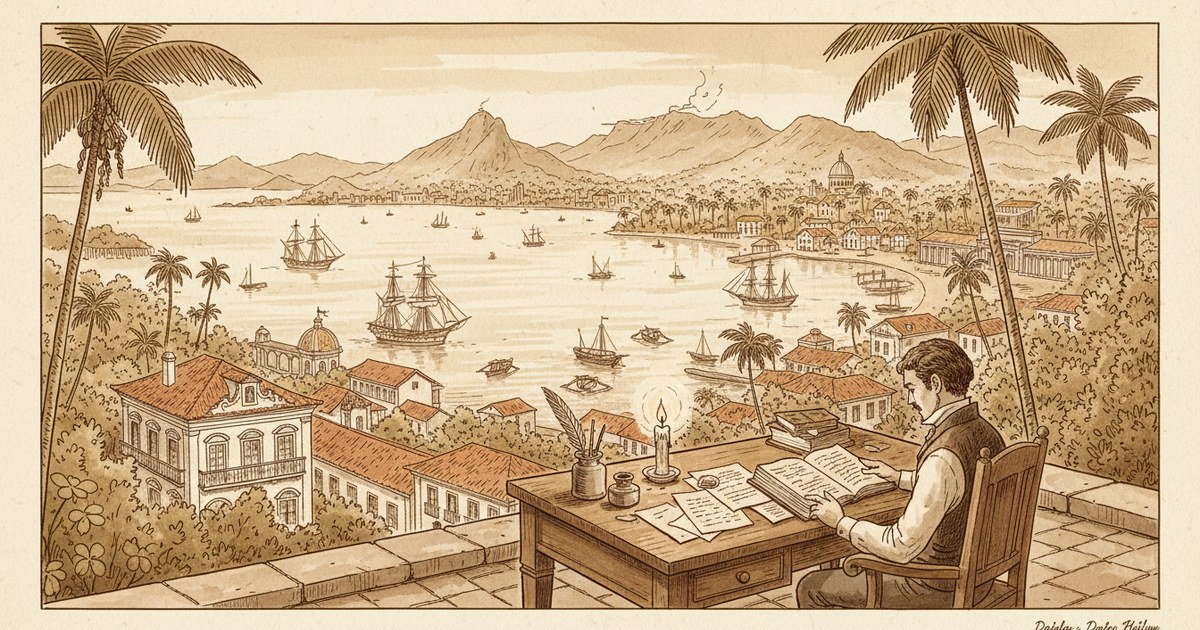
In the 1880s, two writers were doing something no one in European fiction had managed yet. One was in Lisbon. One was in Rio de Janeiro. They wrote in the same language, had never met, and arrived — through completely different lives — at the same devastating irony about the human condition. Eça de Queirós was the son of a Portuguese aristocrat who spent his career mocking the class that made him. Machado de Assis was the grandson of freed slaves who invented a new kind of prose from the margins of a society that didn’t expect him to exist at all. Between them, they invented the modern novel in Portuguese. Europe caught up eventually.
This is the literary tradition English readers have been missing.
There is a tradition of world literature that English readers have been missing for over a century — not because the books weren’t there, but because the translations weren’t good enough to make you care. Russian literature had its Pevear and Volokhonsky moment. German had Michael Hofmann. French has always had champions. But Portuguese and Brazilian literature kept arriving in English in versions so flat, so bureaucratically faithful to the original syntax, that readers tried one and concluded the tradition was minor. It isn’t. It may be the most underserved major literary tradition in the English-speaking world.
The argument runs like this: Machado de Assis, writing in Rio de Janeiro in the 1880s, was doing things with narrative form that European fiction wouldn’t attempt for another fifty years. Susan Sontag called him one of the great underrated writers of world literature. Harold Bloom put him in the company of Tolstoy and Flaubert. And yet walk into any English bookshop and you will find shelves of Dostoevsky, half a shelf of Zola, and perhaps one Machado — in a translation that will almost certainly underserve him. Meanwhile, in Portugal, Eça de Queirós was writing novels of such social precision and psychological cruelty that his contemporaries called him the Portuguese Flaubert, which is accurate but undersells him. He had a satirical edge Flaubert rarely allowed himself.
The translation gap is the actual story here. For most of the twentieth century, English readers encountered these books through versions made in an era when translation meant staying close to the original sentence structure — a policy that worked tolerably for some languages and was catastrophic for Portuguese, which produces effects in English that require a different kind of editorial courage to render. The books were available. They just weren’t readable. That has changed. The editions appearing now — from translators who understand that fidelity to the sentence is not the same as fidelity to the work — are revealing a tradition that doesn’t need to apologize to anyone.
What makes this moment different from previous attempts to bring the tradition to English readers is partly critical mass. For the first time, you can read Machado, Eça, Pessoa, and Clarice Lispector in translations that were made by people who had absorbed not just the Portuguese language but the specific tonal registers each writer was working in. A good translation of Machado requires understanding that he is doing comedy; a good translation of Eça requires understanding that his sentences are performing class; a good translation of Pessoa requires understanding that his prose is doing something closer to music than argument. Those are different skills, and for a long time the English literary world didn’t know it needed to ask for them.
Where to Start
The two entry points that matter most are both Brazilian, both Machado de Assis, and both discussed in depth here:
- Posthumous Memoirs of Brás Cubas (1881) — a dead man narrating his own life, interrupting himself to argue with the reader, skipping chapters because he feels like it, and producing one of the darkest comedies in the nineteenth-century novel. Start here if you want to understand what the tradition can do at its most radical.
- Dom Casmurro (1899) — the novel that gave Brazil its version of the Hamlet question: did Capitu cheat? Machado lets the unreliable narrator make his case and leaves the jury permanently hung. Start here if you want the more immediately gripping entry — a novel that pulls you in as a psychological thriller before revealing itself as something much stranger.
Both novels reward rereading in a way that very few nineteenth-century works do. The first time through, you follow the story. The second time, you watch the machinery. That combination — books that work on you differently at different speeds — is the hallmark of the tradition at its best, and it is why these two are the right door in.
The Brazilian Thread
Machado de Assis was born in 1839 in Rio de Janeiro, the grandson of freed slaves, and died in 1908 as the most celebrated writer in Brazil — a country that had not yet decided what its literature was supposed to be. He made himself the answer to that question by ignoring what the realist novel was supposed to do and building something that felt, to his Brazilian contemporaries, bewilderingly unlike anything they expected. To contemporary readers, it looks like the novel learned a hundred years too early.
The biography matters more than it might seem. Machado was an epileptic, a stutterer, mixed-race in a society organized around racial hierarchy, and largely self-educated — he never attended university. He worked his way up through newspaper typesetting, journalism, and minor government posts, reading voraciously in French and English along the way. When he finally turned to the long form, he arrived with a reader’s eye rather than a scholar’s. He wasn’t trying to reproduce what the European novel had done. He had read too much of it to be impressed by the imitation.
Posthumous Memoirs of Brás Cubas is the book that broke the form open. Brás Cubas is narrating from beyond the grave, which means he has nothing to protect and no reason to flatter the reader. He digresses into philosophy he doesn’t believe, addresses the reader directly to disagree with them, and organizes his chapters with contemptuous arbitrariness — one is three pages long, one is three lines, one is a row of ellipses. What he is actually describing is a life of comfortable Brazilian privilege, a love affair sustained across a marriage, a political career spent doing nothing, and a philosophy of human selfishness worked out with the care of a man who has nothing left to lose. The formal games are not decoration. They are the argument. This translation (translated by Zeno Vergueiro) renders the prose with the lightness and ironic control it requires — the jokes land, the cruelty lands, the philosophical asides don’t drag.
The most revealing passage in Posthumous Memoirs is the one where Brás Cubas pauses to calculate his final moral accounting. He lists the debts he carried into death and the credits he accumulated, the way a man might balance a ledger. The credits include not having passed a congenital misery on to a child — because he never had children. He closes the books with satisfaction: the debits balance the credits, which means he came out ahead of everyone who did reproduce. The joke is bottomless. It is a novel about a man who did nothing, helped no one, and died congratulating himself on the precision of his own emptiness. That passage, delivered in the prose equivalent of a shrug, is Machado telling you everything you need to know about the Brazilian ruling class of the 1880s without once raising his voice.
Dom Casmurro is the companion piece, written eighteen years later and formally more conventional — which makes it, in some ways, the more unsettling book. Bentinho, who calls himself Dom Casmurro, is telling us the story of his marriage to Capitu and the betrayal he believes she committed. The question of whether she actually committed it is Brazil’s most enduring literary argument. Machado gives the prosecution full access to the witness stand and never calls the defense. What he is actually doing — visible only after you’ve read the novel once and gone back — is showing you how a man builds a case against a woman he may have loved too desperately to let be human. It is as precise an anatomy of jealousy as anything in Othello. This translation preserves the deceptive plainness of the original — the prose that sounds like a reasonable man’s testimony until you notice what it’s leaving out.
The famous description of Capitu’s eyes — “olhos de ressaca,” eyes like the undertow — is the novel’s most analyzed phrase, and for good reason: it is the only moment in the book where Bentinho’s language runs briefly away from him into something that sounds like awe. He catches himself immediately and resumes his measured narration. But that slip is the whole novel in miniature. The man telling the story of a betrayal cannot quite control his admiration for the woman he is accusing, and Machado gives you just enough of that uncontrolled admiration to make you wonder whether the betrayal is in the story or in the telling.
The Portuguese Tradition
While Machado was dismantling the realist novel from inside, Portugal had a writer building one of the great realist traditions in European fiction. Eça de Queirós was born in 1845, educated in Coimbra, posted as a diplomat to Havana and Bristol and Paris, and spent his career writing novels about Portugal with the merciless clarity of a man who had seen enough of Europe to know what his country was pretending not to be. His novels are the Portuguese entry point into the nineteenth-century conversation about how modern life was failing modern people.
The biographical detail that colors everything Eça wrote is that he was an illegitimate child, born to parents who did not acknowledge him publicly until he was an adult. He was raised by his grandmother in a provincial village while his father — a successful civil servant — maintained a respectable life in Lisbon. When Eça eventually entered that respectable world, he entered it with the eyes of someone who had been kept outside it long enough to see its mechanisms clearly. His satirical precision about bourgeois Portuguese society is not abstract social criticism. It is a man describing the world that had a use for his father and no official use for him.
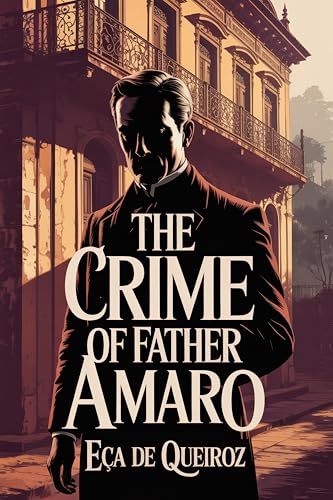
The Crime of Father Amaro (1875) was the novel that made his reputation and nearly destroyed it. A young priest posted to a provincial town begins an affair with the daughter of his landlady — a woman herself obsessed with the Church. The scandal on publication was not that Eça depicted clerical hypocrisy but that he presented it as structural rather than personal: a system that produces exactly the behavior it officially forbids. The novel was revised twice, each version more precise and more damning.
The scene that captures the novel’s method most precisely is not the affair itself but one of the devotional meetings held in the landlady’s parlor, where the local clergy and their female admirers gather to discuss Church matters, exchange gossip, and eat. Eça renders it with the documentary patience of a naturalist observing a species — the specific pastries consumed, the particular mix of piety and flirtation in the conversation, the way the young priest Amaro is simultaneously an object of spiritual admiration and obvious physical attention. Nothing is stated. Everything is shown. The reader understands before any of the characters do that the catastrophe is already in motion in the very rituals designed to prevent it.
Cousin Bazilio (1878) works in tighter domestic space. Luísa is left behind in Lisbon when her husband travels, and when her cousin Bazilio returns from Paris, the affair begins with the speed of people who have been waiting for an excuse. What distinguishes the novel from other provincial-Bovary variations is what comes after: a blackmail plot executed by Luísa’s servant that is both genuinely tense and genuinely funny, and that exposes how the same social codes that condemn women’s desire are then weaponized against them by everyone below them in the hierarchy.
The Maias (1888) is the masterwork — three generations of an aristocratic family traced through a Portugal modernizing in theory while staying exactly the same in practice. It operates at Anna Karenina scale without the religious scaffolding. Margaret Jull Costa’s translation is the one to read, and it handles the novel’s enormous social canvas without losing the comedy in the detail. It is one of the finest English translations of any Portuguese-language work.
The central love affair of The Maias — between Carlos da Maia and a woman who eventually reveals herself to be his sister, both victims of a family history neither of them knew — works not as Gothic melodrama but as the logical terminus of a society that has kept everyone sufficiently ignorant of their own past. The incest plot is Eça’s answer to the question of what happens when a culture refuses to examine itself. The Maia family has suppressed its history so thoroughly that its children literally cannot recognize each other. That is a political argument dressed as a plot twist, and it is handled with a control that never lets the symbolism overwhelm the human grief.
Fernando Pessoa, born in 1888, spent his adult life in Lisbon writing under heteronyms — invented poets with distinct biographies and philosophies. The Book of Disquiet, assembled from fragments after his death, is one of the great prose works of European modernism. He stands as proof that the tradition did not exhaust itself in the nineteenth century, though he is a different reading experience from Machado or Eça: less narrative, more immersive, a book you return to rather than read through.
Pessoa’s situation was stranger than almost any writer of his era. He invented not just pen names but entire personalities — Alberto Caeiro, Ricardo Reis, Álvaro de Campos — each with a distinct poetic style, biography, and philosophical position. They reviewed each other’s work. They argued with each other in print. Pessoa maintained them simultaneously, writing as Caeiro in one mood and as Campos in another, and leaving behind a trunk containing roughly twenty-seven thousand documents when he died in 1935. The Book of Disquiet, assembled posthumously from that archive, is the closest thing to a self-portrait — written under yet another heteronym, Bernardo Soares, an assistant bookkeeper in Lisbon who spends his evenings observing the city and his interior life with equal, exhausted precision.
The Question of Translation
Portuguese presents translators with a specific problem. The language builds meaning through accumulation — long, clause-laden sentences that hold multiple qualifications in suspension — and the temptation for translators working phrase by phrase is to break those constructions into English declaratives that are technically accurate and tonally wrong. Machado’s irony depends on a certain syntactic elongation, a sense of the prose taking its time to deliver a verdict that turns out to be devastating. Flatten the sentence and you flatten the joke. Flatten the joke and you have a nineteenth-century novel about a dead man making observations, which sounds like exactly the kind of book you don’t need to read.
The same problem, differently inflected, applies to Eça. His sentences carry social performance in their structure — characters who speak in elaborate subordinate clauses are marking their class, their education, their relationship to French culture. A translation that regularizes those structures into clean English prose has misread the novel. The comedy of Portuguese bourgeois life in the 1870s is partly a comedy of affectation, and affectation requires a certain syntactic excess to register.
There is also the question of register shifts — moments when Machado drops from his elevated ironic mode into something blunt and almost brutal, or when Eça lets a peasant character’s speech cut through three pages of bourgeois posturing with a single sentence. Those shifts are doing rhetorical work that depends on the contrast being legible. If the whole translation runs at the same temperature, the moments that are supposed to land as cold water don’t land at all. The best translators of this tradition understand that their job is to reproduce the contrast, not just the content.
The editions featured on this site take these problems seriously. The translations make choices — about sentence rhythm, about register, about where to let the prose breathe — that serve the English reader rather than the source text’s grammar. These are translations made by people who understood what the books were trying to do. That is rarer than it should be, and it is the reason this tradition is finally readable in English the way it deserves to be.


Aluísio Azevedo and Brazilian Naturalism
Aluísio Azevedo occupies a different register from Machado de Assis. Where Machado was ironic, interior, and philosophically detached, Azevedo was a naturalist in the Zola mould — interested in environment, class, and the way poverty shapes human beings from the outside in. His 1890 novel The Slum is the defining work of Brazilian naturalism and one of the most viscerally alive novels in the Portuguese language.
The book is set in a Rio de Janeiro tenement — a cortiço, literally a beehive — and follows the competing lives of a Portuguese immigrant landlord and the hundreds crammed into his building’s rooms and courtyards. It is hot, sensory, and merciless. Azevedo does not sentimentalize poverty; he shows how it operates structurally, wearing down individual will until behaviour starts to look like destiny. If you have read Machado and found him cool and controlled, Azevedo will feel like opening a window. He is the necessary counterweight.
- The Slum — The foundational text of Brazilian naturalism. A Rio tenement, a Portuguese landlord, and a community ground down by circumstance.
Frequently Asked Questions
Is Machado de Assis really considered a postmodern writer even though he died in 1908?
The term gets applied to him retrospectively and with good reason: the self-interrupting narration, the chapters that exist only to announce they will be skipped, the narrator who directly addresses and argues with the reader — these are techniques we associate with Borges and Calvino, writers who came fifty to seventy years later. Machado didn’t label what he was doing, but Posthumous Memoirs of Brás Cubas, published in 1881, predates by decades the formal experiments that would eventually get classified as postmodern. Whether the label fits matters less than the fact that the book still feels contemporary in a way that most nineteenth-century fiction does not.
Did Capitu actually cheat? Is there a consensus among scholars?
There is no consensus, and Machado almost certainly intended it that way. The debate in Brazil is serious enough that it has a name — “the Capitu question” — and it has produced decades of literary criticism, a landmark 2008 TV miniseries, and arguments that are still happening in university seminars. The most persuasive readings tend to focus not on what Capitu did but on what Bentinho’s narration reveals about Bentinho: his obsessive jealousy, his tendency to interpret every ambiguity as confirmation of betrayal, and his conspicuous control over what the reader is and isn’t allowed to see. Whether Capitu was innocent or guilty, the narrator is not reliable enough to convict her.
Where should I read Eça de Queirós if I’ve never tried him — The Maias, or one of the shorter novels first?
Start with Cousin Bazilio if you want to ease in — it’s the tightest of his major novels, with a blackmail plot that gives it a thriller’s momentum alongside its social satire, and it runs to roughly three hundred pages rather than the six hundred of The Maias. The Crime of Father Amaro is the other natural entry point, especially if you’re interested in how nineteenth-century novelists handled institutional religion. Save The Maias for when you’ve developed an appetite for Eça’s rhythms; it rewards the investment, but it asks for patience that comes more easily once you already trust him.
Is The Book of Disquiet a novel? How do you actually read it?
It is not a novel, not quite a diary, and not quite a collection of essays — the most honest description is that it is a fragmentary prose record left by an invented person. Pessoa wrote the pieces that make up The Book of Disquiet across roughly two decades without ever assembling them into a final order; all existing editions are editorial constructions from the archive he left behind, which means different editions arrange the fragments differently. The practical advice: read it the way you’d read a book of poetry — not straight through in long sittings, but in short sessions, letting individual passages sit. It is a book that accumulates rather than progresses, and trying to race it will lose you the thing it’s actually doing.
This post contains affiliate links. As an Amazon Associate, we earn from qualifying purchases.

You must be logged in to post a comment.