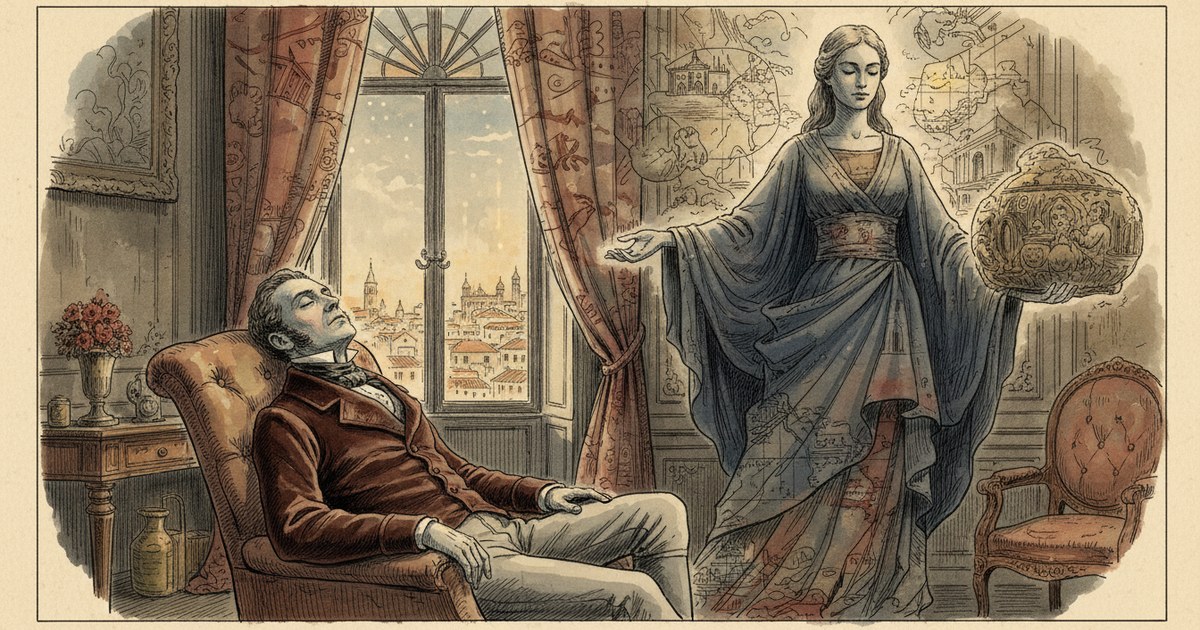
Brás Cubas is already dead when he starts talking. That’s the first joke. The second is that he can’t stop. The third — and this one takes a while to land — is that he’s right about everything, and you hate him for it, and you keep reading anyway.
The Posthumous Memoirs of Brás Cubas, published in 1881 by Joaquim Maria Machado de Assis, opens with a dedication to the first worm that gnawed on the author’s flesh. It is not being cute. This book means that. It is a novel narrated from death backward through a wasted life, and it has the audacity to be one of the funniest things written in the nineteenth century — funnier than Dickens, more structurally unhinged than anything Flaubert attempted, and more philosophically honest than almost any novel you care to name. It was also published in a slave-owning empire, by a man who rose from poverty and mixed-race obscurity to become the most important writer in the history of Brazil. These facts are not incidental. They are the whole point.
The Structure Is the Argument
Most novels ask you to forget you’re reading. This one refuses that contract from page one. Machado gives us chapters that are three sentences long. He gives us a chapter that is a single blank page — and titles it “Chapter LV.” He addresses you directly and with mild contempt, the way a man at a dinner party might turn to someone he’s just met and say: “You think I don’t know what you’re thinking? I do. And it’s not flattering to either of us.”
The lineage is deliberate. Machado was reading Laurence Sterne — Tristram Shandy, the 1759 novel that broke narrative convention before it had properly formed — and absorbed the lesson completely. But where Sterne’s chaos is comedic in the way of a man who can’t stop talking, Machado’s is philosophical. The digressions aren’t digressions. They’re the structure. A life that kept interrupting itself with excuses, deflections, and brilliant rationalizations for doing nothing of consequence.
Brás Cubas wanted to be a statesman. He wanted to invent a medicinal plaster that would make him famous. He wanted Virgília, who married someone else and then became his mistress anyway. He got some of these things, partially. He died without children, without his plaster, without his political ambitions, having never written the book he planned. And from the other side of death, he calculates — with the careful arithmetic of a man who has had eternity to think about it — that this makes him a winner. Slightly. Because at least he produced no new human beings to inherit the misery of existence.
That’s the thesis of the book, and it arrives like a stone through a window.
What makes the structure particularly vicious is that Brás is a gifted self-justifier. When he describes his brief, unsuccessful stint in politics — he wins a seat, accomplishes nothing, loses the seat — he writes it off in two paragraphs, not because he’s embarrassed, but because he’s decided it wasn’t worth his attention. The chapters shrink around the failures and swell around the vanities: a long account of a hat, a longer account of a slight at a party, a chapter on nothing titled “In Which I Play the Part of a Generous Man.” Machado is using chapter length as irony. The empty page is the most honest chapter in the book. It tells you exactly as much as those years contained.
The Delirium
Before you get the cold arithmetic, you get the fever dream. In Chapter VII — one of the great set pieces of nineteenth-century fiction — the dying Brás is seized by a hallucination. A figure appears: Pandora, riding a hippopotamus, carrying him through the entirety of human history. Civilizations rise and collapse, centuries of war and love and ambition compressed into a single vision. He screams at her. She is unmoved. She shows him everything, which turns out to mean: nothing you do matters in the span I contain.
Machado writes this chapter in a register completely unlike the rest of the book — vast, almost baroque — then snaps back to Brás’s bedroom. The pettiness of the scene that follows lands harder for the contrast. This is what the novel keeps doing: expanding to cosmological scale, then collapsing to a drawing room, a mistress’s apartment, a social snub at a party. Human life is both things simultaneously: large in its suffering, small in its ambitions. Brás Cubas knows this and does nothing with the knowledge, which is also the point.
What’s easy to miss is that Pandora doesn’t punish Brás. She doesn’t judge him. She simply shows him the full ledger of human time and lets him understand his place in it, which is: none. There is a moment in the delirium where he sees himself — just for an instant — as one of thousands of nearly identical men who lived, wanted things, and dissolved. He finds this briefly unbearable, then recovers. By Chapter VIII he is back to worrying about his reputation. This is the structure of the whole novel compressed into one scene: the truth arrives, Brás looks at it squarely, and then he moves on. Moving on is his defining talent. The reader is left holding the truth he put down.
Humanitism, or: The Potatoes
Partway through, Brás encounters his childhood friend Quincas Borba — a philosopher who has either achieved enlightenment or gone completely mad, and the book declines to adjudicate which. Quincas Borba has developed Humanitism: a cosmic philosophy in which Humanity is the supreme principle, individual humans are merely its instruments, and suffering is irrelevant. Its practical conclusion: “To the winner, the potatoes.”
It’s a joke. It’s also Schopenhauer in carnival costume. The will-to-live, stripped of metaphysics, dressed as a self-help slogan. Humanitism is what ideology looks like when the ideologue is honest about what it’s actually for — which is what happens when you translate that pessimism into the idiom of a Brazilian upper class building an empire on enslaved labor while congratulating itself on its enlightenment.
This is where Machado’s biography becomes inseparable from the book. He was the grandson of freed slaves, largely self-educated, the son of a house painter and a washerwoman. He spent his working life among the Brazilian elite, watching them perform their civilization while holding a society together with enslaved bodies. The enslaved people in The Posthumous Memoirs are minor characters, barely named. This has been read as a flaw — or as the most devastating structural choice in the novel. Brás narrates his world without seeing it, and the book, by inhabiting his perspective so faithfully, makes you see the blind spot even as he can’t.
Quincas Borba is also, underneath the joke, a warning. He is what Brás’s worldview looks like when someone takes it seriously enough to systematize it. Brás is too lazy for that kind of rigor; he prefers comfortable nihilism to formal philosophy. But Humanitism names the operating logic of the world Brás lives in: resources flow to the powerful, the suffering of the weak is philosophically reassigned as necessary, and the whole arrangement gets a Latin-sounding name so it feels like wisdom rather than appetite. Machado wrote this in 1880. The formula has not aged.
The Man Who Wrote It
Joaquim Maria Machado de Assis was born in Rio de Janeiro in 1839, the son of a mixed-race house painter and a Portuguese washerwoman from the Azores. By almost any measure available to nineteenth-century Brazil, he should not have become what he became. He had epilepsy. He stuttered. He was poor, dark-skinned, and largely self-taught. He read everything he could borrow and taught himself French and English well enough to translate Shakespeare and Dickens. He got a job as a typographer’s apprentice, then a proofreader, then a journalist, then a bureaucrat in the Ministry of Agriculture — a position he held for decades while writing the novels, stories, and criticism that would define Brazilian literature.
By the time he published The Posthumous Memoirs, he was already established as a writer. But the earlier work was romantic, conventional, aimed at pleasing an audience. The turn to the dead narrator, the broken chapters, the direct addresses, the structural games — that was a choice, made by a man in his forties who had watched the Brazilian elite long enough to have an opinion about them he no longer felt like softening. He founded the Brazilian Academy of Letters in 1897 and served as its first president until his death in 1908. The institution still exists. The portrait of him that hangs there was painted while he was alive. He got to watch them put it up.
One Hundred Years Before Postmodernism
The blank page is a postmodern gesture. The direct addresses are metafiction. The chapter that summarizes two years of a love affair in four lines — because Brás decides empty years can be told in a paragraph — is a comment on narrative selection, on what novels choose to show and why. Machado was doing this in 1881 while Zola was writing naturalism and Tolstoy was writing War and Peace, in Portuguese, in Rio de Janeiro, in a country European critics would not read for another century.
The older English translations carry the stiffness of their era, a formality that smooths over the places where Machado is being deliberately rough, deliberately odd, deliberately rude. The sentences in the original Portuguese are precise and unstable at the same time, like a man being very careful to say the exact wrong thing.
Consider the way Brás handles his mother’s death. He gives her a chapter. It is warm, apparently sincere, full of filial tenderness. Then, four chapters later, he mentions that her illness was inconvenient for a social engagement he had wanted to attend. He doesn’t flag this as a contradiction. He doesn’t notice it is one. The novel’s entire moral architecture is built from moments like this — two truths that can’t coexist placed next to each other without comment, waiting for the reader to feel the gap. It is a technique that would look at home in Nabokov or Pynchon. It was published when Nabokov’s parents were children.
On the Translation
Reading Machado in English requires a translator willing to match his tonal agility: the voice has to be able to move from mock-epic grandeur to drawing-room snark to genuine melancholy inside a single paragraph without any of the registers feeling forced. That’s a harder job than it sounds. The 1952 Grossman translation — published as Epitaph of a Small Winner — was the version that introduced Machado to most English readers, and it did important work, but it irons out some of the strangeness. The prose becomes more consistently elegant than Machado’s own, which is precisely the problem: Brás is not consistently elegant. He is brilliant and sloppy and occasionally cruel, and the translation needs to let him be all three.
The edition featured here opts for a modern English rendering that preserves the tonal instability — the moments where Brás’s sentences become deliberately clumsy because he’s avoiding something, or deliberately ornate because he’s performing for an imagined audience. If you’ve tried Machado before in an older translation and found him somehow less strange than his reputation suggested, this is worth trying again. The strangeness is the point, and a translation that smooths it is, in a quiet way, missing the argument.
He comes out slightly ahead. He had no children. He transmitted his misery to no one.
It is one of the saddest jokes in literature. Machado de Assis, writing in 1881, having watched a society grind people into dust for profit, having made himself into a writer by sheer force of will in a country that should not have allowed it, looked at the whole system and wrote a novel from beyond the grave about a man who wasted his life and knew it and found a way to feel okay about that. The joke at the end is not only about Brás Cubas. It is about everything he chose not to see. That’s where the book bites.

Frequently Asked Questions
Is The Posthumous Memoirs of Brás Cubas a difficult read?
No — it’s one of the most accessible formally experimental novels in existence. The chapters are short, the voice is dry and engaging, and Machado never lets the structural games get in the way of the story. Readers who bounce off Sterne or Joyce typically find this one moves faster and rewards them more immediately.
What’s the difference between the titles The Posthumous Memoirs of Brás Cubas and Epitaph of a Small Winner?
Both are translations of the same novel. Epitaph of a Small Winner was the title used in the influential 1952 Grossman translation; The Posthumous Memoirs of Brás Cubas is a more literal rendering of the Portuguese original. More recent translations have returned to the literal title, and the edition featured here follows that choice.
Do I need to know Brazilian history to appreciate this novel?
No prior knowledge required. A sentence of context helps: imperial Rio de Janeiro, mid-nineteenth century, a society built on enslaved labor. Brás Cubas is upper-class and completely at home in this world. The context sharpens the darkest edges — particularly how slavery is simultaneously everywhere and invisible in his narration — but even without it, the book works as a portrait of a man who knows himself too well and does nothing about it.
Why isn’t Machado de Assis more widely read in the English-speaking world?
Largely a translation gap. Portuguese literature receives far less English attention than French, Russian, or German. Machado spent most of the twentieth century known mainly to specialists, despite Susan Sontag calling him one of the great underrated writers of world literature. That’s been changing, and this is one of the best possible entry points.
Should I read The Posthumous Memoirs of Brás Cubas before Dom Casmurro?
The novels are standalone, but The Posthumous Memoirs is the better entry point — it establishes Machado’s voice and method more dramatically, and the shock of its structure prepares you for the subtler games in Dom Casmurro. Quincas Borba, the philosopher from this novel, also appears in a later Machado novel named after him, so reading in publication order rewards you with an expanding universe of interconnected unreliable narrators.
Was Machado de Assis writing about slavery directly, or only obliquely?
Obliquely — and deliberately so. Brazil abolished slavery in 1888, seven years after this novel was published, and Machado never wrote a novel with abolition as its explicit subject. What he did instead was embed the social logic of slavery into the narration itself: Brás owns enslaved people the way he owns furniture, mentions them in the same register, and expects the reader to find this unremarkable. Several of Machado’s short stories, particularly “The Slave’s Tale” and “Father Against Mother,” are far more explicit about the violence of the system, and they hit harder for being read alongside his novels.
Leave a Reply