Category: Literary Classics

  • Kafka Wrote *The Trial* Before His Arrest.

    Kafka Wrote *The Trial* Before His Arrest.

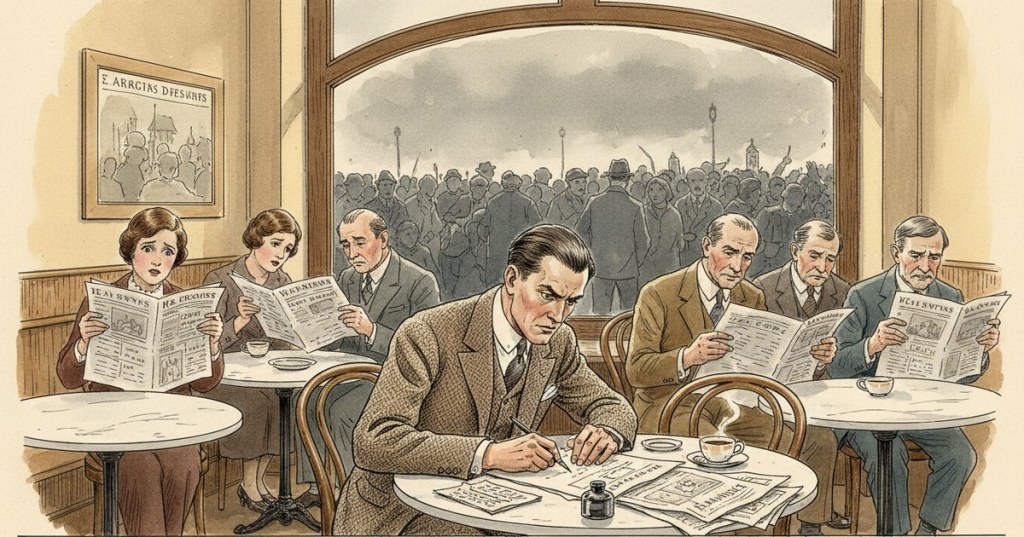
    On the morning of his thirty-first birthday, Josef K. is arrested by two men who eat his breakfast and cannot tell him what he’s charged with. He is not taken anywhere. He goes to work. He comes home. The trial, whatever it is, proceeds without him—or rather, it proceeds through him, feeding on his attempts to stop it. Kafka wrote that opening scene in a single night in August 1914, six weeks after the assassination in Sarajevo and three days after Germany declared war on Russia. He was also, that same week, breaking off his engagement to Felice Bauer for the first time.

    The conjunction matters. The Trial is not about bureaucracy in the abstract. It’s about the specific horror of a man who believes, somewhere beneath his panic, that the charge against him might be real—and who cannot ask what it is because naming it would confirm it. Every procedural absurdity K. encounters, every painter and lawyer and cathedral priest who offers to help, is an escape route that leads deeper in. Kafka understood that mechanism from the inside. He had spent years in it.

    What he finished in those months of 1914 and 1915—he never declared the novel done, left chapters in a drawer, told Max Brod to burn everything—was not a political allegory but something closer to a portrait of guilt that has outrun its cause. Josef K. doesn’t know what he did. Neither do we. That is not a mystery to solve. It is the condition of the book.

    The Man Who Administered His Own Sentence

    Kafka spent eleven years as a senior claims officer at the Workers’ Accident Insurance Institute in Prague, assessing industrial injury compensation for men who had lost fingers, hands, whole limbs to machines their employers had not bothered to guard. He was good at it. He wrote meticulous reports, proposed safety reforms, understood bureaucratic machinery in the way a mechanic understands an engine—by having spent years watching it fail people. His literary reputation has often turned him into a pale, tubercular visionary isolated from the world, but the biographical record is more uncomfortable than that: he was competent and embedded, and he hated that he was.

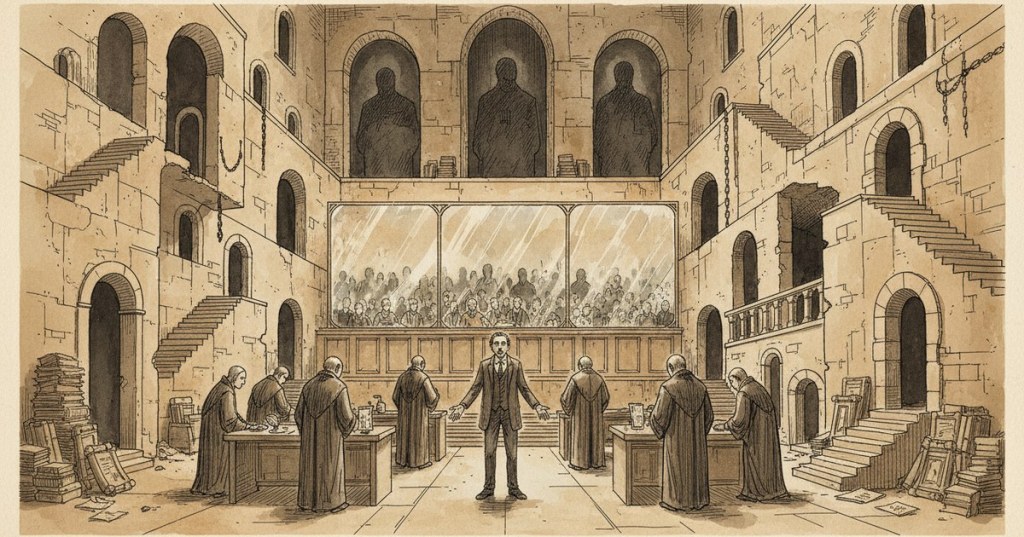
    The engagement to Felice lasted, in its fractured way, from 1912 to 1917. In his diary entries from those years, Kafka describes writing as the only thing that gave him the right to exist, and marriage as something that would extinguish writing, and the inability to choose between them as a kind of permanent verdict. When he writes, in The Trial, about a court that operates in attic rooms above ordinary apartments—that holds its sessions in buildings where families are also cooking dinner and children are doing homework—he is not imagining Kafkaesque abstraction. He is describing what it feels like to carry a proceeding inside you while the world continues its ordinary operations all around you.

    He was diagnosed with tuberculosis in 1917, the year he finally broke the engagement for good. He died in 1924. He was forty. Max Brod published The Trial the following year, against explicit instructions. Whether that was friendship or betrayal is a question the novel, characteristically, refuses to answer.

    What the Court Already Knows

    The genius of the novel is not its surrealism—it is its precision. The court’s logic is not random; it is perfectly consistent, internally, once you accept its first premise: that accusation and guilt are the same thing. Every character K. consults confirms this premise while appearing to contest it. The painter Titorelli explains with cheerful expertise that acquittals are theoretical. The lawyer Huld explains that the most effective strategy is to avoid annoying the lower clerks. The priest in the cathedral explains that the doorkeeper in the parable was not cruel—he was only doing his job. Each explanation is coherent. Each one closes another door.

    What makes the novel land, still, is that K. is not passive. He fights. He organizes. He drafts a petition. He fires his lawyer and decides to represent himself. His energy and intelligence are completely genuine, and they are completely useless, and Kafka is not cruel about this—he is something worse than cruel, he is accurate. The final chapter, where two men in frock coats arrive at K.’s apartment on the eve of his thirty-second birthday, is four pages long and written with the flat procedural clarity of an official report. K. does not resist. He has been preparing for this since the first page, and so have we, and when the knife turns, the sentence Kafka gives us is not dramatic. It is administrative. That economy is the whole argument.

    Why This Translation

    Kafka’s German is not ornate. It is the language of forms and memos—precise, impersonal, faintly polite—turned toward material that strips politeness to its skeleton. A translation that reaches for elegance misses the point; one that flattens into plainness loses the constant, quiet pressure of a bureaucratic register being used to describe a man’s destruction. This edition holds that tension. The sentences read the way official correspondence reads when you know it contains something terrible: smooth on the surface, load-bearing underneath. If you have not read The Trial in English before, or if you read it in a version that felt distant or dated, this is the edition to go back with. Find it here: The Trial: A New Translation.

    The court, the novel insists, was always already in session. You were just the last to know.

    The Trial: A New Translation

    The Trial: A New Translation

    by Franz Kafka

    Buy Paperback

    More from Franz Kafka

    The Castle: A New Translation
    Amerika (The Man Who Disappeared): A New Translation
    A Country Doctor And Other Stories: In the Penal Colony, The Judgment: A New Translation
    Metamorphosis: A New Translation in Modern Accessible English

    This post contains affiliate links. As an Amazon Associate, we earn from qualifying purchases.

  • Zweig Understood Magellan Better Than Magellan Did

    Zweig Understood Magellan Better Than Magellan Did

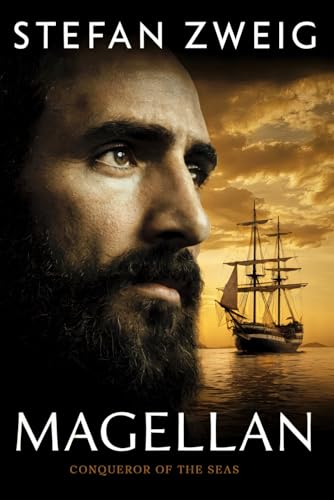
    Ferdinand Magellan never saw the strait named after him. He was dead before the Victoria limped back to Seville with eighteen survivors and a hold full of cloves — killed on a Philippine beach in a skirmish that had nothing to do with circumnavigation and everything to do with a local king’s political dispute that Magellan, characteristically, decided was his business. That detail matters: the man who planned the most audacious voyage in human history could not stop himself from dying in a footnote to someone else’s war.

    Stefan Zweig spent years with that detail. He turned it over, the way you turn over a stone to see what moves underneath. And what he found — writing in 1938, in exile, watching Europe rehearse its own destruction — was not a story about conquest. It was a story about obsession so total it becomes indistinguishable from self-erasure. Zweig’s thesis is quiet but merciless: Magellan was the voyage. Once the voyage was complete, there was nothing left of the man but the dying.

    This is the argument that makes Zweig’s Magellan something other than biography. It is a portrait of a specific kind of human being — the visionary who can only exist in pursuit, who is more alive in a storm off Patagonia than in any room in Lisbon. That Zweig understood this so precisely, at that particular moment in his life, tells you something about what he was writing toward.

    The Exile Who Recognized the Obsessive

    By the late 1930s, Zweig had lost almost everything a Central European intellectual could lose. Vienna — the city he’d written with the tenderness of a man describing his own face — was gone. His books were burned. He was in London, then Bath, then eventually Brazil, carrying his language in his head like a portable homeland. He wrote the Magellan biography in that period, and it would be too easy to say he was simply projecting. What’s more precise is that exile sharpens your eye for certain things: the cost of total commitment, the loneliness of the person who can only see one direction, the way an idea can consume its owner.

    Zweig had made his reputation on psychological portraiture — his Sternstunden der Menschheit, those “decisive moments in history,” had shown he understood that the hinge points of civilization are also the hinge points of individual psychology. What he brought to Magellan was the same scalpel: biographical facts in service of a psychological argument. The Portuguese court dismissing Magellan, King Manuel refusing an audience — Zweig treats these not as political events but as the specific wounds that calcify into obsession. Every door that closes becomes another layer of the armoring that makes Magellan both possible and unreachable.

    He wrote from original sources, cross-referencing the accounts of Pigafetta — the chronicler who survived and left the only firsthand record — against the administrative documents of the Casa de Contratación. Zweig was not a careless researcher. The psychological argument is built on an accurate skeleton. That’s what separates Magellan from historical romance: it earns its interpretations.

    The Voyage as Character, the Mutiny as Climax

    The book’s beating heart is the winter at Port San Julián, where three of Zweig’s five ships mutinied in the dark and cold of a Patagonian April. Magellan’s response was so precise it borders on the algorithmic: he isolated the ships one by one, executed the ringleader, marooned two others, and offered pardons down the chain of command before anyone had time to think. The whole operation took less than a day. Zweig reads this not as military brilliance but as the act of a man for whom the voyage was not a mission but a metabolism — the mutineers weren’t threatening his command, they were threatening his ability to continue existing.

    That specificity of reading is what makes Magellan land the way it does. The strait itself — those 373 miles of channel through the southernmost tip of South America, which Magellan spent thirty-eight days navigating while one of his captains defected back to Spain — becomes in Zweig’s hands a psychological passage as much as a geographical one. The man who emerged on the Pacific side was not triumphant. He was depleted. He had spent everything to get through. The rest was momentum.

    Why This Translation

    The standard English version of Zweig’s Magellan is decades old and it shows — the prose has the slightly formal remove of mid-century translation, competent but cautious, the German sentence architecture left standing rather than rebuilt in English. This new translation strips that scaffolding away and lets Zweig’s own rhythm through: his pacing, his habit of building a paragraph to a single revealing clause, his refusal to let the reader off the hook with easy heroism. The result reads the way Zweig’s essays read — intimate, pressurized, like someone talking to you at close range about something that matters to them. For readers who want to understand what Zweig saw in Magellan, and what Magellan’s story let Zweig say about his own era, this is the version that gets you there. The paperback is available here.

    Magellan crossed the Pacific and died before he knew what he’d proven. Zweig finished the book and within four years was dead by his own hand in a rented room in Petrópolis. Two men who went all the way — and the one who understood the cost better was the one watching from the shore.

    Magellan: Conqueror of the Seas: A New Translation

    Magellan: Conqueror of the Seas: A New Translation

    by Stefan Zweig

    Buy Paperback

    More from Stefan Zweig

    The Stefan Zweig Collection - Volume 1: A New Translation
    The Stefan Zweig Collection - Volume 2: A New Translation
    Marie Antoinette: The Portrait of an Average Woman: A New Translation
    The Stefan Zweig Collection - Volume 3: A New Translation
    The Stefan Zweig Collection - Volume 4: A New Translation
    Twenty-Four Hours In The Life Of A Woman: A New Translation
    The Stefan Zweig Collection - Volume 5: A New Translation
    Balzac: A Biography: New Translation

    This post contains affiliate links. As an Amazon Associate, we earn from qualifying purchases.
  • Verne Mapped the Ocean Before We Reached It

    Verne Mapped the Ocean Before We Reached It

    Good — I have what I need. Let me write this now.

    In 1866, ships from a dozen countries reported the same thing: something vast and luminous was moving beneath them. The reports were credible — speeds no living creature could sustain, a phosphorescent wake miles long, impacts that dented iron hulls. The world’s maritime press went briefly mad trying to name the thing. Jules Verne, watching from Paris, did something more useful. He went home and invented it.

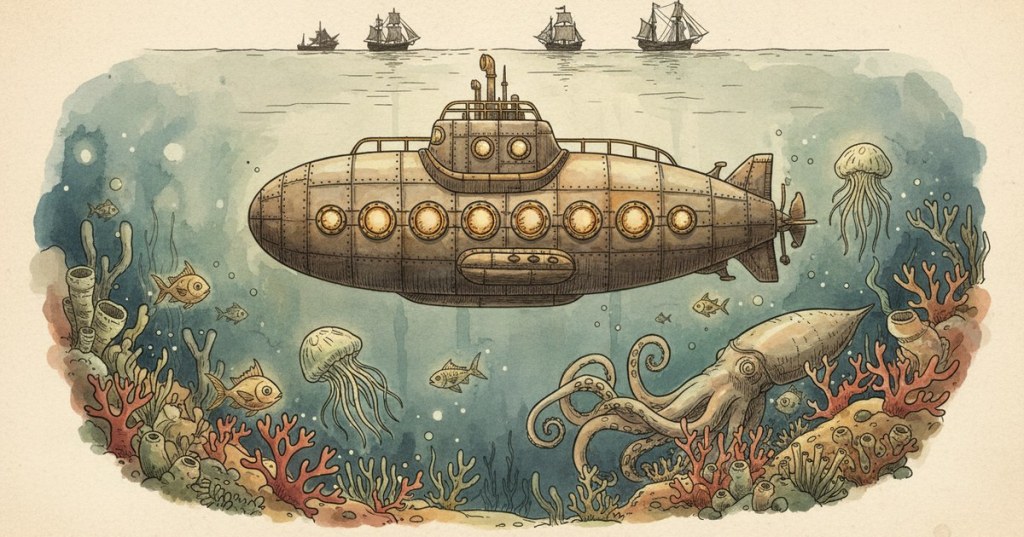
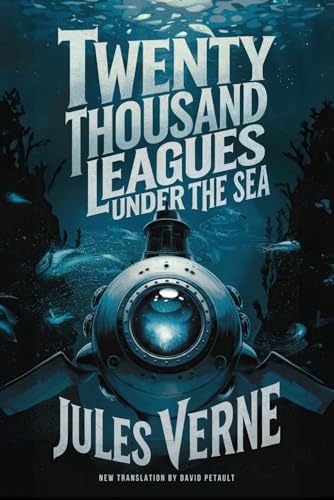
    Twenty Thousand Leagues Under the Sea began as a serial in 1869, a year before anyone had descended more than a few hundred feet in anything resembling a controlled vehicle. Verne had seen a model of the French submarine Plongeur at the 1867 Exposition Universelle — a lumbering, compressed-air prototype that managed brief dips in the Seine. From that seed, he built the Nautilus: electrically powered, capable of circling the globe, equipped with a salon hung with paintings and a library of twelve thousand volumes. The working submarines of 1869 could barely stay down for twenty minutes. Verne’s argument, implicit in every page, was that the ocean was not a void. It was a civilization waiting to be entered.

    That argument has never really been answered. We have explored less than twenty percent of the ocean floor. Verne mapped it before we reached it, and in certain essential ways, we still haven’t caught up.

    The Man Who Turned His Editor’s Rejections into a Career

    Verne was thirty-five when he sold his first novel. Before that: a failed lawyer, a moderately failed playwright, a stockbroker who spent his lunch hours in the Bibliothèque nationale reading scientific journals in fields he had no formal training in — geology, oceanography, astronomy, polar exploration. His first editor rejected the manuscript that would become Five Weeks in a Balloon twice. Verne reportedly told his wife he was going to burn it and try something else. She hid the manuscript. This matters to how Twenty Thousand Leagues reads, because it is a book written by someone who taught himself the science one journal at a time, who had to earn his own authority before he could project it onto a character. Captain Nemo’s serene, absolute expertise — the way he names every organism Aronnax cannot, reads the deep currents the way others read weather — carries the specific confidence of self-made knowledge. Nemo is what Verne wanted to be: the man who had actually read everything.

    The other biographical fact that reshapes the novel: Verne wrote it in the shadow of the Second Empire, a France where political dissent required careful management. Nemo — whose name is Latin for “no one” — is a man who has renounced nations, a stateless fugitive living beneath the reach of governments. He funds anti-colonial uprisings from the sea floor. He mourns something he refuses to name. When Aronnax presses him about his past, Nemo answers: “I am not what you call a civilized man. I have done with society entirely.” That line did not require literary analysis in 1870. Every French reader knew exactly what it meant.

    A Catalogue That Becomes a Grief

    The novel’s central formal gamble is that it gives you a scientist as narrator. Professor Aronnax catalogs everything — species, depths, temperatures, geological formations, the chemical composition of the water at successive fathoms. Lesser writers deploy this technique to seem authoritative. Verne uses it to build an emotional argument. By the time Aronnax has named three hundred organisms, has stood awestruck in the Nautilus’s observation window watching bioluminescent forests scroll past at four knots, you understand what Nemo understood first: the ocean is not empty. It is fuller than the surface world, more ordered, stranger, more alive. The cataloguing is not pedantry — it is the slow accumulation of a love so large it has no object that can hold it. Aronnax cannot stay. He does not want to leave. The novel’s real tension is not whether the crew will escape Nemo. It is whether Aronnax can survive returning to a world that will never be as interesting again.

    What Verne understood, and what most adventure fiction refuses to admit, is that wonder has an aftermath. The specific grief of a man who has seen something no one else has seen — and who will spend the rest of his life failing to describe it adequately — is present on every page without ever being stated directly. It surfaces instead in the catalog: one more species, one more coordinate, one more measurement of a world that does not need us to witness it but that becomes, by being witnessed, unbearably precious. The last line of the book arrives like a door closing on a lit room. You are back on the surface, and the surface is not enough.

    Why This Translation?

    The original English translations of Verne are notoriously damaged goods — the 1872 Mercier Lewis version dropped twenty-five percent of the text, mistranslated the scientific terminology throughout, and smoothed away Nemo’s political edges into something safer for Victorian readers. What Verne actually wrote was more precise, more strange, and considerably more radical than most English readers have ever encountered. This new translation works from the original French, restores the excised passages, and renders Verne’s technical vocabulary accurately while keeping the prose moving at the pace he intended — urgent, specific, alive. If you read Twenty Thousand Leagues in school and found it slow, you were probably reading the wrong book.

    Twenty Thousand Leagues Under the Sea: A New Translation in Modern Accessible English

    Twenty Thousand Leagues Under the Sea: A New Translation in Modern Accessible English

    by Jules Verne

    Buy Paperback

    More from Jules Verne

    The Mysterious Island: A New Translation in Modern Accessible English
    The Lighthouse at the End of the World: A New Translation
    In Search of the Castaways (The Children of Captain Grant): A New Translation in Modern Accessible English
    Journey to the Center of the Earth: A New Translation in Modern Accessible English
    Propeller Island: A New Translation in Modern Accessible English
    The Carpathian Castle: A New Translation
    The Danube Pilot: A New Translation in Modern Accessible English
    Two Years’ Vacation: A New Translation

    This post contains affiliate links. As an Amazon Associate, we earn from qualifying purchases.

  • Nietzsche Wrote God’s Obituary. We’re Still Grieving.

    Nietzsche Wrote God’s Obituary. We’re Still Grieving.

    In the autumn of 1882, Friedrich Nietzsche sat in a boarding house in Genoa, watching the Mediterranean light fail, and began drafting the speech a madman gives in a marketplace. The madman has a lantern. It is midday. He is looking for God. “We have killed him,” the madman says to the crowd that is laughing at him—”you and I.” Then he asks the question that stops the laughter cold: “What festivals of atonement, what sacred games shall we have to invent?”

    That scene—from The Gay Science, which preceded Thus Spoke Zarathustra—is where the argument begins, and Nietzsche never let it end. The death of God was not a theological position. It was a diagnosis: Western civilization had built its entire architecture of meaning on a foundation it could no longer defend, and the building was still standing only because no one had told the inhabitants. Thus Spoke Zarathustra is what Nietzsche wrote next. It is not an answer. It is the question asked at full volume, in the form of a prophet who comes down from his mountain to find that humanity is not ready to hear him.

    Zarathustra speaks. The crowd listens politely and asks for a tightrope walker. Nietzsche understood this was the likeliest outcome.

    The Philosopher Who Diagnosed His Own Century

    He was born in 1844 in Röcken, a small Prussian village, the son of a Lutheran pastor who died of brain disease when Friedrich was four. That biographical fact is not incidental. Nietzsche grew up in a house where faith was the atmosphere, then watched it removed. He became a child prodigy, a professor of classical philology at Basel at twenty-four—the youngest ever appointed—before the migraine attacks and the eye problems and the nausea made sustained academic work impossible. By his mid-thirties he had resigned his professorship, lost the friendship of Wagner over what he called Wagner’s capitulation to Christianity and German nationalism, and was writing books that sold fewer than two hundred copies. He was, in the specific way of the nineteenth century, a man who had arrived too early at a conclusion everyone would eventually have to face.

    What his biography explains about Zarathustra is its loneliness—not as a mood, but as a structural argument. Zarathustra keeps returning to his cave. He gives his wisdom to crowds and they miss it. He finds disciples and sends them away because he wants followers who will surpass him, not worship him. The book’s most famous concept, the Übermensch—the Overman—is precisely this: not a superman in the comic-book sense, but a human being who has stopped requiring God as an excuse not to be fully, terrifyingly responsible for the meaning of their own existence. Nietzsche wrote this in the years he spent alone in Swiss and Italian boarding houses, surviving on plain food and walking through alpine terrain for hours each day because it was the only thing that relieved the headaches. The philosophy of self-overcoming was written by a man who had very little self left to spare.

    He completed the fourth and final part of Zarathustra in 1885. Six years later he collapsed in Turin, found embracing the neck of a horse that had been whipped in the street. He spent the last eleven years of his life in mental silence, cared for by his sister—who would later, with catastrophic consequences, align his work with German nationalism. He never knew his books had finally found their readers. He never knew what would be done to his ideas.

    The Book That Refuses to Be Summarized

    Thus Spoke Zarathustra is structured like a gospel—four parts, a prophet, parables, disciples—but it behaves like a grenade thrown at every gospel that preceded it. Its central chapters include “On the Three Metamorphoses,” where Nietzsche describes the human spirit moving from camel (the beast that bears all burdens willingly) to lion (the beast that can say no) to child (the beast that can begin again, free of obligation to what came before). This is not mysticism. It is a map of a specific psychological passage: out of inherited meaning, through the violence of negation, into the terrifying freedom of self-authorship. Anyone who has spent time sitting with a commitment—to a religion, a career, a relationship, an identity—that has gone hollow knows exactly what the camel stage feels like from the inside. Nietzsche just named it.

    The chapter called “On the Vision and the Riddle” contains the concept of eternal recurrence—the thought experiment that if time is infinite and matter finite, every moment must repeat, endlessly, including your worst ones—delivered as a confrontation with a dwarf on a mountain path who keeps whispering “gravity” in Zarathustra’s ear. The question eternal recurrence poses is not cosmological. It is: would you choose this life again if you had to live it forever? It is the most brutal possible test of whether you have actually made peace with the life you are living. Most readers find the chapter unexpectedly physical—there is a gate, a gateway, a serpent, a shepherd who bites the serpent’s head off, and Zarathustra laughing. It is the closest Nietzsche ever gets to writing a seizure in prose.

    Why This Translation

    The problem with most English editions of Zarathustra is that they preserve the nineteenth-century formality—the “thou”s and “thee”s, the inverted syntax—in a way that creates a reverent distance from the text. That distance is exactly wrong. Nietzsche was writing in deliberate opposition to reverence. He wanted the book to feel urgent, spoken, direct. This new translation works in the idiom of contemporary English without flattening the strangeness of the original: the aphorisms still land like blows, the passages of lyric intensity still lift off the page, but the reader is not required to climb through archaic diction to reach the argument. The result is a Zarathustra that reads the way it must have felt in German—dangerous, beautiful, slightly unhinged, and alive.

    You can find the paperback edition here. Nietzsche asked what festivals of atonement we would invent to replace what we had killed. We are still answering. We will be for a while.

    Thus Spoke Zarathustra: A New Translation in Modern Accessible English

    Thus Spoke Zarathustra: A New Translation in Modern Accessible English

    by Friedrich Nietzsche

    Buy Paperback

    More from Friedrich Nietzsche

    The Gay Science: A New Translation
    The Will to Power: A New Translation
    The Birth of Tragedy: A New Translation
    Beyond Good and Evil : A New Translation
    Untimely Meditations: A New Translation
    The Dawn (Thoughts on the Prejudices of Morality): A New Translation
    Human, All Too Human (A Book for Free Spirits): A New Translation
    On the Genealogy of Morality: A New Translation

    This post contains affiliate links. As an Amazon Associate, we earn from qualifying purchases.

  • Proust Started a Sentence and Never Stopped

    Proust Started a Sentence and Never Stopped

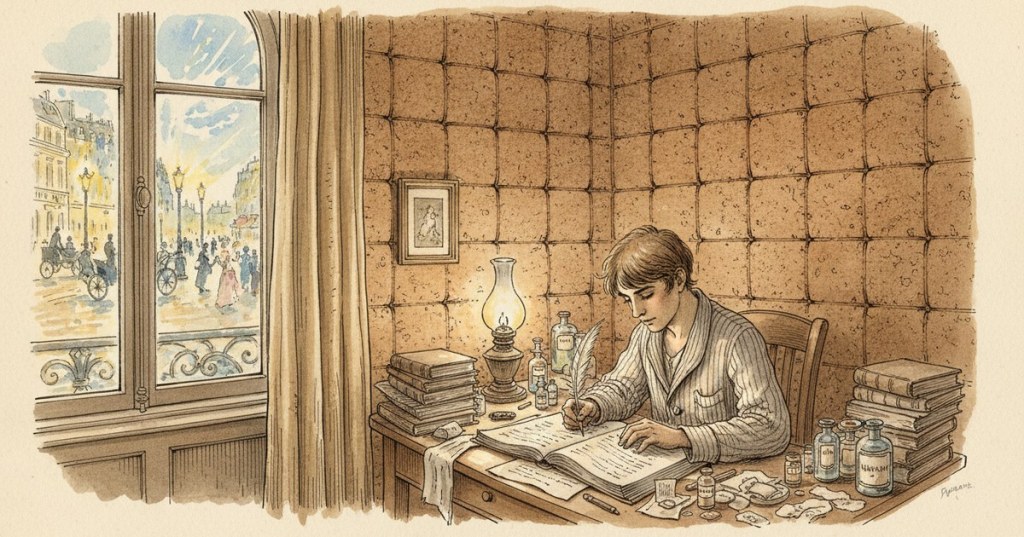
    In 1909, Marcel Proust sat down in a cork-lined bedroom in Paris and began writing a sentence. It ran for several pages. He was describing the experience of waking up, of not knowing where or when you are, of feeling the whole architecture of identity collapse and slowly reassemble itself from nothing but sensation. By the time he died in 1922, he had written 3,000 pages and had not quite finished. The sentence, in a sense, was still going.

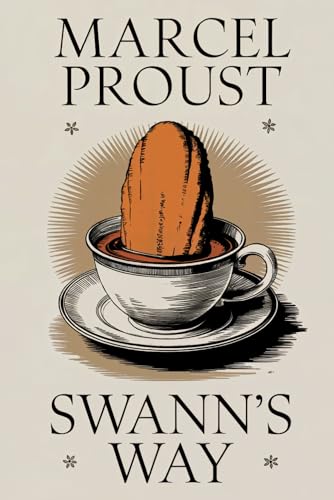
    Swann’s Way is the first volume of that sentence. It begins with a man lying in the dark, half-asleep, and it ends with him standing in the street remembering a love affair that destroyed his youth and noticing, with the cold precision of a surgeon, that the woman was not even his type. Everything in between is an argument about time — not time as a calendar records it, but time as the nervous system does: associative, recursive, occasionally merciless. The thesis Proust is running is audacious: that voluntary memory lies, that the past is only genuinely recovered when the body is ambushed by it, and that literature is the only instrument sensitive enough to catch this happening in real time.

    That is what makes Swann’s Way unlike anything else in the canon. Not its length. Not its famous sentences. Its argument.

    The Man Who Built a Cathedral to Stay Indoors

    Proust was born in 1871 to a prominent Paris physician father and a Jewish mother whose family connections opened doors into the upper bourgeoisie. He was brilliant, asthmatic, socially ravenous, and constitutionally unsuited to health. His childhood summers in Illiers — fictionalized as Combray — gave him the landscape of Swann’s Way: the church, the two walks, the hawthorns in bloom, the kitchen smell of a house where time moved differently than in Paris. When his mother died in 1905, he began a grief-driven retreat that accelerated into the cork-lined room on Boulevard Haussmann. He had the room lined to keep out noise and dust. He worked at night. He barely left.

    The isolation wasn’t eccentricity for its own sake. Proust needed silence because he was attempting something that required absolute concentration: to reconstruct, with total fidelity, the precise texture of consciousness moving through time. His asthma forced him inward; his grief demanded it stay there. The result is a novel written from the inside of a mind that has nothing left to do but remember — and has learned, through suffering, to distrust everything memory presents without the body’s confirmation.

    He died of pneumonia in November 1922, correcting proofs in bed. The final volumes were published posthumously. He had spent the last years of his life writing death — his narrator’s slow understanding that time had passed and could not be recovered except in the one way that mattered, which was this: the book itself.

    What the Madeleine Actually Does

    Everyone knows the madeleine. What most people don’t know is that Proust uses it as a trap. The narrator dips a madeleine into lime-blossom tea, and something unlocks — not a postcard memory, not a nostalgic haze, but a full sensory resurrection so complete it produces joy disproportionate to any deliberate act of remembering. He spends several pages analyzing why. He is not being indulgent. He is making his case: that the past locked in involuntary memory is the only past that remains entirely real, and that the self who recovers it is, for that moment, standing outside time. The madeleine is not a warmth-and-cookies moment. It is a philosophical proof-of-concept.

    The rest of Swann’s Way tests and complicates the proof. The Combray section, written in the long loose rhythms of total recall, gives us childhood as a place where the geometry of two afternoon walks still structures the whole moral universe. “Swann in Love,” the novella nested inside the novel, shifts tense and distance to show us Swann’s obsession with Odette from close enough to feel the shame of it — a man applying the machinery of aesthetic appreciation to a woman who returns none of it, watching himself do it, unable to stop. What Proust shows in that section, with a flatness that verges on cruelty, is that romantic suffering is a form of solipsism: Swann is not in love with Odette, he is in love with his own capacity to suffer over Odette. The reader recognizes this. The recognizing is uncomfortable.

    Why This Translation

    Translation is the central problem with Proust in English. The sentences need to hold their shape — their long, breath-consuming, subordinate-clause-stacking shape — without collapsing into parody or ironing themselves into clarity Proust never intended. This new translation of Swann’s Way takes those sentences seriously as formal objects, preserving their characteristic rhythm while keeping them navigable for a reader encountering Proust for the first time. If you’ve been putting Proust off because you’re not sure you have the patience, this is the edition to start with — and it’s available here in paperback.

    A word on the patience question: you don’t need more of it than usual. You need a different kind. Proust doesn’t ask you to endure; he asks you to slow down to the speed of a mind actually thinking. Once you match that speed, the length stops being a problem. The only difficulty is that when it’s over, ordinary prose feels slightly impoverished by comparison.

    Swann's Way (In Search of Lost Time Vol. 1): A New Translation

    Swann's Way (In Search of Lost Time Vol. 1): A New Translation

    by Marcel Proust

    Buy Paperback

    More from Marcel Proust

    Pleasures and Days: A New Translation
    In the Shadow of Young Girls in Flower (In Search of Lost Time Vol. 2): A New Translation
    The Fugitive (In Search of Lost Time Vol. 6): A New Translation
    Finding Time Again (In Search of Lost Time Vol. 7): A New Translation
    The Prisoner (In Search of Lost Time Vol. 5): A New Translation
    The Guermantes Way (In Search of Lost Time Vol. 3): A New Translation
    Sodom and Gomorrah (In Search of Lost Time Vol. 4): A New Translation

    This post contains affiliate links. As an Amazon Associate, we earn from qualifying purchases.
  • Hugo Built Notre-Dame. The Church Burned It Down.

    Hugo Built Notre-Dame. The Church Burned It Down.

    In 1482, the Cathedral of Notre-Dame de Paris had a problem: nobody cared about it. The building was crumbling, its statues defaced, its portals encrusted with grime. Medieval architecture was considered barbaric—the word “Gothic” was itself an insult. City planners had been chipping away at the old stone for years, adding windows here, tearing out chapels there. Then Victor Hugo sat down and wrote a novel. Within a decade, restoration had begun. Within a generation, Viollet-le-Duc had given Notre-Dame its iconic spire—a spire that never existed before Hugo’s book made the cathedral impossible to ignore.

    That’s the peculiar violence of Hugo’s achievement. He didn’t describe Notre-Dame. He manufactured its aura. He made it so densely inhabited by Quasimodo’s longing and Frollo’s damnation and Esmeralda’s doomed grace that the stones themselves became emotional architecture. When the roof burned in April 2019, the shock that went around the world wasn’t grief for a medieval building. It was grief for a place Hugo had made sacred. The Church, which had spent centuries treating the cathedral as a utility, was saved—twice over—by a novel it would not have endorsed.

    That’s the thesis Hugo earns: literature can do what institutions cannot. A building survives because a story made it matter. The Hunchback of Notre-Dame is not a love story, not really, and it’s barely a gothic melodrama. It’s an argument—sustained, furious, and occasionally dazzling—that beauty has a right to exist and that power, whether clerical or civil, destroys beauty at its own peril.

    The Man Who Loved Buildings More Than He Loved People

    Hugo was twenty-nine when he published Notre-Dame de Paris in 1831, and he was already angry. The July Revolution had just toppled Charles X; the Romantics were fighting with the Classicists over the soul of French literature; Haussmann hadn’t yet taken a sledgehammer to medieval Paris, but the intention was visible. Hugo had been documenting condemned buildings since he was a teenager, sketching doorways and towers and gargoyles the way another young man might sketch girls. He understood that architecture was text—that the cathedral was a book in stone, written by anonymous hands over three centuries, and that erasing it was a form of censorship.

    His obsessive, forty-page chapter on the cathedral—a chapter that stops the novel dead in its tracks and that every publisher since 1831 has considered cutting—is not a digression. It’s the argument. Hugo believed that the printing press had made cathedrals obsolete as repositories of meaning, but he also believed that made them more precious, not less. The chapter exists because he understood that his novel was itself an act of restoration, that words could do what mortar couldn’t. That self-awareness shapes everything that follows: the deformed bell-ringer who loves beauty he can never possess, the archdeacon who hoards knowledge until it devours him, the dancer who is all surface and no safety. Each character is a theory about what happens when a society fails to protect the things it creates.

    The biographical fact that matters here isn’t Hugo’s politics or his exile or his legendary appetite for other people’s wives. It’s that he spent a decade watching Paris consume itself and decided the best weapon against forgetting was to make you love a specific gargoyle on a specific tower at a specific hour of the morning. That precision—that refusal to be vague about beauty—is why the novel still works.

    What the Book Actually Does to You

    The Hunchback of Notre-Dame is structurally strange in ways that modern readers aren’t warned about. The first hundred pages are a carnival—chaotic, comic, almost Dickensian in their appetite for grotesque detail. Quasimodo doesn’t appear until you’ve already been lost in the crowd for a while, and when he does appear, crowned Pope of Fools and pelted with garbage, the shift in register is so violent it lands like a fist. Hugo wants you to have laughed before he makes you ashamed of laughing.

    What the novel does with Frollo is more disturbing than anything in its reputation suggests. He is not simply a villain. He is a man who has spent his life in the disciplined pursuit of understanding and has arrived, methodically, at evil. His obsession with Esmeralda isn’t passion—it’s the final, logical destination of a mind that has learned to treat other people as problems to be solved. Hugo renders his descent not with horror-movie theatrics but with the flat, clinical patience of someone who has watched intelligent men ruin everything they touch in the name of certainty. The scene where Frollo watches Esmeralda from a window—wanting her and wanting her destroyed in the same moment—is one of the more honest portraits of a particular kind of masculine damage that nineteenth-century literature produced. It hasn’t aged. That’s the uncomfortable part.

    Why This Translation

    Hugo’s French is beautiful and it is also relentless—long sentences that accumulate pressure like water behind a dam, passages of architectural description that demand patience, slang and street Latin and ecclesiastical terminology layered into the same paragraph. Most Victorian translations preserved the grandeur and lost the energy, producing a Hugo who sounds like he’s delivering a sermon. This new translation keeps the drive. The sentences breathe. Quasimodo’s inner life is rendered with the plainness it deserves—not poeticized, not sentimentalized, just present—and Frollo’s monologues retain the cold intelligence that makes him genuinely frightening rather than merely theatrical. If you’ve tried Hugo before and found him airless, try again here. The cathedral is still standing. Get the paperback or the ebook edition here.

    Notre-Dame burned, and within hours a billion dollars in donations had materialized to rebuild it. Hugo would have found that both gratifying and insufficient. You can restore the stones. The question his novel keeps asking—what a society destroys when it destroys what it finds inconvenient—doesn’t have a restoration fund.

    The Hunchback of Notre-Dame : A New Translation in Modern Accessible English

    The Hunchback of Notre-Dame : A New Translation in Modern Accessible English

    by Victor Hugo

    Buy Paperback

    More from Victor Hugo

    Ninety-Three: A New Translation
    Les Misérables - Volume 1: A New Translation in Modern Accessible English
    The Last Day of a Condemned Man: A New Translation
    Les Misérables - Volume 3: A New Translation in Modern Accessible English
    Les Misérables - Volume 2: A New Translation in Modern Accessible English
    Les Misérables - Volume 4: A New Translation in Modern Accessible English
    The Toilers of the Sea: A New Translation
    Les Misérables - Volume 5: A New Translation in Modern Accessible English

    This post contains affiliate links. As an Amazon Associate, we earn from qualifying purchases.

  • The Idiot Is the Most Dangerous Person in the Room

    The Idiot Is the Most Dangerous Person in the Room

    Imagine you want to write a novel about a genuinely good person. Not a saint in a stained-glass window, not a moral exemplar dispensing wisdom from a comfortable distance — a real, breathing, utterly good human being dropped into a world that runs on money, appetite, and performance. Now imagine that such a person, by their sheer goodness, destroys nearly everyone they touch. That is the trap Dostoevsky set for himself in the winter of 1867, broke and gambling-addicted in Geneva, writing The Idiot in frantic serialized installments while his debts compounded and his infant daughter died. He called it the hardest thing he had ever attempted. He called it, privately, a failure. He was wrong on the second count, and the first only makes the novel more extraordinary.

    Prince Lev Myshkin arrives in St. Petersburg on a train from Switzerland, returning to Russia after years abroad being treated for epilepsy. He has almost no money, almost no social armor, and absolutely no capacity for pretense. He says what he means. He remembers the face of a woman he saw in a photograph and immediately tells her she has suffered. He refuses to lie to spare anyone’s feelings — not out of cruelty, but because it simply does not occur to him. In a society built on elaborate performances of status and desire, he walks around like an open wound. Within days, two women are in love with him. A man wants to murder him. A family has been upended. And Myshkin, who intended nothing except kindness, watches it all spiral toward catastrophe with the helpless clarity of someone who can see exactly what is happening but cannot stop it, because stopping it would require him to be someone other than who he is.

    This is not a parable about goodness being punished. It is something far more uncomfortable than that. It is a novel about the cost of being truly seen — and the violence that cost extracts from everyone involved.

    The Man Who Bet His Life on a Character

    Dostoevsky had been obsessed with the problem for years. In his notebooks: “The positively good and beautiful man.” That phrase appears and reappears like a splinter he couldn’t work out. He had tried it before — in earlier sketches, in secondary characters — and knew it resisted fiction the way water resists a fist. Beautiful goodness is static. Drama requires friction. Every previous attempt had either produced a prig or a phantom.

    What saved The Idiot — what made Myshkin possible — was the epilepsy. Dostoevsky knew epilepsy from the inside. He had been having seizures since his twenties, possibly since the traumatic arrest and mock execution in 1849, when he stood in front of a firing squad in Semyonovsky Square and was reprieved at the last moment by a theatrical imperial messenger. He described the aura before a grand mal seizure as a moment of such total harmony, such absolute rightness with the universe, that he would have traded years of his life not to lose it. Myshkin has these moments too. They are the key to his character: a man who has genuinely touched some absolute, pre-social goodness, and who carries it back into ordinary life where it cannot survive — where it becomes legible only as strangeness, as idiocy.

    He finished the novel in 1869 with none of the satisfaction he had hoped for. “I did not succeed in expressing even one-tenth of what I wanted,” he wrote to his niece. But readers recognized something in it immediately. Turgenev, who disliked Dostoevsky personally, admitted the scenes with Nastasya Filippovna — the ruined woman who tears money from a fireplace to humiliate the man who bought her — were unlike anything else in Russian literature. He was right. They still are.

    A Demolition Disguised as a Drawing-Room Novel

    What The Idiot does, structurally, is use the conventions of the 19th-century social novel against themselves. There are dinner parties and marriage proposals and scandals and estates. There is a romantic triangle — a quadrangle, really — that would be at home in Trollope or Turgenev. But Dostoevsky keeps breaking the frame. Characters give speeches that go on too long, that double back on themselves, that admit things people in novels are not supposed to admit. Myshkin tells a story about a public execution — guillotine, France, Dostoevsky’s own memory from Paris — in such precise, suffocating detail that the room goes quiet in a way that feels physically wrong for a drawing-room scene. The novel keeps doing this: placing you in the expected container and then filling it with something that won’t fit.

    Nastasya Filippovna is the other center of gravity, and she is one of the great female characters in all of Russian literature — which means she has often been underread as a victim. She is not a victim. She is the smartest person in most rooms she enters, and she knows it, and she hates herself for what was done to her before the novel begins with a clarity that functions like a weapon. Her relationship with Myshkin is not a romance. It is two people who see each other completely, and that mutual recognition is what makes it impossible. He pities her with a pity so total it approaches love. She knows the difference. The novel knows the difference. That distinction — between pity and love, between witnessing suffering and relieving it — is where The Idiot does its real philosophical work.

    Why This Translation

    The history of The Idiot in English is a history of choices made under competing pressures — fidelity to the Russian sentence structure that can feel meandering to modern ears, or fluency that sometimes shaves off the roughness Dostoevsky needs. The novel is not polished. Its power comes partly from its haste, its instability, the way it lurches forward like a man who knows he’s running out of time. This new paperback translation restores that quality: the dialogues feel inhabited rather than translated, the long monologues build pressure rather than dissipating it, and Myshkin’s particular manner of speech — candid, slightly off-rhythm, disarmingly direct — finally sounds like a voice rather than an approximation of one. If you have only encountered The Idiot in older English versions, you have not quite met it yet. Pick this one up. Some books need to be re-encountered, and this is one of them.

    Imagine you want to write a novel about a genuinely good person. Not a saint in a stained-glass window, not a moral exemplar dispensing wisdom from a comfortable distance — a real, breathing, utterly good human being dropped into a world that runs on money, appetite, and performance. Now imagine that such a person, by their sheer goodness, destroys nearly everyone they touch. That is the trap Dostoevsky set for himself in the winter of 1867, broke and gambling-addicted in Geneva, writing The Idiot in frantic serialized installments while his debts compounded and his infant daughter died. He called it the hardest thing he had ever attempted. He called it, privately, a failure. He was wrong on the second count, and the first only makes the novel more extraordinary.

    Prince Lev Myshkin arrives in St. Petersburg on a train from Switzerland, returning to Russia after years abroad being treated for epilepsy. He has almost no money, almost no social armor, and absolutely no capacity for pretense. He says what he means. He remembers the face of a woman he saw in a photograph and immediately tells her she has suffered. He refuses to lie to spare anyone’s feelings — not out of cruelty, but because it simply does not occur to him. In a society built on elaborate performances of status and desire, he walks around like an open wound. Within days, two women are in love with him. A man wants to murder him. A family has been upended. And Myshkin, who intended nothing except kindness, watches it all spiral toward catastrophe with the helpless clarity of someone who can see exactly what is happening but cannot stop it, because stopping it would require him to be someone other than who he is.

    The Idiot: A New Translation

    The Idiot: A New Translation

    by Fyodor Dostoevsky

    Buy Paperback

    More from Fyodor Dostoevsky

    This post contains affiliate links. As an Amazon Associate, we earn from qualifying purchases.

  • Marie Antoinette Was Not the Problem

    Marie Antoinette Was Not the Problem

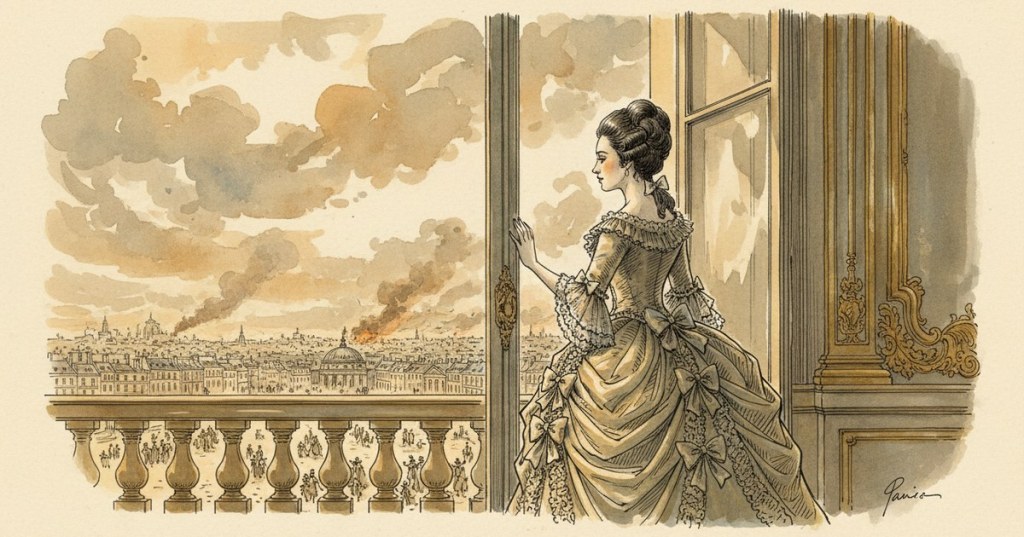
    She was not interesting. That is the most devastating thing Stefan Zweig ever said about anyone — and he said it about Marie Antoinette. Not cruel, he clarifies, not stupid exactly, not even particularly vain by the standards of Versailles. Just average. A young woman of middling intelligence dropped into a gilded trap, left to fill centuries of court ritual with a personality that, under normal circumstances, would have been perfectly adequate for a comfortable provincial life. Then history came for her, and she had to become someone she was never equipped to be.

    Zweig published his biography in 1932, one year before everything collapsed. He was writing from Vienna, watching European civilization arrange itself into the posture of catastrophe. He chose a woman dismissed by historians as a frivolous footnote, a symbol of aristocratic excess, and did something radical: he refused the symbol. He gave her back her ordinariness. Her terror. Her slow, agonizing growth into someone almost equal to what history demanded of her. It is one of the most quietly devastating arguments in twentieth-century biography — that mediocrity, under enough pressure, can crack open into something approaching greatness. That the person who survives the guillotine’s shadow is never the person who walked into it.

    The Man Who Understood Catastrophe Before It Arrived

    Stefan Zweig was born in Vienna in 1881, into the last golden age of European Jewish intellectual life — a world so refined, so certain of its own permanence, that it could not imagine its own destruction. He became the most translated German-language author of the 1930s. Not because he was the most experimental or the most politically urgent, but because he understood psychology the way a surgeon understands anatomy: with precision, without sentimentality, and with a deep respect for how much damage a human body can absorb before it fails.

    He was also a man living on borrowed time, though he didn’t fully know it yet in 1932. He’d been watching the signs — the street violence in Germany, the rising pitch of nationalist rhetoric, the particular way his books were being talked about in certain newspapers. When the Nazis came to power in 1933, they burned his work in the public squares. He left Austria, then England, then eventually Brazil, carrying his archive in his hands and his past in his head. In 1942, in Petrópolis, he and his wife took their lives together. He left a note that said he lacked the strength to start over again. He was sixty years old.

    This is not incidental to reading the Marie Antoinette biography. Zweig wrote it as a man who already understood what it meant to watch a world end — to be on the wrong side of history’s turning, to feel the ground shift under a life built on assumptions of civilization and permanence. When he describes the young dauphine arriving at Versailles, dazzled and shallow, filling her days with fashion and gambling and avoiding the marital bed of a husband who disgusted her, he is not mocking her. He is watching her. Waiting for the moment — and there is a moment, rendered with extraordinary care — when she stops being a symbol and becomes a person.

    What the Biography Actually Does

    Most books about Marie Antoinette are really books about the Revolution, with her as the ornament that justified its violence. Zweig pulls off something harder: he makes the Revolution the backdrop and Marie Antoinette the argument. His central claim is that she only became herself — courageous, dignified, genuinely regal — in the years after she had lost everything. It was not queenship that made her. It was the loss of it. The woman who walked to the scaffold in October 1793, thin and white-haired at thirty-seven, having watched her husband beheaded, her children taken, her friends executed one by one, was not the same creature who had danced at Versailles until four in the morning while France starved. That creature had been burned away. What remained was something Zweig finds genuinely admirable — and genuinely tragic, because it arrived too late to save her, and because it required the destruction of everything she loved to produce it.

    The book moves like a novel. Zweig was a fiction writer by instinct, and he never quite abandons the tools — the scene-setting, the interior monologue, the slow build of dread. He gives you the particular horror of the Temple prison: the darkness, the cold, the sound of Revolutionary guards playing cards through the wall while her children sleep. He gives you the trial, where she answered accusations of incest against her son with a line so controlled, so devastating in its maternal dignity, that even the hostile crowd went briefly silent. He earns that scene. By the time you reach it, you have been living with this woman for four hundred pages, and you feel the cost of her composure the way you feel a physical thing.

    Why This Translation, Why This Edition

    Zweig’s prose is famously difficult to translate well. It moves in long, complex sentences that build pressure gradually, releasing it in a single precisely placed phrase — a rhythm that flatfooted renderings turn into bureaucratic sludge. This new paperback edition uses a translation that restores Zweig’s musicality without sacrificing his clarity, catching the particular quality of his irony: dry, never unkind, always in service of understanding rather than judgment. The edition is clean and reader-friendly, stripped of the academic apparatus that can make biography feel like homework, and it includes a brief but genuinely useful introduction that situates Zweig’s own biography alongside his subject’s without turning the prefatory material into the main event. This is the edition to press into someone’s hands.

    Read it because the world keeps producing moments that require ordinary people to become something they were never prepared to be. Read it because Zweig wrote it knowing that, and because he knew — the way only a man watching catastrophe approach from a fixed position can know — that history does not wait for you to be ready. Marie Antoinette wasn’t ready. She became ready anyway, in the ruins of everything else. Zweig understood that. He had to.

    Marie Antoinette: The Portrait of an Average Woman: A New Translation

    Marie Antoinette: The Portrait of an Average Woman: A New Translation

    by Stefan Zweig

    Buy Paperback

    More from Stefan Zweig

    The Stefan Zweig Collection - Volume 1: A New Translation
    The Stefan Zweig Collection - Volume 2: A New Translation
    The Stefan Zweig Collection - Volume 3: A New Translation
    Magellan: Conqueror of the Seas: A New Translation
    The Stefan Zweig Collection - Volume 4: A New Translation
    Twenty-Four Hours In The Life Of A Woman: A New Translation
    The Stefan Zweig Collection - Volume 5: A New Translation
    Balzac: A Biography: New Translation

    This post contains affiliate links. As an Amazon Associate, we earn from qualifying purchases.
  • The Three Musketeers Is Not What You Think It Is

    The Three Musketeers Is Not What You Think It Is

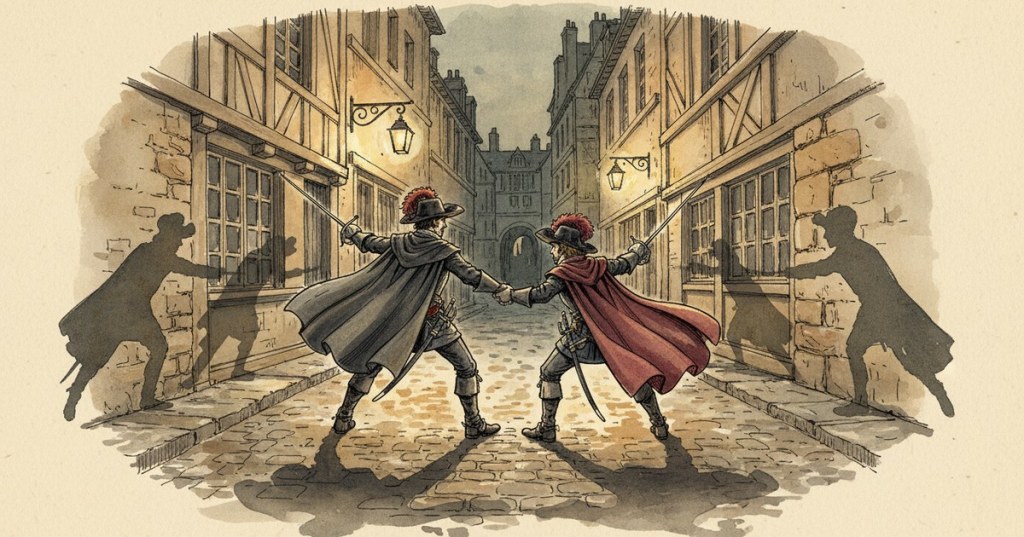
    There is a moment, somewhere in the first fifty pages of The Three Musketeers, when a young Gascon with an ugly horse and an uglier temper manages to schedule three separate duels with three separate men before noon on the same day — and then discovers that all three are friends. Any other writer would have turned this into a disaster. Dumas turns it into the founding of a brotherhood. That whiplash — catastrophe becoming camaraderie in a single paragraph — is the whole engine of the book, and nobody has ever done it better.

    We think we know this story. The films have made sure of that: swashbuckling, capes, a few sword fights, Porthos being loud. But the novel is something stranger and more furious than any of its adaptations have admitted. It is a book about loyalty tested to breaking point, about political power and who it actually crushes, about a woman (Milady de Winter) who is easily the most dangerous intelligence in France — and who the heroes ultimately murder for it. If you came to The Three Musketeers through Hollywood, you have been lied to, pleasantly, for years. The real thing is wilder, darker, funnier, and more morally uncomfortable than any movie had the nerve to show you.

    The question is whether you can get to the real thing. Most English translations have stood between you and Dumas like a well-meaning chaperone — correct, a little stiff, quietly draining the energy from a prose style that in the original runs like a man late for a duel. This new translation is the argument that you don’t have to settle for that anymore.

    The Man Who Wrote Faster Than History Could Keep Up

    Alexandre Dumas was born in 1802 in Villers-Cotterêts, a provincial town north of Paris, the son of a general and the grandson of a Haitian enslaved woman named Marie-Cessette Dumas, whose surname his father took. That lineage mattered — it shaped how Dumas was received, dismissed, and eventually written out of the literary canon that his contemporaries grudgingly admitted he dominated. He arrived in Paris at twenty with almost nothing: a letter of introduction, a gift for penmanship, and an appetite for theatre, history, and argument that never once dimmed.

    He taught himself to write by reading everything. He crashed the Romantic movement just as it was cresting, watched Victor Hugo storm the Comédie-Française with Hernani, and understood immediately what the age wanted: drama, sensation, color, speed. His plays made him famous first. Then, in 1844, two things happened almost simultaneously: The Three Musketeers began its serialization in Le Siècle, and The Count of Monte Cristo began in Journal des Débats. Within twelve months, he had written two of the most-read novels in the history of French literature. He was doing it, by his own account, while running a salon, directing a theatre, entertaining half of Paris, and spending money at a rate that alarmed everyone who watched.

    He worked with collaborators — Auguste Maquet most famously on the Musketeers novels — and this has been used against him ever since, as though collaboration were a form of cheating rather than the normal condition of serialized popular fiction in the 1840s. What Maquet provided was historical scaffolding: the research, the period detail, the document in the Bibliothèque nationale that seeded the idea. What Dumas provided was everything else: the dialogue, the pace, the characters who leap off the page still breathing. No one reading Athos’s scene with Milady at the inn — arguably the most quietly devastating confrontation in the entire novel — has ever wondered who actually wrote it.

    Four Men, One Impossible Standard of Friendship

    The Three Musketeers does something that very few adventure novels have ever managed: it makes you believe in the friendship before it earns it. D’Artagnan arrives in Paris broke and ridiculous, and within two chapters he is fighting alongside men he met hours ago as though they have known each other for a decade. It should feel false. It doesn’t, because Dumas understands that some alliances are legible the moment they form — that certain people recognize each other instantly, and that recognition is its own kind of intimacy. The book is, underneath everything else, a study in what it means to be the kind of person others will run toward trouble alongside.

    But Dumas is too honest a novelist to leave it there. Each musketeer carries a private grief that the camaraderie doesn’t cure — only, occasionally, lightens. Athos drinks because of a wound so old he can barely name it. Aramis wants God and keeps choosing pleasure instead, with a scholar’s ability to justify anything. Porthos wants status with the same naked hunger he’d be mortified to admit. These are not decorative character details. They are the load-bearing walls. And when Milady de Winter enters the novel — cool, brilliant, and catastrophically wronged by the very men the book is asking you to cheer for — Dumas quietly places a crack in the foundation that he never quite bothers to repair. He doesn’t want it repaired. He wants you to feel it.

    Why This Translation, and Why Now

    Every generation of readers deserves a Three Musketeers that doesn’t make them work against the prose to get to the story. Older English versions — some of them produced in the Victorian era by translators who treated Dumas’s propulsive rhythm as something to be calmed down — have given generations of readers an experience closer to a museum diorama than to a novel. The language sits behind glass. This new translation removes the glass. The dialogue runs fast and natural. The action sequences have the kinetic clarity they have in French — you always know where everyone’s sword is. And the novel’s considerable humor, which is often the first casualty of a cautious translation, arrives intact: dry, sudden, and perfectly placed.

    The paperback edition includes a translator’s note and a short historical preface that locates the novel in its actual moment — Louis XIII’s France, Richelieu’s shadow over everything, a kingdom that ran on patronage and whispered favors — without turning the book into homework. You get enough context to understand the stakes. Then you get out of the way and let Dumas run. That is, ultimately, the only correct approach to this novel. It has been making readers miss sleep for a hundred and eighty years. This translation earns its place in that lineage.

    Somewhere in the second half of this book, d’Artagnan will do something that costs him more than he bargained for, and the four men will end up on the wrong side of a wall at dawn, with enemies on three sides and an argument about honor that could only happen between people who have staked everything on each other. You will not want to put it down. The eighteenth century read it that way. The nineteenth did too. There is no good reason for the twenty-first to be any different.

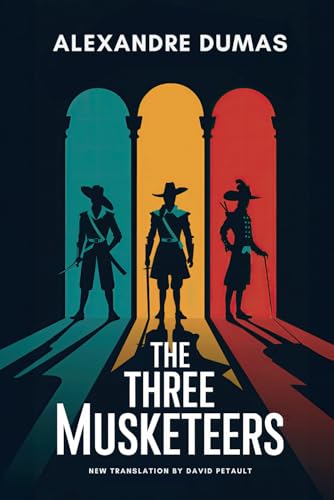
    The Three Musketeers : A New Translation in Modern Accessible English

    The Three Musketeers : A New Translation in Modern Accessible English

    by Alexandre Dumas

    Buy Paperback

    More from Alexandre Dumas

    Twenty Years After (The Three Musketeers Sequel) : A New Translation in Modern Accessible English
    The Black Tulip: A New Translation
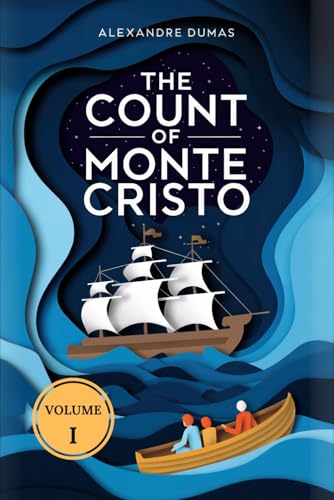
    The Count of Monte Cristo (Volume 1): A New Translation
    The Count of Monte Cristo (Volume 3): A New Translation
    The Count of Monte Cristo (Volume 2): A New Translation
    Queen Margot - Book 1: A New Translation
    The Mohicans of Paris - Book 1: A New Translation
    The Count of Monte Cristo (Volume 4): A New Translation

    This post contains affiliate links. As an Amazon Associate, we earn from qualifying purchases.

  • Stefan Zweig Saw the War Coming. Nobody Listened.

    Stefan Zweig Saw the War Coming. Nobody Listened.

    There is a moment in Stefan Zweig’s novella Burning Secret when a twelve-year-old boy realizes, with sudden, cold clarity, that adults lie. Not the comfortable lies of protection — the structural lies adults tell to protect the architecture of their own desires. He doesn’t cry. He just looks at his mother and sees her, maybe for the first time, as a person capable of betrayal. Zweig gives you that moment in a single paragraph. You feel it the way you feel a door closing in another room.
    That is the Zweig trick, and it is not a trick at all. It is a form of surgical empathy so precise that it reads, a century later, less like literature and more like testimony. The Stefan Zweig Collection: Volume 2 gathers eight of his finest stories and novellas — work spanning the years when Europe was still dreaming and the years when it had begun, slowly, to drown. To read them now is to understand something that has nothing to do with the past and everything to do with the present: that the most violent thing that can happen to a human being is not war, not exile, not poverty, but the sudden, irreversible recognition of who they actually are.

    The Man Who Watched Europe Die

    Stefan Zweig was born in Vienna in 1881, which is to say he was born at the exact center of the world as it then understood itself. Habsburg Vienna was the cultural capital of a continent that believed, with some justification, that it was civilization’s highest achievement. Zweig grew up inside that belief. He befriended Rodin, corresponded with Freud, knew Romain Rolland and Richard Strauss. He was, by thirty, one of the most translated authors in the world — more widely read than Thomas Mann, more loved than Schnitzler. The world he was born into was, as he would later write, “a world of security.”
    He watched it come apart with the particular horror of a man who had loved it completely. The First World War broke something in him. The Second broke everything. In 1934, when the Nazis entered Austria, Zweig left. He left again when England became unbearable. He left again to New York, then to Brazil, where he and his wife Lotte arrived in Petrópolis in 1940 — a tropical city of flowers and parrots, as far from Vienna as geography allows. He had been working on his memoir, The World of Yesterday, a book written in the full knowledge that yesterday was gone and would not return. On February 22, 1942, he finished the manuscript, posted it, and the next morning he and Lotte were found dead. He was sixty years old. They had taken barbiturates, together, in what authorities called a “voluntary death” — his phrase, which he had placed in a brief letter left on his desk.

    The letter said, in part: “I think it better to conclude in good time and in erect bearing a life in which intellectual labour meant the purest joy and personal freedom the highest good on Earth.” There is a debate, still, about whether this was despair or philosophy. Perhaps it was neither. Perhaps it was simply the last gesture of a man who had made a life out of understanding other people and had, finally, understood himself too well.

    Eight Stories That Know Too Much

    What the stories in this collection share — across their wildly different settings, from Austrian spas to Viennese drawing rooms to the casinos of Monte Carlo — is a quality of knowing. Zweig’s narrators and characters are always, always on the verge of understanding something they cannot unfeel once understood. In The Royal Game, perhaps the most formally perfect novella in the German language, a man survives solitary confinement by reconstructing an entire chess manual from memory, playing both sides of every game alone in his head until thought itself becomes his captor and his refuge. When he finally plays chess again, against a living opponent, victory is indistinguishable from madness. Zweig wrote it in exile, in 1941, the last year of his life, and it reads like a self-portrait in a mirror he refused to turn away from.

    The other stories in this volume are quieter but no less devastating. Amok follows a colonial doctor in the Dutch East Indies who has refused to help a woman in desperation and then cannot escape what his refusal cost her — and him. Letter from an Unknown Woman, arguably Zweig’s most famous story, is a document of love so pure and so completely invisible to its object that it becomes, by the final page, something that makes “tragedy” feel like the wrong word. The unnamed woman has loved a writer her entire life. He has never once remembered her name. She knows this. She tells him, in the letter she writes as she is dying. She forgives him, which is somehow the worst part. What Zweig understands — what makes him so necessary — is that the great cruelties of private life are usually committed by people who are not paying attention.

    Why This Translation

    Translating Zweig is not a technical problem. His sentences are accessible, his plots clean, his vocabulary unshowy. The problem is tonal — he writes in a register that hovers between clinical precision and naked feeling, and a translation that tips too far toward either becomes a different book entirely. The translations in this paperback edition manage, with considerable skill, to hold that line. The prose breathes. The devastating moments land without being telegraphed. Crucially, the pacing — Zweig’s great underrated tool, the way he slows time to a crawl inside the moment of recognition — survives intact. This is a collection you can hand to someone who has never read Zweig and be confident they will understand, by the last page of the first story, why he was once the most widely read author alive. They will also understand, perhaps uncomfortably, why he had to be rediscovered. The world he described — a world in which private feeling collides with social performance and private feeling loses — is not a historical curiosity. It is the condition of reading this sentence right now.

    Pick it up. Read the first page of The Royal Game. Then try to put it down.

    The Stefan Zweig Collection - Volume 2: A New Translation

    The Stefan Zweig Collection – Volume 2: A New Translation

    by Stefan Zweig

    Buy Paperback

    More from Stefan Zweig

    The Stefan Zweig Collection - Volume 1: A New Translation
    Marie Antoinette: The Portrait of an Average Woman: A New Translation
    The Stefan Zweig Collection - Volume 3: A New Translation
    Magellan: Conqueror of the Seas: A New Translation
    The Stefan Zweig Collection - Volume 4: A New Translation
    Twenty-Four Hours In The Life Of A Woman: A New Translation
    The Stefan Zweig Collection - Volume 5: A New Translation
    Balzac: A Biography: New Translation

    This post contains affiliate links. As an Amazon Associate, we earn from qualifying purchases.