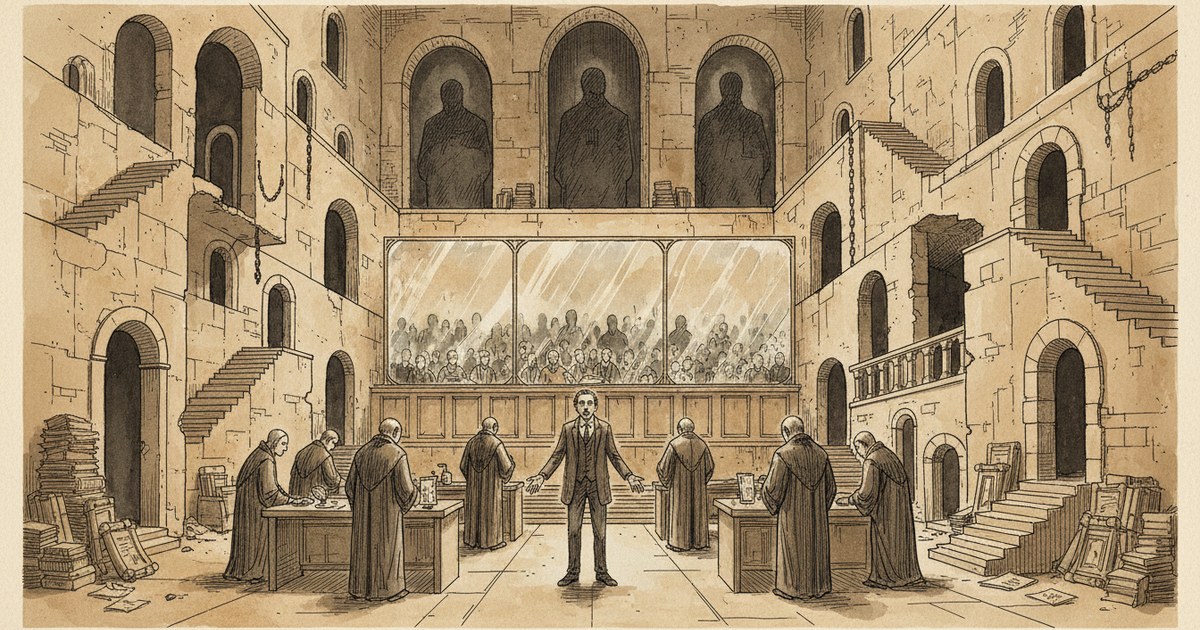
On the morning of his thirty-first birthday, Josef K. is arrested by two men who eat his breakfast and cannot tell him what he’s charged with. He is not taken anywhere. He goes to work. He comes home. The trial, whatever it is, proceeds without him—or rather, it proceeds through him, feeding on his attempts to stop it. Kafka wrote that opening scene in a single night in August 1914, six weeks after the assassination in Sarajevo and three days after Germany declared war on Russia. He was also, that same week, breaking off his engagement to Felice Bauer for the first time.
The conjunction matters. The Trial is not about bureaucracy in the abstract. It’s about the specific horror of a man who believes, somewhere beneath his panic, that the charge against him might be real—and who cannot ask what it is because naming it would confirm it. Every procedural absurdity K. encounters, every painter and lawyer and cathedral priest who offers to help, is an escape route that leads deeper in. Kafka understood that mechanism from the inside. He had spent years in it.
What he finished in those months of 1914 and 1915—he never declared the novel done, left chapters in a drawer, told Max Brod to burn everything—was not a political allegory but something closer to a portrait of guilt that has outrun its cause. Josef K. doesn’t know what he did. Neither do we. That is not a mystery to solve. It is the condition of the book.
The novel’s unfinished state is itself part of the argument. Kafka left at least two chapters in incomplete drafts and never settled on their placement in the sequence. When Max Brod assembled the manuscript for publication in 1925, he was making editorial decisions Kafka had never sanctioned, about which scenes belonged, in what order, with what weight. The Trial we read is partly Brod’s construction—which means the book about a man who never fully understands the proceedings against him reaches us through proceedings its author never fully authorized. That irony is either accidental or too perfect to be accidental, and either way it belongs to the novel.
The Man Who Administered His Own Sentence
Kafka spent eleven years as a senior claims officer at the Workers’ Accident Insurance Institute in Prague, assessing industrial injury compensation for men who had lost fingers, hands, whole limbs to machines their employers had not bothered to guard. He was good at it. He wrote meticulous reports, proposed safety reforms, understood bureaucratic machinery in the way a mechanic understands an engine—by having spent years watching it fail people. His literary reputation has often turned him into a pale, tubercular visionary isolated from the world, but the biographical record is more uncomfortable than that: he was competent and embedded, and he hated that he was.
The engagement to Felice lasted, in its fractured way, from 1912 to 1917. In his diary entries from those years, Kafka describes writing as the only thing that gave him the right to exist, and marriage as something that would extinguish writing, and the inability to choose between them as a kind of permanent verdict. When he writes, in The Trial, about a court that operates in attic rooms above ordinary apartments—that holds its sessions in buildings where families are also cooking dinner and children are doing homework—he is not imagining Kafkaesque abstraction. He is describing what it feels like to carry a proceeding inside you while the world continues its ordinary operations all around you.
He was diagnosed with tuberculosis in 1917, the year he finally broke the engagement for good. He died in 1924. He was forty. Max Brod published The Trial the following year, against explicit instructions. Whether that was friendship or betrayal is a question the novel, characteristically, refuses to answer.
Prague in 1914 adds another layer that tends to get lost in the English-language reception of the novel. Kafka was a German-speaking Jew in a Czech city that was itself inside the Austro-Hungarian Empire—three identities, none of them fully his, none of them fully comfortable. He wrote in German, worked in German, but lived among Czech speakers. He was subject to laws made in Vienna by administrators he had never met and would never see. The court that tries Josef K. has no single location, no named jurisdiction, no identifiable nationality. For Kafka that was not an invented absurdity. It was Tuesday.
What the Court Already Knows
The genius of the novel is not its surrealism—it is its precision. The court’s logic is not random; it is perfectly consistent, internally, once you accept its first premise: that accusation and guilt are the same thing. Every character K. consults confirms this premise while appearing to contest it. The painter Titorelli explains with cheerful expertise that acquittals are theoretical. The lawyer Huld explains that the most effective strategy is to avoid annoying the lower clerks. The priest in the cathedral explains that the doorkeeper in the parable was not cruel—he was only doing his job. Each explanation is coherent. Each one closes another door.
What makes the novel land, still, is that K. is not passive. He fights. He organizes. He drafts a petition. He fires his lawyer and decides to represent himself. His energy and intelligence are completely genuine, and they are completely useless, and Kafka is not cruel about this—he is something worse than cruel, he is accurate. The final chapter, where two men in frock coats arrive at K.’s apartment on the eve of his thirty-second birthday, is four pages long and written with the flat procedural clarity of an official report. K. does not resist. He has been preparing for this since the first page, and so have we, and when the knife turns, the sentence Kafka gives us is not dramatic. It is administrative. That economy is the whole argument.
The parable of the doorkeeper—”Before the Law”—deserves a moment on its own, because Kafka published it as a standalone story in 1915, while the novel sat unfinished in a drawer. A man from the country spends his entire life waiting at a door that was built only for him, and never enters. The doorkeeper never forbids him; he only implies that entry is not currently advisable. The man waits, bribes the doorkeeper, grows old, and dies at the threshold. In the cathedral scene of the novel, a priest offers K. this parable as consolation—or instruction—or warning—and then spends several pages explaining that its meaning is disputed and that all interpretations are equally valid. Kafka embeds the parable, then immediately demonstrates that even the parable cannot be read without the court’s interference. There is no outside text. There is no vantage point from which the system looks comprehensible.
The Architecture of Dread: How the Novel Is Built
One of the things that gets missed in summary is how strange the novel’s structure actually is. It does not build toward revelation in the way a thriller does, or collapse inward in the way a tragedy does. It accumulates. Each chapter introduces a new figure—the washerwoman, the flogger in the lumber room, the manufacturer, the painter—who seems to represent a new avenue of escape or understanding, and each chapter ends with that avenue quietly sealed. The lumber room scene is the most startling example: K. opens a door at his bank and finds, in a storage space he walks past every day, the two guards who arrested him being flogged by a man in leather. He shuts the door. He comes back the next evening and opens it again. They are still there, in the same positions, still being flogged, as though nothing has moved. The scene has no resolution because the novel is not interested in resolution. It is interested in the door you keep opening even when you know what’s behind it.
This structural logic—repetition without progress, motion without direction—is what gives The Trial its particular texture of dread. It does not feel like suspense because suspense implies that something might yet be resolved. It feels like recognition: the slow accumulation of evidence that you already knew this was how it would go.
Why This Translation (translated by David Petault)
Kafka’s German is not ornate. It is the language of forms and memos—precise, impersonal, faintly polite—turned toward material that strips politeness to its skeleton. A translation that reaches for elegance misses the point; one that flattens into plainness loses the constant, quiet pressure of a bureaucratic register being used to describe a man’s destruction. The translation we recommend holds that tension. The sentences read the way official correspondence reads when you know it contains something terrible: smooth on the surface, load-bearing underneath. If you have not read The Trial in English before, or if you read it in a version that felt distant or dated, this is the edition to go back with. Find it here: The Trial: A New Translation.
The older Muir translation, which dominated the English-language reading of Kafka for decades, has real virtues—it was made by people who knew Kafka’s circle and cared deeply about his work—but it was also made in the 1930s, and it shows. Certain words that carried precise bureaucratic weight in Kafka’s German got rendered into English equivalents that have since drifted in meaning, or that carried literary connotations Kafka was deliberately avoiding. The modern English edition featured here strips those accretions away. When K. receives a summons, it reads like a summons. When an official speaks to him with impeccable courtesy about something monstrous, the courtesy lands the way it should: not as warmth, but as the most unsettling thing in the room.
The court, the novel insists, was always already in session. You were just the last to know.
Also worth reading
Further reading: More books by Franz Kafka · Explore German Literature
Frequently Asked Questions
What is the best English translation of The Trial by Franz Kafka?
The translation we recommend on this page is the modern English edition linked above, which preserves Kafka’s precise, bureaucratic register without the archaic phrasing that makes older versions feel dated. The Muir translation held the field for decades and remains historically significant, but its 1930s English has drifted far enough from current usage that it creates a distance Kafka never intended—his German was contemporary and clipped, not literary and elevated. For a first read or a reread, the modern edition featured here is the cleaner entry point.
Is The Trial worth reading in 2026?
More than ever. Kafka wrote about a man prosecuted by a system that never explains its charges, and that premise has only grown more relevant in an era of algorithmic decisions, opaque institutions, and bureaucratic dead ends that defy appeal. The Trial resonates in 2026 not as historical curiosity but as a diagnostic tool — a novel that names something most people feel but struggle to articulate.
How does The Trial compare to The Castle by Kafka?
Both novels trap their protagonists in systems designed to frustrate, but the emotional texture differs significantly. The Trial moves with the urgency of a legal proceeding spiraling toward an unknown verdict — it is tighter, more propulsive, and more claustrophobic. The Castle is slower and more expansive, following a land surveyor who can never quite reach the authority he seeks. Readers who find The Trial gripping often describe The Castle as its philosophical counterpart: same machinery, longer rope.
What should I read after The Trial by Kafka?
The Stefan Zweig Collection — available in two volumes of new translations at classicsretold.com — is the natural next step. Zweig was Kafka’s contemporary, writing in the same Central European literary tradition, and shares Kafka’s interest in psychological pressure and institutional dread. Volume 1 introduces Zweig’s novellas and stories at their most concentrated; Volume 2 extends that range. Together they offer a fuller portrait of the era that produced The Trial.
Did Kafka finish writing The Trial?
No. Kafka wrote the novel intensively between August 1914 and January 1915 but never declared it complete, leaving several chapters in draft form and the chapter sequence unresolved. When he died in 1924 he left instructions for Max Brod to destroy all his unpublished work; Brod ignored those instructions and assembled the manuscript for publication in 1925, making editorial choices about chapter order and inclusion that Kafka had never sanctioned. The novel we read today is partly Brod’s construction—a fact that sits uncomfortably alongside a story about proceedings that never fully disclose their own logic.
What does “Before the Law” mean in The Trial?
“Before the Law” is a parable Kafka published as a standalone story in 1915 and also embedded in the cathedral chapter of The Trial, where a priest recites it to Josef K. as a kind of instruction. A man from the country spends his entire life waiting at a door built only for him, discouraged from entering by a doorkeeper who never explicitly forbids it, and dies at the threshold without ever passing through. Kafka then uses the following pages to show the priest and K. disputing what the parable means—whether the doorkeeper was deceiving the man, whether the man deceived himself, whether any reading is more valid than another—without resolution. The parable is not an explanation of the novel. It is a demonstration that explanations do not help.
You might also enjoy



This post contains affiliate links. As an Amazon Associate, we earn from qualifying purchases.
Leave a Reply