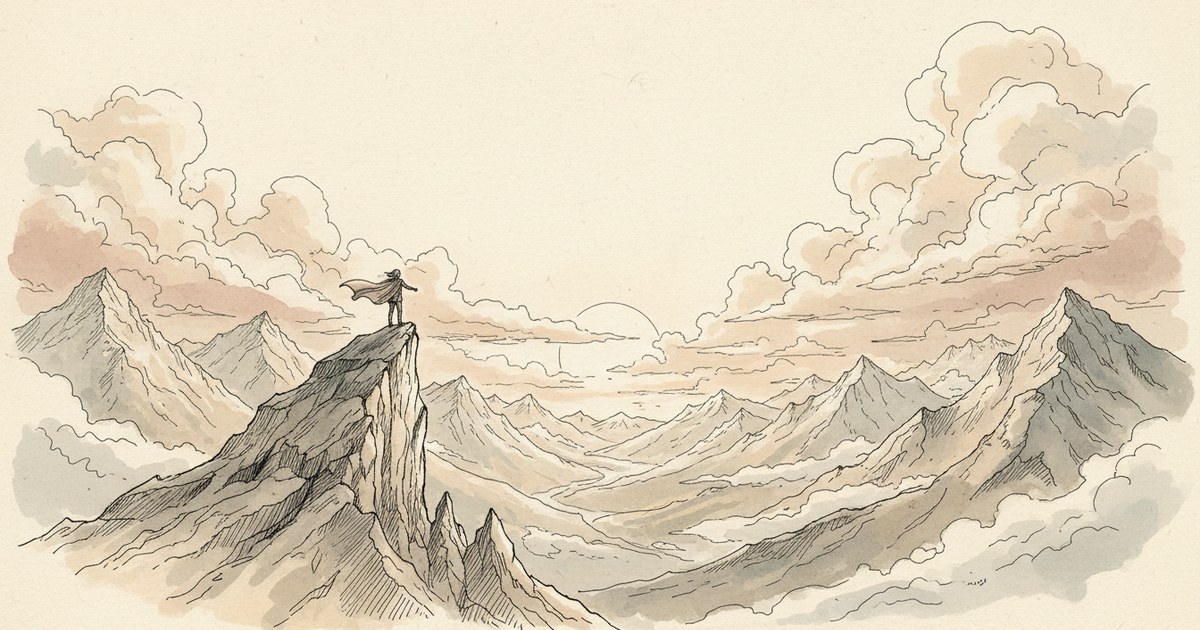
In the autumn of 1882, Friedrich Nietzsche sat in a boarding house in Genoa, watching the Mediterranean light fail, and began drafting the speech a madman gives in a marketplace. The madman has a lantern. It is midday. He is looking for God. “We have killed him,” the madman says to the crowd that is laughing at him—”you and I.” Then he asks the question that stops the laughter cold: “What festivals of atonement, what sacred games shall we have to invent?”
That scene—from The Gay Science, which preceded Thus Spoke Zarathustra—is where the argument begins, and Nietzsche never let it end. The death of God was not a theological position. It was a diagnosis: Western civilization had built its entire architecture of meaning on a foundation it could no longer defend, and the building was still standing only because no one had told the inhabitants. Thus Spoke Zarathustra is what Nietzsche wrote next. It is not an answer. It is the question asked at full volume, in the form of a prophet who comes down from his mountain to find that humanity is not ready to hear him.
Zarathustra speaks. The crowd listens politely and asks for a tightrope walker. Nietzsche understood this was the likeliest outcome.
The Philosopher Who Diagnosed His Own Century
He was born in 1844 in Röcken, a small Prussian village, the son of a Lutheran pastor who died of brain disease when Friedrich was four. That biographical fact is not incidental. Nietzsche grew up in a house where faith was the atmosphere, then watched it removed. He became a child prodigy, a professor of classical philology at Basel at twenty-four—the youngest ever appointed—before the migraine attacks and the eye problems and the nausea made sustained academic work impossible. By his mid-thirties he had resigned his professorship, lost the friendship of Wagner over what he called Wagner’s capitulation to Christianity and German nationalism, and was writing books that sold fewer than two hundred copies. He was, in the specific way of the nineteenth century, a man who had arrived too early at a conclusion everyone would eventually have to face.
What his biography explains about Zarathustra is its loneliness—not as a mood, but as a structural argument. Zarathustra keeps returning to his cave. He gives his wisdom to crowds and they miss it. He finds disciples and sends them away because he wants followers who will surpass him, not worship him. The book’s most famous concept, the Übermensch—the Overman—is precisely this: not a superman in the comic-book sense, but a human being who has stopped requiring God as an excuse not to be fully, terrifyingly responsible for the meaning of their own existence. Nietzsche wrote this in the years he spent alone in Swiss and Italian boarding houses, surviving on plain food and walking through alpine terrain for hours each day because it was the only thing that relieved the headaches. The philosophy of self-overcoming was written by a man who had very little self left to spare.
He completed the fourth and final part of Zarathustra in 1885. Six years later he collapsed in Turin, found embracing the neck of a horse that had been whipped in the street. He spent the last eleven years of his life in mental silence, cared for by his sister—who would later, with catastrophic consequences, align his work with German nationalism. He never knew his books had finally found their readers. He never knew what would be done to his ideas.
The Book That Refuses to Be Summarized
Thus Spoke Zarathustra is structured like a gospel—four parts, a prophet, parables, disciples—but it behaves like a grenade thrown at every gospel that preceded it. Its central chapters include “On the Three Metamorphoses,” where Nietzsche describes the human spirit moving from camel (the beast that bears all burdens willingly) to lion (the beast that can say no) to child (the beast that can begin again, free of obligation to what came before). This is not mysticism. It is a map of a specific psychological passage: out of inherited meaning, through the violence of negation, into the terrifying freedom of self-authorship. Anyone who has spent time sitting with a commitment—to a religion, a career, a relationship, an identity—that has gone hollow knows exactly what the camel stage feels like from the inside. Nietzsche just named it.
The chapter called “On the Vision and the Riddle” contains the concept of eternal recurrence—the thought experiment that if time is infinite and matter finite, every moment must repeat, endlessly, including your worst ones—delivered as a confrontation with a dwarf on a mountain path who keeps whispering “gravity” in Zarathustra’s ear. The question eternal recurrence poses is not cosmological. It is: would you choose this life again if you had to live it forever? It is the most brutal possible test of whether you have actually made peace with the life you are living. Most readers find the chapter unexpectedly physical—there is a gate, a gateway, a serpent, a shepherd who bites the serpent’s head off, and Zarathustra laughing. It is the closest Nietzsche ever gets to writing a seizure in prose.
Why This Translation (translated by David Petault)
The problem with most English editions of Zarathustra is that they preserve the nineteenth-century formality—the “thou”s and “thee”s, the inverted syntax—in a way that creates a reverent distance from the text. That distance is exactly wrong. Nietzsche was writing in deliberate opposition to reverence. He wanted the book to feel urgent, spoken, direct. This new translation works in the idiom of contemporary English without flattening the strangeness of the original: the aphorisms still land like blows, the passages of lyric intensity still lift off the page, but the reader is not required to climb through archaic diction to reach the argument. The result is a Zarathustra that reads the way it must have felt in German—dangerous, beautiful, slightly unhinged, and alive.
You can find the paperback edition here. Nietzsche asked what festivals of atonement we would invent to replace what we had killed. We are still answering. We will be for a while.
Also worth reading
Further reading: More books by Friedrich Nietzsche · Explore German Literature
“`html
What is the best English translation of Thus Spoke Zarathustra for modern readers?
For readers approaching Nietzsche today, Thus Spoke Zarathustra: A New Translation in Modern Accessible English stands out as one of the most reader-friendly editions available. Older Victorian-era translations preserve a certain grandeur but frequently obscure meaning behind archaic diction. This modern accessible translation prioritizes clarity without sacrificing the philosophical depth or rhetorical force of Nietzsche’s original German—making it the practical first choice for anyone who wants to actually understand what Zarathustra is saying, not just admire its ornament.
Is Thus Spoke Zarathustra worth reading in 2026?
Yes, and arguably more than ever. Nietzsche’s central preoccupations in Thus Spoke Zarathustra—the death of inherited values, the will to create meaning in a disenchanted world, and the danger of herd conformity—map directly onto anxieties that define contemporary life. The book does not offer comfort; it offers a mirror. Thus Spoke Zarathustra: A New Translation in Modern Accessible English makes that confrontation available to readers who might have bounced off denser Victorian editions, which means its core provocation reaches a wider audience in 2026 than it could have a generation ago.
How does Thus Spoke Zarathustra compare to The Gay Science as an entry point into Nietzsche?
The Gay Science is where Nietzsche announces the death of God and introduces the eternal recurrence in compressed, aphoristic bursts—it is analytical and probing. Thus Spoke Zarathustra: A New Translation in Modern Accessible English is where those same ideas are dramatized, expanded into parable and prophecy. Readers who prefer argument should start with The Gay Science; readers drawn to narrative and vision will find Zarathustra more immediate. The two books are complementary rather than redundant, and reading them in sequence gives a fuller picture of Nietzsche’s thought than either provides alone.
What should I read after Thus Spoke Zarathustra?
After the sustained intensity of Nietzsche, many readers benefit from a writer who applies philosophical seriousness to human psychology at the level of individual lives rather than sweeping proclamations. Stefan Zweig is the natural next step. The Stefan Zweig Collection – Volume 1: A New Translation and Stefan Zweig Collection – Volume 2: A New Translation, both available at classicsretold.com, collect Zweig’s finest novellas—works that examine obsession, fate, and the fragility of identity with a precision that quietly echoes Nietzschean themes while remaining grounded in character and story. They are accessible, psychologically rich, and rewarding immediately after the more demanding philosophical terrain of Zarathustra.
“`
You might also enjoy



This post contains affiliate links. As an Amazon Associate, we earn from qualifying purchases.
Leave a Reply