Tag: brazilian literature

  • Dead Narrators Tell Better Stories

    Dead Narrators Tell Better Stories

    In the 1880s, two writers were doing something no one in European fiction had managed yet. One was in Lisbon. One was in Rio de Janeiro. They wrote in the same language, had never met, and arrived — through completely different lives — at the same devastating irony about the human condition. Eça de Queirós was the son of a Portuguese aristocrat who spent his career mocking the class that made him. Machado de Assis was the grandson of freed slaves who invented a new kind of prose from the margins of a society that didn’t expect him to exist at all. Between them, they invented the modern novel in Portuguese. Europe caught up eventually.

    This is the literary tradition English readers have been missing.

    There is a tradition of world literature that English readers have been missing for over a century — not because the books weren’t there, but because the translations weren’t good enough to make you care. Russian literature had its Pevear and Volokhonsky moment. German had Michael Hofmann. French has always had champions. But Portuguese and Brazilian literature kept arriving in English in versions so flat, so bureaucratically faithful to the original syntax, that readers tried one and concluded the tradition was minor. It isn’t. It may be the most underserved major literary tradition in the English-speaking world.

    The argument runs like this: Machado de Assis, writing in Rio de Janeiro in the 1880s, was doing things with narrative form that European fiction wouldn’t attempt for another fifty years. Susan Sontag called him one of the great underrated writers of world literature. Harold Bloom put him in the company of Tolstoy and Flaubert. And yet walk into any English bookshop and you will find shelves of Dostoevsky, half a shelf of Zola, and perhaps one Machado — in a translation that will almost certainly underserve him. Meanwhile, in Portugal, Eça de Queirós was writing novels of such social precision and psychological cruelty that his contemporaries called him the Portuguese Flaubert, which is accurate but undersells him. He had a satirical edge Flaubert rarely allowed himself.

    The translation gap is the actual story here. For most of the twentieth century, English readers encountered these books through versions made in an era when translation meant staying close to the original sentence structure — a policy that worked tolerably for some languages and was catastrophic for Portuguese, which produces effects in English that require a different kind of editorial courage to render. The books were available. They just weren’t readable. That has changed. The editions appearing now — from translators who understand that fidelity to the sentence is not the same as fidelity to the work — are revealing a tradition that doesn’t need to apologize to anyone.

    What makes this moment different from previous attempts to bring the tradition to English readers is partly critical mass. For the first time, you can read Machado, Eça, Pessoa, and Clarice Lispector in translations that were made by people who had absorbed not just the Portuguese language but the specific tonal registers each writer was working in. A good translation of Machado requires understanding that he is doing comedy; a good translation of Eça requires understanding that his sentences are performing class; a good translation of Pessoa requires understanding that his prose is doing something closer to music than argument. Those are different skills, and for a long time the English literary world didn’t know it needed to ask for them.

    Where to Start

    The two entry points that matter most are both Brazilian, both Machado de Assis, and both discussed in depth here:

    • Posthumous Memoirs of Brás Cubas (1881) — a dead man narrating his own life, interrupting himself to argue with the reader, skipping chapters because he feels like it, and producing one of the darkest comedies in the nineteenth-century novel. Start here if you want to understand what the tradition can do at its most radical.
    • Dom Casmurro (1899) — the novel that gave Brazil its version of the Hamlet question: did Capitu cheat? Machado lets the unreliable narrator make his case and leaves the jury permanently hung. Start here if you want the more immediately gripping entry — a novel that pulls you in as a psychological thriller before revealing itself as something much stranger.

    Both novels reward rereading in a way that very few nineteenth-century works do. The first time through, you follow the story. The second time, you watch the machinery. That combination — books that work on you differently at different speeds — is the hallmark of the tradition at its best, and it is why these two are the right door in.

    The Brazilian Thread

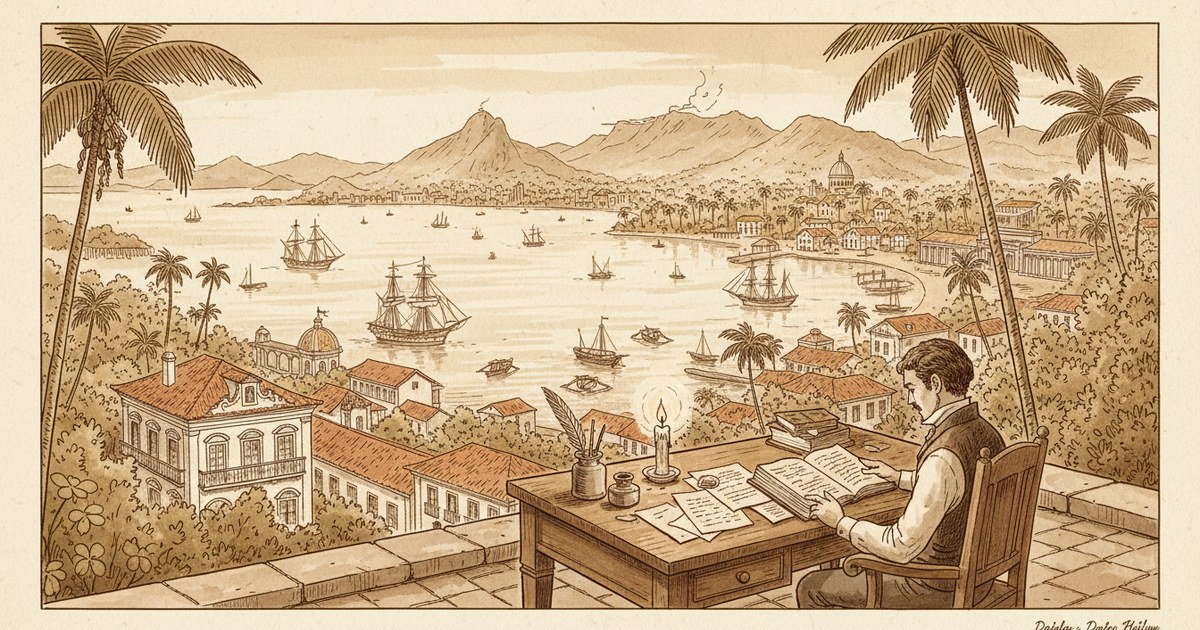
    Machado de Assis was born in 1839 in Rio de Janeiro, the grandson of freed slaves, and died in 1908 as the most celebrated writer in Brazil — a country that had not yet decided what its literature was supposed to be. He made himself the answer to that question by ignoring what the realist novel was supposed to do and building something that felt, to his Brazilian contemporaries, bewilderingly unlike anything they expected. To contemporary readers, it looks like the novel learned a hundred years too early.

    The biography matters more than it might seem. Machado was an epileptic, a stutterer, mixed-race in a society organized around racial hierarchy, and largely self-educated — he never attended university. He worked his way up through newspaper typesetting, journalism, and minor government posts, reading voraciously in French and English along the way. When he finally turned to the long form, he arrived with a reader’s eye rather than a scholar’s. He wasn’t trying to reproduce what the European novel had done. He had read too much of it to be impressed by the imitation.

    Posthumous Memoirs of Brás Cubas is the book that broke the form open. Brás Cubas is narrating from beyond the grave, which means he has nothing to protect and no reason to flatter the reader. He digresses into philosophy he doesn’t believe, addresses the reader directly to disagree with them, and organizes his chapters with contemptuous arbitrariness — one is three pages long, one is three lines, one is a row of ellipses. What he is actually describing is a life of comfortable Brazilian privilege, a love affair sustained across a marriage, a political career spent doing nothing, and a philosophy of human selfishness worked out with the care of a man who has nothing left to lose. The formal games are not decoration. They are the argument. This translation (translated by Zeno Vergueiro) renders the prose with the lightness and ironic control it requires — the jokes land, the cruelty lands, the philosophical asides don’t drag.

    The most revealing passage in Posthumous Memoirs is the one where Brás Cubas pauses to calculate his final moral accounting. He lists the debts he carried into death and the credits he accumulated, the way a man might balance a ledger. The credits include not having passed a congenital misery on to a child — because he never had children. He closes the books with satisfaction: the debits balance the credits, which means he came out ahead of everyone who did reproduce. The joke is bottomless. It is a novel about a man who did nothing, helped no one, and died congratulating himself on the precision of his own emptiness. That passage, delivered in the prose equivalent of a shrug, is Machado telling you everything you need to know about the Brazilian ruling class of the 1880s without once raising his voice.

    Dom Casmurro is the companion piece, written eighteen years later and formally more conventional — which makes it, in some ways, the more unsettling book. Bentinho, who calls himself Dom Casmurro, is telling us the story of his marriage to Capitu and the betrayal he believes she committed. The question of whether she actually committed it is Brazil’s most enduring literary argument. Machado gives the prosecution full access to the witness stand and never calls the defense. What he is actually doing — visible only after you’ve read the novel once and gone back — is showing you how a man builds a case against a woman he may have loved too desperately to let be human. It is as precise an anatomy of jealousy as anything in Othello. This translation preserves the deceptive plainness of the original — the prose that sounds like a reasonable man’s testimony until you notice what it’s leaving out.

    The famous description of Capitu’s eyes — “olhos de ressaca,” eyes like the undertow — is the novel’s most analyzed phrase, and for good reason: it is the only moment in the book where Bentinho’s language runs briefly away from him into something that sounds like awe. He catches himself immediately and resumes his measured narration. But that slip is the whole novel in miniature. The man telling the story of a betrayal cannot quite control his admiration for the woman he is accusing, and Machado gives you just enough of that uncontrolled admiration to make you wonder whether the betrayal is in the story or in the telling.

    The Portuguese Tradition

    While Machado was dismantling the realist novel from inside, Portugal had a writer building one of the great realist traditions in European fiction. Eça de Queirós was born in 1845, educated in Coimbra, posted as a diplomat to Havana and Bristol and Paris, and spent his career writing novels about Portugal with the merciless clarity of a man who had seen enough of Europe to know what his country was pretending not to be. His novels are the Portuguese entry point into the nineteenth-century conversation about how modern life was failing modern people.

    The biographical detail that colors everything Eça wrote is that he was an illegitimate child, born to parents who did not acknowledge him publicly until he was an adult. He was raised by his grandmother in a provincial village while his father — a successful civil servant — maintained a respectable life in Lisbon. When Eça eventually entered that respectable world, he entered it with the eyes of someone who had been kept outside it long enough to see its mechanisms clearly. His satirical precision about bourgeois Portuguese society is not abstract social criticism. It is a man describing the world that had a use for his father and no official use for him.

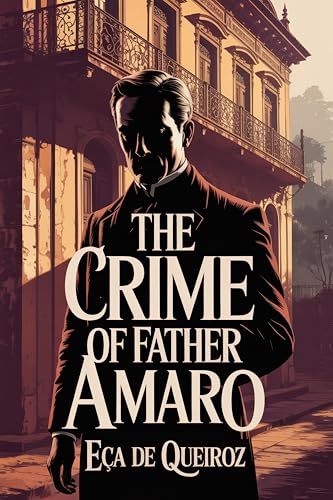
    The Crime of Father Amaro (1875) was the novel that made his reputation and nearly destroyed it. A young priest posted to a provincial town begins an affair with the daughter of his landlady — a woman herself obsessed with the Church. The scandal on publication was not that Eça depicted clerical hypocrisy but that he presented it as structural rather than personal: a system that produces exactly the behavior it officially forbids. The novel was revised twice, each version more precise and more damning.

    The scene that captures the novel’s method most precisely is not the affair itself but one of the devotional meetings held in the landlady’s parlor, where the local clergy and their female admirers gather to discuss Church matters, exchange gossip, and eat. Eça renders it with the documentary patience of a naturalist observing a species — the specific pastries consumed, the particular mix of piety and flirtation in the conversation, the way the young priest Amaro is simultaneously an object of spiritual admiration and obvious physical attention. Nothing is stated. Everything is shown. The reader understands before any of the characters do that the catastrophe is already in motion in the very rituals designed to prevent it.

    Cousin Bazilio (1878) works in tighter domestic space. Luísa is left behind in Lisbon when her husband travels, and when her cousin Bazilio returns from Paris, the affair begins with the speed of people who have been waiting for an excuse. What distinguishes the novel from other provincial-Bovary variations is what comes after: a blackmail plot executed by Luísa’s servant that is both genuinely tense and genuinely funny, and that exposes how the same social codes that condemn women’s desire are then weaponized against them by everyone below them in the hierarchy.

    The Maias (1888) is the masterwork — three generations of an aristocratic family traced through a Portugal modernizing in theory while staying exactly the same in practice. It operates at Anna Karenina scale without the religious scaffolding. Margaret Jull Costa’s translation is the one to read, and it handles the novel’s enormous social canvas without losing the comedy in the detail. It is one of the finest English translations of any Portuguese-language work.

    The central love affair of The Maias — between Carlos da Maia and a woman who eventually reveals herself to be his sister, both victims of a family history neither of them knew — works not as Gothic melodrama but as the logical terminus of a society that has kept everyone sufficiently ignorant of their own past. The incest plot is Eça’s answer to the question of what happens when a culture refuses to examine itself. The Maia family has suppressed its history so thoroughly that its children literally cannot recognize each other. That is a political argument dressed as a plot twist, and it is handled with a control that never lets the symbolism overwhelm the human grief.

    Fernando Pessoa, born in 1888, spent his adult life in Lisbon writing under heteronyms — invented poets with distinct biographies and philosophies. The Book of Disquiet, assembled from fragments after his death, is one of the great prose works of European modernism. He stands as proof that the tradition did not exhaust itself in the nineteenth century, though he is a different reading experience from Machado or Eça: less narrative, more immersive, a book you return to rather than read through.

    Pessoa’s situation was stranger than almost any writer of his era. He invented not just pen names but entire personalities — Alberto Caeiro, Ricardo Reis, Álvaro de Campos — each with a distinct poetic style, biography, and philosophical position. They reviewed each other’s work. They argued with each other in print. Pessoa maintained them simultaneously, writing as Caeiro in one mood and as Campos in another, and leaving behind a trunk containing roughly twenty-seven thousand documents when he died in 1935. The Book of Disquiet, assembled posthumously from that archive, is the closest thing to a self-portrait — written under yet another heteronym, Bernardo Soares, an assistant bookkeeper in Lisbon who spends his evenings observing the city and his interior life with equal, exhausted precision.

    The Question of Translation

    Portuguese presents translators with a specific problem. The language builds meaning through accumulation — long, clause-laden sentences that hold multiple qualifications in suspension — and the temptation for translators working phrase by phrase is to break those constructions into English declaratives that are technically accurate and tonally wrong. Machado’s irony depends on a certain syntactic elongation, a sense of the prose taking its time to deliver a verdict that turns out to be devastating. Flatten the sentence and you flatten the joke. Flatten the joke and you have a nineteenth-century novel about a dead man making observations, which sounds like exactly the kind of book you don’t need to read.

    The same problem, differently inflected, applies to Eça. His sentences carry social performance in their structure — characters who speak in elaborate subordinate clauses are marking their class, their education, their relationship to French culture. A translation that regularizes those structures into clean English prose has misread the novel. The comedy of Portuguese bourgeois life in the 1870s is partly a comedy of affectation, and affectation requires a certain syntactic excess to register.

    There is also the question of register shifts — moments when Machado drops from his elevated ironic mode into something blunt and almost brutal, or when Eça lets a peasant character’s speech cut through three pages of bourgeois posturing with a single sentence. Those shifts are doing rhetorical work that depends on the contrast being legible. If the whole translation runs at the same temperature, the moments that are supposed to land as cold water don’t land at all. The best translators of this tradition understand that their job is to reproduce the contrast, not just the content.

    The editions featured on this site take these problems seriously. The translations make choices — about sentence rhythm, about register, about where to let the prose breathe — that serve the English reader rather than the source text’s grammar. These are translations made by people who understood what the books were trying to do. That is rarer than it should be, and it is the reason this tradition is finally readable in English the way it deserves to be.

    Recommended Edition
    The Posthumous Memoirs of Brás Cubas — Machado de Assis
    Modern English translation

    Kindle →Paperback →

    Machado de Assis
    The Posthumous Memoirs of Brás Cubas: A New TranslationDom Casmurro: A New TranslationThe Posthumous Memoirs of Brás Cubas: A New TranslationDom Casmurro: A New Translation
    Eça de Queirós
    The Crime of Father Amaro: A New Translation

    Aluísio Azevedo and Brazilian Naturalism

    Aluísio Azevedo occupies a different register from Machado de Assis. Where Machado was ironic, interior, and philosophically detached, Azevedo was a naturalist in the Zola mould — interested in environment, class, and the way poverty shapes human beings from the outside in. His 1890 novel The Slum is the defining work of Brazilian naturalism and one of the most viscerally alive novels in the Portuguese language.

    The book is set in a Rio de Janeiro tenement — a cortiço, literally a beehive — and follows the competing lives of a Portuguese immigrant landlord and the hundreds crammed into his building’s rooms and courtyards. It is hot, sensory, and merciless. Azevedo does not sentimentalize poverty; he shows how it operates structurally, wearing down individual will until behaviour starts to look like destiny. If you have read Machado and found him cool and controlled, Azevedo will feel like opening a window. He is the necessary counterweight.

    • The Slum — The foundational text of Brazilian naturalism. A Rio tenement, a Portuguese landlord, and a community ground down by circumstance.

    Frequently Asked Questions

    Is Machado de Assis really considered a postmodern writer even though he died in 1908?

    The term gets applied to him retrospectively and with good reason: the self-interrupting narration, the chapters that exist only to announce they will be skipped, the narrator who directly addresses and argues with the reader — these are techniques we associate with Borges and Calvino, writers who came fifty to seventy years later. Machado didn’t label what he was doing, but Posthumous Memoirs of Brás Cubas, published in 1881, predates by decades the formal experiments that would eventually get classified as postmodern. Whether the label fits matters less than the fact that the book still feels contemporary in a way that most nineteenth-century fiction does not.

    Did Capitu actually cheat? Is there a consensus among scholars?

    There is no consensus, and Machado almost certainly intended it that way. The debate in Brazil is serious enough that it has a name — “the Capitu question” — and it has produced decades of literary criticism, a landmark 2008 TV miniseries, and arguments that are still happening in university seminars. The most persuasive readings tend to focus not on what Capitu did but on what Bentinho’s narration reveals about Bentinho: his obsessive jealousy, his tendency to interpret every ambiguity as confirmation of betrayal, and his conspicuous control over what the reader is and isn’t allowed to see. Whether Capitu was innocent or guilty, the narrator is not reliable enough to convict her.

    Where should I read Eça de Queirós if I’ve never tried him — The Maias, or one of the shorter novels first?

    Start with Cousin Bazilio if you want to ease in — it’s the tightest of his major novels, with a blackmail plot that gives it a thriller’s momentum alongside its social satire, and it runs to roughly three hundred pages rather than the six hundred of The Maias. The Crime of Father Amaro is the other natural entry point, especially if you’re interested in how nineteenth-century novelists handled institutional religion. Save The Maias for when you’ve developed an appetite for Eça’s rhythms; it rewards the investment, but it asks for patience that comes more easily once you already trust him.

    Is The Book of Disquiet a novel? How do you actually read it?

    It is not a novel, not quite a diary, and not quite a collection of essays — the most honest description is that it is a fragmentary prose record left by an invented person. Pessoa wrote the pieces that make up The Book of Disquiet across roughly two decades without ever assembling them into a final order; all existing editions are editorial constructions from the archive he left behind, which means different editions arrange the fragments differently. The practical advice: read it the way you’d read a book of poetry — not straight through in long sittings, but in short sessions, letting individual passages sit. It is a book that accumulates rather than progresses, and trying to race it will lose you the thing it’s actually doing.

    This post contains affiliate links. As an Amazon Associate, we earn from qualifying purchases.
  • Dom Casmurro Is Brazil’s Greatest Liar

    Dom Casmurro Is Brazil’s Greatest Liar

    Bento Santiago has been building his case for decades. He has written it all down, arranged the evidence, named the witnesses, described the looks and the silences and the funeral tears. By the time you reach the last page, he has almost convinced you. And then you put the book down, and you realize: you have just spent two hundred pages inside the mind of the prosecution, and the defense never got to speak.

    Dom Casmurro — published in 1899 by the Brazilian master Joaquim Maria Machado de Assis — is a perfect trap. Not a mystery, not quite a tragedy. A trap. It is built to work on every reader differently, to make some of you certain and others furious and most of you arguing about it at midnight. It has been doing this to Brazil for over a century. The country is still arguing.

    The Man Behind the Book

    Machado de Assis was not the person nineteenth-century Brazil expected to produce its greatest novel. He was born in 1839 in Rio de Janeiro, the son of a mixed-race house painter and a Portuguese washerwoman from the Azores. He grew up in poverty, was largely self-educated, suffered from epilepsy and a stammer, and worked as a typesetter’s apprentice before he taught himself French and began devouring the European literary canon. He rose through the Rio literary world on sheer force of intelligence, eventually helping to found the Brazilian Academy of Letters in 1897 — two years before Dom Casmurro appeared. He was its first president and remained so until his death in 1908.

    What makes this biography relevant to the novel is the angle of vision it produced. Machado spent his entire life watching Brazilian society from a position of both proximity and exclusion — close enough to its drawing rooms and social rituals to render them in perfect detail, distant enough to see their cruelty without sentimentality. Dom Casmurro is set among the comfortable Rio bourgeoisie: seminary educations, beach houses in Flamengo, afternoons playing piano. Machado knew that world, but he was never entirely of it. He saw what the men inside it could do to women and call it love. He wrote it down and disguised it as a love story, and then he waited for readers to notice.

    The Man in the Chair

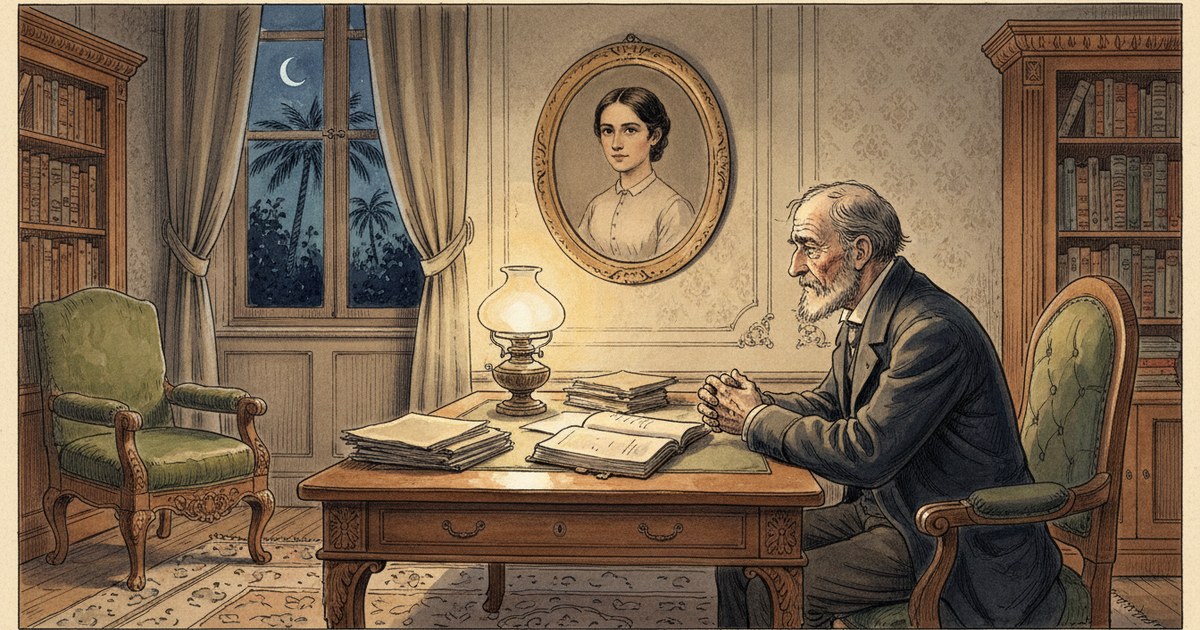
    The novel opens with an aging, bitter man who lives alone and who has given himself a nickname: Dom Casmurro. Lord Sullen. He has earned it. He tells us he is writing to fill time, to bind together the two ends of his life — the brilliant childhood in Rio de Janeiro, and the hollow present. He tells us this casually, almost apologetically. Then he begins.

    What follows is one of the most suffocating first-person narrations in literary history. Bento Santiago — Bentinho, as a boy — was sent to seminary against his will, fell in love with the neighbor girl Capitu, got out of the seminary, married her, had a son, watched his best friend Escobar drown in the sea, watched Capitu weep at Escobar’s funeral, and became convinced — convinced — that she had betrayed him with his closest friend. He sent her away. She died in exile with their son. He never spoke to her again.

    That is the story as he tells it. The question — Brazil’s great national argument, debated in newspapers and schools and bars and literary journals to this day — is whether any of it is true.

    One detail the novel plants early and quietly: Bentinho tells us he has rebuilt his childhood home, brick by brick, in exact replica — the same rooms, the same veranda, the same garden. He lives inside a reconstruction. He is a man who manufactures the past and then inhabits it and calls it memory. Machado puts this in the opening chapters almost as a throwaway. It is not a throwaway. It is the key to everything that follows.

    The Eyes That Started Everything

    Machado was not subtle about what he was doing. He told you exactly where to look.

    Capitu’s eyes appear on almost every significant page. Bentinho describes them as oblíquos e dissimulados — oblique and dissembling, gypsy-like, with a tidal pull. He returns to them obsessively, the way you return to a wound. “The eyes of the gypsy, oblique and sly,” he writes, as though the shape of her eyes is evidence of something. As though the way she looked at him could prove what happened in rooms he wasn’t in.

    Read that again. A man decides his wife is guilty, in part, because he doesn’t like the way her eyes are shaped. Machado plants this early and lets it metastasize. By the end of the novel, Bentinho’s descriptions of Capitu have accumulated into something that feels like a portrait — specific, detailed, damning — and yet every brushstroke was applied by the man who already decided the verdict before he picked up the brush.

    This is the mechanism Machado perfected. Not an unreliable narrator who lies badly, who slips up and contradicts himself in ways you can catch. A narrator who lies beautifully. Who is so precise, so specific, so apparently fair — he even grants Capitu her charms, her wit, her superiority — that you believe him in the moment and only feel uneasy later, in the silence after the chapter ends.

    There is a chapter — barely two pages long — in which young Bentinho watches Capitu scratch his name into the plaster of the garden wall. She is carving “Bento” and then “Capitu” with a nail, unhurried, as if writing a fact rather than a wish. Bentinho reads it as evidence of her love. Later readers read it as evidence of her calculation — she knew what she wanted, and she went and got it. The scene is identical in both readings. Only the verdict changes. This is the trick in miniature: Machado writes the scene and steps back, and the reader’s assumptions do the rest of the work.

    The Machine Machado Built

    Eighteen years before Dom Casmurro, Machado published Posthumous Memoirs of Brás Cubas — arguably the first great unreliable narrator in the Western novel, a dead man dictating his own flattering self-portrait from beyond the grave. With that book, Machado invented the trick. With Dom Casmurro, he perfected it, because here the stakes are real. Brás Cubas is a rogue; we find him charming even as we see through him. Bento Santiago is not charming. He is dangerous. He destroyed a woman and a child and he is asking you to agree that he had no choice.

    The machinery runs on what Bentinho doesn’t say as much as what he does. Consider the funeral scene — the emotional fulcrum of the entire novel. Escobar drowns. The mourners gather. And Bentinho watches Capitu. She cries. She cries, he decides, with too much feeling. She looks at the coffin, he decides, with an expression he recognizes. This is the moment everything breaks. Two sentences about how a woman looked at a coffin, and a marriage ends, and a woman goes into exile, and a child grows up without his father.

    What Machado does not give you — what the novel structurally cannot give you — is anyone else’s account of that moment. There is no second witness. There is only Bentinho, watching, deciding, building his case. The reader is put in the position of the jury that has only heard from the prosecutor. You can feel the claustrophobia of it: you want to lean around him and look at Capitu’s face yourself, and you cannot. He is always in the way.

    The chapter structure sharpens the knife further. Dom Casmurro is broken into 148 short chapters, some barely a paragraph long, each with an ironic or deflecting title. A chapter about jealousy is called “A Tip from Iago.” A chapter about Capitu’s eyes is called “Eyes Like the Tide.” The titles function like editorial commentary — not Machado’s, but Bentinho’s, a man so in control of the narrative that he can even name his own chapters with a wink. This is a man who has told this story to himself so many times that he has developed a style for it. That should terrify you.

    The Company He Keeps

    Critics reach for Shakespeare when they write about this novel, and the comparison holds. Othello also destroyed a wife on the testimony of a man with every reason to lie. Hamlet also lived inside a mind so active, so persuasive, so allergic to stillness that certainty became impossible. But Machado’s move is different from Shakespeare’s in one crucial way: in Othello, we see Iago. We know the lie at the source. In Dom Casmurro, there is no Iago. The source of the lie — if it is a lie — is Bentinho himself, and he doesn’t know it. Or he does know it, and he has written this entire book to convince himself otherwise. Or there is no lie. Or there is. Machado leaves you there, on that edge, and does not reach out a hand.

    What makes the novel feel modern — shockingly, vertiginously modern — is that it anticipates everything we now know about how memory works, how jealousy distorts perception, how the stories we tell ourselves about the people who hurt us harden over time into something that feels like fact. Bentinho is not a villain in the nineteenth-century sense. He is a man who wanted a particular story to be true, who had decades to refine it, and who finally wrote it down and called it autobiography.

    Capitu herself is the most fully alive character in the book, which is extraordinary given that she never speaks for herself. Everything we know about her comes through Bentinho’s filter. And yet she comes through. Her intelligence, her calculated charm, her genuine love for Bentinho — or her performance of it, depending on which reading you bring — all of it survives his narration. That is either because Machado was careful to let her breathe despite the frame, or because Bentinho’s portrait is more honest than he intends. The reader decides. The reader always decides.

    The question “did Capitu cheat?” is a national argument in Brazil in a way that has no real equivalent in English literary culture. There are literary societies devoted to it. Brazilian school children are assigned a position and told to defend it. The novel does not just sustain this — it generates it. Each reading produces a slightly different Capitu and a slightly different Bentinho and therefore a slightly different verdict. What you decide about Capitu tells you something about how much you trust narrators, how much you listen for the voice of the woman the story isn’t about.

    The writer who deserves mention alongside Machado here is Henry James, whose The Turn of the Screw appeared just one year before Dom Casmurro and deploys a structurally similar ambiguity — a narrator whose psychology may be generating the very horrors she reports. James was celebrated across the Atlantic for exactly this trick. Machado, writing in Portuguese in South America, was doing something more sophisticated and received almost none of the same international attention for another fifty years. The literary world’s slowness to find him says more about the world than about the work.

    The Translation Question

    Any novel this dependent on narrative voice lives or dies in translation by whether the translator hears the right note in the original and can reproduce it in English. Bentinho’s prose is not ornate. It is controlled, smooth, occasionally ironic in a way that never announces itself — the irony sits just below the surface, and you feel it rather than see it. Translations that make Bentinho too stiff produce a Victorian melodrama. Translations that make him too casual produce a modern confession. The target is narrower than it looks: a man who is cultured, precise, slightly cold, and absolutely certain he is being fair.

    The edition we recommend catches this register. The prose reads with the intimacy of someone telling you a story over a long dinner — measured, never rushed, occasionally pausing to make a small joke at its own expense. That self-deprecating quality is crucial: Bentinho is charming enough that you want to believe him, and the translation preserves that danger. Earlier English versions — including the 1953 Helen Caldwell translation that first cracked open the “unreliable narrator” reading for English-language scholars — did essential critical work, but the prose now carries its age. This modern English edition puts the novel’s full seductive machinery in working order for a contemporary reader encountering it for the first time.

    Why It Matters Now

    There is one more reason Dom Casmurro keeps finding new readers, and it is not a comfortable one. The novel is, at its structural core, a story about a powerful man destroying a less powerful woman and writing the history afterward. Bentinho controls the record. Capitu has no access to it. Whatever actually happened between them in that marriage — whatever she felt, whatever she suffered, whatever her version of the funeral scene might have looked like — none of it exists. The only account we have is his. He got to write it. She did not.

    That asymmetry is not incidental to the novel. It is the novel. Machado, writing in 1899, understood something about how stories work in societies where certain people control the telling and others do not. The book was ahead of its time in ways that keep becoming clearer. Every generation of readers brings a slightly different set of questions about testimony and power and who gets to be believed, and the novel absorbs all of them without strain. It was designed for exactly this: to be more troubling the more carefully you read it, and to keep being more troubling the further history moves.

    The translation we recommend brings the novel’s voice into the sharpest focus it has ever had in English — the cool, slightly malevolent intimacy of Bentinho’s prose, the irony Machado controls with such unshowy precision. You will not agree with everyone else about what happened. You will probably not agree with yourself if you read it twice. That is the point. That has always been the point.

    Recommended Edition
    Dom Casmurro — Machado de Assis
    Modern English translation

    Kindle →Paperback →

    Frequently Asked Questions

    Did Capitu actually cheat on Dom Casmurro?

    The novel never answers this question directly — and that is entirely intentional. Machado de Assis constructs the narrative so that the only witness is Bento Santiago himself, a man with every psychological motive to believe his wife was unfaithful. Whether Capitu cheated or whether Bentinho invented the betrayal to justify his jealousy is Brazil’s greatest literary debate, still actively argued by readers and scholars more than 125 years after publication. Both readings are supported by the text. That is the genius of the novel.

    What does “Dom Casmurro” mean?

    “Dom” is a Portuguese honorific, and “casmurro” means sullen, withdrawn, or obstinate — someone who keeps to himself and broods. The nickname is given to Bento Santiago by a neighbor poet whose verses he ignores on a train. He adopts it as his own title, which tells you something about him: he has decided who he is, he has named the verdict, and he has arranged everything around it.

    Is Dom Casmurro an unreliable narrator?

    Yes — and one of the most sophisticated in literary history. Machado had already invented the unreliable narrator in his earlier novel Posthumous Memoirs of Brás Cubas (1881). In Dom Casmurro he refined the technique: Bentinho never lies clumsily, never contradicts himself in ways you can easily catch. His narration is precise, specific, even generous toward Capitu in places — which makes it more dangerous. The unreliability is structural, not stylistic. He is the prosecution presenting the case for his own jealousy, and the defense never speaks.

    How does Dom Casmurro compare to Othello?

    The comparison is unavoidable and Machado almost certainly intended it. Both are stories of men destroyed by jealousy they may have manufactured themselves, both involve the destruction of an accused wife, and both hinge on “proof” that proves nothing. The key difference: in Othello we see Iago; we know where the poison originates. In Dom Casmurro, there is no Iago. If the story is a lie, Bentinho is lying to himself as much as to us. That ambiguity is what makes Machado’s version the more modern, and in some ways the more disturbing, of the two.

    Who was Machado de Assis, and why isn’t he more famous outside Brazil?

    Machado de Assis (1839–1908) is widely regarded as the greatest writer in the Portuguese language and one of the founding figures of literary modernism — a generation before European modernism announced itself. He was born into poverty in Rio de Janeiro, the mixed-race son of a house painter, and educated himself into becoming Brazil’s foremost man of letters. His relative obscurity outside the Portuguese-speaking world is almost entirely a consequence of language and geography: he was writing in South America in a language that commanded little international critical attention in the nineteenth century, and serious English translation of his major novels did not arrive until the 1950s. Since then his reputation has grown steadily, and the critical consensus now places Dom Casmurro and Posthumous Memoirs of Brás Cubas among the essential novels of any literary tradition.

    Should I read Posthumous Memoirs of Brás Cubas before Dom Casmurro?

    You do not need to, but reading Brás Cubas first rewards you in a specific way: you arrive at Dom Casmurro already primed to distrust a charming first-person narrator, which makes Bentinho’s smoother, more dangerous voice even more unsettling by contrast. Brás Cubas is the wilder, more experimental book — narrated by a dead man, full of chapters that are deliberately absurd — while Dom Casmurro wears the disguise of a conventional love story. Machado built the ladder with the first novel; the second novel kicks it away once you’ve climbed it.

  • The Dead Man Who Invented Postmodern Fiction

    The Dead Man Who Invented Postmodern Fiction

    Brás Cubas is already dead when he starts talking. That’s the first joke. The second is that he can’t stop. The third — and this one takes a while to land — is that he’s right about everything, and you hate him for it, and you keep reading anyway.

    The Posthumous Memoirs of Brás Cubas, published in 1881 by Joaquim Maria Machado de Assis, opens with a dedication to the first worm that gnawed on the author’s flesh. It is not being cute. This book means that. It is a novel narrated from death backward through a wasted life, and it has the audacity to be one of the funniest things written in the nineteenth century — funnier than Dickens, more structurally unhinged than anything Flaubert attempted, and more philosophically honest than almost any novel you care to name. It was also published in a slave-owning empire, by a man who rose from poverty and mixed-race obscurity to become the most important writer in the history of Brazil. These facts are not incidental. They are the whole point.

    The Structure Is the Argument

    Most novels ask you to forget you’re reading. This one refuses that contract from page one. Machado gives us chapters that are three sentences long. He gives us a chapter that is a single blank page — and titles it “Chapter LV.” He addresses you directly and with mild contempt, the way a man at a dinner party might turn to someone he’s just met and say: “You think I don’t know what you’re thinking? I do. And it’s not flattering to either of us.”

    The lineage is deliberate. Machado was reading Laurence Sterne — Tristram Shandy, the 1759 novel that broke narrative convention before it had properly formed — and absorbed the lesson completely. But where Sterne’s chaos is comedic in the way of a man who can’t stop talking, Machado’s is philosophical. The digressions aren’t digressions. They’re the structure. A life that kept interrupting itself with excuses, deflections, and brilliant rationalizations for doing nothing of consequence.

    Brás Cubas wanted to be a statesman. He wanted to invent a medicinal plaster that would make him famous. He wanted Virgília, who married someone else and then became his mistress anyway. He got some of these things, partially. He died without children, without his plaster, without his political ambitions, having never written the book he planned. And from the other side of death, he calculates — with the careful arithmetic of a man who has had eternity to think about it — that this makes him a winner. Slightly. Because at least he produced no new human beings to inherit the misery of existence.

    That’s the thesis of the book, and it arrives like a stone through a window.

    What makes the structure particularly vicious is that Brás is a gifted self-justifier. When he describes his brief, unsuccessful stint in politics — he wins a seat, accomplishes nothing, loses the seat — he writes it off in two paragraphs, not because he’s embarrassed, but because he’s decided it wasn’t worth his attention. The chapters shrink around the failures and swell around the vanities: a long account of a hat, a longer account of a slight at a party, a chapter on nothing titled “In Which I Play the Part of a Generous Man.” Machado is using chapter length as irony. The empty page is the most honest chapter in the book. It tells you exactly as much as those years contained.

    The Delirium

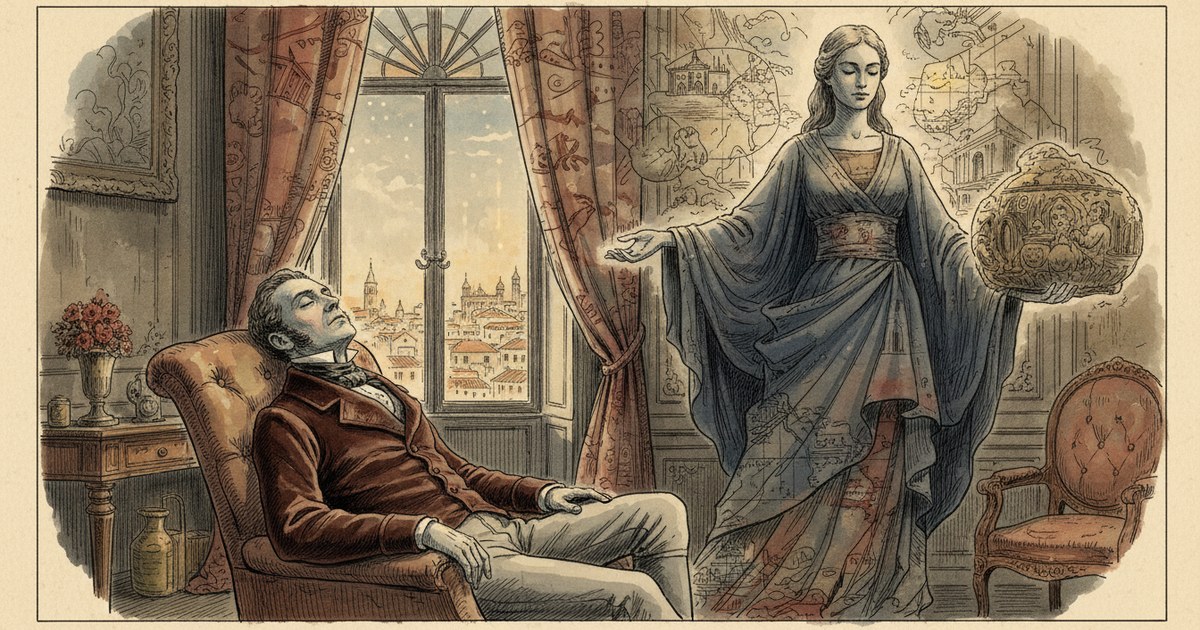
    Before you get the cold arithmetic, you get the fever dream. In Chapter VII — one of the great set pieces of nineteenth-century fiction — the dying Brás is seized by a hallucination. A figure appears: Pandora, riding a hippopotamus, carrying him through the entirety of human history. Civilizations rise and collapse, centuries of war and love and ambition compressed into a single vision. He screams at her. She is unmoved. She shows him everything, which turns out to mean: nothing you do matters in the span I contain.

    Machado writes this chapter in a register completely unlike the rest of the book — vast, almost baroque — then snaps back to Brás’s bedroom. The pettiness of the scene that follows lands harder for the contrast. This is what the novel keeps doing: expanding to cosmological scale, then collapsing to a drawing room, a mistress’s apartment, a social snub at a party. Human life is both things simultaneously: large in its suffering, small in its ambitions. Brás Cubas knows this and does nothing with the knowledge, which is also the point.

    What’s easy to miss is that Pandora doesn’t punish Brás. She doesn’t judge him. She simply shows him the full ledger of human time and lets him understand his place in it, which is: none. There is a moment in the delirium where he sees himself — just for an instant — as one of thousands of nearly identical men who lived, wanted things, and dissolved. He finds this briefly unbearable, then recovers. By Chapter VIII he is back to worrying about his reputation. This is the structure of the whole novel compressed into one scene: the truth arrives, Brás looks at it squarely, and then he moves on. Moving on is his defining talent. The reader is left holding the truth he put down.

    Humanitism, or: The Potatoes

    Partway through, Brás encounters his childhood friend Quincas Borba — a philosopher who has either achieved enlightenment or gone completely mad, and the book declines to adjudicate which. Quincas Borba has developed Humanitism: a cosmic philosophy in which Humanity is the supreme principle, individual humans are merely its instruments, and suffering is irrelevant. Its practical conclusion: “To the winner, the potatoes.”

    It’s a joke. It’s also Schopenhauer in carnival costume. The will-to-live, stripped of metaphysics, dressed as a self-help slogan. Humanitism is what ideology looks like when the ideologue is honest about what it’s actually for — which is what happens when you translate that pessimism into the idiom of a Brazilian upper class building an empire on enslaved labor while congratulating itself on its enlightenment.

    This is where Machado’s biography becomes inseparable from the book. He was the grandson of freed slaves, largely self-educated, the son of a house painter and a washerwoman. He spent his working life among the Brazilian elite, watching them perform their civilization while holding a society together with enslaved bodies. The enslaved people in The Posthumous Memoirs are minor characters, barely named. This has been read as a flaw — or as the most devastating structural choice in the novel. Brás narrates his world without seeing it, and the book, by inhabiting his perspective so faithfully, makes you see the blind spot even as he can’t.

    Quincas Borba is also, underneath the joke, a warning. He is what Brás’s worldview looks like when someone takes it seriously enough to systematize it. Brás is too lazy for that kind of rigor; he prefers comfortable nihilism to formal philosophy. But Humanitism names the operating logic of the world Brás lives in: resources flow to the powerful, the suffering of the weak is philosophically reassigned as necessary, and the whole arrangement gets a Latin-sounding name so it feels like wisdom rather than appetite. Machado wrote this in 1880. The formula has not aged.

    The Man Who Wrote It

    Joaquim Maria Machado de Assis was born in Rio de Janeiro in 1839, the son of a mixed-race house painter and a Portuguese washerwoman from the Azores. By almost any measure available to nineteenth-century Brazil, he should not have become what he became. He had epilepsy. He stuttered. He was poor, dark-skinned, and largely self-taught. He read everything he could borrow and taught himself French and English well enough to translate Shakespeare and Dickens. He got a job as a typographer’s apprentice, then a proofreader, then a journalist, then a bureaucrat in the Ministry of Agriculture — a position he held for decades while writing the novels, stories, and criticism that would define Brazilian literature.

    By the time he published The Posthumous Memoirs, he was already established as a writer. But the earlier work was romantic, conventional, aimed at pleasing an audience. The turn to the dead narrator, the broken chapters, the direct addresses, the structural games — that was a choice, made by a man in his forties who had watched the Brazilian elite long enough to have an opinion about them he no longer felt like softening. He founded the Brazilian Academy of Letters in 1897 and served as its first president until his death in 1908. The institution still exists. The portrait of him that hangs there was painted while he was alive. He got to watch them put it up.

    One Hundred Years Before Postmodernism

    The blank page is a postmodern gesture. The direct addresses are metafiction. The chapter that summarizes two years of a love affair in four lines — because Brás decides empty years can be told in a paragraph — is a comment on narrative selection, on what novels choose to show and why. Machado was doing this in 1881 while Zola was writing naturalism and Tolstoy was writing War and Peace, in Portuguese, in Rio de Janeiro, in a country European critics would not read for another century.

    The older English translations carry the stiffness of their era, a formality that smooths over the places where Machado is being deliberately rough, deliberately odd, deliberately rude. The sentences in the original Portuguese are precise and unstable at the same time, like a man being very careful to say the exact wrong thing.

    Consider the way Brás handles his mother’s death. He gives her a chapter. It is warm, apparently sincere, full of filial tenderness. Then, four chapters later, he mentions that her illness was inconvenient for a social engagement he had wanted to attend. He doesn’t flag this as a contradiction. He doesn’t notice it is one. The novel’s entire moral architecture is built from moments like this — two truths that can’t coexist placed next to each other without comment, waiting for the reader to feel the gap. It is a technique that would look at home in Nabokov or Pynchon. It was published when Nabokov’s parents were children.

    On the Translation

    Reading Machado in English requires a translator willing to match his tonal agility: the voice has to be able to move from mock-epic grandeur to drawing-room snark to genuine melancholy inside a single paragraph without any of the registers feeling forced. That’s a harder job than it sounds. The 1952 Grossman translation — published as Epitaph of a Small Winner — was the version that introduced Machado to most English readers, and it did important work, but it irons out some of the strangeness. The prose becomes more consistently elegant than Machado’s own, which is precisely the problem: Brás is not consistently elegant. He is brilliant and sloppy and occasionally cruel, and the translation needs to let him be all three.

    The edition featured here opts for a modern English rendering that preserves the tonal instability — the moments where Brás’s sentences become deliberately clumsy because he’s avoiding something, or deliberately ornate because he’s performing for an imagined audience. If you’ve tried Machado before in an older translation and found him somehow less strange than his reputation suggested, this is worth trying again. The strangeness is the point, and a translation that smooths it is, in a quiet way, missing the argument.

    He comes out slightly ahead. He had no children. He transmitted his misery to no one.

    It is one of the saddest jokes in literature. Machado de Assis, writing in 1881, having watched a society grind people into dust for profit, having made himself into a writer by sheer force of will in a country that should not have allowed it, looked at the whole system and wrote a novel from beyond the grave about a man who wasted his life and knew it and found a way to feel okay about that. The joke at the end is not only about Brás Cubas. It is about everything he chose not to see. That’s where the book bites.

    Recommended Edition
    The Posthumous Memoirs of Brás Cubas — Machado de Assis
    Modern English translation

    Kindle →Paperback →

    Frequently Asked Questions

    Is The Posthumous Memoirs of Brás Cubas a difficult read?

    No — it’s one of the most accessible formally experimental novels in existence. The chapters are short, the voice is dry and engaging, and Machado never lets the structural games get in the way of the story. Readers who bounce off Sterne or Joyce typically find this one moves faster and rewards them more immediately.

    What’s the difference between the titles The Posthumous Memoirs of Brás Cubas and Epitaph of a Small Winner?

    Both are translations of the same novel. Epitaph of a Small Winner was the title used in the influential 1952 Grossman translation; The Posthumous Memoirs of Brás Cubas is a more literal rendering of the Portuguese original. More recent translations have returned to the literal title, and the edition featured here follows that choice.

    Do I need to know Brazilian history to appreciate this novel?

    No prior knowledge required. A sentence of context helps: imperial Rio de Janeiro, mid-nineteenth century, a society built on enslaved labor. Brás Cubas is upper-class and completely at home in this world. The context sharpens the darkest edges — particularly how slavery is simultaneously everywhere and invisible in his narration — but even without it, the book works as a portrait of a man who knows himself too well and does nothing about it.

    Why isn’t Machado de Assis more widely read in the English-speaking world?

    Largely a translation gap. Portuguese literature receives far less English attention than French, Russian, or German. Machado spent most of the twentieth century known mainly to specialists, despite Susan Sontag calling him one of the great underrated writers of world literature. That’s been changing, and this is one of the best possible entry points.

    Should I read The Posthumous Memoirs of Brás Cubas before Dom Casmurro?

    The novels are standalone, but The Posthumous Memoirs is the better entry point — it establishes Machado’s voice and method more dramatically, and the shock of its structure prepares you for the subtler games in Dom Casmurro. Quincas Borba, the philosopher from this novel, also appears in a later Machado novel named after him, so reading in publication order rewards you with an expanding universe of interconnected unreliable narrators.

    Was Machado de Assis writing about slavery directly, or only obliquely?

    Obliquely — and deliberately so. Brazil abolished slavery in 1888, seven years after this novel was published, and Machado never wrote a novel with abolition as its explicit subject. What he did instead was embed the social logic of slavery into the narration itself: Brás owns enslaved people the way he owns furniture, mentions them in the same register, and expects the reader to find this unremarkable. Several of Machado’s short stories, particularly “The Slave’s Tale” and “Father Against Mother,” are far more explicit about the violence of the system, and they hit harder for being read alongside his novels.