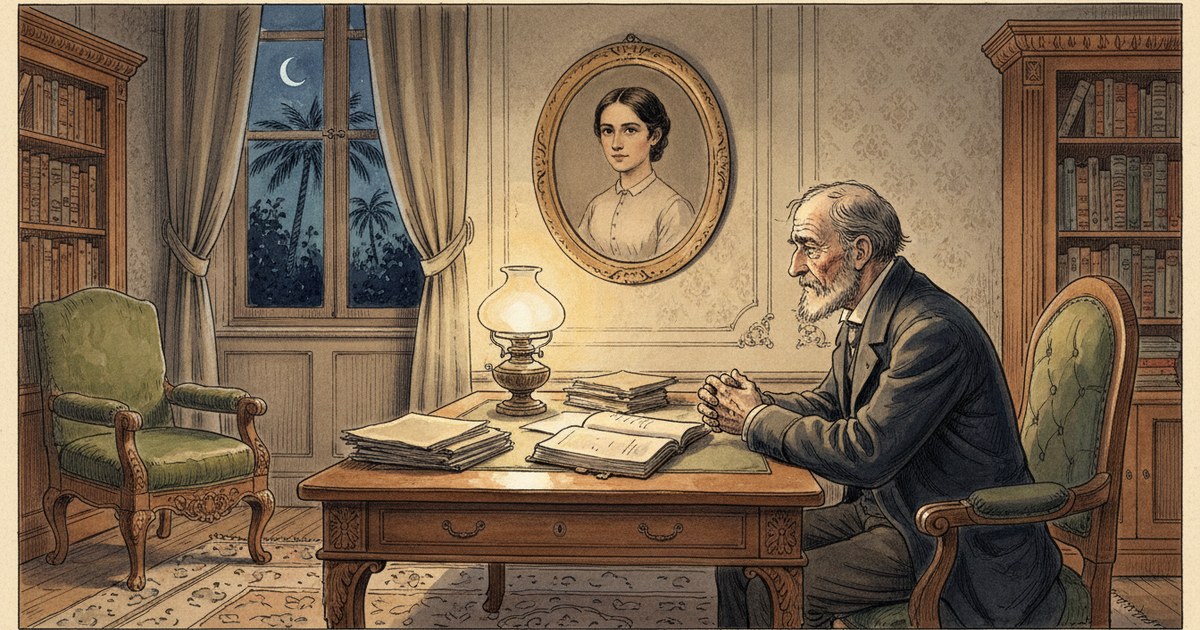
Bento Santiago has been building his case for decades. He has written it all down, arranged the evidence, named the witnesses, described the looks and the silences and the funeral tears. By the time you reach the last page, he has almost convinced you. And then you put the book down, and you realize: you have just spent two hundred pages inside the mind of the prosecution, and the defense never got to speak.
Dom Casmurro — published in 1899 by the Brazilian master Joaquim Maria Machado de Assis — is a perfect trap. Not a mystery, not quite a tragedy. A trap. It is built to work on every reader differently, to make some of you certain and others furious and most of you arguing about it at midnight. It has been doing this to Brazil for over a century. The country is still arguing.
The Man Behind the Book
Machado de Assis was not the person nineteenth-century Brazil expected to produce its greatest novel. He was born in 1839 in Rio de Janeiro, the son of a mixed-race house painter and a Portuguese washerwoman from the Azores. He grew up in poverty, was largely self-educated, suffered from epilepsy and a stammer, and worked as a typesetter’s apprentice before he taught himself French and began devouring the European literary canon. He rose through the Rio literary world on sheer force of intelligence, eventually helping to found the Brazilian Academy of Letters in 1897 — two years before Dom Casmurro appeared. He was its first president and remained so until his death in 1908.
What makes this biography relevant to the novel is the angle of vision it produced. Machado spent his entire life watching Brazilian society from a position of both proximity and exclusion — close enough to its drawing rooms and social rituals to render them in perfect detail, distant enough to see their cruelty without sentimentality. Dom Casmurro is set among the comfortable Rio bourgeoisie: seminary educations, beach houses in Flamengo, afternoons playing piano. Machado knew that world, but he was never entirely of it. He saw what the men inside it could do to women and call it love. He wrote it down and disguised it as a love story, and then he waited for readers to notice.
The Man in the Chair
The novel opens with an aging, bitter man who lives alone and who has given himself a nickname: Dom Casmurro. Lord Sullen. He has earned it. He tells us he is writing to fill time, to bind together the two ends of his life — the brilliant childhood in Rio de Janeiro, and the hollow present. He tells us this casually, almost apologetically. Then he begins.
What follows is one of the most suffocating first-person narrations in literary history. Bento Santiago — Bentinho, as a boy — was sent to seminary against his will, fell in love with the neighbor girl Capitu, got out of the seminary, married her, had a son, watched his best friend Escobar drown in the sea, watched Capitu weep at Escobar’s funeral, and became convinced — convinced — that she had betrayed him with his closest friend. He sent her away. She died in exile with their son. He never spoke to her again.
That is the story as he tells it. The question — Brazil’s great national argument, debated in newspapers and schools and bars and literary journals to this day — is whether any of it is true.
One detail the novel plants early and quietly: Bentinho tells us he has rebuilt his childhood home, brick by brick, in exact replica — the same rooms, the same veranda, the same garden. He lives inside a reconstruction. He is a man who manufactures the past and then inhabits it and calls it memory. Machado puts this in the opening chapters almost as a throwaway. It is not a throwaway. It is the key to everything that follows.
The Eyes That Started Everything
Machado was not subtle about what he was doing. He told you exactly where to look.
Capitu’s eyes appear on almost every significant page. Bentinho describes them as oblíquos e dissimulados — oblique and dissembling, gypsy-like, with a tidal pull. He returns to them obsessively, the way you return to a wound. “The eyes of the gypsy, oblique and sly,” he writes, as though the shape of her eyes is evidence of something. As though the way she looked at him could prove what happened in rooms he wasn’t in.
Read that again. A man decides his wife is guilty, in part, because he doesn’t like the way her eyes are shaped. Machado plants this early and lets it metastasize. By the end of the novel, Bentinho’s descriptions of Capitu have accumulated into something that feels like a portrait — specific, detailed, damning — and yet every brushstroke was applied by the man who already decided the verdict before he picked up the brush.
This is the mechanism Machado perfected. Not an unreliable narrator who lies badly, who slips up and contradicts himself in ways you can catch. A narrator who lies beautifully. Who is so precise, so specific, so apparently fair — he even grants Capitu her charms, her wit, her superiority — that you believe him in the moment and only feel uneasy later, in the silence after the chapter ends.
There is a chapter — barely two pages long — in which young Bentinho watches Capitu scratch his name into the plaster of the garden wall. She is carving “Bento” and then “Capitu” with a nail, unhurried, as if writing a fact rather than a wish. Bentinho reads it as evidence of her love. Later readers read it as evidence of her calculation — she knew what she wanted, and she went and got it. The scene is identical in both readings. Only the verdict changes. This is the trick in miniature: Machado writes the scene and steps back, and the reader’s assumptions do the rest of the work.
The Machine Machado Built
Eighteen years before Dom Casmurro, Machado published Posthumous Memoirs of Brás Cubas — arguably the first great unreliable narrator in the Western novel, a dead man dictating his own flattering self-portrait from beyond the grave. With that book, Machado invented the trick. With Dom Casmurro, he perfected it, because here the stakes are real. Brás Cubas is a rogue; we find him charming even as we see through him. Bento Santiago is not charming. He is dangerous. He destroyed a woman and a child and he is asking you to agree that he had no choice.
The machinery runs on what Bentinho doesn’t say as much as what he does. Consider the funeral scene — the emotional fulcrum of the entire novel. Escobar drowns. The mourners gather. And Bentinho watches Capitu. She cries. She cries, he decides, with too much feeling. She looks at the coffin, he decides, with an expression he recognizes. This is the moment everything breaks. Two sentences about how a woman looked at a coffin, and a marriage ends, and a woman goes into exile, and a child grows up without his father.
What Machado does not give you — what the novel structurally cannot give you — is anyone else’s account of that moment. There is no second witness. There is only Bentinho, watching, deciding, building his case. The reader is put in the position of the jury that has only heard from the prosecutor. You can feel the claustrophobia of it: you want to lean around him and look at Capitu’s face yourself, and you cannot. He is always in the way.
The chapter structure sharpens the knife further. Dom Casmurro is broken into 148 short chapters, some barely a paragraph long, each with an ironic or deflecting title. A chapter about jealousy is called “A Tip from Iago.” A chapter about Capitu’s eyes is called “Eyes Like the Tide.” The titles function like editorial commentary — not Machado’s, but Bentinho’s, a man so in control of the narrative that he can even name his own chapters with a wink. This is a man who has told this story to himself so many times that he has developed a style for it. That should terrify you.
The Company He Keeps
Critics reach for Shakespeare when they write about this novel, and the comparison holds. Othello also destroyed a wife on the testimony of a man with every reason to lie. Hamlet also lived inside a mind so active, so persuasive, so allergic to stillness that certainty became impossible. But Machado’s move is different from Shakespeare’s in one crucial way: in Othello, we see Iago. We know the lie at the source. In Dom Casmurro, there is no Iago. The source of the lie — if it is a lie — is Bentinho himself, and he doesn’t know it. Or he does know it, and he has written this entire book to convince himself otherwise. Or there is no lie. Or there is. Machado leaves you there, on that edge, and does not reach out a hand.
What makes the novel feel modern — shockingly, vertiginously modern — is that it anticipates everything we now know about how memory works, how jealousy distorts perception, how the stories we tell ourselves about the people who hurt us harden over time into something that feels like fact. Bentinho is not a villain in the nineteenth-century sense. He is a man who wanted a particular story to be true, who had decades to refine it, and who finally wrote it down and called it autobiography.
Capitu herself is the most fully alive character in the book, which is extraordinary given that she never speaks for herself. Everything we know about her comes through Bentinho’s filter. And yet she comes through. Her intelligence, her calculated charm, her genuine love for Bentinho — or her performance of it, depending on which reading you bring — all of it survives his narration. That is either because Machado was careful to let her breathe despite the frame, or because Bentinho’s portrait is more honest than he intends. The reader decides. The reader always decides.
The question “did Capitu cheat?” is a national argument in Brazil in a way that has no real equivalent in English literary culture. There are literary societies devoted to it. Brazilian school children are assigned a position and told to defend it. The novel does not just sustain this — it generates it. Each reading produces a slightly different Capitu and a slightly different Bentinho and therefore a slightly different verdict. What you decide about Capitu tells you something about how much you trust narrators, how much you listen for the voice of the woman the story isn’t about.
The writer who deserves mention alongside Machado here is Henry James, whose The Turn of the Screw appeared just one year before Dom Casmurro and deploys a structurally similar ambiguity — a narrator whose psychology may be generating the very horrors she reports. James was celebrated across the Atlantic for exactly this trick. Machado, writing in Portuguese in South America, was doing something more sophisticated and received almost none of the same international attention for another fifty years. The literary world’s slowness to find him says more about the world than about the work.
The Translation Question
Any novel this dependent on narrative voice lives or dies in translation by whether the translator hears the right note in the original and can reproduce it in English. Bentinho’s prose is not ornate. It is controlled, smooth, occasionally ironic in a way that never announces itself — the irony sits just below the surface, and you feel it rather than see it. Translations that make Bentinho too stiff produce a Victorian melodrama. Translations that make him too casual produce a modern confession. The target is narrower than it looks: a man who is cultured, precise, slightly cold, and absolutely certain he is being fair.
The edition we recommend catches this register. The prose reads with the intimacy of someone telling you a story over a long dinner — measured, never rushed, occasionally pausing to make a small joke at its own expense. That self-deprecating quality is crucial: Bentinho is charming enough that you want to believe him, and the translation preserves that danger. Earlier English versions — including the 1953 Helen Caldwell translation that first cracked open the “unreliable narrator” reading for English-language scholars — did essential critical work, but the prose now carries its age. This modern English edition puts the novel’s full seductive machinery in working order for a contemporary reader encountering it for the first time.
Why It Matters Now
There is one more reason Dom Casmurro keeps finding new readers, and it is not a comfortable one. The novel is, at its structural core, a story about a powerful man destroying a less powerful woman and writing the history afterward. Bentinho controls the record. Capitu has no access to it. Whatever actually happened between them in that marriage — whatever she felt, whatever she suffered, whatever her version of the funeral scene might have looked like — none of it exists. The only account we have is his. He got to write it. She did not.
That asymmetry is not incidental to the novel. It is the novel. Machado, writing in 1899, understood something about how stories work in societies where certain people control the telling and others do not. The book was ahead of its time in ways that keep becoming clearer. Every generation of readers brings a slightly different set of questions about testimony and power and who gets to be believed, and the novel absorbs all of them without strain. It was designed for exactly this: to be more troubling the more carefully you read it, and to keep being more troubling the further history moves.
The translation we recommend brings the novel’s voice into the sharpest focus it has ever had in English — the cool, slightly malevolent intimacy of Bentinho’s prose, the irony Machado controls with such unshowy precision. You will not agree with everyone else about what happened. You will probably not agree with yourself if you read it twice. That is the point. That has always been the point.

Frequently Asked Questions
Did Capitu actually cheat on Dom Casmurro?
The novel never answers this question directly — and that is entirely intentional. Machado de Assis constructs the narrative so that the only witness is Bento Santiago himself, a man with every psychological motive to believe his wife was unfaithful. Whether Capitu cheated or whether Bentinho invented the betrayal to justify his jealousy is Brazil’s greatest literary debate, still actively argued by readers and scholars more than 125 years after publication. Both readings are supported by the text. That is the genius of the novel.
What does “Dom Casmurro” mean?
“Dom” is a Portuguese honorific, and “casmurro” means sullen, withdrawn, or obstinate — someone who keeps to himself and broods. The nickname is given to Bento Santiago by a neighbor poet whose verses he ignores on a train. He adopts it as his own title, which tells you something about him: he has decided who he is, he has named the verdict, and he has arranged everything around it.
Is Dom Casmurro an unreliable narrator?
Yes — and one of the most sophisticated in literary history. Machado had already invented the unreliable narrator in his earlier novel Posthumous Memoirs of Brás Cubas (1881). In Dom Casmurro he refined the technique: Bentinho never lies clumsily, never contradicts himself in ways you can easily catch. His narration is precise, specific, even generous toward Capitu in places — which makes it more dangerous. The unreliability is structural, not stylistic. He is the prosecution presenting the case for his own jealousy, and the defense never speaks.
How does Dom Casmurro compare to Othello?
The comparison is unavoidable and Machado almost certainly intended it. Both are stories of men destroyed by jealousy they may have manufactured themselves, both involve the destruction of an accused wife, and both hinge on “proof” that proves nothing. The key difference: in Othello we see Iago; we know where the poison originates. In Dom Casmurro, there is no Iago. If the story is a lie, Bentinho is lying to himself as much as to us. That ambiguity is what makes Machado’s version the more modern, and in some ways the more disturbing, of the two.
Who was Machado de Assis, and why isn’t he more famous outside Brazil?
Machado de Assis (1839–1908) is widely regarded as the greatest writer in the Portuguese language and one of the founding figures of literary modernism — a generation before European modernism announced itself. He was born into poverty in Rio de Janeiro, the mixed-race son of a house painter, and educated himself into becoming Brazil’s foremost man of letters. His relative obscurity outside the Portuguese-speaking world is almost entirely a consequence of language and geography: he was writing in South America in a language that commanded little international critical attention in the nineteenth century, and serious English translation of his major novels did not arrive until the 1950s. Since then his reputation has grown steadily, and the critical consensus now places Dom Casmurro and Posthumous Memoirs of Brás Cubas among the essential novels of any literary tradition.
Should I read Posthumous Memoirs of Brás Cubas before Dom Casmurro?
You do not need to, but reading Brás Cubas first rewards you in a specific way: you arrive at Dom Casmurro already primed to distrust a charming first-person narrator, which makes Bentinho’s smoother, more dangerous voice even more unsettling by contrast. Brás Cubas is the wilder, more experimental book — narrated by a dead man, full of chapters that are deliberately absurd — while Dom Casmurro wears the disguise of a conventional love story. Machado built the ladder with the first novel; the second novel kicks it away once you’ve climbed it.

You must be logged in to post a comment.