Tag: science fiction

  • Verne’s Castaways Never Needed Rescuing

    Verne’s Castaways Never Needed Rescuing

    There is a moment in The Mysterious Island when Cyrus Harding, engineer, former Union officer, and the closest thing Jules Verne ever wrote to a personal avatar, stands on a volcanic outcrop and surveys the domain his small band of castaways has built from nothing. They have a forge. They have a telegraph line. They have a working mill, a brick kiln, cultivated fields, and a domesticated animal population. They have been on the island for less than two years. Verne presents this not as fantasy but as an argument — a careful, methodical demonstration that human intelligence, applied with discipline and solidarity, is sufficient to rebuild civilization from the ground up. The adventure novel is the wrapper. The manifesto is what’s inside.

    Five Men and an Idea

    The setup is irresistible. Five Union prisoners — an engineer, a journalist, a sailor, a young orphan boy, and an emancipated Black man named Nab — escape a Confederate prison camp in Richmond by stealing a military balloon. A storm drives them thousands of miles off course and deposits them on an uncharted Pacific island, somewhere in the vast nowhere south of the shipping lanes. They have almost nothing: no tools, no weapons, no provisions beyond what they can scavenge in the first hours. What they do have is Cyrus Harding, and Verne makes abundantly clear that this is enough.

    But Harding is not a lone genius in the Romantic mold. He does not heroically solve problems while the others watch. What Verne constructs, with the obsessive patience of an engineer himself, is a collective intelligence. The journalist Gideon Spilett provides curiosity and documentation. The sailor Pencroff brings practical seamanship and a stubborn animal vitality. Nab provides loyalty and physical endurance, and if Verne’s portrayal of him reflects the limitations of his era, the structural fact remains: the colony cannot function without him, and Verne never lets the reader forget it. The boy Harbert is essentially the reader surrogate — young, eager, learning. Together they are not five castaways. They are a society in miniature, and Verne is asking what a society, stripped of inherited wealth, inherited power, and inherited institutions, can actually build.

    The answer, rendered across nearly a thousand pages of scrupulous technical detail, is: everything. Verne walks his readers through the smelting of iron ore, the production of nitroglycerine, the construction of a brick house, the weaving of cloth, the cultivation of grain, the management of livestock. He does this not to impress but to instruct, and the instruction carries a political charge that Verne’s contemporary readers would have felt immediately. This is a book published in 1875, in the shadow of the Paris Commune, four years after French workers seized the capital and tried to govern it themselves before being massacred for their trouble. Verne was not a revolutionary, but he was a utopian, and utopias have political valence even when their authors pretend otherwise.

    The Ghost in the Machine

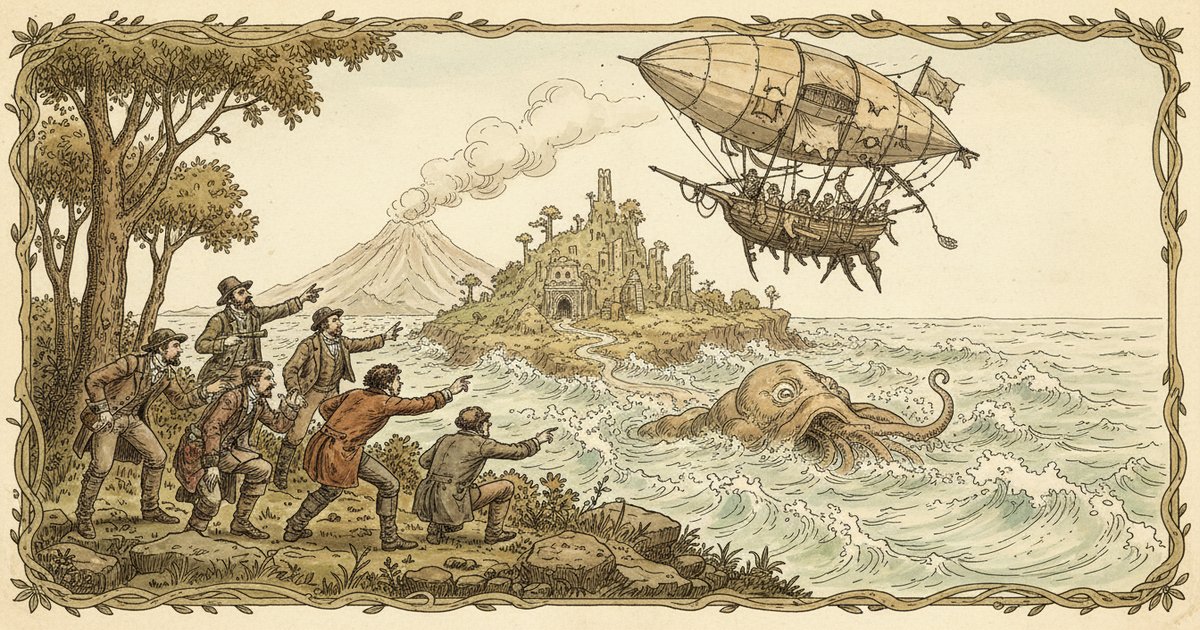
    The island has a secret. Strange things happen that the castaways cannot explain. Tools appear where there were none. A dangerous animal is killed by an unseen hand. A message arrives in a bottle. Someone, or something, is watching over them, intervening at precisely the moments when the colony would otherwise be destroyed. The mystery accumulates slowly, with Verne’s characteristic patience, until late in the novel it resolves into one of the great cameo appearances in all of adventure literature: Captain Nemo, last seen sinking warships in Twenty Thousand Leagues Under the Sea, has been living beneath the island in his submarine, the Nautilus, for decades.

    The revelation is more than a sequel hook. It is a thematic closing of the circle. Nemo — whose very name means “nobody” in Latin — is the novel’s dark mirror. He too built a civilization outside the reach of the world’s powers, and he too organized it around intelligence, self-sufficiency, and a rejection of unjust authority. But Nemo’s utopia was solitary and predicated on destruction. The castaways’ utopia is collective and predicated on creation. Verne is drawing a line between two kinds of withdrawal from an unjust world: the nihilistic and the constructive. Nemo, dying, blesses what Harding has built and asks that it continue. It is as close to an authorial benediction as Verne ever wrote.

    Nemo’s backstory, elaborated here more fully than in the earlier novel, reveals him as an Indian prince whose family was destroyed by British colonial power. His hatred of empire was not abstract. Verne, writing for a French audience that had just watched its own imperial ambitions lead to catastrophic defeat in the Franco-Prussian War, was embedding a critique of European expansionism inside a story ostensibly about American Civil War heroes building a new world. The layers compound. The island is named Lincoln Island by the castaways in honor of the assassinated president. Verne is not subtle about what civilization is being contrasted with what.

    The Dignity of Making Things

    What separates The Mysterious Island from the comfortable tradition of the Robinson Crusoe narrative is Verne’s insistence on the social dimension of labor. Crusoe rebuilds a kind of English property-owning civilization on his island, complete with a servant. Harding builds something closer to a cooperative, in which each member contributes according to ability and the fruits of the colony belong to the colony. No one is paid. No one is a servant. The work is shared, the meals are shared, and the decisions, while generally deferred to Harding’s expertise, are made collectively. For a novel published in the same decade as the First International and the early labor movement, this is not an accidental arrangement.

    Verne also insists, with almost tedious thoroughness, that the castaways understand what they are doing. They do not find things; they make them. They do not stumble upon solutions; they derive them. The novel is full of passages that read like encyclopedia entries, explaining the chemistry of iron smelting or the mechanics of a hydraulic elevator with a pedagogue’s precision. This has frustrated readers who want the plot to move faster, and it is true that Verne tests the patience of anyone accustomed to the pace of modern thrillers. But the slowness is intentional. Every page of technical detail is an argument: human knowledge, freely shared and collectively applied, is the foundation of any civilization worth having. What industrial capitalism does, Verne implies, is appropriate that knowledge for private profit while keeping the workers who apply it in ignorance of what they are actually doing. On Lincoln Island, everyone knows everything.

    This is the manifesto buried in the adventure novel, and a fresh English translation — one that renders Verne’s precise, often formally elevated prose without the condescension of Victorian-era translators who thought his work was merely for children — allows modern readers to feel its full weight. Verne was not writing escapism. He was writing a blueprint. The island was a thought experiment about what human beings could do together if they were freed from the hierarchies and dependencies that industrial society had convinced them were natural. The fact that he wrapped this argument in volcanic eruptions, pirate attacks, and a dying submarine captain does not diminish it. It preserves it.

    Read this translation. Read it as what it is: one of the nineteenth century’s most ambitious novels, a book that believes, with a fervor that still feels urgent, that intelligence and cooperation are enough to build the world we actually want.

    What is the best English translation of The Mysterious Island?

    For most readers today, the best English translation of The Mysterious Island is one that strips away the Victorian-era stiffness of older versions while preserving Verne’s scientific imagination and storytelling drive. This modern accessible English translation does exactly that — it renders Verne’s prose in clean, natural language that reads fluently without losing the novel’s sense of wonder or its detailed attention to engineering and survival. Readers who struggled with 19th-century translations will find this edition far easier to follow from the first chapter to the last.

    Is The Mysterious Island worth reading in 2026?

    Yes — more than most people expect. The Mysterious Island holds up in 2026 because its core themes — self-reliance, ingenuity under pressure, the relationship between humans and the natural world — resonate as sharply now as they did in 1875. Verne’s castaways don’t wait to be rescued; they build, invent, and reason their way out of crisis, which makes the novel feel remarkably contemporary. With a modern accessible translation removing the language barrier, there is no longer any reason to put it off.

    How does The Mysterious Island compare to Twenty Thousand Leagues Under the Sea?

    Both novels belong to Verne’s Voyages Extraordinaires and share the figure of Captain Nemo, but they are very different reading experiences. Twenty Thousand Leagues Under the Sea is driven by spectacle and mystery — an underwater odyssey told from the outside, where Nemo remains an enigma. The Mysterious Island is warmer and more grounded: it is a survival story, a novel of community and problem-solving, and it provides Nemo’s backstory and redemption. Readers who loved the oceanic grandeur of Twenty Thousand Leagues will find The Mysterious Island richer in character and emotional payoff. This modern accessible English translation of both titles makes comparing them side by side easier than ever.

    What should I read after The Mysterious Island?

    If The Mysterious Island sparked an appetite for classic adventure fiction in modern English, two titles from the classicsretold.com catalog are natural next reads. The Three Musketeers: A New Translation in Modern Accessible English delivers the same pace and ingenuity in a swashbuckling historical setting — Dumas at his most entertaining, rendered without the archaic weight of older translations. For something darker and more literary, The Hunchback of Notre-Dame: A New Translation in Modern Accessible English offers Hugo’s Paris in language that finally lets the story breathe. Both reward readers who came to Verne for plot, ideas, and a sense of another world made fully real.

    Curated pick
    The Mysterious Island — Jules Verne
    Modern English translation

    Kindle →Paperback →

  • Captain Nemo Built His Prison Underwater

    Captain Nemo Built His Prison Underwater

    In 1866, ships from a dozen countries reported the same thing: something vast and luminous was moving beneath them. The reports were credible — speeds no living creature could sustain, a phosphorescent wake miles long, impacts that dented iron hulls. The world’s maritime press went briefly mad trying to name the thing. Jules Verne, watching from Paris, did something more useful. He went home and invented it.

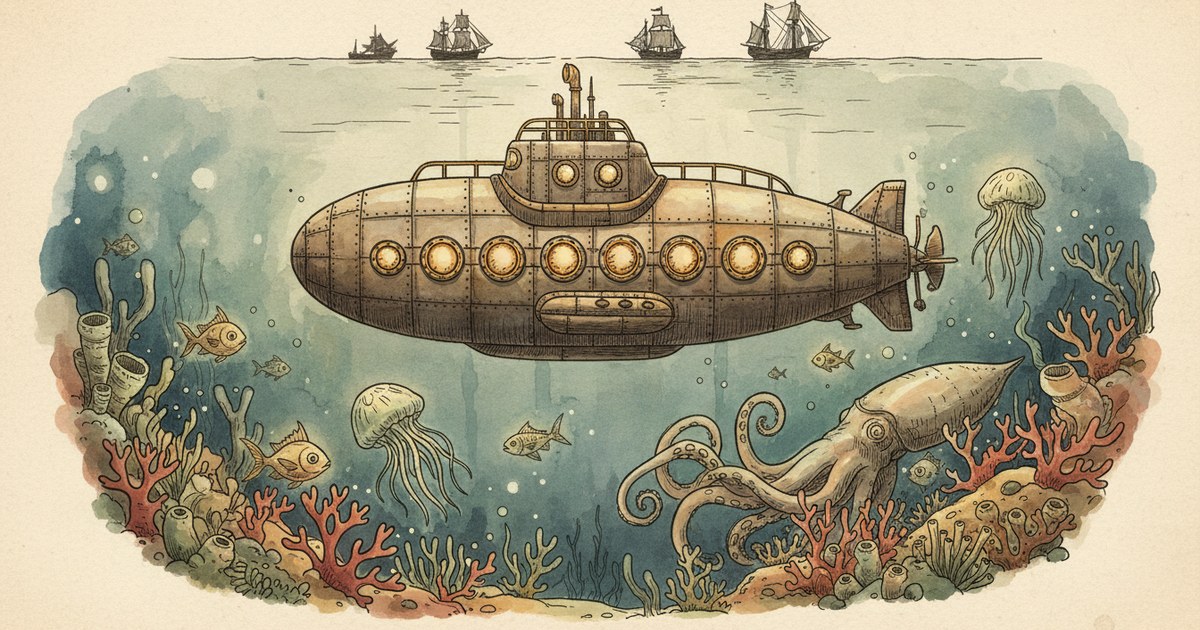
    Twenty Thousand Leagues Under the Sea began as a serial in 1869, a year before anyone had descended more than a few hundred feet in anything resembling a controlled vehicle. Verne had seen a model of the French submarine Plongeur at the 1867 Exposition Universelle — a lumbering, compressed-air prototype that managed brief dips in the Seine. From that seed, he built the Nautilus: electrically powered, capable of circling the globe, equipped with a salon hung with paintings and a library of twelve thousand volumes. The working submarines of 1869 could barely stay down for twenty minutes. Verne’s argument, implicit in every page, was that the ocean was not a void. It was a civilization waiting to be entered.

    That argument has never really been answered. We have explored less than twenty percent of the ocean floor. Verne mapped it before we reached it, and in certain essential ways, we still haven’t caught up.

    What makes the novel more than a technical fantasy is the bet Verne makes on his reader: that you will care about a man who refuses to tell you why he is angry. Captain Nemo is introduced as a presence before he is introduced as a person. The Nautilus moves. Aronnax is held captive. And then, eventually, there is the captain — cold, fluent in everything, grieving something he will not name. The mystery of Nemo is not solved by the end of the book. Verne understood that explained grief is grief defused. The opacity is the point.

    The Man Who Turned His Editor’s Rejections into a Career

    Verne was thirty-five when he sold his first novel. Before that: a failed lawyer, a moderately failed playwright, a stockbroker who spent his lunch hours in the Bibliothèque nationale reading scientific journals in fields he had no formal training in — geology, oceanography, astronomy, polar exploration. His first editor rejected the manuscript that would become Five Weeks in a Balloon twice. Verne reportedly told his wife he was going to burn it and try something else. She hid the manuscript. This matters to how Twenty Thousand Leagues reads, because it is a book written by someone who taught himself the science one journal at a time, who had to earn his own authority before he could project it onto a character. Captain Nemo’s serene, absolute expertise — the way he names every organism Aronnax cannot, reads the deep currents the way others read weather — carries the specific confidence of self-made knowledge. Nemo is what Verne wanted to be: the man who had actually read everything.

    The editor who finally said yes was Pierre-Jules Hetzel, and the relationship that followed was one of the defining editorial partnerships of the nineteenth century — and one of the most consequential acts of political censorship in French popular fiction. Hetzel had his own exile to answer for: he had fled France after Louis-Napoleon’s coup in 1851, spending years in Brussels before returning. He understood exactly what Verne was doing with Nemo. And he made Verne pull back. In the original manuscript, Nemo was explicitly a Polish nobleman, his family destroyed by Russian imperial forces, his hatred of nations rooted in a specific historical atrocity. Hetzel judged this too inflammatory — France needed Russian goodwill — and insisted Nemo’s origins be left ambiguous. The wound that drives the entire novel was edited out of the novel. It surfaces only as absence: the portrait of a woman and two children that hangs in Nemo’s quarters, the tears he sheds at a crewman’s underwater burial, the fury that overtakes him when he encounters certain warships. You can feel the missing context in every scene where Nemo almost explains himself and then does not.

    The other biographical fact that reshapes the novel: Verne wrote it in the shadow of the Second Empire, a France where political dissent required careful management. Nemo — whose name is Latin for “no one” — is a man who has renounced nations, a stateless fugitive living beneath the reach of governments. He funds anti-colonial uprisings from the sea floor. He mourns something he refuses to name. When Aronnax presses him about his past, Nemo answers: “I am not what you call a civilized man. I have done with society entirely.” That line did not require literary analysis in 1870. Every French reader knew exactly what it meant.

    A Catalogue That Becomes a Grief

    The novel’s central formal gamble is that it gives you a scientist as narrator. Professor Aronnax catalogs everything — species, depths, temperatures, geological formations, the chemical composition of the water at successive fathoms. Lesser writers deploy this technique to seem authoritative. Verne uses it to build an emotional argument. By the time Aronnax has named three hundred organisms, has stood awestruck in the Nautilus’s observation window watching bioluminescent forests scroll past at four knots, you understand what Nemo understood first: the ocean is not empty. It is fuller than the surface world, more ordered, stranger, more alive. The cataloguing is not pedantry — it is the slow accumulation of a love so large it has no object that can hold it. Aronnax cannot stay. He does not want to leave. The novel’s real tension is not whether the crew will escape Nemo. It is whether Aronnax can survive returning to a world that will never be as interesting again.

    The scene that makes this most visceral is the walk across the ocean floor near the island of Crespo. Nemo leads Aronnax and Conseil out through the Nautilus’s airlock onto the seabed in diving suits, armed with air rifles, hunting for sport but really, you sense, conducting a kind of liturgy. They move through underwater forests that Verne describes as trees of black coral, their branches perfectly still in the absence of current, hung with seaweed the color of garnets. Aronnax reaches for his notebook and realizes he cannot write. He can only watch. The scene lasts for pages and nothing narratively consequential happens in it — no danger, no revelation, no plot development — and yet it is the emotional center of the book, the moment you understand what the novel is actually about. Verne is not writing adventure fiction. He is writing about what it costs to witness something no language is adequate to.

    What Verne understood, and what most adventure fiction refuses to admit, is that wonder has an aftermath. The specific grief of a man who has seen something no one else has seen — and who will spend the rest of his life failing to describe it adequately — is present on every page without ever being stated directly. It surfaces instead in the catalog: one more species, one more coordinate, one more measurement of a world that does not need us to witness it but that becomes, by being witnessed, unbearably precious. The last line of the book arrives like a door closing on a lit room. You are back on the surface, and the surface is not enough.

    Nemo’s Politics: What the Novel Is Actually Arguing

    Readers who approach Twenty Thousand Leagues as a submarine adventure story are not wrong, exactly. The adventure is real and it moves fast. But Verne was doing something more pointed, and the political argument runs underneath the plot the way the Nautilus runs beneath the shipping lanes — invisible from above, but propelling everything.

    Nemo is not simply a man who prefers solitude. He is a man who has made a philosophical decision about civilization and found it wanting. The ocean, in his formulation, belongs to no nation — there are no property rights below the waves, no tariffs, no flags, no armies with jurisdiction over the deep-sea vents. His electricity comes from the sea. His food comes from the sea. He is economically and politically sovereign in a way that no surface-dweller can be. When he surfaces to sink a warship — a scene that genuinely shocked readers in 1870 — Verne is not endorsing terrorism. He is dramatizing what it looks like when a man follows his principles to their logical conclusion without the friction of social compromise. Nemo is what pure sovereignty produces: someone who is both heroic and monstrous, and whose creator refuses to arbitrate between the two. The novel ends without resolving him because Verne knew that resolving him would be dishonest. Some arguments do not have answers. Some men cannot be absorbed back into the world they have rejected.

    Why This Translation?

    The original English translations of Verne are notoriously damaged goods — the 1872 Mercier Lewis version dropped twenty-five percent of the text, mistranslated the scientific terminology throughout, and smoothed away Nemo’s political edges into something safer for Victorian readers. What Verne actually wrote was more precise, more strange, and considerably more radical than most English readers have ever encountered. This new translation works from the original French, restores the excised passages, and renders Verne’s technical vocabulary accurately while keeping the prose moving at the pace he intended — urgent, specific, alive. If you read Twenty Thousand Leagues in school and found it slow, you were probably reading the wrong book.

    One concrete example of what the Mercier Lewis cuts cost you: the Atlantis sequence. When the Nautilus glides over the submerged ruins of what Nemo identifies as the lost continent, Verne gives Aronnax a full geological and architectural inventory — basalt columns, granite foundations, the outlines of temples and harbors visible through the submarine’s lights. Lewis reduced this to a paragraph. In the complete French text, it runs for several pages, and the effect is cumulative: by the time Aronnax has catalogued the drowned city in enough detail to almost map it, you feel the weight of everything that has been lost, not just to the ocean but to history, to time, to the indifference of the surface world. That passage is one of Verne’s most arresting pieces of writing. Most English readers have never read it. The translation we recommend puts it back where it belongs.

    Further reading: More books by Jules Verne · Explore French Literature

    What is the best English translation of Twenty Thousand Leagues Under the Sea?

    For readers who want the full depth of Verne’s original vision without the archaic phrasing that plagues older Victorian-era editions, Twenty Thousand Leagues Under the Sea: A New Translation in Modern Accessible English is the strongest choice available today. Earlier translations—particularly the widely circulated Mercier Lewis version—cut significant passages and introduced errors that distorted Verne’s scientific detail and narrative voice. This modern translation restores the complete text and renders it in clear, contemporary English that doesn’t require a 19th-century reading vocabulary to enjoy.

    Is Twenty Thousand Leagues Under the Sea worth reading in 2026?

    Yes—and more so than many readers expect. Verne wrote Captain Nemo as a figure of radical independence, grief, and moral ambiguity that feels entirely contemporary. The novel’s tension between wonder and unease aboard the Nautilus, its meditation on freedom versus isolation, and its portrait of a man who has renounced the surface world all resonate sharply in an era defined by surveillance, disconnection, and technological anxiety. The modern accessible translation removes the one barrier that kept earlier readers at arm’s length: the stiff, dated prose of Victorian editions.

    How does Twenty Thousand Leagues Under the Sea compare to The Mysterious Island: A New Translation in Modern Accessible English?

    The Mysterious Island is in many ways a companion piece—it revisits Captain Nemo at the end of his life and ties up threads left open in Twenty Thousand Leagues. Where Twenty Thousand Leagues is driven by mystery and the claustrophobic grandeur of the deep ocean, The Mysterious Island is a survival story with an ensemble cast, broader in scope and warmer in tone. Readers who respond to Nemo’s enigmatic presence in the first book will find his reappearance in The Mysterious Island genuinely moving. Both modern accessible translations use consistent contemporary English, so the transition between the two books is seamless.

    What should I read after Twenty Thousand Leagues Under the Sea?

    If you want to stay in the world of 19th-century adventure translated into clean, modern English, two titles from the classicsretold.com catalog are natural next reads. The Three Musketeers: A New Translation in Modern Accessible English by Alexandre Dumas delivers the same propulsive plotting and larger-than-life characters, with the added pull of political intrigue and swashbuckling action set in 17th-century France. If you prefer something with more psychological weight, The Hunchback of Notre-Dame: A New Translation in Modern Accessible English by Victor Hugo is a dense, rewarding novel about justice, beauty, and social cruelty—every bit as ambitious as Verne at his best.

    Frequently Asked Questions

    Curated pick
    Twenty Thousand Leagues Under the Sea — Jules Verne
    Modern English translation

    Kindle →Paperback →

    More from Jules Verne
    The Mysterious IslandThe Lighthouse at the End of the World