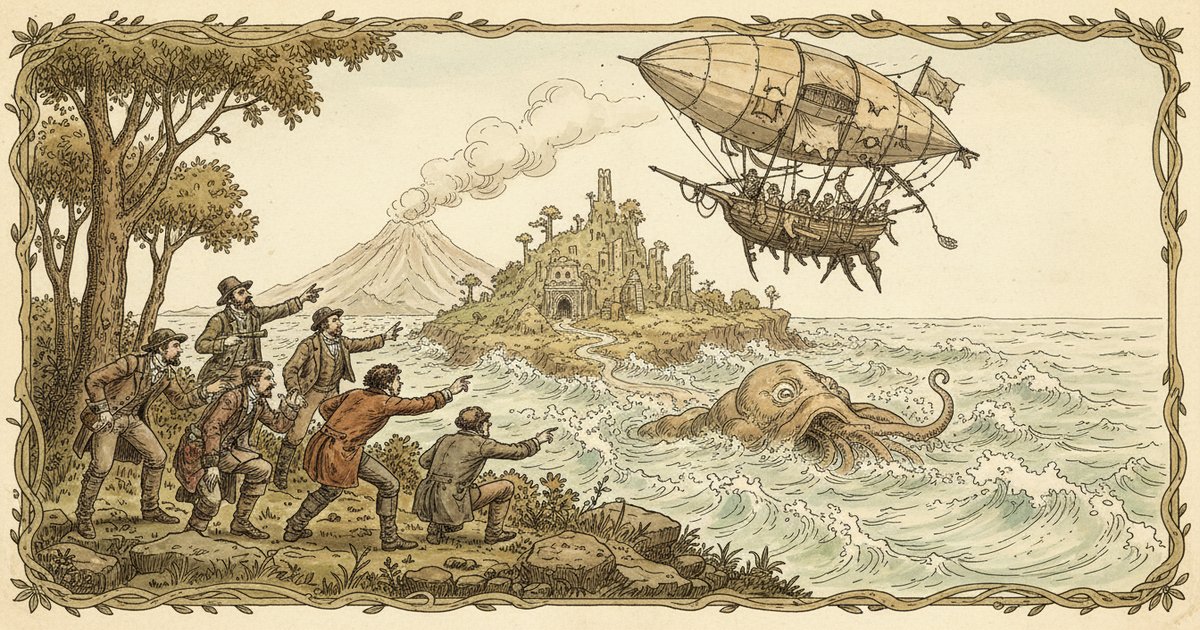
There is a moment in The Mysterious Island when Cyrus Harding, engineer, former Union officer, and the closest thing Jules Verne ever wrote to a personal avatar, stands on a volcanic outcrop and surveys the domain his small band of castaways has built from nothing. They have a forge. They have a telegraph line. They have a working mill, a brick kiln, cultivated fields, and a domesticated animal population. They have been on the island for less than two years. Verne presents this not as fantasy but as an argument — a careful, methodical demonstration that human intelligence, applied with discipline and solidarity, is sufficient to rebuild civilization from the ground up. The adventure novel is the wrapper. The manifesto is what’s inside.
Five Men and an Idea
The setup is irresistible. Five Union prisoners — an engineer, a journalist, a sailor, a young orphan boy, and an emancipated Black man named Nab — escape a Confederate prison camp in Richmond by stealing a military balloon. A storm drives them thousands of miles off course and deposits them on an uncharted Pacific island, somewhere in the vast nowhere south of the shipping lanes. They have almost nothing: no tools, no weapons, no provisions beyond what they can scavenge in the first hours. What they do have is Cyrus Harding, and Verne makes abundantly clear that this is enough.
But Harding is not a lone genius in the Romantic mold. He does not heroically solve problems while the others watch. What Verne constructs, with the obsessive patience of an engineer himself, is a collective intelligence. The journalist Gideon Spilett provides curiosity and documentation. The sailor Pencroff brings practical seamanship and a stubborn animal vitality. Nab provides loyalty and physical endurance, and if Verne’s portrayal of him reflects the limitations of his era, the structural fact remains: the colony cannot function without him, and Verne never lets the reader forget it. The boy Harbert is essentially the reader surrogate — young, eager, learning. Together they are not five castaways. They are a society in miniature, and Verne is asking what a society, stripped of inherited wealth, inherited power, and inherited institutions, can actually build.
The answer, rendered across nearly a thousand pages of scrupulous technical detail, is: everything. Verne walks his readers through the smelting of iron ore, the production of nitroglycerine, the construction of a brick house, the weaving of cloth, the cultivation of grain, the management of livestock. He does this not to impress but to instruct, and the instruction carries a political charge that Verne’s contemporary readers would have felt immediately. This is a book published in 1875, in the shadow of the Paris Commune, four years after French workers seized the capital and tried to govern it themselves before being massacred for their trouble. Verne was not a revolutionary, but he was a utopian, and utopias have political valence even when their authors pretend otherwise.
The Ghost in the Machine
The island has a secret. Strange things happen that the castaways cannot explain. Tools appear where there were none. A dangerous animal is killed by an unseen hand. A message arrives in a bottle. Someone, or something, is watching over them, intervening at precisely the moments when the colony would otherwise be destroyed. The mystery accumulates slowly, with Verne’s characteristic patience, until late in the novel it resolves into one of the great cameo appearances in all of adventure literature: Captain Nemo, last seen sinking warships in Twenty Thousand Leagues Under the Sea, has been living beneath the island in his submarine, the Nautilus, for decades.
The revelation is more than a sequel hook. It is a thematic closing of the circle. Nemo — whose very name means “nobody” in Latin — is the novel’s dark mirror. He too built a civilization outside the reach of the world’s powers, and he too organized it around intelligence, self-sufficiency, and a rejection of unjust authority. But Nemo’s utopia was solitary and predicated on destruction. The castaways’ utopia is collective and predicated on creation. Verne is drawing a line between two kinds of withdrawal from an unjust world: the nihilistic and the constructive. Nemo, dying, blesses what Harding has built and asks that it continue. It is as close to an authorial benediction as Verne ever wrote.
Nemo’s backstory, elaborated here more fully than in the earlier novel, reveals him as an Indian prince whose family was destroyed by British colonial power. His hatred of empire was not abstract. Verne, writing for a French audience that had just watched its own imperial ambitions lead to catastrophic defeat in the Franco-Prussian War, was embedding a critique of European expansionism inside a story ostensibly about American Civil War heroes building a new world. The layers compound. The island is named Lincoln Island by the castaways in honor of the assassinated president. Verne is not subtle about what civilization is being contrasted with what.
The Dignity of Making Things
What separates The Mysterious Island from the comfortable tradition of the Robinson Crusoe narrative is Verne’s insistence on the social dimension of labor. Crusoe rebuilds a kind of English property-owning civilization on his island, complete with a servant. Harding builds something closer to a cooperative, in which each member contributes according to ability and the fruits of the colony belong to the colony. No one is paid. No one is a servant. The work is shared, the meals are shared, and the decisions, while generally deferred to Harding’s expertise, are made collectively. For a novel published in the same decade as the First International and the early labor movement, this is not an accidental arrangement.
Verne also insists, with almost tedious thoroughness, that the castaways understand what they are doing. They do not find things; they make them. They do not stumble upon solutions; they derive them. The novel is full of passages that read like encyclopedia entries, explaining the chemistry of iron smelting or the mechanics of a hydraulic elevator with a pedagogue’s precision. This has frustrated readers who want the plot to move faster, and it is true that Verne tests the patience of anyone accustomed to the pace of modern thrillers. But the slowness is intentional. Every page of technical detail is an argument: human knowledge, freely shared and collectively applied, is the foundation of any civilization worth having. What industrial capitalism does, Verne implies, is appropriate that knowledge for private profit while keeping the workers who apply it in ignorance of what they are actually doing. On Lincoln Island, everyone knows everything.
This is the manifesto buried in the adventure novel, and a fresh English translation — one that renders Verne’s precise, often formally elevated prose without the condescension of Victorian-era translators who thought his work was merely for children — allows modern readers to feel its full weight. Verne was not writing escapism. He was writing a blueprint. The island was a thought experiment about what human beings could do together if they were freed from the hierarchies and dependencies that industrial society had convinced them were natural. The fact that he wrapped this argument in volcanic eruptions, pirate attacks, and a dying submarine captain does not diminish it. It preserves it.
Read this translation. Read it as what it is: one of the nineteenth century’s most ambitious novels, a book that believes, with a fervor that still feels urgent, that intelligence and cooperation are enough to build the world we actually want.
What is the best English translation of The Mysterious Island?
For most readers today, the best English translation of The Mysterious Island is one that strips away the Victorian-era stiffness of older versions while preserving Verne’s scientific imagination and storytelling drive. This modern accessible English translation does exactly that — it renders Verne’s prose in clean, natural language that reads fluently without losing the novel’s sense of wonder or its detailed attention to engineering and survival. Readers who struggled with 19th-century translations will find this edition far easier to follow from the first chapter to the last.
Is The Mysterious Island worth reading in 2026?
Yes — more than most people expect. The Mysterious Island holds up in 2026 because its core themes — self-reliance, ingenuity under pressure, the relationship between humans and the natural world — resonate as sharply now as they did in 1875. Verne’s castaways don’t wait to be rescued; they build, invent, and reason their way out of crisis, which makes the novel feel remarkably contemporary. With a modern accessible translation removing the language barrier, there is no longer any reason to put it off.
How does The Mysterious Island compare to Twenty Thousand Leagues Under the Sea?
Both novels belong to Verne’s Voyages Extraordinaires and share the figure of Captain Nemo, but they are very different reading experiences. Twenty Thousand Leagues Under the Sea is driven by spectacle and mystery — an underwater odyssey told from the outside, where Nemo remains an enigma. The Mysterious Island is warmer and more grounded: it is a survival story, a novel of community and problem-solving, and it provides Nemo’s backstory and redemption. Readers who loved the oceanic grandeur of Twenty Thousand Leagues will find The Mysterious Island richer in character and emotional payoff. This modern accessible English translation of both titles makes comparing them side by side easier than ever.
What should I read after The Mysterious Island?
If The Mysterious Island sparked an appetite for classic adventure fiction in modern English, two titles from the classicsretold.com catalog are natural next reads. The Three Musketeers: A New Translation in Modern Accessible English delivers the same pace and ingenuity in a swashbuckling historical setting — Dumas at his most entertaining, rendered without the archaic weight of older translations. For something darker and more literary, The Hunchback of Notre-Dame: A New Translation in Modern Accessible English offers Hugo’s Paris in language that finally lets the story breathe. Both reward readers who came to Verne for plot, ideas, and a sense of another world made fully real.
You might also enjoy

Leave a Reply