Tag: translation guide

  • Milton Wrote Paradise Lost Completely Blind

    In the autumn of 1660, John Milton was hiding. Charles II had returned to England, the Commonwealth was finished, and men who had served Cromwell’s regime were being hunted. Milton had served it at the highest level — as Secretary for Foreign Tongues, he had written the Latin defenses of regicide that went out to European courts as official government propaganda. He had justified the execution of a king in prose elegant enough to circulate in the chanceries of France and the Netherlands. Now the king’s son was back, and Milton was somewhere in London, waiting to learn whether he would be arrested, tried, and hanged.

    He wasn’t. Friends intervened — Andrew Marvell is usually credited — and Milton was released after a brief imprisonment, fined, and left alone. He went home, nearly completely blind, and over the next several years dictated one of the longest poems in the English language to his daughters and a series of amanuenses. The subject he chose was the Fall of Man. The villain he created was so persuasive, so fully realized, so obviously the most intelligent being in the room, that readers have been arguing about Milton’s intentions ever since. William Blake concluded that Milton was “of the Devil’s party without knowing it.” That argument hasn’t stopped.

    The question isn’t whether Paradise Lost is great. That’s settled. The question is how you’re going to read it — and which edition will actually get you through twelve books of seventeenth-century blank verse without losing the argument Milton spent a decade constructing.

    The Propagandist Who Outlived His Revolution

    Milton was born in 1608 into a prosperous London family that took education seriously enough to hire private tutors before sending him to Cambridge. He was a prodigy who knew it, and he spent his twenties reading deeply in Greek, Latin, Italian, and Hebrew — not as party tricks but as scaffolding for a poetic ambition he was already mapping. He wanted to write the great English epic. He spent the next two decades doing almost everything else first.

    The Italian journey matters for the poem. In 1638, Milton spent over a year traveling through France and Italy, where he met Galileo — then under house arrest by the Inquisition, old, nearly blind himself. The encounter lodged in Milton’s imagination. Galileo appears by name in Paradise Lost, and Book VIII is essentially a long debate about heliocentrism, with the archangel Raphael declining to settle the question definitively for Adam. Milton had sat with the man who proved the earth moved and was silenced for it. That tension — between what we know, what we’re permitted to know, and what we do with forbidden knowledge — runs through every book of the poem.

    The political decade is where the poem’s voice comes from. From 1640 onward, Milton threw himself into the pamphlet wars of the Civil War, writing with a ferocity and elegance that made him the regime’s indispensable polemicist. He defended the execution of Charles I. He wrote Areopagitica, still the most eloquent argument for press freedom in the language. He understood revolutionary rhetoric not as an observer but as a practitioner — he knew how it built its case, how it inspired, and ultimately how it failed. Satan’s speeches in Books I and II aren’t the work of a writer who stumbled onto a compelling villain. They are the work of a man who had spent twenty years writing exactly that kind of oratory, and who understood, better than anyone, why it was dangerous.

    By 1652, Milton was completely blind. By 1660, his revolution was over. He dictated Paradise Lost in the years that followed — years of genuine personal danger, reduced circumstances, and the slow work of making sense of catastrophic political failure. The poem’s insistence that God’s ways are just has always read differently once you know the man who wrote it had every reason to doubt the claim.

    The Villain Is the Point

    Paradise Lost opens in Hell. Satan and the fallen angels are lying on a burning lake, stunned from their defeat, and Satan is the first to speak. Within fifty lines he has delivered one of the most seductive speeches in English: “Better to reign in Hell, than serve in Heav’n.” It sounds like defiant wisdom until you think about what it actually means — a declaration that pride beats everything else, dressed up as independence. Milton knows you’re going to admire it. He wrote it to be admired. That’s the trap.

    The twelve books that follow are built on a deceptively simple architecture. Books I and II establish Satan as the poem’s most dynamic character. Books III through VI shift the perspective — God and the Son in Heaven, the war that preceded the Fall, the creation of the world. Books VII through XII focus on Adam and Eve: their life together before the Fall, the temptation, the moment of choice, the aftermath. The poem builds toward a final image of two human beings walking out of Paradise, hand in hand, into a world that is, if not what they wanted, their own. It’s not a triumphant ending, but it isn’t despairing either.

    What catches most readers off guard is the tenderness Milton brings to Adam and Eve before the Fall. They are happy — genuinely, specifically, domestically happy. They tend their garden, they talk, they sleep together, they wake to pray. Milton renders their relationship with an attentiveness that makes what Eve does with the apple feel like a real tragedy rather than a morality-play mistake. When Adam, knowing what Eve has done and what it means, chooses to eat as well so that he won’t be separated from her, the poem makes you understand the choice even while refusing to endorse it. That’s the moment the poem stops being about theology and starts being about people.

    The poem’s difficulty is real but specific. The syntax can run for twenty lines. The classical allusions assume a reader who knows their Homer and their Virgil. The theological arguments require patience. None of this is insurmountable with the right edition — but pick the wrong one and you’ll find yourself lost in apparatus when you should be following an argument, or stranded in syntax when the stakes are highest. The poem rewards the work required to follow it. The work required shouldn’t be the syntax.

    The Translation Landscape

    Since Paradise Lost was written in English, “translation” here means something specific: modernization and editorial framing. The original text is available in several serious scholarly editions. The Penguin Classics edition, edited by John Leonard, is the standard recommendation for serious general readers — Leonard’s notes are patient and well-calibrated, identifying allusions without turning every page into a seminar. The Oxford World’s Classics edition offers a similarly clean text with solid annotation and a useful introduction. For academic work, the Norton Critical Edition edited by Gordon Teskey is the authoritative option: it includes extensive contextual materials, contemporary responses, and centuries of critical commentary, but it presupposes a reader who wants to study the poem rather than read it. None of these choices is wrong. They solve different problems.

    The challenge all three share is that they preserve Milton’s original seventeenth-century syntax and vocabulary — the right decision for anyone who wants the real poem, but a genuine barrier for a reader coming to Paradise Lost for the first time. This is where a modern accessible version does something the scholarly editions don’t attempt. This edition renders Milton’s argument in contemporary English without stripping the poem of its grandeur or its moral seriousness. Where the original opens: “Of Man’s First Disobedience, and the Fruit / Of that Forbidden Tree, whose mortal taste / Brought Death into the World, and all our woe” — a reader has to work through the inverted syntax before the meaning arrives. A modernized version makes the sentence parse on first reading, which matters enormously when you’re trying to track a theological argument across twelve books and ten thousand lines. The argument is the same. The obstacle is gone.

    Why This Edition, and Why Now

    Paradise Lost has spent three and a half centuries being taught primarily to people already trained in classical literature and biblical history — readers for whom the poem’s density was a familiar kind of difficulty. For everyone else, the most common experience is abandonment somewhere around Book III, not because the argument has failed but because the syntax has finally won. This modern English edition removes that specific obstacle without condescending to the reader. The argument is still serious. The moral stakes are still real. Satan still sounds better than he should. You can follow all of it without a dictionary open in the other hand.

    If you’re coming to Milton for the first time, or if you’ve tried the original and stalled, this edition is available on Amazon and offers the most direct route into a poem that genuinely rewards the effort. The argument Milton is making — that free will matters even when it ends in catastrophe, that loss and understanding can coexist — is as alive now as when he dictated it in the dark.

    Is Paradise Lost difficult to read?

    In the original, yes — Milton’s sentences routinely run for twenty lines, and the poem assumes familiarity with classical epic and biblical history. A modern accessible edition removes the syntactic barrier while preserving the argument and emotional weight. Most readers find the poem gripping once they can follow the logic without fighting the seventeenth-century grammar simultaneously.

    Do I need to know the Bible to understand Paradise Lost?

    A working knowledge helps — the Fall of Man, the war in Heaven, and the figures of Satan, Adam, and Eve are the poem’s raw material. But Milton reinterprets all of it, and a good edition glosses the references you need. Readers without a religious background often find the poem’s philosophical questions about free will and divine justice more interesting, not less, because they come without preset answers.

    How long is Paradise Lost?

    Twelve books, approximately ten thousand lines. In a modern prose rendering, that’s a single manageable volume — roughly the length of a medium novel. Most readers report that the pace accelerates after Book II, once Satan’s trajectory becomes clear and the focus shifts to Adam and Eve in the garden.

    Is Satan really the hero of Paradise Lost?

    This is the central argument the poem has been generating for three centuries. Milton clearly makes Satan the most rhetorically powerful character in the poem. Whether that’s intentional theological demonstration — showing how sin seduces — or, as Blake believed, an unconscious betrayal of Milton’s official position, the poem never settles the question for you. That refusal is part of what makes it worth reading twice.

    Curated pick
    Paradise Lost — John Milton
    Modern English translation

    Kindle →Paperback →

  • Dead Narrators Tell Better Stories

    Dead Narrators Tell Better Stories

    In the 1880s, two writers were doing something no one in European fiction had managed yet. One was in Lisbon. One was in Rio de Janeiro. They wrote in the same language, had never met, and arrived — through completely different lives — at the same devastating irony about the human condition. Eça de Queirós was the son of a Portuguese aristocrat who spent his career mocking the class that made him. Machado de Assis was the grandson of freed slaves who invented a new kind of prose from the margins of a society that didn’t expect him to exist at all. Between them, they invented the modern novel in Portuguese. Europe caught up eventually.

    This is the literary tradition English readers have been missing.

    There is a tradition of world literature that English readers have been missing for over a century — not because the books weren’t there, but because the translations weren’t good enough to make you care. Russian literature had its Pevear and Volokhonsky moment. German had Michael Hofmann. French has always had champions. But Portuguese and Brazilian literature kept arriving in English in versions so flat, so bureaucratically faithful to the original syntax, that readers tried one and concluded the tradition was minor. It isn’t. It may be the most underserved major literary tradition in the English-speaking world.

    The argument runs like this: Machado de Assis, writing in Rio de Janeiro in the 1880s, was doing things with narrative form that European fiction wouldn’t attempt for another fifty years. Susan Sontag called him one of the great underrated writers of world literature. Harold Bloom put him in the company of Tolstoy and Flaubert. And yet walk into any English bookshop and you will find shelves of Dostoevsky, half a shelf of Zola, and perhaps one Machado — in a translation that will almost certainly underserve him. Meanwhile, in Portugal, Eça de Queirós was writing novels of such social precision and psychological cruelty that his contemporaries called him the Portuguese Flaubert, which is accurate but undersells him. He had a satirical edge Flaubert rarely allowed himself.

    The translation gap is the actual story here. For most of the twentieth century, English readers encountered these books through versions made in an era when translation meant staying close to the original sentence structure — a policy that worked tolerably for some languages and was catastrophic for Portuguese, which produces effects in English that require a different kind of editorial courage to render. The books were available. They just weren’t readable. That has changed. The editions appearing now — from translators who understand that fidelity to the sentence is not the same as fidelity to the work — are revealing a tradition that doesn’t need to apologize to anyone.

    What makes this moment different from previous attempts to bring the tradition to English readers is partly critical mass. For the first time, you can read Machado, Eça, Pessoa, and Clarice Lispector in translations that were made by people who had absorbed not just the Portuguese language but the specific tonal registers each writer was working in. A good translation of Machado requires understanding that he is doing comedy; a good translation of Eça requires understanding that his sentences are performing class; a good translation of Pessoa requires understanding that his prose is doing something closer to music than argument. Those are different skills, and for a long time the English literary world didn’t know it needed to ask for them.

    Where to Start

    The two entry points that matter most are both Brazilian, both Machado de Assis, and both discussed in depth here:

    • Posthumous Memoirs of Brás Cubas (1881) — a dead man narrating his own life, interrupting himself to argue with the reader, skipping chapters because he feels like it, and producing one of the darkest comedies in the nineteenth-century novel. Start here if you want to understand what the tradition can do at its most radical.
    • Dom Casmurro (1899) — the novel that gave Brazil its version of the Hamlet question: did Capitu cheat? Machado lets the unreliable narrator make his case and leaves the jury permanently hung. Start here if you want the more immediately gripping entry — a novel that pulls you in as a psychological thriller before revealing itself as something much stranger.

    Both novels reward rereading in a way that very few nineteenth-century works do. The first time through, you follow the story. The second time, you watch the machinery. That combination — books that work on you differently at different speeds — is the hallmark of the tradition at its best, and it is why these two are the right door in.

    The Brazilian Thread

    Machado de Assis was born in 1839 in Rio de Janeiro, the grandson of freed slaves, and died in 1908 as the most celebrated writer in Brazil — a country that had not yet decided what its literature was supposed to be. He made himself the answer to that question by ignoring what the realist novel was supposed to do and building something that felt, to his Brazilian contemporaries, bewilderingly unlike anything they expected. To contemporary readers, it looks like the novel learned a hundred years too early.

    The biography matters more than it might seem. Machado was an epileptic, a stutterer, mixed-race in a society organized around racial hierarchy, and largely self-educated — he never attended university. He worked his way up through newspaper typesetting, journalism, and minor government posts, reading voraciously in French and English along the way. When he finally turned to the long form, he arrived with a reader’s eye rather than a scholar’s. He wasn’t trying to reproduce what the European novel had done. He had read too much of it to be impressed by the imitation.

    Posthumous Memoirs of Brás Cubas is the book that broke the form open. Brás Cubas is narrating from beyond the grave, which means he has nothing to protect and no reason to flatter the reader. He digresses into philosophy he doesn’t believe, addresses the reader directly to disagree with them, and organizes his chapters with contemptuous arbitrariness — one is three pages long, one is three lines, one is a row of ellipses. What he is actually describing is a life of comfortable Brazilian privilege, a love affair sustained across a marriage, a political career spent doing nothing, and a philosophy of human selfishness worked out with the care of a man who has nothing left to lose. The formal games are not decoration. They are the argument. This translation (translated by Zeno Vergueiro) renders the prose with the lightness and ironic control it requires — the jokes land, the cruelty lands, the philosophical asides don’t drag.

    The most revealing passage in Posthumous Memoirs is the one where Brás Cubas pauses to calculate his final moral accounting. He lists the debts he carried into death and the credits he accumulated, the way a man might balance a ledger. The credits include not having passed a congenital misery on to a child — because he never had children. He closes the books with satisfaction: the debits balance the credits, which means he came out ahead of everyone who did reproduce. The joke is bottomless. It is a novel about a man who did nothing, helped no one, and died congratulating himself on the precision of his own emptiness. That passage, delivered in the prose equivalent of a shrug, is Machado telling you everything you need to know about the Brazilian ruling class of the 1880s without once raising his voice.

    Dom Casmurro is the companion piece, written eighteen years later and formally more conventional — which makes it, in some ways, the more unsettling book. Bentinho, who calls himself Dom Casmurro, is telling us the story of his marriage to Capitu and the betrayal he believes she committed. The question of whether she actually committed it is Brazil’s most enduring literary argument. Machado gives the prosecution full access to the witness stand and never calls the defense. What he is actually doing — visible only after you’ve read the novel once and gone back — is showing you how a man builds a case against a woman he may have loved too desperately to let be human. It is as precise an anatomy of jealousy as anything in Othello. This translation preserves the deceptive plainness of the original — the prose that sounds like a reasonable man’s testimony until you notice what it’s leaving out.

    The famous description of Capitu’s eyes — “olhos de ressaca,” eyes like the undertow — is the novel’s most analyzed phrase, and for good reason: it is the only moment in the book where Bentinho’s language runs briefly away from him into something that sounds like awe. He catches himself immediately and resumes his measured narration. But that slip is the whole novel in miniature. The man telling the story of a betrayal cannot quite control his admiration for the woman he is accusing, and Machado gives you just enough of that uncontrolled admiration to make you wonder whether the betrayal is in the story or in the telling.

    The Portuguese Tradition

    While Machado was dismantling the realist novel from inside, Portugal had a writer building one of the great realist traditions in European fiction. Eça de Queirós was born in 1845, educated in Coimbra, posted as a diplomat to Havana and Bristol and Paris, and spent his career writing novels about Portugal with the merciless clarity of a man who had seen enough of Europe to know what his country was pretending not to be. His novels are the Portuguese entry point into the nineteenth-century conversation about how modern life was failing modern people.

    The biographical detail that colors everything Eça wrote is that he was an illegitimate child, born to parents who did not acknowledge him publicly until he was an adult. He was raised by his grandmother in a provincial village while his father — a successful civil servant — maintained a respectable life in Lisbon. When Eça eventually entered that respectable world, he entered it with the eyes of someone who had been kept outside it long enough to see its mechanisms clearly. His satirical precision about bourgeois Portuguese society is not abstract social criticism. It is a man describing the world that had a use for his father and no official use for him.

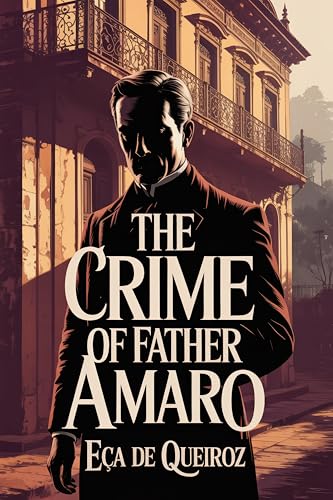
    The Crime of Father Amaro (1875) was the novel that made his reputation and nearly destroyed it. A young priest posted to a provincial town begins an affair with the daughter of his landlady — a woman herself obsessed with the Church. The scandal on publication was not that Eça depicted clerical hypocrisy but that he presented it as structural rather than personal: a system that produces exactly the behavior it officially forbids. The novel was revised twice, each version more precise and more damning.

    The scene that captures the novel’s method most precisely is not the affair itself but one of the devotional meetings held in the landlady’s parlor, where the local clergy and their female admirers gather to discuss Church matters, exchange gossip, and eat. Eça renders it with the documentary patience of a naturalist observing a species — the specific pastries consumed, the particular mix of piety and flirtation in the conversation, the way the young priest Amaro is simultaneously an object of spiritual admiration and obvious physical attention. Nothing is stated. Everything is shown. The reader understands before any of the characters do that the catastrophe is already in motion in the very rituals designed to prevent it.

    Cousin Bazilio (1878) works in tighter domestic space. Luísa is left behind in Lisbon when her husband travels, and when her cousin Bazilio returns from Paris, the affair begins with the speed of people who have been waiting for an excuse. What distinguishes the novel from other provincial-Bovary variations is what comes after: a blackmail plot executed by Luísa’s servant that is both genuinely tense and genuinely funny, and that exposes how the same social codes that condemn women’s desire are then weaponized against them by everyone below them in the hierarchy.

    The Maias (1888) is the masterwork — three generations of an aristocratic family traced through a Portugal modernizing in theory while staying exactly the same in practice. It operates at Anna Karenina scale without the religious scaffolding. Margaret Jull Costa’s translation is the one to read, and it handles the novel’s enormous social canvas without losing the comedy in the detail. It is one of the finest English translations of any Portuguese-language work.

    The central love affair of The Maias — between Carlos da Maia and a woman who eventually reveals herself to be his sister, both victims of a family history neither of them knew — works not as Gothic melodrama but as the logical terminus of a society that has kept everyone sufficiently ignorant of their own past. The incest plot is Eça’s answer to the question of what happens when a culture refuses to examine itself. The Maia family has suppressed its history so thoroughly that its children literally cannot recognize each other. That is a political argument dressed as a plot twist, and it is handled with a control that never lets the symbolism overwhelm the human grief.

    Fernando Pessoa, born in 1888, spent his adult life in Lisbon writing under heteronyms — invented poets with distinct biographies and philosophies. The Book of Disquiet, assembled from fragments after his death, is one of the great prose works of European modernism. He stands as proof that the tradition did not exhaust itself in the nineteenth century, though he is a different reading experience from Machado or Eça: less narrative, more immersive, a book you return to rather than read through.

    Pessoa’s situation was stranger than almost any writer of his era. He invented not just pen names but entire personalities — Alberto Caeiro, Ricardo Reis, Álvaro de Campos — each with a distinct poetic style, biography, and philosophical position. They reviewed each other’s work. They argued with each other in print. Pessoa maintained them simultaneously, writing as Caeiro in one mood and as Campos in another, and leaving behind a trunk containing roughly twenty-seven thousand documents when he died in 1935. The Book of Disquiet, assembled posthumously from that archive, is the closest thing to a self-portrait — written under yet another heteronym, Bernardo Soares, an assistant bookkeeper in Lisbon who spends his evenings observing the city and his interior life with equal, exhausted precision.

    The Question of Translation

    Portuguese presents translators with a specific problem. The language builds meaning through accumulation — long, clause-laden sentences that hold multiple qualifications in suspension — and the temptation for translators working phrase by phrase is to break those constructions into English declaratives that are technically accurate and tonally wrong. Machado’s irony depends on a certain syntactic elongation, a sense of the prose taking its time to deliver a verdict that turns out to be devastating. Flatten the sentence and you flatten the joke. Flatten the joke and you have a nineteenth-century novel about a dead man making observations, which sounds like exactly the kind of book you don’t need to read.

    The same problem, differently inflected, applies to Eça. His sentences carry social performance in their structure — characters who speak in elaborate subordinate clauses are marking their class, their education, their relationship to French culture. A translation that regularizes those structures into clean English prose has misread the novel. The comedy of Portuguese bourgeois life in the 1870s is partly a comedy of affectation, and affectation requires a certain syntactic excess to register.

    There is also the question of register shifts — moments when Machado drops from his elevated ironic mode into something blunt and almost brutal, or when Eça lets a peasant character’s speech cut through three pages of bourgeois posturing with a single sentence. Those shifts are doing rhetorical work that depends on the contrast being legible. If the whole translation runs at the same temperature, the moments that are supposed to land as cold water don’t land at all. The best translators of this tradition understand that their job is to reproduce the contrast, not just the content.

    The editions featured on this site take these problems seriously. The translations make choices — about sentence rhythm, about register, about where to let the prose breathe — that serve the English reader rather than the source text’s grammar. These are translations made by people who understood what the books were trying to do. That is rarer than it should be, and it is the reason this tradition is finally readable in English the way it deserves to be.

    Recommended Edition
    The Posthumous Memoirs of Brás Cubas — Machado de Assis
    Modern English translation

    Kindle →Paperback →

    Machado de Assis
    The Posthumous Memoirs of Brás Cubas: A New TranslationDom Casmurro: A New TranslationThe Posthumous Memoirs of Brás Cubas: A New TranslationDom Casmurro: A New Translation
    Eça de Queirós
    The Crime of Father Amaro: A New Translation

    Aluísio Azevedo and Brazilian Naturalism

    Aluísio Azevedo occupies a different register from Machado de Assis. Where Machado was ironic, interior, and philosophically detached, Azevedo was a naturalist in the Zola mould — interested in environment, class, and the way poverty shapes human beings from the outside in. His 1890 novel The Slum is the defining work of Brazilian naturalism and one of the most viscerally alive novels in the Portuguese language.

    The book is set in a Rio de Janeiro tenement — a cortiço, literally a beehive — and follows the competing lives of a Portuguese immigrant landlord and the hundreds crammed into his building’s rooms and courtyards. It is hot, sensory, and merciless. Azevedo does not sentimentalize poverty; he shows how it operates structurally, wearing down individual will until behaviour starts to look like destiny. If you have read Machado and found him cool and controlled, Azevedo will feel like opening a window. He is the necessary counterweight.

    • The Slum — The foundational text of Brazilian naturalism. A Rio tenement, a Portuguese landlord, and a community ground down by circumstance.

    Frequently Asked Questions

    Is Machado de Assis really considered a postmodern writer even though he died in 1908?

    The term gets applied to him retrospectively and with good reason: the self-interrupting narration, the chapters that exist only to announce they will be skipped, the narrator who directly addresses and argues with the reader — these are techniques we associate with Borges and Calvino, writers who came fifty to seventy years later. Machado didn’t label what he was doing, but Posthumous Memoirs of Brás Cubas, published in 1881, predates by decades the formal experiments that would eventually get classified as postmodern. Whether the label fits matters less than the fact that the book still feels contemporary in a way that most nineteenth-century fiction does not.

    Did Capitu actually cheat? Is there a consensus among scholars?

    There is no consensus, and Machado almost certainly intended it that way. The debate in Brazil is serious enough that it has a name — “the Capitu question” — and it has produced decades of literary criticism, a landmark 2008 TV miniseries, and arguments that are still happening in university seminars. The most persuasive readings tend to focus not on what Capitu did but on what Bentinho’s narration reveals about Bentinho: his obsessive jealousy, his tendency to interpret every ambiguity as confirmation of betrayal, and his conspicuous control over what the reader is and isn’t allowed to see. Whether Capitu was innocent or guilty, the narrator is not reliable enough to convict her.

    Where should I read Eça de Queirós if I’ve never tried him — The Maias, or one of the shorter novels first?

    Start with Cousin Bazilio if you want to ease in — it’s the tightest of his major novels, with a blackmail plot that gives it a thriller’s momentum alongside its social satire, and it runs to roughly three hundred pages rather than the six hundred of The Maias. The Crime of Father Amaro is the other natural entry point, especially if you’re interested in how nineteenth-century novelists handled institutional religion. Save The Maias for when you’ve developed an appetite for Eça’s rhythms; it rewards the investment, but it asks for patience that comes more easily once you already trust him.

    Is The Book of Disquiet a novel? How do you actually read it?

    It is not a novel, not quite a diary, and not quite a collection of essays — the most honest description is that it is a fragmentary prose record left by an invented person. Pessoa wrote the pieces that make up The Book of Disquiet across roughly two decades without ever assembling them into a final order; all existing editions are editorial constructions from the archive he left behind, which means different editions arrange the fragments differently. The practical advice: read it the way you’d read a book of poetry — not straight through in long sittings, but in short sessions, letting individual passages sit. It is a book that accumulates rather than progresses, and trying to race it will lose you the thing it’s actually doing.

    This post contains affiliate links. As an Amazon Associate, we earn from qualifying purchases.