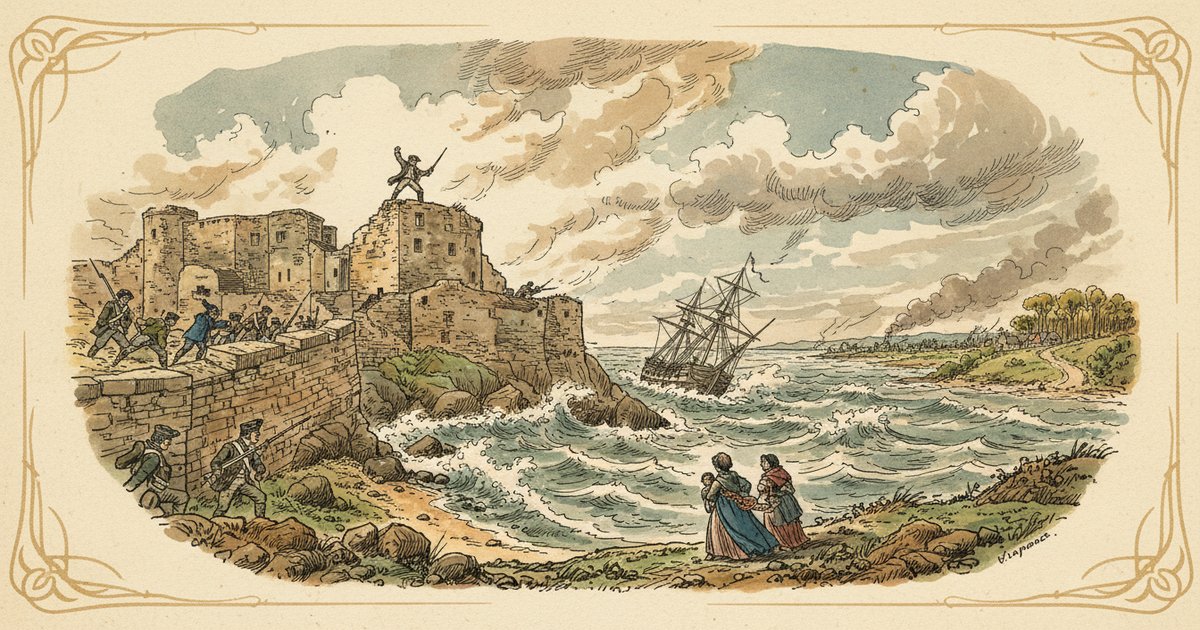
In the spring of 1794, a Republican officer named Gauvain makes a decision that costs him his head. He has captured the Royalist leader Lantenac — the man who burned villages and shot prisoners, the embodiment of the counter-revolution — and then, after watching Lantenac risk his life to pull three children from a burning tower, he opens the cell door and lets him walk free. Mercy over doctrine. The human gesture over the iron logic of revolution. His superior and surrogate father, the priest-turned-commissar Cimourdain, cannot save him. The morning of the execution, as the guillotine falls, Cimourdain shoots himself through the heart.
Victor Hugo did not invent this dilemma. By the time he published Ninety-Three in 1874, he had lived inside it for decades — watched the Paris Commune’s insurgents die by the thousands on the streets he’d walked as a young man, buried a son in 1871 and another in 1873, and spent nineteen years in political exile for refusing to bend to Napoleon III. He knew exactly what ideological certainty costs the people who love you. The novel is usually described as his reckoning with the French Revolution. It is more precisely a reckoning with the question that obsessed him at the end of his life: what do we owe each other when the cause is real and the cost is human?
Ninety-Three is his answer. It is not comfortable. It is not optimistic. But it is the most honest thing he ever wrote.
The Man Who Outlived Almost Everyone He Loved
Hugo was forty when his daughter Léopoldine drowned with her husband in the Seine in 1843. He learned about it from a newspaper, sitting in a café. He did not publish a novel for fifteen years. When the losses resumed in the 1870s — his wife Adèle gone in 1868, his son Charles in 1871, his son François-Victor in 1873 — he was in his seventies, back in Paris after the exile, watching the Republic he’d sacrificed his career for consume itself in the Commune’s bloody reprisals. These are not incidental biographical details. They are the pressure system that shaped every sentence of Ninety-Three.
What this accumulated grief produced, paradoxically, was not a book of despair but one of ferocious moral argument. Hugo had always been a political writer — he’d been a peer of France, a member of the National Assembly, a man who gave speeches on the floor of parliament about the abolition of the death penalty. But Ninety-Three is where politics stops being abstract. Gauvain is young, idealistic, beloved. Cimourdain, who mentored him from boyhood, believes in the Revolution with the totality of a man who has replaced God with a cause. The father-and-surrogate-son dynamic is not an accident; Hugo had buried two sons. He understood what it means to outlive the people you shaped.
The biographical detail that changes how the book reads is the exile itself. Nineteen years on Guernsey and Jersey, forced to watch France from a distance while Louis-Napoleon consolidated power — Hugo knew what it meant to be correct about history and still lose. That knowledge is everywhere in the Vendée sections, in the way he renders both the Royalist guerrillas and the Republican columns with equal moral weight, refusing the easy consolation of a clean villain.
There is a passage early in the novel — before the armies are even properly introduced — where a Republican sergeant named Radoub finds the three children alone in a forest clearing, starving, the youngest still nursing at their dead mother’s breast. He picks them up without ceremony and carries them back to his battalion, which votes, collectively and without irony, to adopt them. It is a moment of almost absurd tenderness dropped into the middle of a war narrative. Hugo puts it there deliberately. He wants you to know what the soldiers are capable of before he shows you what the war will require of them. The grief in the novel is not decorative; it is structural.
The War That History Forgot to Make Simple
The Vendée counter-revolution of 1793 is not a story most readers arrive at knowing. The guillotine, the Jacobins, Robespierre’s Terror — these have iconic weight. The civil war in the bocage of western France, where peasants with scythes fought Republican columns through sunken lanes and dense forests, is less tidy, less photogenic, and therefore largely unknown outside France. Hugo chose it precisely because it resists simplification. The Royalist Marquis de Lantenac leads men who murder prisoners and burn farms. The Republicans march under a banner of liberation while also shooting Royalist civilians. Nobody gets to be purely right. The war grinds on because both sides believe they are saving something essential about France.
Hugo’s genius in Ninety-Three is the pivot the novel makes at its exact center. Three small children — separated from their mother in the war’s chaos, caught between the armies — become the novel’s moral fulcrum. When they are trapped in a burning tower, it is Lantenac, the Royalist butcher, who turns back to save them. A single human reflex undoes his ideology. And it is Gauvain — the young Republican, the novel’s moral hero — who cannot then send Lantenac to the guillotine for all the others he killed. The chain of mercy runs downward until it destroys him. Hugo does not frame this as tragedy or as triumph. He frames it as the truth about human beings: that we are, at our best, ungovernable by our own systems.
What makes the Vendée so useful to Hugo as a setting is that it was, by 1874, still contested political territory in France. Republicans remembered it as a royalist insurgency crushed in the name of progress. Conservatives remembered it as a massacre of faithful Catholics by godless revolutionaries. Historians now estimate that somewhere between 200,000 and 400,000 people died in the region between 1793 and 1796 — a figure that dwarfs the more famous death toll of the Parisian Terror. Hugo had watched France spend the better part of a century arguing about who the villains were. His answer, embedded in the structure of the novel itself, is that the question is the wrong one. The Vendée is not a morality tale about good versus evil. It is a case study in what happens when human beings become fully convinced they are on the right side of history.
How Hugo Builds a Villain You End Up Respecting
Lantenac arrives in the novel the way a weather system arrives — before you see him, you feel the pressure change. Hugo spends nearly fifty pages establishing his reputation through other characters’ fear before the Marquis appears in person. When he finally does, he is in his seventies, boarding a ship under fire, giving orders with the calm of a man who has simply decided that nothing frightens him anymore. He executes a deserter without particular cruelty and without particular pleasure. He is not sadistic. He is something more unsettling: entirely committed. Hugo understood that the most dangerous people in revolutions are not the ones who enjoy violence but the ones who regard it as arithmetic.
This is what makes the burning tower scene so devastating. Lantenac has already condemned the three children to be shot if Gauvain’s Republican forces breach the tower walls — he announced it coldly, as a military calculation. Then the tower catches fire. The children are trapped on an upper floor. Lantenac watches for a moment, and then he goes back. He climbs toward the flames, finds a rope, and lowers the children down one by one. Hugo does not explain it. He does not give Lantenac an interior monologue about a sudden change of heart. The man simply acts, as if the calculus that had governed everything else momentarily stopped running. That gap — between the ideology and the instinct — is where Hugo locates the entire argument of the novel.
Why This Translation?
For most English readers, Ninety-Three has been available only in Victorian-era translations that carry all the stiffness of their moment — sentences that heave and creak, dialogue that sounds like parliament rather than people. This new translation restores what those versions muffled: Hugo’s rhythm, which moves like weather, fast and then slow, intimate and then vast; his capacity to make a military campaign feel as immediate as a conversation in a dark room. It is a book that rewards being read in a version that actually sounds like a novel. Ninety-Three: A New Translation is available now in paperback — the right way to meet the last thing Hugo had left to say.
The specific problem with nineteenth-century English renderings of Hugo is that his prose operates on two registers simultaneously: the oratorical and the intimate. He can move from a panoramic description of a battlefield — the kind of elevated, almost biblical sweep that was his signature — directly into a single soldier noticing that his boots have worn through. When Victorian translators hit the oratorical passages, they amplified them into something approaching parody. When they hit the intimate passages, they formalized them into stiffness. The translation we recommend holds both registers in the same sentence the way Hugo intended, so that the grandeur never loses its human scale. That balance is not easy to achieve, and it is exactly what makes Ninety-Three readable today rather than merely admirable.
Translation Landscape
Ninety-Three (Penguin Classics, trans. Adèle Dorange and Christine Donougher) — The 2024 Penguin Classics edition — the first major new English translation in over a century. Donougher is among the most trusted translators of nineteenth-century French prose (her Zola and Les Misérables are benchmarks). This is the standard scholarly edition going forward.
Ninety-Three (Carroll & Graf, trans. Aline Delano (revised ed.)) — The Delano translation from 1874, revised and still the most commonly found older paperback. Period-accurate voice; the oratorical passages can tip into parody, but the Vendée battle sequences hold up. Acceptable if the Penguin edition is unavailable.
Also worth reading
What Makes This Novel Feel Different From the Rest of Hugo
Readers who come to Ninety-Three after Les Misérables or The Hunchback of Notre-Dame sometimes report a surprise: it feels tighter. Not shorter — it is still Hugo, and Hugo is never spare — but more compressed in its moral argument. Les Misérables is a cathedral of a book, built to contain everything Hugo believed about poverty, law, love, and the nature of goodness. Ninety-Three is more like a proof. It sets up three figures — the implacable old Royalist, the idealistic young Republican, the merciless commissar — and runs them through a series of situations designed to find the exact point at which ideology breaks and the human being underneath it shows through. Every chapter is doing work. There are no lengthy digressions about the Paris sewer system here.
This compression also means the emotional impact arrives faster and harder. By the time Hugo reaches the final confrontation between Cimourdain and Gauvain — the surrogate father forced to authorize the execution of the surrogate son — readers who have spent a hundred pages watching their relationship have very little distance left. Cimourdain is not a monster. He is a man who believes, completely and without self-deception, that the Revolution requires this. His suicide in the novel’s final lines is not the act of a villain who has been defeated. It is the act of a man for whom the cause and the person were the same thing, and now both are gone. Hugo gives him no redemption. He gives him only honesty. After a lifetime of writing, that restraint is the mark of a writer who has nothing left to prove.
Frequently Asked Questions
What is the best English translation of Ninety-Three by Victor Hugo?
For modern readers, the best place to start is Ninety-Three: A New Translation, a contemporary rendering that strips away the archaic phrasing found in Victorian-era editions while preserving Hugo’s intensity and rhetorical power. Unlike nineteenth-century translations that can feel stiff or dated, this version reads as living prose, making Hugo’s portrait of the French Revolution’s most savage year fully accessible to a twenty-first-century audience without sacrificing literary fidelity.
Is Ninety-Three worth reading in 2026?
Yes. Hugo’s final novel speaks directly to questions that have not gone away: what justifies political violence, whether idealism survives contact with war, and how ordinary people behave when history forces an impossible choice. The 1793 Vendée uprising is the setting, but the moral vertigo at the novel’s core is permanent. Ninety-Three: A New Translation makes that argument easier to hear by removing the language barrier that causes many readers to abandon older editions.
How does Ninety-Three compare to The Hunchback of Notre-Dame?
Both novels show Hugo using a single, charged historical moment as a lens for universal themes, but they pull in opposite directions. The Hunchback of Notre-Dame is architectural and symbolic, built around a cathedral and the fatal weight of beauty and deformity. Ninety-Three is kinetic and ideological, driven by revolution, counter-revolution, and a climax of stunning moral ambiguity. Readers who want Hugo’s lyrical grandeur should start with Hunchback; readers who want his political urgency will find Ninety-Three the more gripping experience. Both are available in modern accessible translations at classicsretold.com.
What should I read after Ninety-Three?
Two titles pair naturally with it. The Hunchback of Notre-Dame: A New Translation in Modern Accessible English returns you to Hugo’s France from a different angle, trading revolutionary terror for medieval pageantry and the tragedy of outcasts in a rigid society. If you want to move from Hugo to the broader French Romantic tradition, The Three Musketeers: A New Translation in Modern Accessible English by Alexandre Dumas delivers the same era’s swashbuckling energy with relentless pace and wit. Both are available at classicsretold.com.
Was Ninety-Three Victor Hugo’s last novel?
Yes. Hugo published Ninety-Three in 1874, when he was seventy-one years old, and it was the last novel he completed. He lived another eleven years, dying in 1885 at eighty-three, but spent that final decade primarily writing poetry and attending to his enormous public legacy rather than returning to long fiction. The novel carries the weight of a final statement — its refusal to offer easy consolation feels like the deliberate choice of a writer who knew he was done arguing and wanted to leave the most honest version of what he believed.
How historically accurate is Ninety-Three?
Hugo was scrupulous about the broad strokes of the Vendée uprising — the geography of the bocage, the guerrilla tactics of the Chouans, the role of the Committee of Public Safety — while inventing his central characters wholesale. Lantenac, Gauvain, and Cimourdain are fictional, but the military and political machinery surrounding them is drawn from Hugo’s extensive research into the period. He was particularly careful about the Revolutionary calendar and the specific military campaigns of 1793, which gives the novel an atmosphere of documented reality even when its moral argument is entirely his own invention.
You might also enjoy


This post contains affiliate links. As an Amazon Associate, we earn from qualifying purchases.


You must be logged in to post a comment.