He wrote a 300-page treatise on love in 1822 — a taxonomy of desire, a field guide to the heart — and sold seventeen copies in ten years. The woman who inspired it, Métilde Dembowski, refused to see him alone. She suspected he was taking notes. She was right.
That gap — between Stendhal’s analytical detachment and his helpless, humiliating surrender to feeling — is where his fiction lives. The short stories he wrote in the 1830s, including those gathered in The Chest and the Ghost (and other Stories), are not the work of a man who had figured love out. They are the work of a man who had failed at it repeatedly and learned to render that failure with a surgeon’s eye and a gambler’s nerve. The thesis is uncomfortable: Stendhal understood desire precisely because he could never stop being destroyed by it.
The stories circle what he called la chasse au bonheur — the pursuit of happiness — a phrase that sounds like a motto and reads like a wound. His characters pursue happiness the way a moth pursues a lamp: with complete commitment and no expectation of survival. A woman betrays the man she loves to keep him near. A police chief uses the machinery of justice to eliminate a rival. Desire in these pages is never decorative. It is the lever that moves everything else.
What makes these stories more than clever period pieces is the precision of the emotional diagnosis. Stendhal’s characters don’t suffer vaguely. They suffer in ways that are embarrassingly specific — the particular humiliation of being seen through by the person you’re trying to impress, the exact mathematics of jealousy, the way hope and pride fight each other inside the same chest at the same moment. He had catalogued all of it in De l’Amour, and now, in fiction, he could show it moving.
The Man Who Needed a Pseudonym to Tell the Truth
Henri Beyle was born in Grenoble in 1783, hated it, left as fast as he could, followed Napoleon across half of Europe, and spent the rest of his life trying to get back to Italy. He adopted the pen name Stendhal — borrowed, improbably, from a small Prussian town — because anonymity was the only condition under which he felt free to write honestly. He used over a hundred pseudonyms in his lifetime. The proliferation wasn’t eccentricity. It was strategy: a man with that many masks is a man who understood that the self is also a performance, and that audiences matter.
The years he spent as French consul in Civitavecchia, from 1831 until his death in 1842, are the direct context for these stories. The posting was a backwater — he called it a tomb — but it gave him access to Italian archives, and in those archives he found records of crimes of passion from the Renaissance: confessions, execution orders, accounts of desire curdled into violence. He didn’t merely adapt them. He read them as confirmation of everything he already believed: that passion is the only authentic response to existence, and that society’s job is to punish it. Every biographical fact about Stendhal bends back toward the same question: what does a person do when what they want most is also what the world most forbids?
The answer, for Stendhal, was write it down. De l’Amour, the treatise, gave him the theory. The stories gave him the cases. And the distance of fiction — characters with Spanish names, Italian settings, plots borrowed from dusty chronicles — gave him permission to say what direct confession couldn’t.
There is one detail from Civitavecchia worth sitting with. Stendhal’s consular duties were minimal and he loathed them. But the boredom had a productive edge: with nothing urgent to do, he read obsessively, drafted constantly, and sent long letters back to Paris describing his intellectual loneliness with such wit that his correspondents saved them. The man who looked most like a minor bureaucrat gathering dust in a coastal town was, simultaneously, writing the stories that would be pulled out of obscurity a century after his death and recognized as something close to masterpieces. He had predicted as much — he famously expected to be read around 1880, then revised the estimate to 1935. He was, characteristically, both right and wrong at the same time.
The Shortest Distance Between Two People Is a Complication
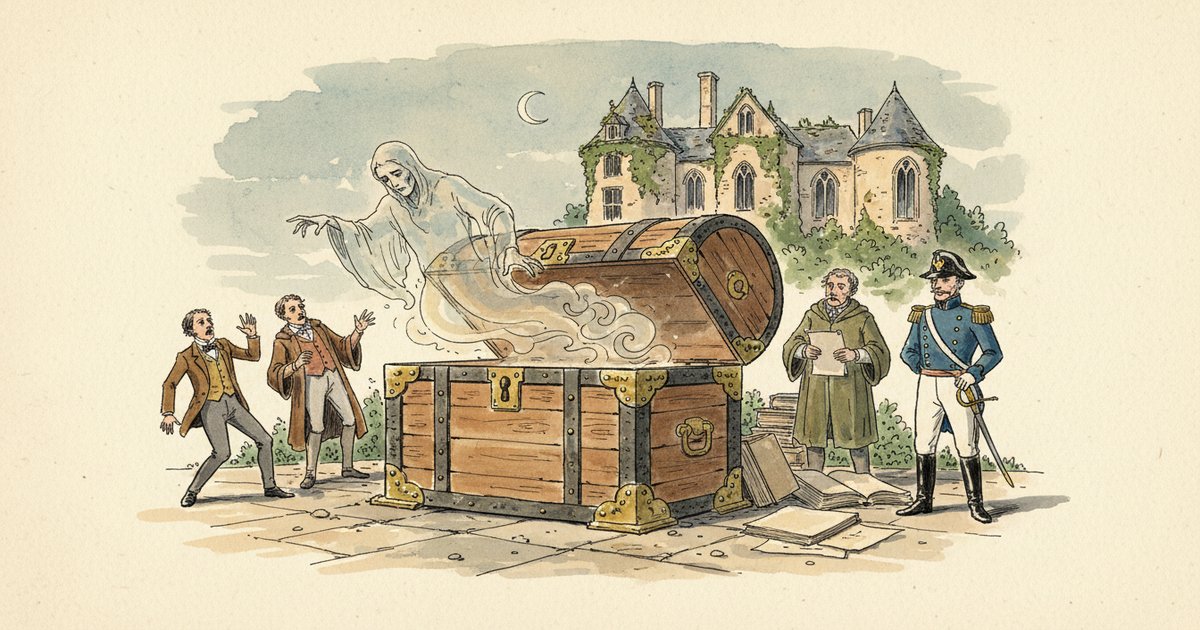
What distinguishes these stories from other Romantic-era fiction is their refusal of sentiment. Stendhal does not romanticize passion — he dissects it. In “The Chest and the Ghost,” desire operates through a gothic frame that he deploys not for atmosphere but for irony: the supernatural is cover for very natural appetites, and the story’s real horror is not the ghost but the calculation behind the haunting. In “Recollections of an Italian Gentleman,” a man’s memory becomes a form of obsession — the past not as nostalgia but as a trap that the present keeps springing. The characters believe they are pursuing happiness. The reader watches them pursue their own undoing with total lucidity about everything except themselves.
That gap — between what characters know and what they cannot stop doing — is where Stendhal’s irony sharpens into something that cuts. These are not tragedies. They’re something colder: portraits of intelligent people who see clearly and act anyway, because what else is there to do? The prose moves the way his best fiction always does — fast, specific, no decoration — and the translation we recommend here earns its place by preserving that velocity. Too many versions of Stendhal slow him down, soften the edges, turn his directness into period furniture. This one doesn’t. The sentences land.
The structure of “The Chest and the Ghost” is worth examining closely, because it shows exactly how Stendhal works. He sets up what looks like a supernatural mystery — a chest, a ghost, whispered rumors in a provincial household — and then, sentence by sentence, withdraws the gothic scaffolding until you’re left staring at something much more unsettling: two people who want each other and have decided that deception is preferable to honesty. The ghost was always a pretense. The chest was always a prop. The performance of fear was always a performance of desire. Stendhal doesn’t announce this revelation; he just stops holding the curtain up and lets you work it out. It takes about three seconds. Then you go back and reread the opening paragraph and realize he told you everything on page one.
What These Stories Owe to The Red and the Black
Readers who come to The Chest and the Ghost from The Red and the Black will recognize the machinery immediately. Julien Sorel, the carpenter’s son who claws his way into Parisian society through a combination of brilliance and calculated charm, is the novel-length version of every protagonist in these stories: someone who understands the rules of the game well enough to play, but whose actual feelings keep breaking through the strategy at the worst possible moments. The stories are shorter and more compressed, but the emotional logic is identical. A character decides to want something. The wanting takes over. The strategy collapses. What’s left is either comedy or catastrophe, depending on which way the final scene turns.
The Red and the Black was published in 1830, just as Stendhal was being packed off to Civitavecchia. The stories in this collection are what came after — after the novel, after the exile, after whatever hope he still harbored about his own romantic prospects had finished evaporating. That context matters. The novel has Julien’s ambition driving the engine, and ambition at least has the dignity of a clear direction. The stories are quieter and more claustrophobic. The characters want things they can’t name. That unnamed quality is where Stendhal gets most interesting, and most true.
Why These Stories Have Been Missing from English
The question of which Stendhal reaches English readers has always been shaped by which Stendhal publishers thought would sell. The Red and the Black and The Charterhouse of Parma have never gone out of print. The shorter fiction — the novellas, the Italian chronicles, the stories collected here — has had a much more irregular history in translation. Some pieces appeared in Victorian anthologies with the kind of bowdlerizing footnotes that turn irony into earnest moralizing. Others simply weren’t translated at all, which is how two of the stories in this collection arrive as English-language debuts. Two stories that Stendhal completed, that have sat in French editions for nearly two centuries, that no one had previously thought worth the effort of translation. That is either a remarkable oversight or a remarkable opportunity, depending on your perspective. The edition featured here treats it as the latter.
The implication is worth spelling out: if you have read Stendhal in English before — even carefully, even devotedly — you have read an incomplete Stendhal. These aren’t footnotes. These are stories in which his characteristic obsessions appear in concentrated form, without the sprawl of a novel to dilute them. Reading them fills in a gap you probably didn’t know was there.
Why This Translation?
Several of these stories have rarely appeared in English at all — two are making their English-language debut here — which means that even committed readers of Stendhal have been missing part of the picture. The Chest and the Ghost (and other Stories) isn’t a sampler for newcomers, though it works as one. It’s the late Stendhal: the consul in his tomb by the sea, pulling Renaissance crime records out of dusty folders and finding, in other people’s catastrophes, confirmation of everything he had lived. Read it alongside The Red and the Black if you want context; read it alone if you want proof that short fiction can do everything the novel does, in a fifth of the space. Available now in paperback: pick it up here.
The specific translation choices matter more with Stendhal than with almost any other French author, because so much of his effect depends on tone. His sentences are short, dry, and often end with a twist that functions like a deadpan punchline — the equivalent of a raised eyebrow. Translate too literally and the eyebrow disappears into wooden phrasing. Translate too freely and you lose the specificity that makes the irony land. The edition featured here threads that needle. Where older translations reach for Victorian dignity, this one reaches for clarity. Where older translations explain the joke, this one trusts the reader to get it. That trust is itself a kind of fidelity to Stendhal, who famously said he wrote for the happy few — by which he meant people sharp enough to read between his lines.
He never did solve the problem of love. Neither do his characters. That’s what makes them worth reading.
Also worth reading
What is the best English translation of The Chest and the Ghost and other Stories by Stendhal?
This new translation of Stendhal’s lesser-known short fiction is among the most accessible English editions available. Unlike older Victorian-era renderings that can feel stiff and dated, this modern translation preserves Stendhal’s dry wit and psychological sharpness while reading naturally for contemporary audiences. It is an ideal entry point for readers encountering Stendhal’s shorter work for the first time.
Is The Chest and the Ghost and other Stories worth reading in 2026?
Stendhal’s preoccupations — social performance, romantic obsession, the gap between how people present themselves and who they truly are — map cleanly onto modern life. These stories are short, precise, and often darkly funny. In 2026, when irony and self-deception are cultural fixtures, Stendhal reads less like a historical curiosity and more like a sharp observer of human nature who happened to write two centuries ago.
How does The Chest and the Ghost and other Stories compare to The Charterhouse of Parma?
The Charterhouse of Parma is expansive — a full novel driven by political intrigue and romantic idealism across hundreds of pages. The Chest and the Ghost and other Stories works in miniature: compact plots, swift reversals, and characters stripped down to a single dominant flaw or desire. Readers who find Stendhal’s novels demanding will discover in these stories a more concentrated version of the same intelligence, and readers already devoted to The Charterhouse of Parma will find here the same psychological acuity operating at close range.
What should I read after The Chest and the Ghost and other Stories?
If Stendhal’s cynical wit and romantic irony appealed to you, the natural next step is Victor Hugo’s The Hunchback of Notre-Dame: A New Translation in Modern Accessible English, available at classicsretold.com — it shares the same French Romantic-era atmosphere but turns the emotional register up sharply, trading wit for tragedy and spectacle. For readers who want momentum and adventure alongside the period intrigue, The Three Musketeers: A New Translation in Modern Accessible English, also at classicsretold.com, delivers exactly that without sacrificing literary quality.
Frequently Asked Questions



This post contains affiliate links. As an Amazon Associate, we earn from qualifying purchases.
Leave a Reply