Looking for the best Stefan Zweig translation in English? This guide compares readability, emotional precision, and modern accessibility so you can start with the edition that captures his full voice before the world ended.
Find Your Best Zweig Translation
Use this guide to compare editions before you choose your next read.
The reputation of German-language literature precedes it badly. Dense. Philosophical. Difficult. The kind of reading that requires a degree you don’t have and a patience you haven’t cultivated. That reputation is partly earned — there is a tradition of German prose that is genuinely demanding — and mostly misleading. Kafka is not difficult. Zweig is not difficult. Nietzsche wrote aphorisms designed to be read in a single sitting and felt in the gut. The difficulty, where it exists, is the difficulty of any serious literature: it asks you to think while you read.
German-language literature in this context means what it has always meant to those who study it seriously: literature written in German, regardless of nationality. Kafka was Czech. Zweig was Austrian. Nietzsche was German but spent most of his productive years in Italian boarding houses and Swiss mountains, writing in deliberate exile from the culture that had formed him. The language is the tradition; the borders are secondary.
Translation matters more with German than with almost any other European language, and the reason is structural. German syntax is architecturally inverted: the verb arrives at the end of the clause, sometimes at the end of a very long clause, and the reader must hold the entire construction in suspension before the meaning resolves. A sentence that begins with a subject, accumulates qualifications, piles on subordinate clauses, and finally delivers its verb at the last possible moment creates a particular kind of suspense — intellectual, syntactical, almost physical. A bad translation flattens this into English word order and loses that suspense entirely. What was a carefully engineered delay becomes a simple declaration. The sentence still means the same thing, technically. But it no longer does the same thing to the reader. This is why two translations of the same Kafka novel can feel like two entirely different books.
The role of a reading guide in this context is not to translate but to curate — to identify the editions that preserve what the original was doing, that make responsible choices about the impossible trade-offs between fidelity and readability, and that carry the reader as close as possible to the experience of reading the German. The translations featured here have been selected on exactly those grounds. Where a newer translation corrects the distortions of an older one, that is noted. Where the translation question is genuinely contested — as it is with Kafka, where scholars still disagree — the reasoning behind the recommended edition is explained. The goal is to get you to the right book by the right route.
Where to Start
Start with Zweig. Not because he is the greatest — he would himself resist that claim — but because he is the most immediately available. The World of Yesterday is the place to begin: a memoir of a civilization in the process of destroying itself, written by a man who understood what he was watching. From Zweig, move to Kafka, whose work is short enough to read in a weekend and strange enough to occupy a lifetime. Nietzsche is for when you want to understand the philosophical atmosphere that produced both of them.
Goethe and the Classical Tradition
Before Kafka, before Nietzsche, before the catastrophes that defined the German twentieth century, there was Goethe — and Goethe is where German literary ambition was first fully articulated. Johann Wolfgang von Goethe spent sixty years writing Faust, a work in two parts that remains the founding document of German literary aspiration. The premise is familiar: a man sells his soul to the devil. What makes Goethe’s version different, and what makes it the central myth of the German tradition, is what Faust wants in exchange. Not pleasure. Not power. Not wealth. Knowledge. Faust wants to understand everything, and when he realizes he cannot, he makes his bargain. Part I of Faust is approachable and genuinely dramatic — the compact with Mephistopheles, the seduction and destruction of Gretchen, the scenes that have entered the culture so thoroughly that most readers recognize them without having read the source. Part II is a different matter entirely: an allegorical journey through classical mythology, medieval empire, and aesthetic philosophy that is one of the most demanding works in any language and one of the most rewarding for those who persist. The gap between the two parts is not merely a matter of difficulty. It is a gap between a young man’s energy and an old man’s wisdom, between drama and vision.
The Sorrows of Young Werther, published in 1774, is Goethe at his most immediate and, historically, his most dangerous. The novel invented a type — the hypersensitive young man overwhelmed by feeling, unable to fit himself into a world of practical compromises, in love with a woman he cannot have. Werther shoots himself at the end. What Goethe cannot have anticipated, though perhaps should have, was the response: a wave of copycat suicides across Europe, young men dressed in Werther’s costume — blue coat, yellow waistcoat — found dead with the novel open beside them. It was the first literary contagion, and it established something that would define the German Romantic tradition: the idea that literature was not merely about life but capable of acting on it, for better or catastrophically for worse.
Friedrich Schiller was the other half of what literary historians call the Weimar Classical period — Goethe and Schiller working in the same small city in the 1790s and early 1800s, in correspondence and competition, defining what German literature was supposed to be. Where Goethe was synthetic and comprehensive, Schiller was urgent and political. His plays — The Robbers, Mary Stuart, William Tell — were the democratic conscience of German literature, written while the aristocracy still ran everything and while the French Revolution was demonstrating, at enormous cost, what happened when the people ran out of patience. Schiller believed in freedom as a philosophical principle and dramatized it in historical settings because the present was too dangerous. The plays remain stageable and urgent. Mary Stuart in particular — two queens, one prisoner, one throne — is as tightly constructed a political drama as anything in the European repertoire.
Goethe & The Classical Tradition
Nietzsche — The Philosopher Who Wrote Like a Novelist
Nietzsche is almost always read wrong in English — either as a proto-fascist whose work was corrupted by his sister, or as a self-help writer whose aphorisms can be extracted and applied to productivity. Both readings miss the point by a wide margin. Nietzsche was a philologist who became a philosopher because he found philosophy too timid, and his work is best understood as a sustained attack on the complacency of European culture in the second half of the nineteenth century.
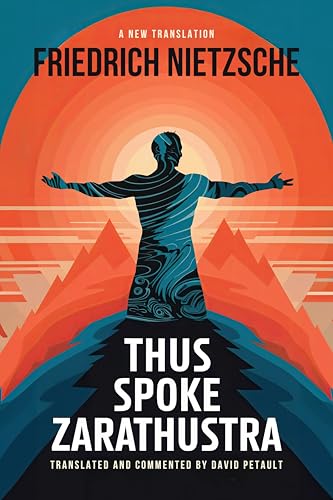
Thus Spoke Zarathustra is the most ambitious of his books and the strangest — a philosophical poem in the form of a prophet’s wanderings, deliberately written to resist summary. Our guide to Nietzsche’s best books addresses the reading order question, which matters more with Nietzsche than with almost any other writer: start in the wrong place and the whole project looks unhinged. Start in the right place and it looks like the most lucid critique of modernity anyone has written.
The right place is not Zarathustra. Before that book becomes legible, Nietzsche needs to be read in his aphoristic mode — The Gay Science, where the declaration that God is dead first appears, not as a triumphant announcement but as a terrifying diagnosis; or Beyond Good and Evil, where the critique of morality is made with surgical precision rather than prophetic heat. The aphorisms are short, often brilliant, sometimes maddening, and they establish the vocabulary and the concerns that Zarathustra then dramatizes. Read in this order, the famous passage in The Gay Science — the madman running through the marketplace with a lantern at midday, crying that we have killed God and asking whether we understand what we have done — lands with the force Nietzsche intended: not as atheist celebration but as existential reckoning. We have destroyed the foundation of our values, he is saying, and we have not yet begun to understand what that means.
Kafka — The Writer Who Named a Century
Franz Kafka published almost nothing in his lifetime and instructed his friend Max Brod to burn the manuscripts after his death. Brod did not comply. The three unfinished novels and the complete stories that survived constitute one of the strangest and most influential bodies of work in any language — work so distinctive that it generated its own adjective, a word that now describes experiences Kafka himself would have recognized instantly.
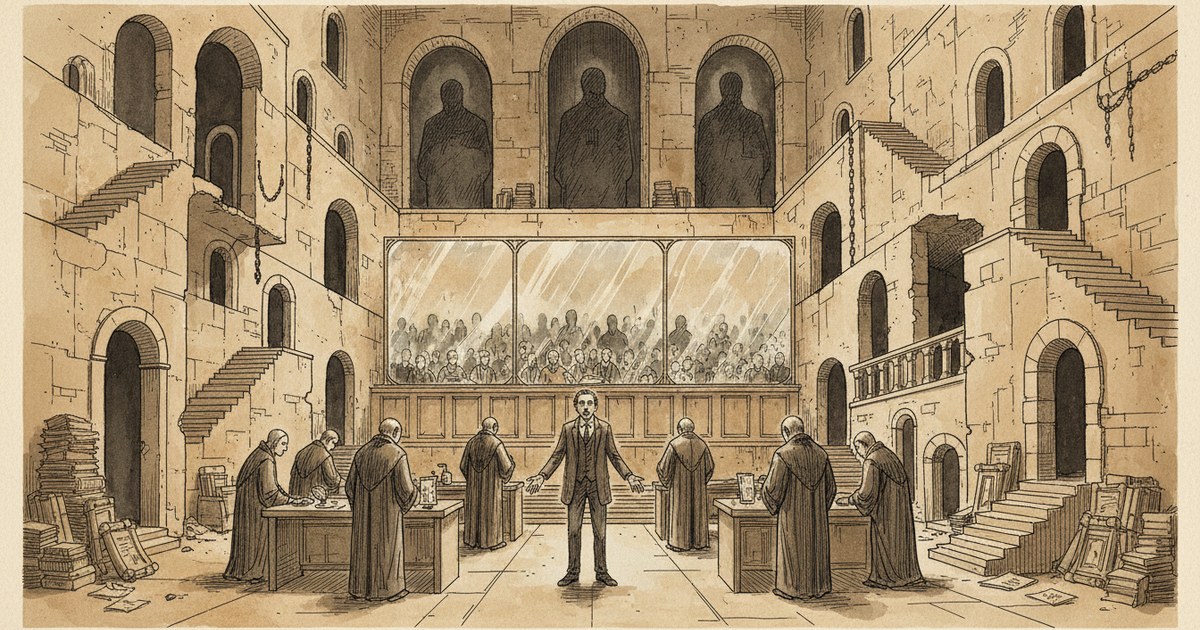
The Trial is the place to start: Josef K., arrested without charge and prosecuted without ever learning the nature of his crime, navigating a legal system that operates according to its own opaque logic. The novel was written in 1914 and 1915, before the century gave it its full resonance. The opening sentence — “Someone must have made a false accusation against Josef K., for he was arrested one morning without having done anything wrong” — is one of the most precisely engineered first sentences in European literature. The passive construction is not an accident: the accusation arrives from nowhere, made by no one identifiable, and the grammatical structure enacts the very condition it describes. Everything that follows is an attempt to find the subject of that sentence, the someone who accused him. The attempt fails. The system is not corrupt in any simple sense; it simply operates according to logic that the accused cannot access, and the horror is that this is presented as entirely normal.
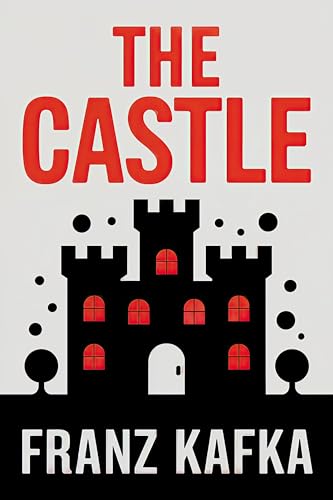
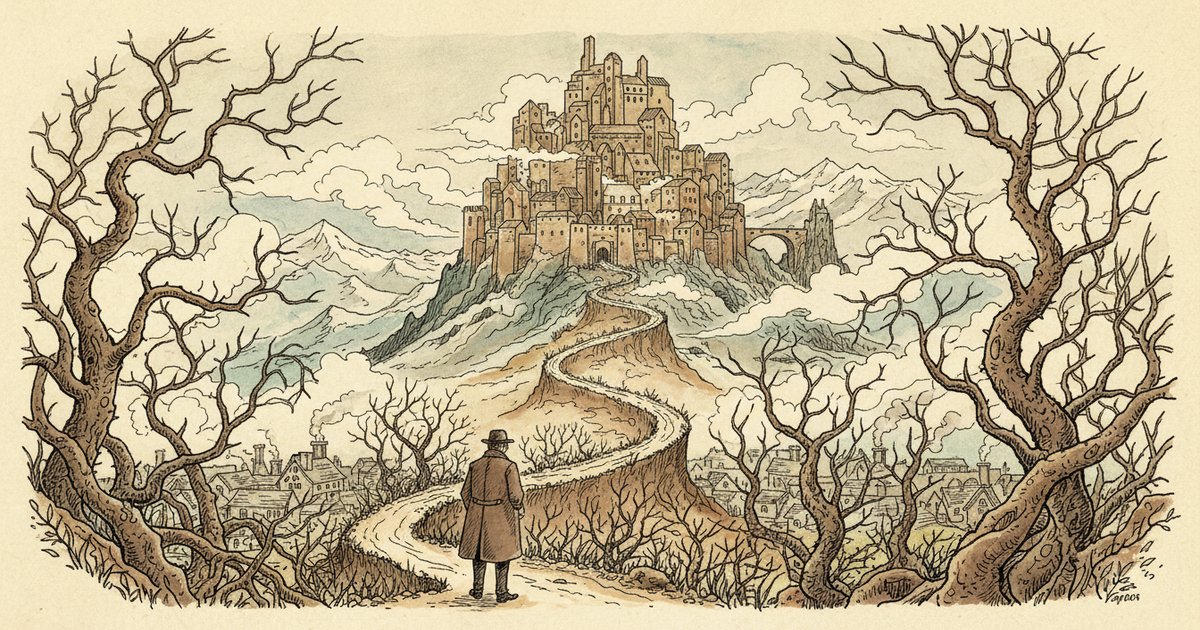
The Castle is the companion piece — a land surveyor arrives in a village and spends the entire novel attempting, and failing, to make contact with the authorities who summoned him. Both novels end mid-sentence. Both are complete.
What makes The Castle distinct from The Trial is the texture of the failure. Where Josef K. is prosecuted, K. the land surveyor is simply ignored — worse, perhaps, in its way. He can see the Castle from the village. He can telephone it, and someone always answers. But the answers are evasive, the appointments are canceled, the officials are perpetually unavailable, and the villagers have long since accommodated themselves to a system of endless deferral. There is a scene in which K. speaks at length with a minor official named Bürgel in the middle of the night, and Bürgel explains — exhaustively, almost generously — exactly the circumstances under which a petitioner might successfully bring his case before the authorities. The circumstances are fantastically specific and happen to match K.’s situation precisely. K. falls asleep during the explanation. It is one of the funniest and most devastating scenes in modern literature.
The translation question matters enormously with Kafka. His German is precise, spare, and almost affectless — a style that has been consistently over-dramatized in older English translations. The Muir translations, which introduced Kafka to English readers in the 1930s, impose a Gothic atmosphere that isn’t there in the original. More recent translations by Breon Mitchell and others correct this. Our guides address the specific translation choices for each book.
Stefan Zweig — Europe’s Most Readable Writer
Stefan Zweig was the most widely read writer in Europe in the 1920s and 1930s — translated into more languages than any contemporary, published in editions that sold in the millions, celebrated from Brazil to Japan. Then came the war, exile, and death by suicide in Petrópolis in 1942. For thirty years after his death, he was largely forgotten in the English-speaking world. The rediscovery, which began in the 1990s and accelerated in the 2010s, has been nearly complete — Zweig is now recognized as one of the essential witnesses to what Europe was before it destroyed itself.
The World of Yesterday is his memoir, written in exile, covering the Vienna of his youth through the catastrophes of both World Wars. It is one of the great documents of the twentieth century — not as history, exactly, but as testimony: the account of a man who understood, in real time, that he was watching the end of a world. Our essay Zweig Knew the World Was Already Over examines what made his vision so precise. His Jewish Legends represent a different, quieter Zweig — the writer working within a tradition rather than observing one collapse.
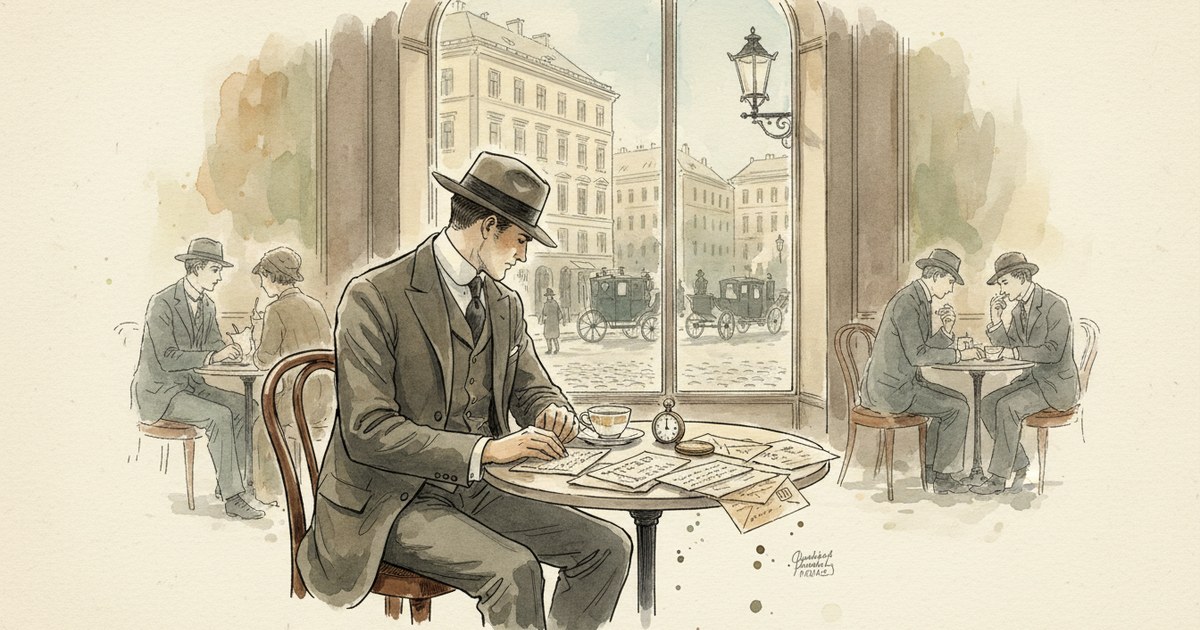
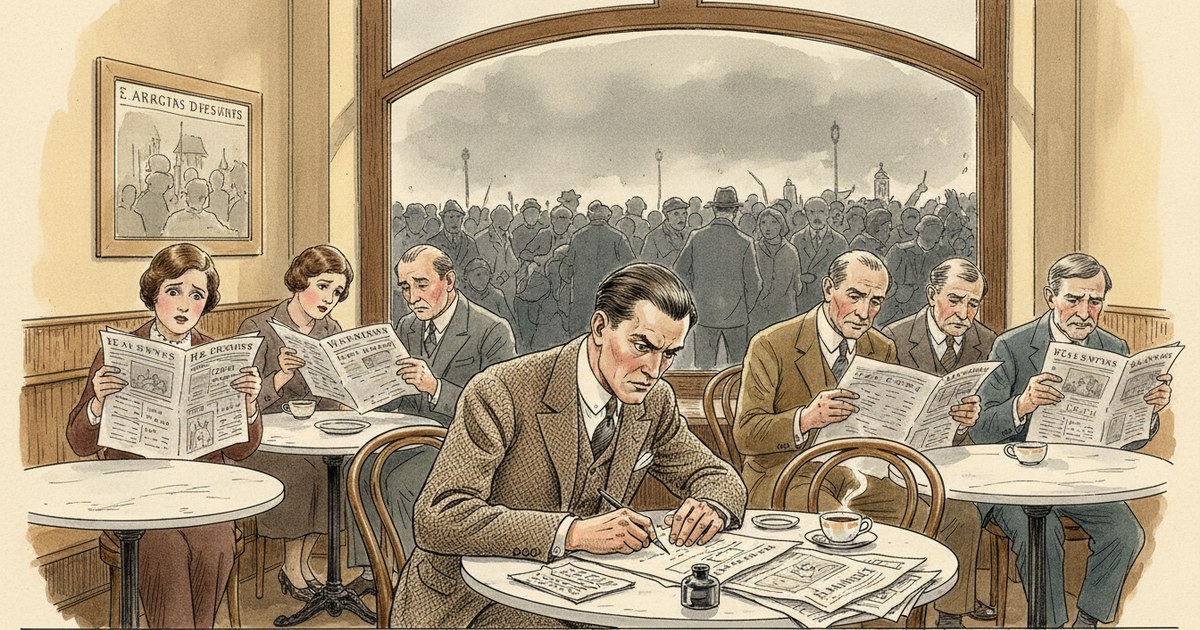
The passage in The World of Yesterday that stops most readers is the description of Vienna before the First World War — a city of coffee houses and concert halls, of intellectual conversation and cosmopolitan ease, where it seemed genuinely possible that European civilization was ascending toward something rather than teetering above an abyss. Zweig describes this world not with naive nostalgia but with the particular anguish of someone who knows what came after. He is writing the memoir in 1941, in exile in Brazil, his Austrian passport cancelled, his books burned. The Vienna he describes is gone so completely that it requires an act of imagination to believe it existed. What makes the book devastating is that Zweig provides that imagination and then takes it away. You understand what was lost because he makes you see it, and then he makes you watch it disappear.
The Twentieth Century Beyond Kafka and Zweig
The German-language tradition did not begin with Kafka and Zweig, and it did not end with them. The twentieth century produced several other writers whose work is essential to any serious engagement with the tradition — and whose absence from English reading lists says more about the accidents of literary fashion than about their quality.
Thomas Mann is the great German novelist in the way that Tolstoy is the great Russian novelist — a writer of such comprehensive ambition and sustained achievement that the tradition orients itself around him. Buddenbrooks, published in 1901 when Mann was twenty-six, is the great German family novel: four generations of a Lübeck merchant family in decline, the commercial instinct fading as the artistic one strengthens, told with the precision of a surgeon and the sympathy of a son. Mann was drawing on his own family history, and the emotional accuracy is inseparable from the formal control — the novel spans decades and dozens of characters without losing its thread or its feeling. The Magic Mountain, published in 1924, is more demanding and more rewarding in proportion: a young man named Hans Castorp arrives at a Swiss sanatorium to visit a cousin for three weeks and stays seven years. In those seven years, while Castorp debates philosophy with the tuberculosis patients and drifts through an extended holiday from ordinary life, Europe drifts toward war. The sanatorium is a symbol so fully realized that it stops feeling like a symbol and starts feeling like a place.
Bertolt Brecht approached the literary tradition from the theatre rather than the novel, and what he built there was designed to work against everything theatre had been doing. The Threepenny Opera and Mother Courage and Her Children are the two essential works — the first a savage comic opera set among criminals and beggars, the second a study of a woman who follows armies to profit from war and loses everything she values to the same war she profits from. Brecht invented what he called the epic theatre, a set of techniques designed to prevent empathy — to interrupt the audience’s identification with the characters before it could produce the comfortable catharsis of conventional drama. He wanted audiences to think rather than feel, to remain critical observers rather than become absorbed participants. He was largely right that the theatre had been making audiences feel rather than think, and his corrective, however uncomfortable in the experience, produced plays that remain politically alive in ways that most theatre of the same period does not.
W.G. Sebald is the great late discovery of German-language literature — a writer who was almost unknown until his sixties and who died in a car accident in 2001, leaving four major prose works and a question about what else he might have written. The Rings of Saturn, The Emigrants, and Austerlitz are prose works that move between memoir, history, and fiction without announcing which mode they are currently inhabiting. Photographs are embedded in the text without captions. Narrators speak in voices that are and are not Sebald’s own. The subject, always, is what time does to memory, what history does to individuals, and what German culture did to European Jewish life and then suppressed. Sebald spent most of his adult life in England, teaching German literature at the University of East Anglia, and his displacement is present in everything he wrote — a German writer who could not write in Germany about Germany, circling the subject from the outside, in English exile.
How to Read German-Language Literature
The tradition is large and the entry points matter. A few practical orientations:
Start with Zweig or Kafka, not Goethe or Nietzsche. This is not because Goethe and Nietzsche are inferior — they are not — but because they require more context to read productively. Zweig is immediately available: his prose translates well, his subjects are human-scale, and his memoir The World of Yesterday provides a historical orientation to the whole period that makes subsequent reading richer. Kafka’s stories are short enough to read in a single sitting and strange enough to reward rereading indefinitely. Both writers give you an experience before they give you a system. Start with the experience.
With Kafka, the translator matters enormously. This is not a minor scholarly preference — it is a practical reading question. The older Muir translations, which many older paperback editions still use, impose a Gothic drama on Kafka’s prose that is not present in the German original. His style is spare, precise, almost bureaucratic — the horror comes from the flatness of the description, not from elevated diction or atmospheric language. More recent translations correct this and return Kafka’s prose to the affectless register where its real power lives. The edition featured here has been chosen with this in mind.
With Nietzsche, read the aphoristic books before Zarathustra. The Gay Science and Beyond Good and Evil are the preparation. They establish the vocabulary, the concerns, and the targets of Nietzsche’s critique in a form that is self-contained and immediately graspable — each aphorism is a complete unit of thought. Zarathustra, approached after these, becomes a dramatization of positions already understood. Approached cold, it can seem merely eccentric.
Do not skip Austria. The Austrian literary tradition — Zweig, Robert Musil, Thomas Bernhard, Ingeborg Bachmann — is as rich as the German, and quite different in tone. Where the German tradition tends toward the systematic and the ambitious, the Austrian tends toward the ironic and the self-aware. Musil’s The Man Without Qualities is the great unfinished novel of the twentieth century, a work of such sustained intelligence and dark comedy that its incompletion feels appropriate — a novel about a civilization that ran out of time, left unfinished by a writer who ran out of time. Bernhard’s novels are tirades, monologues of such sustained venom and precision that they become their own form of music. Bachmann’s prose and poetry are among the most formally exacting works in the tradition. The Austrian tradition is not a footnote to the German. It is a parallel conversation.
The Larger Context
German-language literature does not exist in isolation. The tradition was in constant conversation with the French realists — Flaubert’s influence on the German novel was direct and acknowledged, and understanding Madame Bovary illuminates what the German novelists were responding to and reacting against. The philosophical tradition — Kant, Hegel, Schopenhauer, Nietzsche — runs beneath the fiction like a current, surfacing visibly in Kafka and Zweig and in the Austrian writers who came after them.
Reading German-language literature seriously means reading across these borders — between fiction and philosophy, between Austria and Germany, between the nineteenth century and the catastrophes of the twentieth. The writers in this tradition were not working in separate rooms. They were participants in a single long argument about what European civilization was and what it was becoming. The argument ended badly. The books remain.
Frequently Asked Questions
What is the best German novel to start with?
The two most reliable entry points are Zweig’s The World of Yesterday and Kafka’s The Trial. Zweig is the more immediately accessible of the two — his memoir reads with the momentum of a novel and provides historical orientation that enriches everything else in the tradition. Kafka’s The Trial is slightly more demanding but short enough to read in a weekend, and it remains one of the most viscerally immediate works in any language.
Is German literature really as difficult as its reputation suggests?
The reputation is real but applied too broadly. There is genuinely demanding work in the tradition — Musil’s The Man Without Qualities, Hegel’s Phenomenology of Spirit, Goethe’s Faust Part II — that requires sustained attention and some preparation. But Kafka’s stories are not difficult. Zweig’s prose is not difficult. Nietzsche’s aphorisms are designed for immediate impact. The difficulty, where it exists, is the difficulty of seriousness rather than obscurity: these writers expect you to think while you read, which is a different thing from being inaccessible.
Which German-language authors are most important?
Any serious list would include: Goethe, the founding figure of the literary tradition; Nietzsche, the philosopher who rewrote the terms of European thought; Kafka, whose three novels and stories generated their own adjective and their own tradition; Thomas Mann, the great German novelist of the twentieth century; Stefan Zweig, the essential witness to prewar European culture; Bertolt Brecht, who reinvented what theatre was for; W.G. Sebald, the great late voice on memory, history, and suppressed guilt; and Robert Musil, whose unfinished The Man Without Qualities is one of the most sustained acts of literary intelligence in the European tradition.
Does it matter which translation of Kafka I read?
Yes, significantly. Kafka’s German is spare, precise, and almost affectless — the horror of his fiction comes directly from the flatness of its register, the way catastrophic events are described in the tone of an office memorandum. The older Muir translations, which introduced Kafka to English readers in the 1930s and which many older paperback editions still carry, impose a Gothic atmosphere on this prose that is not present in the original and that fundamentally changes the reading experience. More recent translations restore the affectless precision that makes Kafka’s work distinctive, and the translation we recommend has been selected specifically for this quality.
This post contains affiliate links. As an Amazon Associate, we earn from qualifying purchases.














You must be logged in to post a comment.