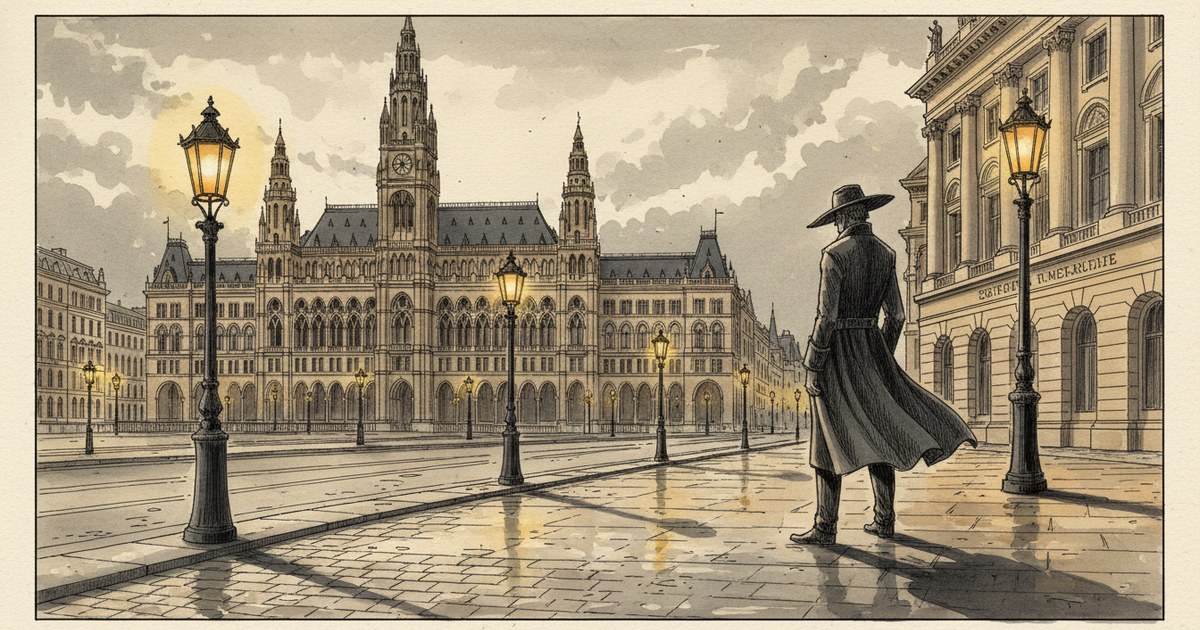
Search “Ringstrasse” today and the results come back immediately: the Kunsthistorisches Museum in its Italian Renaissance skin, the Burgtheater playing neoclassical grandeur, the neo-Gothic Rathaus spiking the skyline like a cathedral that forgot what century it was born in. Vienna’s imperial boulevard is one of the most photographed urban projects in Europe — and one of the most misunderstood. Visitors walk it and see ambition, sweep, the confidence of empire. What they are actually walking through is the architecture of anxiety: a civilization so uncertain of its own modernity that it dressed everything in costumes ransacked from dead civilizations and called it progress. Someone had already written the manual for this. She was eighteen years old, and she finished the draft in 1817.

Mary Shelley’s Frankenstein was published in 1818, thirty-nine years before Franz Joseph I signed the decree demolishing Vienna’s medieval walls and ordering the construction of the Ringstrasse. The novel is not a ghost story or a monster story. It is a story about what happens when you assemble something from borrowed parts and pretend the stitching doesn’t show — and then have the audacity to call your creation new. Every stone of the Ringstrasse is a suture. The Ringstrasse is Frankenstein’s creature, built at imperial scale.
That argument sounds provocative until you actually walk the boulevard and the novel together. Then it feels obvious — which is perhaps the most useful thing a great book can do. Make the thing you were already looking at suddenly legible.
Geneva, 1816: The Summer That Made the Monster
The year before Mary Shelley began writing in earnest was the year the sky turned wrong. Mount Tambora had erupted in April 1815, sending enough ash and sulfur into the atmosphere to drop global temperatures and eliminate summer across the Northern Hemisphere. In 1816, crops failed across Europe and North America. The skies over Lake Geneva were apocalyptic — lurid, chemically strange, the kind of sunsets that looked painted by someone who had never seen a sunset. Mary Godwin, not yet Shelley, was nineteen that summer, living with Percy Bysshe Shelley, twenty-four, at the Villa Diodati near Geneva alongside Byron and his physician Polidori. They read ghost stories aloud by firelight. Byron proposed that each of them write one.
What Mary brought to that challenge was not just imagination but immersion. The galvanism debates were live and scandalous: Luigi Galvani had published his experiments on frog legs in 1791, demonstrating that electrical current could animate dead muscle. Giovanni Aldini, his nephew, had taken the show public — applying galvanic current to the body of an executed criminal at Newgate Prison in 1803, making the jaw clench, the eye open, the fist rise. These were not fringe spectacles. They were serious scientific theater, and the question underneath them was serious: what is the difference between matter and life? What exactly does lightning do to a frog, and how far can you take the principle? Percy Shelley had read the natural philosophers obsessively. That summer, the ideas were in the air along with the Tambora ash, and Mary absorbed both. Victor Frankenstein is not a madman. He is the smartest person in his lecture hall, following the logic of his era to its conclusion.
She never lets him off the hook for that. The crime in Frankenstein is not ambition — it is abandonment. Victor builds his creature and then recoils from it. The monster’s fury is not born from evil. It is born from being made, and then being left.
Franz Joseph’s Creature: The Ringstrasse as Architectural Frankenstein
In December 1857, Emperor Franz Joseph issued a decree dissolving Vienna’s old city walls and opening the space for what would become one of history’s most deliberate acts of urban theater. The Ringstrasse was not a city growing; it was a city being assembled to specification. What followed over the next four decades was a controlled raid on the architectural past: Theophil Hansen designed the Parliament building in the Greek Revival style, borrowing democracy’s visual language for an empire that was not one; Heinrich von Ferstel’s Votivkirche plundered French Gothic for its soaring twin spires; Gottfried Semper and Carl von Hasenauer clothed the Kunsthistorisches Museum in Italian Renaissance grandeur to house collections the Habsburgs had accumulated from every corner of a continent. None of these styles were native. All of them were selected, as Victor Frankenstein selected his materials, for what they signified — for the aura they could transfer.
Hans Makart was the Ringstrasse’s painter in the same way that Semper was its architect: both were producing something enormous, theatrical, and historically composite, each canvas and façade a demonstration that the right arrangement of borrowed references could produce the impression of inherent authority. Makart’s studio became a social institution; his paintings, vast and operatic, were events. They were also, in retrospect, the ideology made explicit — the belief that grandeur could be assembled from the correct ingredients rather than grown from something real. The Ringstrasse’s most honest building might be the Rathaus, its neo-Gothic façade rising over a city with no medieval civic tradition to justify it, a borrowed spine for a body that was something else entirely. Frankenstein’s creature had a borrowed nervous system too. It could feel everything. It could not be claimed.
The Knife That Saves, the System That Destroys
While the Ringstrasse was going up, something equally extraordinary was happening a few kilometers away at the Vienna General Hospital — the Allgemeines Krankenhaus — which had become by the mid-nineteenth century the most advanced medical institution in the world. The Vienna School of Medicine was drawing physicians from across Europe and America to learn pathological anatomy, to look inside the body with a precision that had no precedent. Theodor Billroth performed the first successful gastrectomy there in 1881, removing two-thirds of a patient’s stomach and reattaching the remainder to the small intestine. The patient lived. The knife, in skilled hands, could do things that looked like creation.
But the same institution had, a generation earlier, destroyed Ignaz Semmelweis. Semmelweis had noticed in the 1840s that the mortality rate from childbed fever was dramatically lower in the ward staffed by midwives than in the ward staffed by physicians who had come directly from performing autopsies. He proposed that the physicians were carrying something — what we now call pathogens — on their hands. He was ignored, mocked, forced out, and eventually committed to a mental asylum, where he died in 1865 at fifty-seven, possibly from the same infection he had spent his career trying to prevent. The system did not lack the intelligence to hear him. It lacked the will to bear the implication — that the people doing the healing were also doing the harm. Frankenstein already knew this. Victor is not evil. He is a man who cannot tolerate the full consequences of what he has done, and so he runs, and the running is what turns creation into catastrophe. Semmelweis saw too clearly. The institution’s response was the same as Victor’s: it looked away.
The Vienna Medical School and Victor Frankenstein are not an analogy. They are the same story, playing out in different registers — the story of what happens when a system built around mastery encounters the thing mastery cannot fix, which is the consequences of mastery itself.
Why This Translation Changes Everything
Most readers who bounce off Frankenstein are bouncing off the register, not the novel. The archaic syntax, the Romantic effusions, the layers of framing narration — Walton writing letters, Victor narrating to Walton, the creature narrating to Victor — can feel like obstacles before the reader gets to what the book actually is, which is a philosophical thriller of devastating precision. the edition linked below strips the archaic drag without flattening the prose into something generic. What comes through, finally, is Victor’s rationalizations in their full, self-serving clarity — you can watch him construct his innocence in real time — and the creature’s chapters, which are the most extraordinary thing in the novel. The creature speaks in complete paragraphs. It argues. It cites its own experience as evidence. It is more articulate than anyone who has ever feared it, and this translation lets that eloquence land without the reader having to fight the sentence structure to get there. The frame narrative, which is easy to dismiss, becomes in this edition what it always was: a reminder that this is a story being told and retold, and that every telling involves selection, omission, the possibility of self-deception. You finish it thinking about what Victor left out.
Frequently Asked Questions
What does the Ringstrasse have to do with Frankenstein?
The Ringstrasse — Vienna’s imperial boulevard built between 1857 and 1900 — was an act of assembly rather than growth. Its architects deliberately mixed neo-Gothic, neo-Renaissance, and neo-Baroque styles, constructing an identity from borrowed historical fragments. Mary Shelley’s Frankenstein, written forty years before the first stone was laid, described exactly this impulse and its consequences: the creature built from assembled parts is not the horror. The horror is what the creator refuses to acknowledge about what he has made.
Did the Shelleys ever visit Vienna?
Percy and Mary Shelley travelled through continental Europe in 1814 and again in 1816. Mary’s journals mention passing through Austria, though the Ringstrasse didn’t yet exist — Franz Joseph’s decree demolishing Vienna’s medieval walls came in 1857, four decades after Frankenstein was published. What the Shelleys would have seen was the late Habsburg baroque: the predecessor culture the Ringstrasse simultaneously celebrated and replaced.
Is Frankenstein gothic horror or science fiction?
Both — and the tension between those categories is what keeps the novel alive. The gothic framework (isolation, transgression, the return of what cannot be buried) is the emotional architecture. The science fiction premise (galvanism, reanimation, the medical frontier) is the intellectual engine. The Ringstrasse era was caught in the same bind: obsessed with both aesthetic grandeur and scientific progress, it embodied the same unresolved contradiction Shelley had diagnosed in 1818.
Which edition of Frankenstein is best for a first read?
For a first read, the edition linked below is the most direct route into the novel — the archaic register is modernized without flattening the prose, so Victor’s rationalizations and the creature’s eloquence both land cleanly. If you want scholarly apparatus, the Oxford World’s Classics edition has the best editorial notes on the scientific background. The Penguin Classics edition is the standard academic text. But for the experience of the novel as a novel, the edition linked below is where to start.
This post contains affiliate links. As an Amazon Associate, we earn from qualifying purchases.








You must be logged in to post a comment.