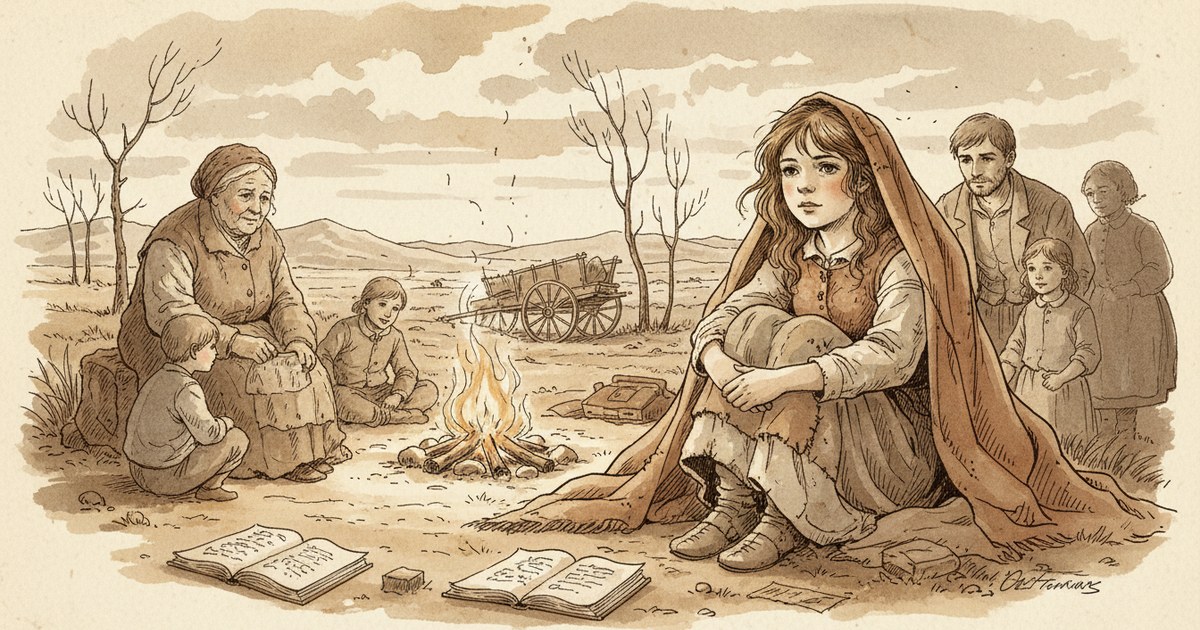
At the gates of Paris, a thirteen-year-old girl is watching a customs official search her mother’s caravan. The canvas is so faded its color is unguessable. The donkey, Palikare, is the family’s only asset. The mother is dying on a mattress inside. Within the first pages of Nobody’s Girl, Hector Malot has already done the brutal work: Perrine has nothing, knows no one in France, and the one person who loves her is slipping away. What follows is not a rescue story. It is a study in what a child does when there is no rescue coming.
Malot published En Famille in 1893 — serialized in sixty installments in Le Petit Journal, then released in two volumes by Flammarion — and the Académie Française awarded it the Montyon Prize the following year. The praise was deserved, but the category of “children’s classic” has always undersold it. This is a novel about survival strategy, about a child who understands that being unknown is a form of power. When Perrine’s mother dies and she sets off on foot to find a grandfather in a mill town two hundred kilometers north, she does not announce herself. She takes a false name — Aurelie — and earns her way into the old man’s trust through competence before she ever risks the truth. Malot’s thesis is unsentimental: affection, in this world, must be made. It cannot simply be claimed.
What makes the book land harder than most novels of its era is that Perrine’s grandfather, Vulfran Paindavoin, is blind. He cannot see her face, cannot recognize any physical resemblance to the son he disowned. She must be known entirely through her actions, her voice, the quality of her work. The blindness is not symbolic decoration — it is the mechanism. Malot built a novel in which identity can only be established through proof, and then watched what that demand does to a child with everything at stake.
The Novelist Who Knew That Sentiment Is a Luxury
Hector Malot was born in 1830 in La Bouille, a village on the Seine in Normandy, and he spent his early career doing exactly what his characters cannot afford to do: waiting to be discovered. He clerked in a notary’s office, moved to Paris, wrote theater criticism, circulated among the literary figures of the Second Empire. His first novels appeared in the 1860s — competent, well-reviewed, largely forgotten. What changed him was the decision to stop writing about the bourgeois parlor and start writing about the road.
Sans Famille, published in 1878, made him famous across Europe. It follows Rémi, an abandoned boy traveling France with a street musician and his performing animals — a premise that reads like Dickens until you notice that Malot is less interested in sentiment than in the economics of survival. The novel was an immediate sensation, awarded the Montyon Prize, translated into dozens of languages, adapted for stage and screen well into the twentieth century. Malot had found his subject: the child moving through a world that owes them nothing, discovering what they are made of precisely because no one will tell them.
En Famille is the companion, written fifteen years later when Malot was in his sixties and had nothing to prove. The formal ambition is more compressed. Where Sans Famille sprawls across France in picaresque episodes, En Famille drives toward a single destination and a single question: how do you make someone love you when you cannot tell them who you are? The biographical connection matters here — Malot had by the 1890s watched the Paris he knew transformed by industrial capital, by the expansion of textile mills and their company towns, by a new class of self-made patriarchs whose fortunes had made them gods of small provincial worlds. Vulfran Paindavoin is drawn from that observation. His power is entirely real. His blindness is the one crack in it.
Malot died in 1907, productive until the end, honored but never quite fully absorbed into the French literary canon. He worked in a register — clear, direct, morally serious without being moralistic — that the twentieth century would struggle to categorize. He was not a naturalist in Zola’s mode, not a symbolist, not an aesthete. He was something rarer: a novelist who believed that how a child behaves under pressure is one of the most interesting things a novel can show you.
The Arithmetic of Trust
Perrine arrives at the mill town of Maraucourt with almost nothing: a few francs, a working knowledge of English and French, and the intelligence to understand that revealing herself too soon will destroy everything. Her father, Edmond Vaillant, had married an Indian woman against his own father’s wishes and died before the reconciliation he’d been working toward could happen. Perrine is, legally and practically, a stranger to her own inheritance. The name she takes — Aurelie — is not a lie she enjoys. It is a tool she uses with the precision of someone who cannot afford mistakes.
What Malot does brilliantly is refuse to sentimentalize the deception. Perrine does not feel guilty about it in the way a lesser novel would insist she should. She feels the pressure of maintaining it — the constant calibration of what she can reveal, what she must withhold, when a moment of genuine connection threatens to expose her. The reader is never allowed to settle into comfortable sympathy. We know she is lying. We understand completely why. The tension between those two facts never releases.
The grandfather is the other achievement of the novel. Vulfran Paindavoin is not a villain softened by age. He is a man who made a fortune through will and ruthlessness and has not changed his fundamental nature simply because he can no longer see. When he takes an interest in Aurelie — this capable, linguistically gifted girl who turns out to be useful to his business — there is no sentimentality in it. He values her because she performs. What shifts, slowly, is his dependence. And Malot is precise about what dependence does to a proud man: it does not humble him, but it opens a door that was previously bolted shut.
The novel’s climax, when Perrine finally tells him the truth, is not a scene of tearful reconciliation. It is a scene of reckoning. The grandfather must decide whether the girl who earned his trust is the same person as the granddaughter he refused to acknowledge — whether those are even separable questions. Malot refuses to smooth this over. The emotion is earned because the logic is airtight, and the logic is airtight because every scene before it was doing necessary work.
The Translation Landscape
En Famille has always lived in the shadow of Sans Famille, and its translation history reflects that neglect. The most widely circulated English versions are public domain texts from the early twentieth century — competent period pieces that render the French with reasonable fidelity but carry the full weight of Edwardian syntax. Sentences run long and subordinate. Register distinctions between characters flatten out. Perrine’s voice, which in Malot’s French is precise and slightly guarded — a child who chooses words carefully — becomes generic Victorian-girl diction, earnest and undifferentiated. These versions are readable, but they make the novel feel older than it is and more sentimental than Malot intended.
There is also a tradition of simplified adaptations aimed at young readers, particularly in the mid-twentieth century, which tend to excise the economic specificity that gives the novel its weight. The mill town’s industrial operations, the exchange of favors and suspicion among workers, the way Vulfran’s blindness changes the power dynamics of every conversation he has — these are the load-bearing elements, and they tend to get cut when the book is packaged as a childhood adventure. What remains is a pleasant story about a plucky orphan. What’s lost is the argument.
The modern translation landscape for this title is sparse. Unlike Malot’s more famous companion novel, En Famille has not attracted the sustained attention of a major press. No Penguin Classics edition exists in current print. No Oxford World’s Classics volume. The book has, until recently, been available in English primarily in versions that were already antique when your grandparents might have read them. That gap is precisely what the edition linked below addresses.
Why This Translation?
the edition linked below was built around a single editorial decision: treat this as a novel for adults who happen to be reading about a child, not as a children’s book that adults might find charming. That means preserving the novel’s procedural precision — the way Malot tracks Perrine’s finances, her daily labor, the specific calculations she makes about when to trust and when to withhold. It means keeping Vulfran’s voice authoritative and difficult rather than softening him into a lovable curmudgeon. And it means letting Perrine’s narrated interiority stay guarded, as Malot wrote it, rather than opening it up into the confessional mode that later translations assumed a young protagonist required.
A passage midway through illustrates the difference. When Perrine first correctly translates a business dispatch for Vulfran — a moment that begins her real relationship with him — the older public domain versions tend to describe her relief and pleasure at having pleased him. the edition linked below stays with what Malot actually wrote: her awareness that she has now made herself useful, and her immediate, quiet calculation of what that usefulness might be worth. The distinction is small on the surface and structural underneath. This translation keeps Perrine’s intelligence where Malot put it — fully in view, working at all times. That is the novel’s engine, and this edition does not muffle it. The paperback edition is available on Amazon, with the ebook available through the same listing.
Is Nobody’s Girl a sequel to Nobody’s Boy (Sans Famille)?
No. The two novels share a thematic concern — a child without family navigating a world that offers no guarantees — but they have no plot connection. The characters, settings, and storylines are entirely separate. Sans Famille follows a boy named Rémi across France; En Famille follows a girl named Perrine toward a single destination. They were written fifteen years apart and can be read in any order or independently.
What age is this book appropriate for?
Malot wrote for a general audience serializing in a major Paris newspaper, and the novel works best when read that way — as serious fiction about a child, not as fiction exclusively for children. the edition linked below is aimed at adult readers, though older teens who are comfortable with nineteenth-century social realism will find it rewarding. The subject matter is not graphic, but it is direct about poverty, illness, and the mechanics of economic power in ways that simplified adaptations tend to avoid.
Is this book in the public domain?
The original French text of En Famille (1893) is fully in the public domain. The translation in this edition is new work, under its own copyright. When you purchase the edition linked below, you are buying access to this specific modern English translation — its editorial choices, its rendering of Malot’s register, its decisions about how to carry his voice into contemporary English.
How does this compare to older free translations available online?
The free versions available through Project Gutenberg and similar archives are early twentieth-century translations that read as products of their era: longer sentences, flattened character voices, and a tendency to soften Malot’s unsentimental edges. They are accurate in a word-by-word sense but carry a period register that distances modern readers from the novel’s emotional logic. the edition linked below was translated and edited to read as contemporary literary fiction — not modernized, but alive in the way that good recent translations of Flaubert or Maupassant feel alive. The goal was a version you would hand to someone who doesn’t already read nineteenth-century novels and have them finish it.
Also worth reading

Leave a Reply