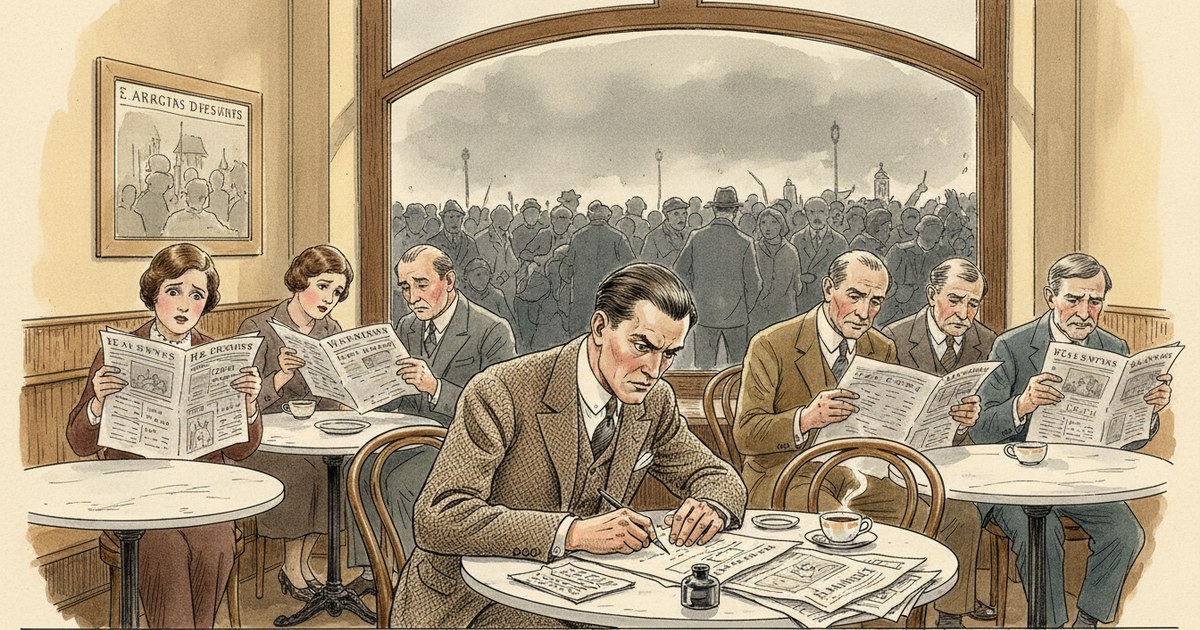
In a smoke-filled rail car cutting through the Austrian Alps, or perhaps on the rain-slicked deck of a steamer bound for Rio, a Stefan Zweig story begins. It starts with a glance, a dropped glove, or a nervous tic. Within three pages, the protagonist is no longer a traveler; they are a casualty of their own hidden history. There is a specific, thrumming velocity to Zweig’s prose—a “nervous energy,” he called it—that collapses the distance between the 1920s and tonight. He does not build tension so much as he unmasks the obsession that was already there, waiting for the right catalyst to explode.
To read Zweig for the first time is to realize that the “modern” psychological thriller was perfected nearly a century ago in a Viennese study. During the 1930s, he was the most translated author in the world, a literary superstar whose novellas were consumed like prestige television is today. Yet, his massive bibliography of biographies, essays, and fiction can feel like an intimidating labyrinth for the uninitiated. You need a map not because his work is difficult, but because it is so potent that starting in the wrong place is like jumping into a high-speed centrifuge without a harness.
The “Zweig momentum” is his signature. He understood that human beings are essentially stable structures held together by very thin wires of social convention. His stories are the sound of those wires snapping. Whether it is a world chess champion losing his mind to a silent internal adversary or a woman spending her entire life in the shadow of a single, unrequited encounter, Zweig’s focus never wavers from the internal conflagration. He was the great chronicler of the “amok”—the moment when the civilized mind surrenders to the irresistible pull of a singular, devastating impulse.
The Architect of the Vanishing World
To understand why Zweig wrote with such desperate urgency, one must look at the map of Europe that was dissolving beneath his feet. Born in 1881 to a wealthy Jewish family in Vienna, Zweig was a true child of the Habsburg Empire’s golden twilight. He lived in a world where “security” was the highest virtue, where the currency was stable, the theaters were full, and the progress of humanity seemed inevitable. He was a pacifist, a polyglot, and a European in the deepest sense of the word, counting Sigmund Freud, Auguste Rodin, and Romain Rolland as his closest peers. His Vienna was the laboratory of the modern soul, and he was its most sensitive recording instrument.
This “World of Yesterday,” as he later titled his definitive memoir, was not just a place but a state of mind. When the First World War shattered the borders of Europe, and the rise of Nazism subsequently turned his books into fuel for bonfires, Zweig became a man without a country. His life became a frantic flight: from Vienna to London, then New York, and finally to Petrópolis, Brazil. He watched from afar as the cosmopolitan, humanist culture he inhabited was systematically erased. Every novella he wrote in exile was an attempt to preserve the psychological complexity of a civilization that was being replaced by the blunt force of ideology.
This sense of impending loss is what gives his biographies of figures like Marie Antoinette or Erasmus their peculiar bite. He wasn’t interested in dry dates; he was looking for the moment where a person’s character collided with the machinery of history. His suicide in 1942, a joint pact with his wife Lotte in Brazil, was the final, tragic testament to his belief that the Europe he loved was gone forever. He died believing the “darkness” had won, yet his work remains the most vibrant evidence we have of the light that preceded it. He didn’t just record history; he captured the feeling of living through its disintegration.
The Essential Starting Points
If you are standing at the threshold of Zweig’s library, the first door you should open is Chess Story (also known as The Royal Game). It is the ultimate concentration of his style, written in the final months of his life. Set on a passenger liner, it depicts a confrontation between a mechanical, brutal world chess champion and a mysterious passenger who learned the game while in solitary confinement by the Gestapo. It is a terrifying exploration of how the mind can save itself through obsession, only to be destroyed by that same salvation. It is short, jagged, and impossible to put down—a perfect entry point into his “nervous” narrative drive.
From there, move to Letter from an Unknown Woman. This is Zweig at his most emotionally operatic. A famous novelist receives a letter from a woman he does not remember, detailing a lifelong devotion that has dictated her every move, her every sacrifice, and her eventual ruin. In the hands of a lesser writer, this would be melodrama; in Zweig’s hands, it is a clinical and devastating study of how the human heart can build a cathedral out of a ghost. It shows his remarkable ability to inhabit the interior lives of his characters, peeling back the layers of social propriety to reveal the raw nerves beneath.
Finally, no one should consider themselves a reader of Zweig without experiencing The World of Yesterday. It is frequently cited as the greatest memoir of the 20th century, and for good reason. It is the biography of an era rather than a man. Zweig barely mentions his own marriages or private scandals; instead, he chronicles the death of a dream. He takes you from the coffee houses of fin-de-siècle Vienna to the trenches of the Great War and the chilling silence of a London flat as the second war begins. It is the essential companion to his fiction, providing the context for the “psychological velocity” that defines his creative output.
Why the Right Translation Changes Everything
For decades, Stefan Zweig was a victim of his own popularity. Because he was so widely read, many early English translations were rushed to market, resulting in prose that felt stiff, Victorian, and strangely distant. This was a tragedy, because Zweig’s German is anything but stiff. He wrote with a breathless, cinematic quality, favoring rhythm and psychological precision over flowery ornamentation. If you read an older edition, you might find the plots compelling but the “voice” muffled, as if you are watching a brilliant film through a dusty lens.
This is why the modern resurgence of Zweig is so vital. Newer translations, such as the ones featured in the Classics Retold editions, focus on recapturing that specific “nervous energy” that Zweig intended. A modern English translation understands that Zweig’s sentences are designed to mimic the pulse of his characters—speeding up during moments of panic, slowing down during the agony of reflection. By stripping away the linguistic cobwebs of the mid-20th century, these editions allow the psychological sharpness of his work to pierce through. You aren’t just reading a story about 1920; you are feeling the immediacy of 1920.
If you are ready to begin your journey, we highly recommend The Stefan Zweig Collection Vol 2. This curated volume brings together several of his most vital novellas, including Chess Story, in a format that prioritizes the visceral impact of his prose. It is designed to be the definitive starting point for the contemporary reader, offering a bridge into the mind of a writer who understood our private obsessions better than we often understand them ourselves. You can find this essential edition here: The Stefan Zweig Collection Vol 2. It is more than a book; it is an invitation to a lost world that feels hauntingly familiar.
Is Stefan Zweig’s work difficult to read?
Not at all. In fact, Zweig was known for his extreme readability and fast-paced narratives. While his themes are psychologically deep, his prose is remarkably clear and direct. He intentionally avoided the dense, philosophical digressions common in many of his German-speaking contemporaries, preferring the “velocity” of a well-told story that focuses on character and action.
Why is he often called a “chronicler of the lost world”?
Zweig lived through the total collapse of the European cultural order. Because he was born into the stable, wealthy environment of the Austro-Hungarian Empire and died in exile during WWII, his work captures the specific transition from a world of security and humanism to one of total war and ideology. He felt a personal responsibility to document the “soul” of the Europe that was being destroyed.
Did Stefan Zweig write full-length novels?
Zweig was primarily a master of the “novella”—a format longer than a short story but shorter than a novel. He felt this length was perfect for exploring a single psychological obsession without losing momentum. While he did write one full-length novel, Beware of Pity, his most famous and influential fiction remains his shorter, more concentrated works.
Why did his popularity decline and then suddenly return?
After his death in 1942, Zweig’s brand of high-humanism and psychological focus fell out of fashion in favor of more overtly political or experimental literature. However, in the 21st century, readers have rediscovered his uncanny ability to describe the fragility of civilization and the complexity of the human mind. His work feels incredibly relevant in an era of global uncertainty and rapid social change.

Leave a Reply