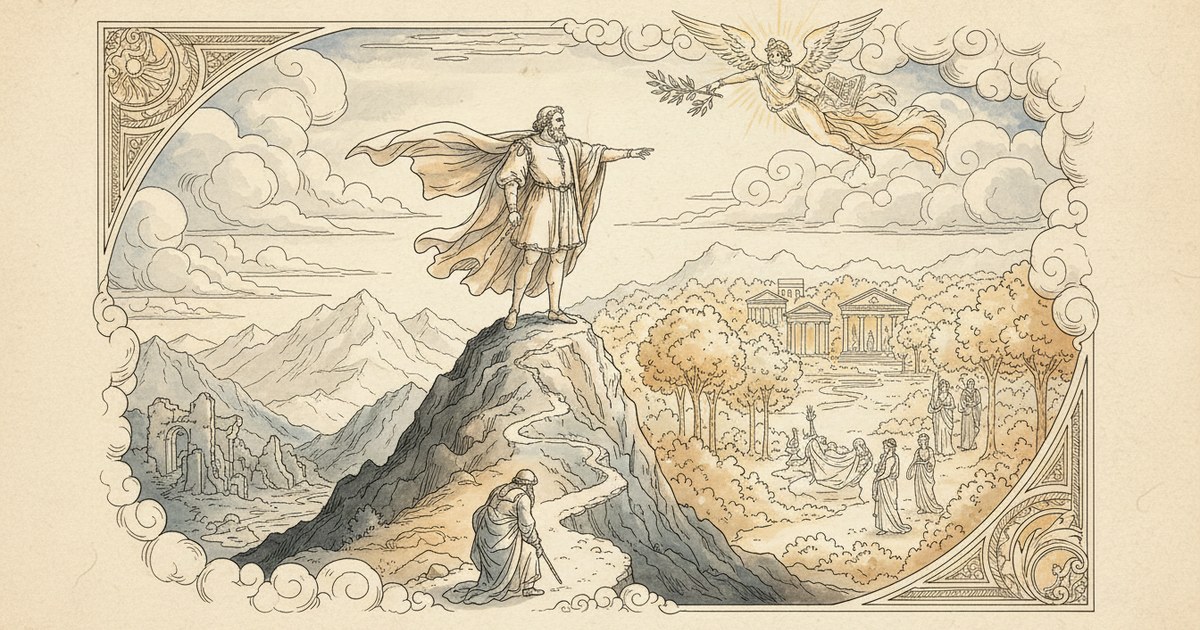
In the desert, Satan offers everything. He has done this before with the first man and it worked — a piece of fruit, a whispered promise, and the whole order of creation cracked. Now he stands in the Judean wilderness with a second man and unfolds, one by one, the full inventory of human desire: food, power, glory, Rome, Athens, the pinnacle of the temple itself. Each time, the answer is no. Not a heroic no, not a thunderous no, but a quiet, specific, almost lawyerly no — here is why what you’re offering isn’t what you claim it is, and here is why I don’t want it anyway. Paradise Regained is a poem about four days in a desert, and Milton spent its 2,100 lines arguing that this refusal, not any act of arms or miracle, is what saves the world.
John Milton published it in 1671 alongside Samson Agonistes in a single slim volume, as though daring the reading public to notice. They mostly didn’t. For three centuries, critics treated it as a footnote — the lesser sequel, the obligatory companion piece, the poem Milton wrote because he had nothing left to say. He was blind. He was in his sixties. He had already written Paradise Lost, the poem that ended English epic poetry by perfecting it. The assumption was that he was done. The assumption was wrong.
Paradise Lost is magnificent the way cathedrals are magnificent — you feel small inside it, and that smallness is the point. Paradise Regained refuses that grandeur entirely. No armies, no architecture, no Satan hurling chaos across the cosmos. Just two figures, a wilderness, and a conversation that keeps circling back to the same question: what does it mean to be human and refuse to become something else? Milton’s answer is the whole poem. It takes work to hear it clearly. It has always taken work. But the argument is there, precise and structural, and in modern English the effort finally costs what it should.
The Man Who Wrote for a Revolution That Failed
Milton was fifty-three when Charles II rode into London in May 1660, ending the Commonwealth and restoring the monarchy Milton had spent two decades defending in prose. He had served as Latin Secretary to the Council of State under Cromwell. He had written the official justifications for the execution of Charles I. He was, in the plain sense, a propagandist for the revolution — and the revolution had collapsed. For a few months in 1660, his name was on a list of men to be punished. He was briefly imprisoned. That he was not executed was probably a function of his blindness and his fame; executing England’s greatest living poet would have looked petty, even to a restored king.
What matters for the poems is what the failure did to his thinking. Paradise Lost (1667) was already written in darkness, dictated to his daughters in the mornings. But it was written when the question of how Providence works — why God permits catastrophe, what patience actually costs — had become personally urgent. The blindness explains the poem’s obsessive interiority. The political defeat explains its theology. A poet who had backed the winning side would not have written those lines about patience as heroism.
Paradise Regained was written in the years after that, when the restoration of monarchy was not a fresh wound but a settled fact. Milton was no longer in danger, but he was no longer relevant either. The poem he wrote is precisely about someone who refuses to be seduced by relevance — by kingdoms, by influence, by the visible markers of power and success. When Jesus dismisses Satan’s offer of Rome — the greatest empire of the ancient world, spread before him in a panoramic vision — he does not say it is evil. He says it is not his. The distinction matters. It reads differently when you know who wrote it and what he had lost.
The Athens temptation is where Milton gets most personal. Satan offers Jesus the full inheritance of Greek thought — Plato, Aristotle, the Stoics, the entire tradition Milton had devoted his youth to mastering. Jesus declines, calmly, and argues that Hebrew scripture contains deeper wisdom than Greek philosophy reaches for. Critics have argued about this passage for centuries: is Milton endorsing it or dramatizing it? Either way, a man who read Latin and Greek before breakfast chose to put those words in the mouth of his hero. That is a biographical fact that changes the poem.
A Debate Conducted in a Desert
Paradise Regained is a brief epic — Milton’s own term — structured as dialogue. Satan proposes; Jesus refuses and explains the refusal. The form is dialectical rather than narrative, which is partly why it has always been a harder read than Paradise Lost. Paradise Lost has battles, seductions, betrayals. Paradise Regained has argument. Four days of it. The temptations escalate from physical (bread, hunger) to political (kingdoms, empire) to intellectual (Athens, philosophy) to the vertiginous final moment on the temple pinnacle — where Satan, having exhausted his offers, essentially dares Jesus to prove himself. The structure is a pressure test, and the poem’s thesis is that Jesus passes not by doing anything but by remaining exactly what he is.
The key is understanding that Milton’s Jesus is not performing patience. He is enacting a specific theory of heroism — one that inverts the epic tradition entirely. Classical heroes act. Achilles kills. Odysseus schemes. Aeneas founds cities. Milton’s Jesus sits in a desert and thinks clearly. The poem’s climax turns on a single line: Tempt not the Lord thy God, he said and stood. The full stop after “said” is doing structural work. The standing, after everything Satan has thrown at him, is the entire argument. He has not fallen. He is still there. That is the victory.
The Athens passage deserves its own paragraph because it is where the poem is most surprising. Satan offers not just texts but the living tradition — the olive grove of Academe, the lectures, the full inheritance of Western thought. Jesus’s refusal is not anti-intellectual; it is a comparative judgment. He argues that Hebrew poetry reaches what Greek philosophy only reaches toward, that the Psalms contain more genuine wisdom than the Stoics. You can disagree with the claim. But it forces the reader to ask what they think wisdom is and where it comes from. That is something a poem can do that an argument cannot.
Paradise Regained is also, quietly, a poem about Milton’s politics. The vision of Rome that Satan unfolds in Book III is one of the most detailed descriptions of imperial power in English literature — and Jesus turns it down. Not because empire is wicked, but because this particular empire rests on violence and corruption and would not respond to a just ruler anyway. The analysis is Machiavellian in its realism. Milton, who had watched Cromwell’s republic curdle into something close to the monarchy it replaced, knew how power degrades the institutions built to exercise it. His Jesus does not pretend otherwise. He simply declines to play.
The Translation Landscape
Paradise Regained has never received the editorial attention of its predecessor. Most readers encounter it tucked inside the same volume as Paradise Lost — the Penguin Classics edition edited by John Leonard, or the Oxford World’s Classics edited by Orgel and Goldberg — where it appears almost as an afterthought, annotated but not foregrounded. These editions preserve Milton’s original seventeenth-century English: the inverted syntax, the Latinate constructions, the subordinate clauses stacked four deep. For readers already at home with Milton’s style, this is workable. For first-time readers, it is an obstacle that has nothing to do with the poem’s actual difficulty.
The best scholarly edition remains Barbara Lewalski’s 2007 Longman annotated text, which does the most rigorous work on the classical and biblical sources Milton draws on at every turn. If you want to understand why a specific line is doing what it does, Lewalski is indispensable. But Lewalski is also a scholarly apparatus built for graduate students, and the experience of reading the poem as literature — as argument that builds and lands — gets crowded out by footnotes. The poem can get lost in its own documentation.
the edition linked below takes a different position: that the difficulty of Paradise Regained should be intellectual, not syntactic. A modern English rendering strips the seventeenth-century linguistic scaffolding without touching the argument. The line Tempt not the Lord thy God, he said and stood survives intact because it is already plain. What changes are the passages where Milton’s Latin-inflected constructions turn subordinate clauses into mazes. In those moments, a modern rendering lets the reader hear what Milton is actually arguing, rather than spending cognitive energy reconstructing his syntax before asking whether he was right.
Why This Translation?
The case for this edition is simple: Paradise Regained is a harder poem than Paradise Lost in every respect except the language — and the original language has been making it harder than it needs to be for three centuries. Milton’s argument about patience, refusal, and what heroism actually looks like is one of the most original things ever written in English. It deserves readers who don’t already read seventeenth-century poetry for pleasure. This translation, available here, does exactly that work: it makes the poem’s argument audible to a reader encountering Milton for the first time, without softening or simplifying what he was saying.
the edition linked below is not a substitute for Milton; it is a door into him. Read it first. Then, if the argument catches you — if the image of a man standing in a desert saying no to everything lands — go back to the original. The poem will be there, still doing the same work, and you will be better equipped to hear it. Four days in a desert, and the world does not end. That is the whole point. Milton spent 2,100 lines making it land.
Is Paradise Regained a sequel to Paradise Lost?
It follows Paradise Lost chronologically and thematically, but Milton published it separately four years later, and it reads as a standalone poem. Paradise Lost ends with Adam and Eve expelled from Eden; Paradise Regained picks up the thread of redemption through Christ’s temptation in the wilderness. You don’t need to have read Paradise Lost to follow the argument — the poem establishes its own terms — but reading Paradise Lost first gives you the full shape of Milton’s thinking about the Fall and how it is answered.
How long is Paradise Regained?
Approximately 2,100 lines across four books, making it roughly one-fifth the length of Paradise Lost. Most readers finish it in a single sitting of two to three hours. Milton called it a “brief epic,” borrowing the classical category of the shorter heroic poem, and the compression is deliberate — the poem’s restraint mirrors its subject.
Why does Milton never use the name Jesus in the poem?
Milton refers to his protagonist as “the Son” or “our Savior” throughout, a deliberate theological choice. He is treating the temptation narrative as an inquiry into the nature of the Incarnation — what it means for the divine to inhabit human form and human limitation — and the anonymity keeps the focus on the action and argument rather than on the figure’s established identity. Satan knows who he is dealing with. The poem’s drama is about whether Jesus does.
What is the best way to approach Paradise Regained if I’ve never read Milton?
Start with this modern English edition and read it straight through without stopping to look things up. The argument is linear and each temptation builds on the last; following the structure matters more than catching every allusion on a first read. Once you have the shape of the poem — four days, escalating offers, one sustained refusal — return to the passages that caught you. The Athens temptation in Book IV and the pinnacle scene at the close of Book IV are the two moments where Milton’s thinking is most compressed and most original. Both repay multiple readings.
Also worth reading

Leave a Reply