Tag: French literature

  • The Great Meaulnes Is About Outgrowing Wonder

    The Great Meaulnes Is About Outgrowing Wonder

    The Writer Behind The Great Meaulnes

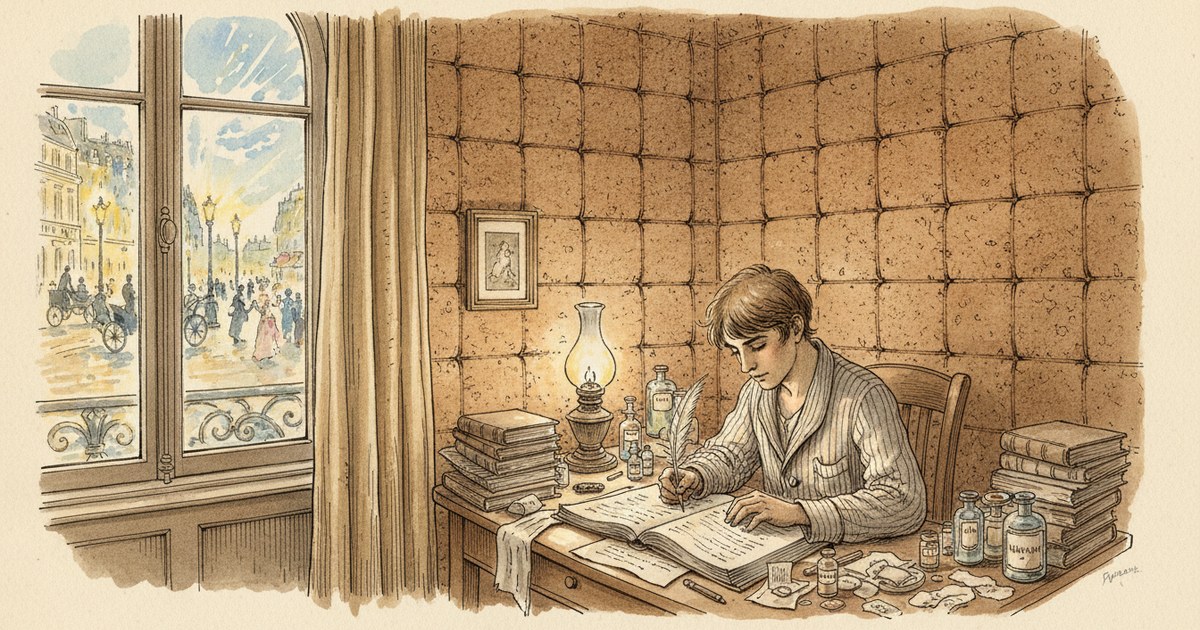
    In the summer of 1905, a twenty-year-old student named Henri-Alban Fournier caught a glimpse of a young woman on the steps of the Grand Palais in Paris — pale dress, calm face, already walking away. He followed her. She turned, told him she was engaged, and disappeared into the crowd. He spent the next eight years trying to turn that afternoon into a novel. The woman’s name was Yvonne de Quièvrecourt. The novel became Le Grand Meaulnes. Fournier never stopped writing her name in his journals.

    Fournier was born in 1886 in La Chapelle-d’Angillon, a small village in the Berry region of central France — flat, agricultural country where the horizon does strange things in late afternoon light. His parents were schoolteachers, and he grew up in a succession of rural schoolhouses, that particular world of chalk dust and bell schedules that saturates the novel’s opening chapters. He was a brilliant student but restless, oscillating between Paris’s literary circles — where he became close friends with Jacques Rivière, who would later edit the Nouvelle Revue Française — and the provincial countryside he couldn’t quite leave behind in his imagination. He published under the pen name Alain-Fournier.

    He finished Le Grand Meaulnes in 1913. It was published in September of that year and immediately shortlisted for the Prix Goncourt, losing by one vote. A year later, France mobilized for war. Fournier was called up as an infantry lieutenant. On September 22, 1914 — less than six weeks into active combat — he was killed near Saint-Rémy-la-Calonne, leading his platoon through a wood. He was twenty-seven. His body wasn’t found until 1991, in a mass grave with his men. He left behind one complete novel.

    The correspondence Fournier kept with Jacques Rivière — published after both men’s deaths — reveals just how deliberately he constructed the novel’s emotional logic. In one letter from 1910, three years before the book was finished, he describes his aim as writing something that would give the reader “the feeling of having lived for a moment the life that is most beautiful and most impossible to live.” That is not a young writer fumbling toward a theme. That is someone who already knows exactly what kind of wound he is trying to inflict, and is patiently sharpening the instrument. The letters also show how close the novel’s geography is to his own childhood: the schoolhouse where Seurel’s parents live and teach is drawn almost floor-plan-accurate from the one in Épineuil-le-Fleuriel where Fournier spent his boyhood, and which still stands today as a small museum to the novel.

    What Makes The Great Meaulnes Still Matter

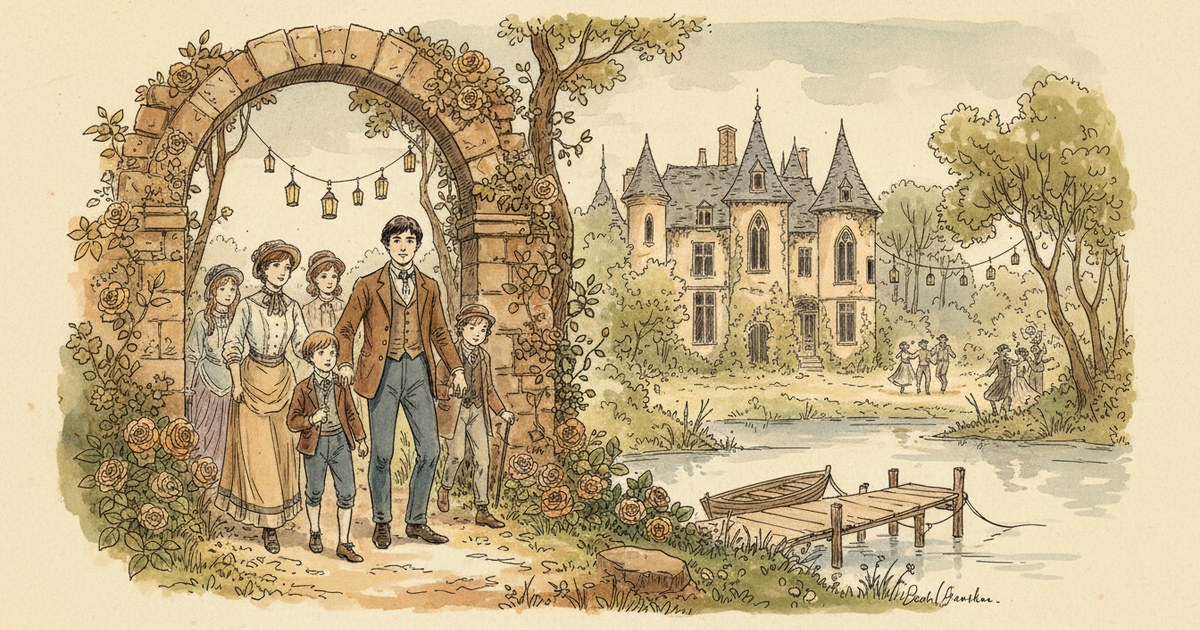
    Le Grand Meaulnes — rendered here as The Great Meaulnes — opens in a village schoolhouse in the French countryside, where fifteen-year-old François Seurel narrates the arrival of a strange older boy named Augustin Meaulnes. Meaulnes promptly disappears into the countryside on a borrowed horse and cart, stumbles upon a crumbling estate where an inexplicable fête is underway — children in period costume, boats on a frozen pond, music from no clear source — falls in love with the daughter of the house, then loses everything when he finds his way back to ordinary life. The plot sounds like a fairy tale, but the novel’s real subject is the specific cruelty of growing up: the way adolescence promises a world of enchantment and then locks the door behind you. Fournier described it as a book about “the impossibility of recapturing what has been glimpsed once and lost.” That single sentence is the thesis of the entire twentieth century’s literature of longing.

    What makes the novel strange and durable — more than a century after its publication — is its refusal to be fully realistic or fully fantastical. Meaulnes’s lost domain exists on actual roads, with actual distances, but no one can find it twice. Fournier’s Berry countryside feels enchanted not because magic is invoked but because the prose holds every ordinary detail — a frost-covered courtyard, a jacket borrowed for a party, the smell of a schoolroom stove — at the precise angle where memory starts to look like myth. The love story is real and doomed, the friendship between Seurel and Meaulnes is the most honest thing in the book, and underneath it all runs a grief that Fournier understood personally: the grief of a man who had already looked back.

    The scene that crystallizes the novel’s method better than any other is Meaulnes’s first full night at the mysterious fête. He wakes in a strange bedroom in borrowed clothes — a child’s fancy-dress waistcoat that fits him oddly, a nineteenth-century jacket retrieved from some forgotten trunk — and walks out into a courtyard full of costumed children playing games by candlelight. No one questions his presence. No one asks where he has come from. The scene works because Fournier refuses to explain it: there is no magical portal, no explicit dream logic. The strangeness floats on a sea of completely specific, tactile detail — the cold of the flagstones, the particular color of the candle flames against the winter dark. When Meaulnes first sees Yvonne de Galais across that courtyard, the moment lasts half a sentence. Fournier understood that the longer you describe a glimpse, the less it resembles one.

    The Novel’s Strange Architecture

    One thing readers rarely discuss in advance — and probably shouldn’t have spoiled for them — is how dramatically the novel’s structure shifts in its final third. The first two-thirds operate in the register of enchanted adolescence: dreamlike, suspended, narrated at a slight remove. Then the book pivots hard. A second character, Frantz de Galais, arrives with his own collapsed love story, and the novel suddenly reveals itself to be about something more uncomfortable than nostalgia. It is about the way one person’s romantic obsession radiates outward and damages everyone around him. Meaulnes is not just a dreamer; he is, by the end, genuinely culpable. He abandons a wife, neglects a child, vanishes when people need him. The lost domain is not only something taken from him — it is also an excuse he uses. Fournier does not editorialize about this. He simply lets the last fifty pages happen, and the chill they produce is entirely different from the ache of the first hundred.

    This structural gambit is part of why the novel has sustained serious literary attention for over a century, while remaining genuinely readable as a coming-of-age story on first encounter. Teenagers read it as a novel about losing paradise. Adults re-read it and notice how much damage paradise-seeking does to the people in Meaulnes’s immediate orbit. François Seurel, the narrator, is perhaps the book’s true subject: a loyal, self-effacing young man who systematically subordinates his own life to Meaulnes’s quest, and seems never to fully recognize what that has cost him. The novel is named after Meaulnes. But it is Seurel who is left standing at the end, holding everyone else’s losses.

    Why Read a Modern Translation?

    Most English readers have encountered The Great Meaulnes through translations that strain toward an archaic, dreamy register — which is understandable but wrong. Fournier’s French is not ornate. It is clean, with occasional bursts of strange intensity, closer to Chekhov than to Proust. The translation featured here approaches the text with that in mind: the sentences breathe, the dialogue sounds like actual teenagers rather than Victorian literary characters, and the novel’s abrupt tonal shifts — from mundane to uncanny and back — land with the disorienting force Fournier intended. The decision to keep the protagonist’s name as Meaulnes rather than anglicizing it, and to preserve the rural schoolhouse rhythms of the opening rather than smoothing them into something generically pastoral, matters more than it might seem. This is a book where the texture of place is inseparable from the texture of longing. A translation that irons that out irons out the book.

    A useful test for any translation of this novel is the scene in which Seurel first describes the schoolhouse and its grounds — the opening pages before Meaulnes even arrives. Older translations tend to poeticize this passage, loading it with atmospheric adjectives that signal to the reader: this is a special, literary place. But in Fournier’s French, the description is almost bureaucratic in its precision — the exact layout of the buildings, the specific placement of a gate, the way the schoolyard connects to the road. The enchantment is produced by that precision, not despite it. A translation that reaches for lyricism too early in this passage tips its hand too soon, and the reader loses the experience of watching an ordinary world slowly become strange. The edition we recommend holds its nerve through those opening pages, letting the strangeness accumulate at Fournier’s own pace.

    Alain-Fournier in the Context of His Moment

    It is worth placing Fournier in the specific literary moment he inhabited, because it explains some of what looks eccentric about the novel from a twenty-first-century vantage point. Le Grand Meaulnes was published in 1913 — the same year as Proust’s Du côté de chez Swann, Apollinaire’s Alcools, and Alain’s Les Aventures du cœur. French literature was in the middle of a generational fracture between the symbolists, who had dominated the previous two decades, and the new realists and modernists who were about to remake the form. Fournier’s novel belongs to neither camp cleanly. It has the symbolists’ taste for dream-logic and the uncanny, but none of their obscurantism. It has the realists’ eye for specific social texture — the schoolteacher household, the rural class dynamics, the particular economics of a provincial fête — but none of their cynicism. The result is something that embarrassed critics who needed clean categories, and delighted readers who did not.

    Fournier’s friendship with Jacques Rivière was not incidental to this. Rivière was one of the most rigorous literary intelligences of his generation, and his correspondence with Fournier served as a kind of extended workshop for the novel in progress. When Fournier sent Rivière early drafts, Rivière pushed back on anything that slid into sentimentality without earning it — a pressure that left clear marks on the finished book. The novel’s refusal to console, its willingness to let Meaulnes behave badly without exculpating him, its dry-eyed ending: these are partly the product of that friendship. Rivière survived the war, edited the NRF, and wrote what remains one of the finest essays on the novel in 1924. He died the following year, of typhoid fever, at thirty-four.

    Frequently Asked Questions

    What does “Le Grand Meaulnes” actually mean in French?

    Grand in this context does not mean great in the sense of greatness or achievement — it is closer to the English colloquial use of “big” or “tall,” the way schoolboys might nickname a tall, striking classmate. Seurel uses it as an admiring, slightly awed form of address: Meaulnes is simply the biggest, most impressive person in his immediate world. Some translators have rendered it as “Big Meaulnes,” which is literally accurate but tonally flat. Most English editions retain “The Great Meaulnes,” accepting the slight elevation in register as the lesser distortion.

    Did Alain-Fournier ever meet Yvonne de Quièvrecourt again after their 1905 encounter?

    Yes — once, briefly, in 1913, the year the novel was published. By that point Yvonne was married with children, and the meeting was cordial and unremarkable. Fournier was by then involved with the actress Simone, with whom he had a serious relationship in the final years of his life. He did not, as far as the surviving correspondence shows, find the second meeting devastating — though he noted it in a letter to Rivière with characteristic terseness. The real Yvonne and the fictional Yvonne de Galais had long since diverged. She outlived the novel’s author by fifty years, dying in 1966.

    Has The Great Meaulnes been adapted for film?

    There have been two notable French film adaptations: Jean-Gabriel Albicocco’s 1967 version, which is visually striking and leans heavily into the novel’s dream atmosphere, and a 2006 adaptation directed by Jean-Daniel Verhaeghe. Neither has displaced the novel in French cultural memory, and neither has achieved significant international distribution. The 1967 film is occasionally cited by fans of the book, but the general consensus is that the novel’s power depends on Seurel’s narrating consciousness in a way that resists straightforward cinematization — the camera can show the lost domain, but it cannot easily reproduce the experience of half-understanding it.

    Is The Great Meaulnes considered a young adult novel in France?

    It occupies an unusual position in French literary culture: it is taught in secondary schools and shelved as a coming-of-age novel, but it is also consistently listed among the most important French novels of the twentieth century by critics and writers. The French equivalent of a consensus “desert island” novel, it appears on general reading lists alongside Flaubert and Stendhal, and is regularly cited by French authors — including Le Clézio and Modiano — as a formative influence. The young-adult classification, to the extent it exists in France, has never diminished its literary standing there the way equivalent shelving decisions sometimes do in English-speaking markets.

    Recommended Edition
    The Great Meaulnes — Alain-Fournier
    Modern English translation

    Kindle →Paperback →

    This post contains affiliate links. As an Amazon Associate, Classics Retold earns from qualifying purchases. This does not affect our editorial recommendations.
  • Hugo Wrote for the People, Not Scholars

    Hugo Wrote for the People, Not Scholars

    French literature from the eighteenth through the twentieth century is the deepest single tradition in world fiction. Not the oldest, not the most exported, but the deepest — in the sense that its preoccupations compound across generations, each century rewriting the one before. Voltaire dismantles optimism; Hugo restores it through sheer force of feeling; Flaubert arrives to dismantle everything Hugo built; Proust watches the wreckage and decides to memorize it. The tradition is a long argument with itself.

    Most English readers encounter it badly. A Madame Bovary assigned in survey courses. A film adaptation of Les Misérables with the barricade scenes cut short. A translation of Candide that irons out the jokes. These reading guides exist to correct that — to return the books to the specific quality of attention they were written to demand.

    Translation is not a secondary concern when it comes to French literature — it is the primary one. The French sentence is architectural. Its irony is structural, built into the grammar itself; its wit depends on rhythm, on the precise position of a word, on a cadence that arrives half a beat later than you expect. When a translator flattens that rhythm in pursuit of plain English readability, what disappears is not decoration but meaning. Voltaire’s jokes stop being jokes. Flaubert’s sentences, which in French feel like controlled detonations, become merely correct. Proust’s digressions, which in French spiral outward with unmistakable intentionality, begin to seem like failures of discipline. The difference between a good and a bad translation of a French novel is not a matter of nuance. It is the difference between the book and something that shares its plot.

    Classics Retold exists to solve that problem. We do not produce translations — we read them, compare them, and identify the editions that honour the original with enough fidelity and enough courage to make genuine demands on an English reader. For every book in this guide, we have selected the translation we recommend on the basis of close reading: sentence by sentence, scene by scene. Where the translation question is genuinely contested — where two strong editions make different and defensible choices — we say so. The goal is not to tell you what to think about these books. It is to make sure you are reading the right version before you start thinking at all.

    Where to Start

    If you have never read French literature seriously, start with Voltaire. Candide is ninety pages, ruthlessly constructed, and funnier than anything its century produced in English. From there, Hugo’s Les Misérables — not the abridged edition — for the full experience of nineteenth-century romantic amplitude. Then Flaubert, who wrote in direct reaction to Hugo’s sentimentality, and whose prose style remains the most influential in any language. Proust is for later, when you have built up the patience the novel requires and rewards.

    The Enlightenment and Its Discontents

    Voltaire published Candide in 1759 and insisted, despite all evidence, that he had nothing to do with it. The denial was tactical — the book was immediately banned in Geneva, Paris, and Rome — but it also pointed to something real about the text. Candide is not quite a novel. It is a philosophical proposition disguised as an adventure story, and the disguise is so complete that the proposition hits harder than it would have if delivered directly.

    The proposition is this: Leibnizian optimism — the doctrine that we live in the best of all possible worlds — is not merely wrong but obscene. Voltaire had watched the Lisbon earthquake of 1755 kill sixty thousand people and seen theologians argue that the deaths must serve some divine purpose. Candide is his answer. Our reading guide on Candide examines what makes the novel’s comedy so precise — and why it has outlasted every earnest philosophical treatise of its century.

    The scene that crystallises the book’s method comes near the end, when Candide and his battered companions finally acquire a small plot of land outside Constantinople and Pangloss, still incorrigible, still insisting that everything has worked out for the best, prepares to deliver another metaphysical lecture. Candide cuts him off with the novel’s most famous line: il faut cultiver notre jardin — we must cultivate our garden. In context, it is not a counsel of contentment. It is a counsel of exhaustion. Voltaire’s joke is that the only reasonable response to the best of all possible worlds is to stop talking about it and grow vegetables.

    The Romantics — Hugo, Dumas, Stendhal
    The Hunchback of Notre-Dame : A New Translation in Modern Accessible EnglishThe Three Musketeers : A New Translation in Modern Accessible EnglishNinety-Three: A New TranslationTwenty Years After (The Three Musketeers Sequel) : A New Translation in Modern Accessible EnglishThe Charterhouse of Parma: New TranslationThe Black Tulip: A New Translation

    The Romantics

    The nineteenth century produced three novelists whose ambitions were essentially architectural. Hugo wanted to build cathedrals out of language. Dumas wanted to construct machines of pure narrative pleasure. Stendhal, the quietest of the three, wanted to dissect the psychology of ambition with the precision of a surgeon who was also, privately, in love with his subject.

    Hugo wrote Les Misérables over the course of twenty years, publishing it in 1862 when he was in political exile. Our guide to Les Misérables addresses the novel as what it actually is: an act of political witness that happens to be a great story. His earlier novel, The Hunchback of Notre-Dame, is formally tighter — a book about the cathedral as much as the people inside it.

    What abridged editions always cut — and what their cuts reveal about a fundamental misreading of Hugo’s intentions — are the digressions: the long chapter on the Paris sewer system, the extended meditation on the Battle of Waterloo, the history of the Petit-Picpus convent. These are not interruptions to the story. They are Hugo’s argument that Jean Valjean’s suffering cannot be understood without understanding the entire structure that produced it. The sewer is where the city’s waste goes, and the sewer is also where Valjean carries a dying man to safety. Hugo’s digressions are always doing two things at once. Abridged editions do neither.

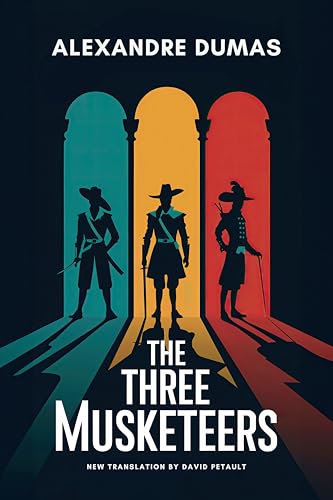
    Dumas operates in a different register entirely. The Three Musketeers has been pedagogized into tedium by school curricula — treated as entertainment for children, which it isn’t. The novel is a study in loyalty, masculine friendship, and the gap between idealism and political reality. It is also, page for page, one of the most propulsive narratives ever written in any language.

    The scene that demonstrates what Dumas is actually doing comes in the early chapters, when d’Artagnan arrives in Paris from Gascony — poor, provincial, riding a horse described as bright yellow and valued at three écus — and proceeds within a single afternoon to schedule duels with all three musketeers by offending each of them in rapid succession. It is comic, but it is also a precise psychological portrait: d’Artagnan is so determined to prove himself that he cannot stop provoking people. The bravado is real, but so is the desperation underneath it. Dumas understood that those two things are usually the same thing.

    Stendhal’s The Red and the Black is perhaps the first genuinely modern novel — the first to concern itself with the inner life of a social climber in a way that produces neither condemnation nor endorsement, only understanding.

    Stendhal based his protagonist Julien Sorel partly on a real case: a young seminarian named Antoine Berthet who shot a former employer in church in 1827 and was guillotined the following year. What interested Stendhal was not the crime but the decades of resentment and thwarted ambition that preceded it — the way a society that claimed to reward merit in fact rewarded birth, and what that contradiction did to the psychology of a brilliant young man who had absorbed the promise and then discovered the reality. Julien Sorel is not sympathetic exactly. But Stendhal makes sure you understand him completely, and understanding is more unsettling than sympathy.

    Realism and Its Aftermath

    Flaubert hated the Romantics. He hated their sentimentality, their grandiosity, their willingness to let feeling substitute for precision. Madame Bovary, published in 1857 and immediately prosecuted for obscenity, is the rebuttal. Emma Bovary has been formed by Romantic fiction — she expects her life to feel the way novels feel — and the book watches her discover that it doesn’t. Our guide to Madame Bovary focuses on the novel’s temporal compression and on what Flaubert’s famous prose style actually does on the sentence level.

    Flaubert spent five years writing Madame Bovary and was known to work for an entire week on a single page, reading each completed sentence aloud to test its rhythm. The result is a prose style in which every word is doing precisely the work assigned to it and nothing else — a style in which the famous authorial impersonality is itself a form of cruelty. The agricultural fair scene, in which Rodolphe seduces Emma while a pompous official delivers a speech about the virtues of manure and livestock management below their window, is the novel’s masterwork: irony operating on three levels simultaneously, without Flaubert once indicating which level you should be attending to.

    Proust arrives fifty years after Flaubert and appears at first to be everything Flaubert opposed — discursive, associative, apparently formless. But the surface is deceptive. In Search of Lost Time is as ruthlessly constructed as Candide, its architecture just harder to see from inside a single volume. Our reading guide to In Search of Lost Time addresses the question English readers always ask first: how to begin, and whether to finish.

    The madeleine passage — in which the narrator dips a small cake into tea and is overwhelmed by a memory he cannot immediately identify — is the most famous moment in the novel, and it is also, for most readers, the first encounter with what Proust is actually doing. The passage is not about nostalgia. It is about the difference between voluntary memory, which is willed and therefore approximate, and involuntary memory, which arrives unbidden and is therefore true. Proust’s entire seven-volume structure rests on that distinction. Every digression, every extended meditation on jealousy or art or the nature of time, is an elaboration of what happened when the madeleine dissolved in the tea. Once you understand that, the length stops feeling like an indulgence.

    The Twentieth Century

    If the nineteenth century in French literature was the century of the social novel — of class, ambition, and the machinery of power — the twentieth century turned inward. Its great subjects were consciousness, absurdity, freedom, and what a human being owes to a world that has given no indication of owing anything in return. The writers who defined this period were not primarily academic philosophers, though several of them wrote philosophy as well as fiction. They were novelists who understood that the felt experience of an idea — the way it lands in the body, in the moment of reading — is not the same as the idea argued in the abstract, and that fiction could do something philosophy could not.

    Albert Camus published The Stranger in 1942 and The Plague in 1947, and the two novels together constitute a sustained examination of what it means to live without guaranteed meaning. The Stranger opens with one of the most destabilising sentences in any language: “Mother died today. Or maybe yesterday, I don’t know.” The flatness is the point. Meursault, the novel’s narrator, is not callous — he is honest in a way that the social world around him cannot accommodate, and the novel is the story of how that world punishes him for it. What makes Camus genuinely difficult — and genuinely irreducible to a philosophical position — is that Meursault is neither a hero nor a warning. He is simply a consciousness, registering experience with more accuracy than comfort allows. The Plague works on a larger scale: an Algerian city quarantined by an epidemic becomes an image of occupied France, and the question of whether to resist — and how, and at what cost — is distributed across a cast of characters who answer it differently and with equal plausibility. Camus did not believe in God and did not believe in despair. The space between those two refusals is where both novels live.

    Antoine de Saint-Exupéry’s The Little Prince, published in 1943, is the best-selling French-language book ever written and almost certainly the most consistently misread. It is shelved in the children’s section because it has illustrations and a child as its central figure. It belongs there about as accurately as Gulliver’s Travels does. Saint-Exupéry was a pioneering aviator who had survived multiple crashes across three continents, had reported on the Spanish Civil War, and had watched France fall to Nazi occupation. When he sat down to write The Little Prince, he was in exile in New York, estranged from his wife, drinking heavily, and struggling with injuries from a crash that had left him in chronic pain. He knew, with some certainty, that he would not survive the war. The little prince who has left his small planet, who carries with him the memory of a single rose he loved and perhaps loved inadequately — this is a book about grief and exile and the things we fail to protect until it is too late. Saint-Exupéry disappeared over the Mediterranean in July 1944, on a reconnaissance mission, and was never found. The novel’s ending is not a fantasy. It is a farewell.

    Simone de Beauvoir published The Second Sex in 1949, and the book changed how the twentieth century thought about women, freedom, and what it means to become a person rather than simply be assigned one. Its opening argument — “One is not born, but rather becomes, a woman” — is the sentence around which the entire analysis pivots. De Beauvoir’s claim is that femininity is not a natural condition but a historical and cultural construction, and that the construction has been so thorough, so embedded in language and law and literature, that most women have participated in their own confinement without being able to name it. The Second Sex is philosophy, but it is also literary criticism, anthropology, and personal testimony, and the combination produces a book that is harder to dismiss than any purely abstract argument could be. It was immediately scandalised in France and immediately translated into English, where it had an equally immediate and lasting effect. Beauvoir belongs in any account of French literature not merely as a feminist thinker but as a writer whose prose, even in translation, carries the peculiar force of someone who has thought something through to its end and is no longer willing to be polite about the conclusions.

    The Novel of Ideas

    Laclos’s Les Liaisons Dangereuses, published in 1782, seven years before the Revolution, is an epistolary novel about aristocrats who weaponize seduction. It caused a scandal on publication and has never stopped causing one. The translation question — which English edition to trust — is one the guide addresses directly, because the wrong translation turns Laclos’s surgical prose into drawing-room gossip.

    What makes the novel genuinely disturbing — more disturbing than its reputation as a tale of aristocratic wickedness would suggest — is that the Marquise de Merteuil and the Vicomte de Valmont are not simply villains. They are the two most intelligent people in the book, and their letters reveal a clarity about power, desire, and social performance that the novel’s more virtuous characters entirely lack. The Marquise in particular is writing, across her letters, a sustained feminist analysis of the society that has made seduction her only available form of power. Laclos, writing seven years before the Revolution, understood that an aristocracy rotten enough to produce Merteuil was an aristocracy that had already lost its justification. The guillotine arrives, historically, a decade after the last letter.

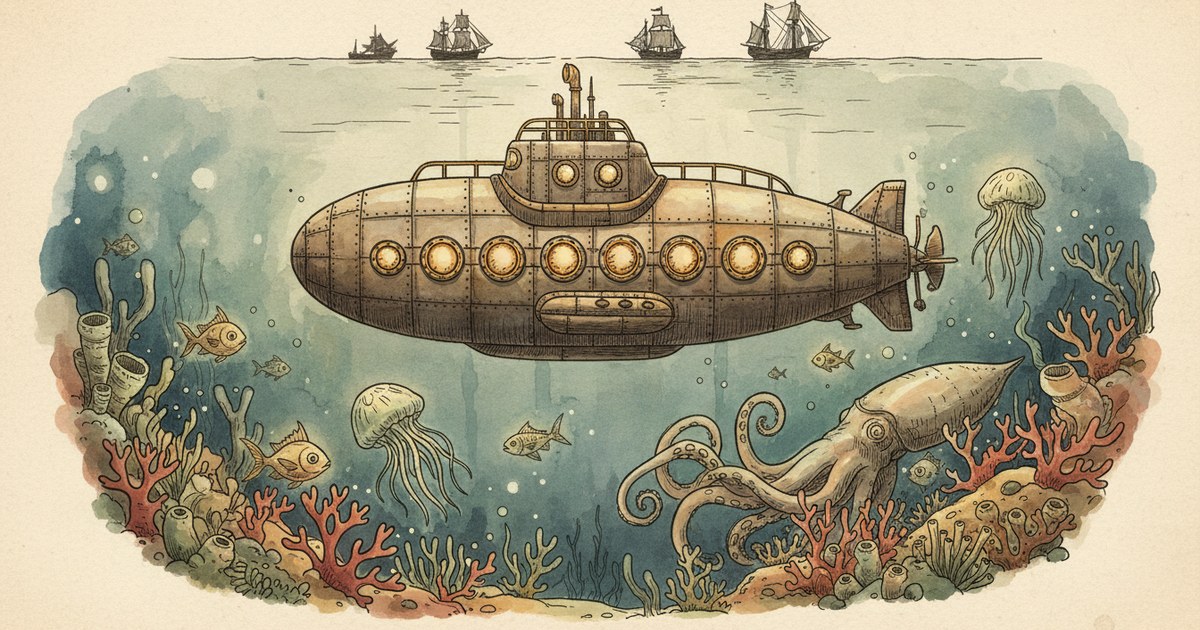
    Jules Verne is almost never read as the political writer he was. 20,000 Leagues Under the Sea is usually packaged as an adventure novel for young readers. But Captain Nemo is a figure of anti-colonial rage, and the Nautilus is a utopian project — a society of one, built in deliberate exile from the world above. Our guide to Jules Verne’s Political Vision recovers what the bowdlerized English translations have long suppressed.

    In later Verne novels — particularly The Mysterious Island, which reveals Nemo’s full history — we learn that he is Prince Dakkar, an Indian nobleman whose family was massacred by British colonial forces during the 1857 rebellion. The Nautilus, read in this light, is not a marvel of technology. It is a weapon of mourning. Every time Nemo sinks a warship, he is answering a specific historical atrocity. The original English translations, produced by publishers nervous about offending British readers, softened or erased this context entirely. They turned a novel about colonial violence into a Victorian adventure story. The difference between those two books is not a matter of translation style. It is a matter of whether the book is allowed to mean what it means.

    The tradition these writers belong to is not merely literary. It is argumentative, adversarial, and deeply concerned with how power organizes itself and how fiction might resist that organization. Reading French literature in good translation is not an act of cultural tourism. It is engagement with a conversation that has been going on for three hundred years and is not finished.

    How to Read French Literature

    French literature rewards method. It is not a tradition you can dip into randomly and expect to get full value from — the books talk to each other too directly, and missing the conversation means missing a significant part of what each individual book is doing. A few practical principles will help.

    On your first pass through the tradition, read chronologically. Start with Voltaire, move through Hugo and Stendhal and Flaubert, arrive at Proust and then Camus. The sequence is not arbitrary — each writer is, consciously or not, arguing with the one before, and reading in order means you arrive at those arguments already equipped to understand them. After your first pass, read thematically: all the novels of ambition together (Stendhal, Balzac, Flaubert), all the novels of political witness together (Hugo, Camus, de Beauvoir). The tradition looks different from each angle, and both angles are useful.

    Never read an abridged Hugo. This is not a suggestion — it is the minimum condition for reading Hugo at all. The digressions in Les Misérables are not interruptions to the story. They are the story’s argument about why the story matters. An abridged Les Misérables is a novel about an escaped convict and an obsessed policeman. The unabridged version is a novel about the entire structure of nineteenth-century French society and why it produces escaped convicts and obsessed policemen in the first place. These are different books. One of them is Hugo.

    For Proust, the only workable approach is full commitment to the first volume. Swann’s Way is long, and it does not apologize for its length, but it is also — once you have adjusted to its rhythms — one of the most pleasurable reading experiences in the tradition. Commit to it entirely before deciding whether to continue. Do not read the first fifty pages and make a judgment. The novel earns its length, but it does not earn it immediately — it earns it retrospectively, in the way that a piece of music earns its opening bars only once you have heard the whole. If you reach the end of Swann’s Way and are not compelled to continue, that is a legitimate response. But make the decision from there, not from the middle.

    Finally: always check who translated the edition you are buying before you buy it. This is not optional. A Madame Bovary translated in 1886 is a different book from one translated in 2010 — not because the French has changed, but because English has, and because translation reflects the assumptions of its moment as much as it reflects the original. Nineteenth-century translators of Flaubert routinely softened his irony and cleaned up his prose because they found his indifference to moral judgment unsettling. Their translations are not wrong exactly, but they are translations of a different Flaubert — a more comfortable one. The translator matters as much as the edition. The reading guides on this site name the translation we recommend for every book covered, and explain the reasoning. Use that information before you start.

    Voltaire & The Enlightenment
    Candide: A New TranslationThe Voltaire Collection: Vol. 1: New TranslationThe Voltaire Collection: Vol. 2: New TranslationZadig: A New TranslationTreatise on Tolerance: New Translation
    Flaubert & Realism
    Madame Bovary: A New Translation
    Proust
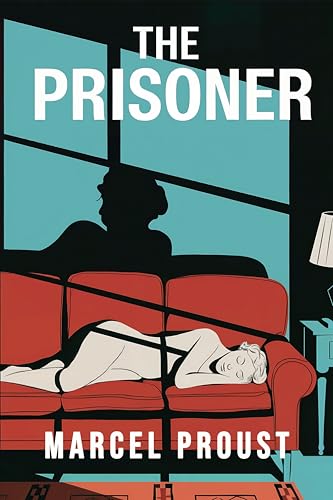
    Swann's Way (In Search of Lost Time Vol. 1): A New TranslationPleasures and Days: A New TranslationIn the Shadow of Young Girls in Flower (In Search of Lost Time Vol. 2): A New TranslationThe Fugitive (In Search of Lost Time Vol. 6): A New TranslationFinding Time Again (In Search of Lost Time Vol. 7): A New TranslationThe Prisoner (In Search of Lost Time Vol. 5): A New Translation
    Laclos & The Novel of Ideas
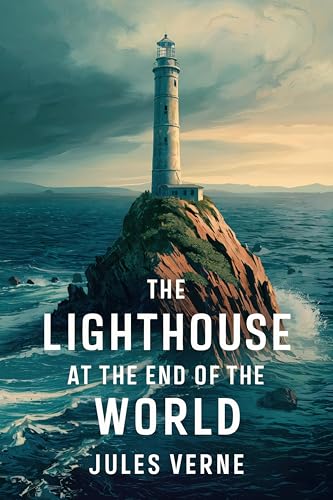
    Twenty Thousand Leagues Under the Sea: A New Translation in Modern Accessible EnglishThe Mysterious Island: A New Translation in Modern Accessible EnglishThe Lighthouse at the End of the World: A New TranslationIn Search of the Castaways (The Children of Captain Grant): A New Translation in Modern Accessible EnglishJourney to the Center of the Earth: A New Translation in Modern Accessible EnglishPropeller Island: A New Translation in Modern Accessible English

    Frequently Asked Questions

    What is the best French novel to read first?

    Candide by Voltaire is the ideal entry point into French literature for almost every reader. At roughly ninety pages, it is short enough to finish in a single sitting, but its comedy, its philosophical precision, and its controlled fury give you an immediate sense of what distinguishes French literary culture from English — the willingness to treat ideas as weapons and to make wickedly good jokes with them at the same time. Every major theme of the tradition — the problem of suffering, the corruption of institutions, the gap between what societies claim and what they do — is present in miniature.

    Which French authors should every reader know?

    Six authors form the spine of the tradition: Voltaire, whose Candide established the French novel as a vehicle for philosophical argument; Victor Hugo, whose ambition and emotional force defined the Romantic century; Gustave Flaubert, whose prose style became the template for literary realism in every language; Marcel Proust, who pushed the novel further into consciousness than anyone before or since; Albert Camus, who made existential philosophy feel like lived experience rather than academic argument; and Simone de Beauvoir, whose The Second Sex changed not just French literature but the intellectual history of the twentieth century. Any serious reader of the tradition will eventually need all six.

    Does translation quality really matter for French literature?

    For French literature specifically, translation quality matters more than for almost any other tradition, because so much of what makes French writing French is carried in its rhythm, its irony, and its wit — all of which are structural, not decorative, and all of which are the first things to collapse in a careless translation. Voltaire’s jokes depend on timing; Flaubert’s moral vision is embedded in sentence cadence; Proust’s digressions mean something different depending on whether they read as deliberate spirals or mere looseness. A poor translation of a Russian novel may blunt its emotional force. A poor translation of a French novel can invert its meaning entirely.

    How is French literature different from English literature?

    French literature is more argumentative, more willing to treat the novel as a vehicle for ideas rather than simply for story, and more interested in the relationship between fiction and political reality. Where English literature has tended — with significant exceptions — toward character, psychology, and social observation conducted at close range, French literature has more consistently asked large questions: about the nature of freedom, the legitimacy of institutions, the relationship between the individual and history. This is not a difference of quality but of orientation. French novels are, on the whole, more interested in being right about something than in being liked, and that adversarial quality is part of what makes the tradition so permanently alive.

    This post contains affiliate links. As an Amazon Associate, we earn from qualifying purchases.

    Recommended Edition
    The Hunchback of Notre-Dame — Victor Hugo
    Modern English translation

    Kindle →Paperback →

  • Seduction Is Just Warfare by Other Means

    Seduction Is Just Warfare by Other Means

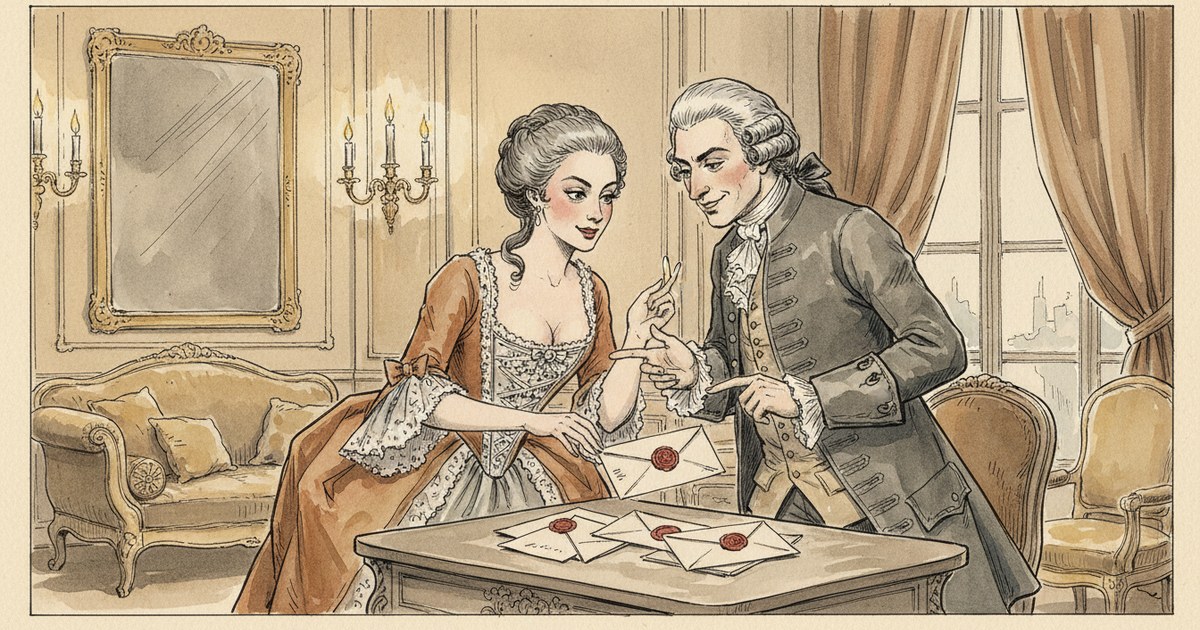
    Choderlos de Laclos wrote Les Liaisons Dangereuses in 1782 and was never fully forgiven for it. The novel — told entirely in letters — follows two aristocrats, the Vicomte de Valmont and the Marquise de Merteuil, as they scheme to seduce, ruin, and discard people for sport. It caused a scandal on publication. It has never stopped causing one.

    The question most readers arrive with is not whether to read it, but which translation to read it in.

    What the Novel Actually Is

    This is not a romance. It is a novel about power — specifically, about two people who have decided that other people’s feelings are raw material to be processed for entertainment. Valmont and Merteuil are brilliant, charming, and entirely without scruple. The letters they write to each other are some of the most coldly intelligent prose in French literature. The letters they write to their victims are almost unbearably manipulative.

    Laclos spent his career as a military engineer, and the novel has an engineer’s precision. Every letter is placed deliberately. The reader always knows more than any single character. The effect is not suspense — it is dread. Consider Letter 48, in which Valmont writes to Merteuil at the very moment he is composing a tender declaration to Madame de Tourvel — using her back as his writing desk. He describes the scene to Merteuil with amused detachment while the woman beneath him believes herself the object of his most sincere feeling. Laclos does not editorialize. He simply shows you the letter, and the information it contains is enough to make your skin crawl.

    The Man Who Wrote One Book

    Pierre-Ambroise-François Choderlos de Laclos was born in Amiens in 1741 into a family of minor nobility — respectable enough to access aristocratic circles, not grand enough to dominate them. He spent two decades as a garrison officer, stationed in provincial towns, doing the unglamorous administrative work of the French military while the courtly world he observed went about its glittering business at a distance. That outsider’s proximity matters. Les Liaisons Dangereuses is not the work of someone who was part of that world; it is the work of someone who watched it very carefully and had opinions.

    Laclos wrote one novel. He spent years working on a treatise on women’s education that was never finished, served in the Revolutionary wars, and died in 1803 having published essentially nothing else. Les Liaisons Dangereuses is his entire literary legacy, which gives it a strange completeness — there is no early Laclos, no late Laclos, just this one perfect machine of a book. He lived long enough to see the world his novel described destroyed by revolution, and then to serve the republic that replaced it. Napoleon eventually made him a general. Whether Laclos found any irony in that — a man who had written the most devastating portrait of the ancien régime, rewarded by its successor — the historical record does not say.

    The Best Translation to Read

    The two translations most commonly recommended are P.W.K. Stone (Penguin Classics) and Douglas Parmée (Oxford World’s Classics). Both are reliable. The Stone translation has been in print since 1961 and remains the most widely read; it’s accurate, clear, and carries the formal register of the original without becoming stiff. The Parmée translation is slightly more contemporary in rhythm and better suited to readers who find Stone’s prose dated.

    For most readers, the translation we recommend is Stone. The formal, slightly elevated prose actually serves the novel — Valmont and Merteuil speak in a register that marks them as people who have turned language into a weapon. A more colloquial translation softens that edge. The test is simple: read Merteuil’s Letter 81 in both versions. In Stone, her self-description — the account of how she trained herself to suppress every visible emotion, to read rooms, to perform sincerity on demand — lands with the cold weight it requires. The register is that of a manifesto delivered in a drawing room. In more contemporary versions, it risks reading like self-help. Stone keeps the distance that Laclos built into the character, and that distance is the point.

    Where It Sits in the Canon

    It influenced Stendhal. It influenced Flaubert. The cold precision of Madame Bovary’s irony has Laclos behind it. If you read Laclos and then go back to Flaubert, you’ll see the debt immediately. What Flaubert learned from Laclos is not subject matter but method: the idea that a narrator can be entirely absent — that the prose can efface itself so completely that the reader is left alone with the characters and their self-delusions, with no authorial hand to guide the verdict. Laclos achieves this through the epistolary form itself; Flaubert would spend his whole career trying to achieve the same effect in continuous prose.

    The novel also has a quieter but significant relationship with Rousseau. Julie, ou la Nouvelle Héloïse — published twenty years earlier and also an epistolary novel — was the defining sentimental counterpoint to everything Laclos was doing. Rousseau believed that letters revealed the authentic self; Laclos spent 175 letters demonstrating that they do nothing of the kind. The two novels are, in a sense, in direct argument with each other, and understanding that argument explains why Madame de Tourvel — the virtuous woman Valmont pursues and destroys — is written with such uncomfortable sympathy. She is the Rousseauian reader, destroyed by her faith in authenticity.

    The World It Came From

    France in 1782 was seven years from revolution, though nobody knew it yet. The aristocratic leisure class — the world Valmont and Merteuil inhabit — was defined above all by time: time to write letters, to receive them, to read them aloud, to parse them for hidden meaning, to compose replies that concealed as much as they revealed. The letter was not merely a communication technology; it was the primary medium through which that class conducted its social and erotic life. Relationships were built in correspondence. Reputations were made and destroyed by what was written, forwarded, withheld. Laclos did not choose the epistolary form because it was fashionable — though it was — he chose it because it was the form in which his characters actually lived.

    This is why the novel felt so dangerous when it appeared. Contemporary readers did not experience it as fiction in the way we might today. The letters read like letters they could have received, from people they might have known. Laclos claimed, in a preface dripping with irony, that he was merely the editor of a real correspondence. Nobody fully believed him; many were not entirely sure. The scandal was not that the book described depravity — libertine literature was abundant in 18th-century France — but that it described depravity with such recognizable specificity. It was not a warning. It was a mirror held up to a class that preferred its mirrors flattering.

    The speed of the novel’s notoriety was itself remarkable. Within weeks of publication it was being read in the salons it depicted — the same aristocratic women who recognized the social world on every page were passing it between each other under their shawls. Several readers attempted to identify the real people behind the characters, and at least one candidate for “the real Merteuil” was proposed in Parisian society within the year. Laclos denied everything with the practiced innocence of a man who had written a 400-page argument for the unreliability of all stated positions.

    What People Get Wrong

    Readers who come to the novel via the 1988 film — Glenn Close, John Malkovich, the costumes, the heat — often find the book colder than expected. That is not a flaw. The film is a story of passion; the novel is a story of geometry. Valmont and Merteuil do not lose control because they feel too much. They lose control because they have constructed a system so intricate that it eventually turns on its architects. The seductions in the novel are less erotic than tactical. Reading it, you are less a voyeur than an analyst watching a campaign unfold — which is precisely the effect Laclos intended.

    The second misreading is more consequential: the assumption that Merteuil is simply a villain. She is not. She is the only character in the novel who has thought seriously about what she is doing and why. Letter 81 — the letter in which she explains, to Valmont, how she constructed herself from nothing, how she taught herself to read faces and master her own, how she became what she is through deliberate self-creation — is one of the most remarkable pieces of writing in 18th-century French literature. It is a philosophical autobiography delivered as a weapon. Merteuil is monstrous, yes. She is also the most fully realized intelligence in the book, and Laclos knows it. The novel’s moral universe does not simply punish her for being powerful. It punishes her for existing in a world that had no legitimate place for what she was.

    The third misreading — less common but worth naming — is to read Cécile de Volanges, the young convent-educated girl Merteuil and Valmont jointly destroy, as simply naive. She is naive, yes, but she is also fifteen years old, has been educated in deliberate ignorance of the world she is about to enter, and is surrounded by adults whose interest in her well-being is performative at best. Her letters, which start out cheerful and girlish and grow increasingly confused and frightened, track a very specific kind of harm. Laclos gives her enough interiority that her destruction doesn’t feel like furniture. It feels like a crime the reader watched happen and did nothing to stop.

    Who Should Read It

    Anyone who has read Stendhal, Flaubert, or Balzac and wants to understand where they came from. Anyone interested in how the epistolary form can be used not just as a narrative device but as a structural argument — the form of letters is the point; it creates the information asymmetry that makes the novel work. Anyone who finds the aristocratic world of 18th-century France fascinating and wants to see it at its most predatory.

    It is not a long book. The Penguin edition runs to about 400 pages, but it reads faster than that — the letters pull you forward. It is also, despite everything, frequently very funny. Valmont’s accounts of his own maneuvers have the self-satisfied comedy of someone who is absolutely certain he is the cleverest person in any room — a certainty the novel methodically dismantles, but which produces some genuinely sharp comedy on the way down. Reading Laclos is not a grim experience. It is an exhilarating one, with a slow-building sense of doom underneath.

    If You Liked This

    The natural companions are novels about intelligence turned predatory. Stendhal’s The Red and the Black takes the same engine — manipulation as a form of sport, ambition dressed as seduction — and runs it through the post-Napoleonic social climb; Julien Sorel is a provincial Valmont with worse odds. Flaubert’s Sentimental Education (not Bovary — the disillusionment arc here is harder and more systemic) shows what happens when that same cold clarity turns inward and hollows out its subject entirely. And Henry James’s The Portrait of a Lady is the anglophone version of the same problem: characters who treat other people as objects to be arranged, and one woman who slowly understands that she has been arranged. These books talk to each other. Reading them in sequence is its own education.

    Frequently Asked Questions

    Is Dangerous Liaisons worth reading?

    Yes, without qualification. It is one of the most precisely constructed novels in the Western canon — a book that uses form and content as a single argument. If you have any interest in how psychological manipulation works, how power operates through language, or simply in prose that never wastes a sentence, it belongs on your list.

    Is Les Liaisons Dangereuses appropriate for young readers?

    It depends on the reader, not the age. The novel contains seduction, sexual manipulation, and the deliberate destruction of a young woman’s reputation and sanity. None of it is graphic by contemporary standards — this is 18th-century French prose, not modern literary fiction — but the themes are adult and the psychological content is genuinely dark. Mature teenagers who read seriously will handle it; it is not a book for younger adolescents.

    Which is better — the 1988 film or the book?

    They are doing different things. The film, directed by Stephen Frears with a screenplay by Christopher Hampton, is an excellent adaptation that translates the novel’s cruelty into something warmer and more visceral. The book is colder, more structural, and ultimately more disturbing — because it never lets you forget that you are watching a system operate, not a passion unfold. Read the book first. The film rewards you differently once you know how the machine is supposed to work.

    How long does it take to read Les Liaisons Dangereuses?

    The Penguin Classics edition runs to roughly 400 pages, but the epistolary format moves faster than continuous prose — letters are short, the transitions are abrupt, and the forward pull is strong. Most readers finish it in four to six hours of focused reading, spread across two or three sittings. It does not drag.

    Why did Les Liaisons Dangereuses cause such a scandal in 1782?

    The scandal was not simply about content — libertine fiction was widely available in 18th-century France — but about recognizability. The social world Laclos depicted was specific enough that contemporaries attempted to identify real people behind the characters, and the novel’s formal device (Laclos claiming to be merely an editor of genuine letters) blurred the line between fiction and document in a way that felt threatening. It was suppressed after the Revolution as a product of aristocratic decadence, then again under Napoleon on different grounds. The book has spent most of its existence being banned by someone.

    Is there a connection between Les Liaisons Dangereuses and Cruel Intentions?

    Yes, direct and credited. Roger Kumble’s 1999 film Cruel Intentions is a loose adaptation that transposes the story to a Manhattan prep school milieu, with Sebastian Valmont (Ryan Phillippe) and Kathryn Merteuil (Sarah Michelle Gellar) replacing the French aristocrats. The core structure — a wager over a seduction, letters used as instruments of power, a system that destroys its architects — is preserved almost intact. Hampton’s 1988 screenplay (which became both the Frears film and a stage play) was also separately adapted as Valmont by Miloš Forman in 1989, meaning the novel generated two major films in a single year, which is itself a measure of how much material it contains.

    📚 Further Reading
    If Laclos interests you, the natural next steps are Stendhal’s The Red and the Black and Flaubert’s Madame Bovary — both available in modern English translations from Classics Retold.

    Stendhal Guide →
    Flaubert Guide →

    Recommended Edition
    Dangerous Liaisons — Pierre Choderlos de Laclos
    Modern English translation

    Kindle →Paperback →

  • Verne’s Castaways Never Needed Rescuing

    Verne’s Castaways Never Needed Rescuing

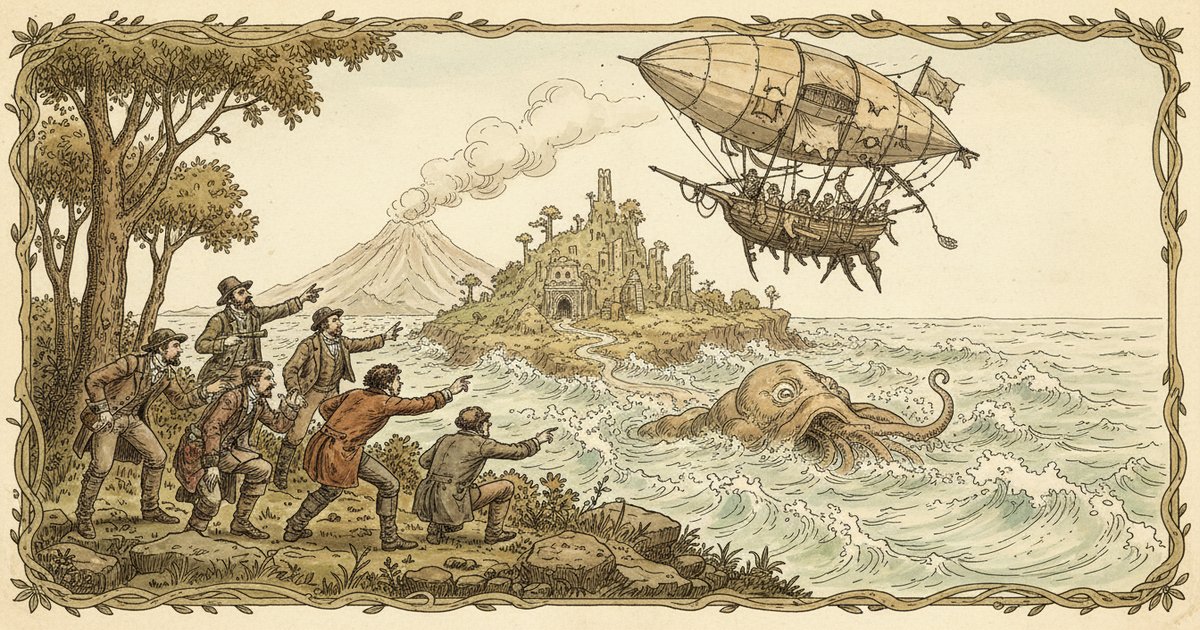
    There is a moment in The Mysterious Island when Cyrus Harding, engineer, former Union officer, and the closest thing Jules Verne ever wrote to a personal avatar, stands on a volcanic outcrop and surveys the domain his small band of castaways has built from nothing. They have a forge. They have a telegraph line. They have a working mill, a brick kiln, cultivated fields, and a domesticated animal population. They have been on the island for less than two years. Verne presents this not as fantasy but as an argument — a careful, methodical demonstration that human intelligence, applied with discipline and solidarity, is sufficient to rebuild civilization from the ground up. The adventure novel is the wrapper. The manifesto is what’s inside.

    Five Men and an Idea

    The setup is irresistible. Five Union prisoners — an engineer, a journalist, a sailor, a young orphan boy, and an emancipated Black man named Nab — escape a Confederate prison camp in Richmond by stealing a military balloon. A storm drives them thousands of miles off course and deposits them on an uncharted Pacific island, somewhere in the vast nowhere south of the shipping lanes. They have almost nothing: no tools, no weapons, no provisions beyond what they can scavenge in the first hours. What they do have is Cyrus Harding, and Verne makes abundantly clear that this is enough.

    But Harding is not a lone genius in the Romantic mold. He does not heroically solve problems while the others watch. What Verne constructs, with the obsessive patience of an engineer himself, is a collective intelligence. The journalist Gideon Spilett provides curiosity and documentation. The sailor Pencroff brings practical seamanship and a stubborn animal vitality. Nab provides loyalty and physical endurance, and if Verne’s portrayal of him reflects the limitations of his era, the structural fact remains: the colony cannot function without him, and Verne never lets the reader forget it. The boy Harbert is essentially the reader surrogate — young, eager, learning. Together they are not five castaways. They are a society in miniature, and Verne is asking what a society, stripped of inherited wealth, inherited power, and inherited institutions, can actually build.

    The answer, rendered across nearly a thousand pages of scrupulous technical detail, is: everything. Verne walks his readers through the smelting of iron ore, the production of nitroglycerine, the construction of a brick house, the weaving of cloth, the cultivation of grain, the management of livestock. He does this not to impress but to instruct, and the instruction carries a political charge that Verne’s contemporary readers would have felt immediately. This is a book published in 1875, in the shadow of the Paris Commune, four years after French workers seized the capital and tried to govern it themselves before being massacred for their trouble. Verne was not a revolutionary, but he was a utopian, and utopias have political valence even when their authors pretend otherwise.

    The Ghost in the Machine

    The island has a secret. Strange things happen that the castaways cannot explain. Tools appear where there were none. A dangerous animal is killed by an unseen hand. A message arrives in a bottle. Someone, or something, is watching over them, intervening at precisely the moments when the colony would otherwise be destroyed. The mystery accumulates slowly, with Verne’s characteristic patience, until late in the novel it resolves into one of the great cameo appearances in all of adventure literature: Captain Nemo, last seen sinking warships in Twenty Thousand Leagues Under the Sea, has been living beneath the island in his submarine, the Nautilus, for decades.

    The revelation is more than a sequel hook. It is a thematic closing of the circle. Nemo — whose very name means “nobody” in Latin — is the novel’s dark mirror. He too built a civilization outside the reach of the world’s powers, and he too organized it around intelligence, self-sufficiency, and a rejection of unjust authority. But Nemo’s utopia was solitary and predicated on destruction. The castaways’ utopia is collective and predicated on creation. Verne is drawing a line between two kinds of withdrawal from an unjust world: the nihilistic and the constructive. Nemo, dying, blesses what Harding has built and asks that it continue. It is as close to an authorial benediction as Verne ever wrote.

    Nemo’s backstory, elaborated here more fully than in the earlier novel, reveals him as an Indian prince whose family was destroyed by British colonial power. His hatred of empire was not abstract. Verne, writing for a French audience that had just watched its own imperial ambitions lead to catastrophic defeat in the Franco-Prussian War, was embedding a critique of European expansionism inside a story ostensibly about American Civil War heroes building a new world. The layers compound. The island is named Lincoln Island by the castaways in honor of the assassinated president. Verne is not subtle about what civilization is being contrasted with what.

    The Dignity of Making Things

    What separates The Mysterious Island from the comfortable tradition of the Robinson Crusoe narrative is Verne’s insistence on the social dimension of labor. Crusoe rebuilds a kind of English property-owning civilization on his island, complete with a servant. Harding builds something closer to a cooperative, in which each member contributes according to ability and the fruits of the colony belong to the colony. No one is paid. No one is a servant. The work is shared, the meals are shared, and the decisions, while generally deferred to Harding’s expertise, are made collectively. For a novel published in the same decade as the First International and the early labor movement, this is not an accidental arrangement.

    Verne also insists, with almost tedious thoroughness, that the castaways understand what they are doing. They do not find things; they make them. They do not stumble upon solutions; they derive them. The novel is full of passages that read like encyclopedia entries, explaining the chemistry of iron smelting or the mechanics of a hydraulic elevator with a pedagogue’s precision. This has frustrated readers who want the plot to move faster, and it is true that Verne tests the patience of anyone accustomed to the pace of modern thrillers. But the slowness is intentional. Every page of technical detail is an argument: human knowledge, freely shared and collectively applied, is the foundation of any civilization worth having. What industrial capitalism does, Verne implies, is appropriate that knowledge for private profit while keeping the workers who apply it in ignorance of what they are actually doing. On Lincoln Island, everyone knows everything.

    This is the manifesto buried in the adventure novel, and a fresh English translation — one that renders Verne’s precise, often formally elevated prose without the condescension of Victorian-era translators who thought his work was merely for children — allows modern readers to feel its full weight. Verne was not writing escapism. He was writing a blueprint. The island was a thought experiment about what human beings could do together if they were freed from the hierarchies and dependencies that industrial society had convinced them were natural. The fact that he wrapped this argument in volcanic eruptions, pirate attacks, and a dying submarine captain does not diminish it. It preserves it.

    Read this translation. Read it as what it is: one of the nineteenth century’s most ambitious novels, a book that believes, with a fervor that still feels urgent, that intelligence and cooperation are enough to build the world we actually want.

    What is the best English translation of The Mysterious Island?

    For most readers today, the best English translation of The Mysterious Island is one that strips away the Victorian-era stiffness of older versions while preserving Verne’s scientific imagination and storytelling drive. This modern accessible English translation does exactly that — it renders Verne’s prose in clean, natural language that reads fluently without losing the novel’s sense of wonder or its detailed attention to engineering and survival. Readers who struggled with 19th-century translations will find this edition far easier to follow from the first chapter to the last.

    Is The Mysterious Island worth reading in 2026?

    Yes — more than most people expect. The Mysterious Island holds up in 2026 because its core themes — self-reliance, ingenuity under pressure, the relationship between humans and the natural world — resonate as sharply now as they did in 1875. Verne’s castaways don’t wait to be rescued; they build, invent, and reason their way out of crisis, which makes the novel feel remarkably contemporary. With a modern accessible translation removing the language barrier, there is no longer any reason to put it off.

    How does The Mysterious Island compare to Twenty Thousand Leagues Under the Sea?

    Both novels belong to Verne’s Voyages Extraordinaires and share the figure of Captain Nemo, but they are very different reading experiences. Twenty Thousand Leagues Under the Sea is driven by spectacle and mystery — an underwater odyssey told from the outside, where Nemo remains an enigma. The Mysterious Island is warmer and more grounded: it is a survival story, a novel of community and problem-solving, and it provides Nemo’s backstory and redemption. Readers who loved the oceanic grandeur of Twenty Thousand Leagues will find The Mysterious Island richer in character and emotional payoff. This modern accessible English translation of both titles makes comparing them side by side easier than ever.

    What should I read after The Mysterious Island?

    If The Mysterious Island sparked an appetite for classic adventure fiction in modern English, two titles from the classicsretold.com catalog are natural next reads. The Three Musketeers: A New Translation in Modern Accessible English delivers the same pace and ingenuity in a swashbuckling historical setting — Dumas at his most entertaining, rendered without the archaic weight of older translations. For something darker and more literary, The Hunchback of Notre-Dame: A New Translation in Modern Accessible English offers Hugo’s Paris in language that finally lets the story breathe. Both reward readers who came to Verne for plot, ideas, and a sense of another world made fully real.
    Recommended Edition
    The Mysterious Island — Jules Verne
    Modern English translation

    Kindle →Paperback →

  • Respectable Women Are the Biggest Gamblers

    Respectable Women Are the Biggest Gamblers

    Here’s the post:

    She is not watching the faces. She is watching the hands. Mrs. C., a composed English widow of sixty-seven, has been telling her story for forty years, and the moment she begins, you understand why she cannot stop. It was Monte Carlo, sometime around 1880. She had developed the habit her late husband taught her: reading gamblers not by their expressions but by what their hands betrayed at the roulette table. “Everything can be seen in those hands,” she says. “Those who are covetous by their clawing, the profligate by their relaxation, the calculating by their steadiness, the desperate by their trembling.” She was watching, the way you do when you are recently widowed and have nothing left to want, when a pair of young hands appeared at the table — white-knuckled, shaking, half-mad with hunger — and she was lost.

    Stefan Zweig’s Twenty-Four Hours in the Life of a Woman is a novella about what happens in the hours that follow. But that description undersells it. The book is really about what happens in the forty years after those hours — how one day of reckless moral action can calcify into the defining fact of a life, the thing a woman carries everywhere and tells no one, until finally she tells a stranger. Zweig’s thesis, pressed close beneath the surface of his elegant sentences, is this: a single impulse toward goodness — the decision to try to save someone — can destroy you just as thoroughly as any sin. And the cruelest part is that you will spend the rest of your life unable to decide whether it was worth it.

    The book was published in 1927, the same year Zweig was at the height of his fame, the most translated living author in the world. It appeared inside a collection called Verwirrung der Gefühle — Confusion of Feelings — which is the most honest possible title any writer has ever given his collected work. The frame story places Mrs. C.’s confession inside a broader social scandal: a married Frenchwoman at a seaside pension has run off with a man she met three days prior, and the other guests are arguing about whether she should be condemned or understood. An unnamed narrator argues for understanding. Mrs. C. pulls him aside. She has something to say.

    What makes that frame more than a narrative convenience is the specific way Zweig loads the debate. The other guests at the pension deliver their verdicts with the speed of people who have never once surprised themselves — the kind of certainty that only comes from having never been genuinely tested. Mrs. C. listens, and her silence says everything. She knows what happens to a person when the moment of testing actually arrives. She also knows that the person who emerges from it is not the person who walked in, and that explaining the gap to anyone who hasn’t felt it is essentially impossible. That is why she’s been carrying this story alone for four decades. And that is why, when she finally speaks, she cannot quite stop.

    There is also something quietly devastating in the detail that she chooses to tell a stranger rather than anyone she knows. The narrator is not her priest, not her doctor, not a friend of thirty years. He is simply a man who argued for understanding at the dinner table, which is the minimum qualification Mrs. C. requires. That Zweig makes this the threshold — one moment of public sympathy, and the floodgates open — tells you everything about how isolated she has been inside her own correctness. The confession is not catharsis. It is the sound of a pressure valve that has been sealed for four decades finally finding the smallest possible crack.

    The Man Who Understood Too Much

    Zweig was born in Vienna in 1881 into the sort of comfortable Jewish bourgeois family that produced writers the way other families produced lawyers — almost inevitably, and with mild concern. Vienna in the late Habsburg era was a city organized around surfaces: the correct café, the correct coat, the correct degree of emotional restraint. What Zweig absorbed from that world, and spent his entire career quietly dismantling, was the fiction that restraint protects you. His great subject — across novellas, biographies, memoirs — was always the moment when the surface cracks. Not the scandal itself, but the interior pressure that precedes it. He was, at his core, a psychologist who chose fiction as his instrument.

    That interest in inner life sharpened as his own world came apart. In 1934, the Nazis burned his books in Germany. He fled Austria in 1935, then London, then New York, then finally Petrópolis, a small hill town in Brazil, where he and his wife Lotte took their lives together in February 1942 — the night of Carnival, the city full of noise and light. He had written in his farewell letter that his spiritual homeland, Europe, had destroyed itself, and he could not rebuild himself in a new world. This matters to how his fiction reads. Zweig understood, at the cellular level, what it means to build an entire life around a vanished moment. His Mrs. C. is not an abstraction. She is a precise portrait of the person Zweig was becoming.

    He was also, and this is the biographical detail that changes everything, a man professionally obsessed with female interiority at a time when almost no one thought it worth serious attention. His notebooks record hundreds of conversations with women, careful and attentive, during an era when a woman’s crisis was generally attributed to nerves. Mrs. C.’s story could not have been written by someone who didn’t genuinely believe that the interior life of a sixty-seven-year-old English widow was as vast and worth excavating as anything in Freud’s casebook.

    Zweig and Freud were, in fact, neighbors of a kind — both Viennese, both preoccupied with the forces that move beneath social comportment, and personally acquainted. Zweig delivered a eulogy at Freud’s funeral in 1939. That proximity is not incidental to the fiction. Where Freud wanted to name and categorize what drives people, Zweig wanted to dramatize the moment before naming was possible — the instant when a person acts without yet understanding why. Mrs. C. cannot fully explain her decision to follow the young gambler out of the casino. She can only describe what his hands looked like, and trust that the narrator will understand the rest. Zweig believed he would. He believed we all would.

    There is one more biographical thread worth pulling. By 1927, Zweig had already written novellas about chess obsession, about a doctor destroyed by a single moral failure in colonial Malaya, about a woman who loves a man across two decades without his knowledge. What links them all is a fascination with monomania — the way a single experience can colonize a person’s entire inner life, crowding out everything else until the person and the obsession are indistinguishable. Mrs. C. is Zweig’s most controlled study of that process, and the control itself is part of the point. She is not raving. She is precise, composed, almost clinical in the way she reconstructs the day. That is exactly what forty years of private obsession produces: a person who has rehearsed the story so many times it has become perfectly smooth, with all the rough edges worn down — and all the feeling locked inside the smoothness.

    The Twenty-Four Hours That Last a Lifetime

    What Mrs. C. does during her single day is precise and devastating: she follows the young Polish gambler, pulls him back from the edge of catastrophe, accompanies him through a night of near-ruin and miraculous recovery at the tables, sleeps with him — a decision she describes with neither shame nor bravado, only the flat accuracy of a woman reporting a fact — and then, the next morning, watches him walk back into the casino and lose everything she helped him win. She had believed, for the span of about eighteen hours, that she could save him. She was wrong. The book does not moralize about this. It simply shows her face in the moment she understands.

    What makes the novella last — what makes it feel, at barely ninety pages, more substantial than most novels — is that Zweig keeps the moral weight distributed precisely, without letting anyone off. The young gambler is not a villain. Mrs. C. is not a fool. The narrator does not know what to make of her story, and neither do we. Zweig wrote at a speed that can feel dangerous, sentences that arrive at their point before you’ve braced for it, and the effect in this book is something close to vertigo. You come to the final page and realize: the day she is describing is not the worst thing that happened to her. The worst thing is that she survived it, intact and changed and entirely alone with what she now knows about herself.

    There is one detail Zweig plants early that only registers fully on a second reading. When Mrs. C. first sees the young man’s hands at the roulette table, she notices they do not belong to the rest of him — they move with a ferocity that his face, still boyish, has not yet earned. She is drawn to that gap. It is the gap between what a person appears to be and what they are actually capable of, and Mrs. C., who has spent twenty years being the composed, contained English widow, recognizes it because she contains the same gap herself. The entire novella is the story of what happens when that gap closes, for a single day, and then widens again permanently.

    The ending deserves mention without being spoiled in full. Zweig gives Mrs. C. one final piece of information — delivered almost as an afterthought, as these things always are — that reframes everything she has told us. It does not explain the young gambler. It does not absolve him or condemn him. It simply adds a fact that Mrs. C. had not known during those twenty-four hours, which means she made her decisions in ignorance, which means the question of whether she was right becomes permanently unanswerable. Zweig understood that the most honest ending for this story was not resolution but the permanent suspension of judgment. That is also, incidentally, where he leaves the reader: holding the weight of the story with no verdict to set it down on.

    What Monte Carlo Actually Was

    It is worth pausing on the setting, because Zweig chose it with precision. The Casino de Monte-Carlo opened in 1863, and by the 1880s it had become one of the defining institutions of European leisure — a place where the aristocracy and the newly wealthy could shed their ordinary identities for an afternoon and pretend that fate was a wheel that spun impartially. Suicide on the casino steps was common enough that Monaco’s government reportedly paid newspapers not to report it. The gambler who loses everything is not a melodramatic invention; he was a fixture of the place, recognized and unremarked upon. When Mrs. C. follows the young Pole out of that building, she is not doing something unusual in the context of Monte Carlo. What is unusual is what she decides it means.

    Zweig was intimately familiar with that world. He traveled widely across Europe during his most productive years, staying in grand hotels, moving through exactly the kind of cosmopolitan resort culture that forms the backdrop of the novella. He knew what a gambling room looked and smelled like at two in the morning, what the faces of the desperate looked like under chandelier light, and crucially, what the faces of the bystanders looked like — the people who watched and did nothing, because nothing was the correct social response. Mrs. C. breaks with that world the moment she moves toward the young man. That is the moral rupture the book is built on, and it lands harder if you understand that in 1880 Monte Carlo, her intervention was genuinely transgressive — not romantic or brave, but strange and slightly alarming.

    The casino also functions as Zweig’s most economical symbol. Roulette is, structurally, a machine for generating the illusion of pattern where none exists — gamblers lean forward convinced they have spotted a streak, a tendency, a logic in the spinning wheel, and the wheel ignores them entirely. Mrs. C. is doing the same thing with the young man. She reads his hands, reads his posture, reads the hunger in his face, and constructs a narrative in which she can be the variable that changes his outcome. The casino’s great lesson — that no outside force can alter what the wheel will do — is the lesson Zweig has set her up to learn. That he delivers it in a setting where everyone around her is making the same mistake, and losing, gives the story a layer of dark structural irony that you absorb before you consciously notice it.

    Why This Translation?

    Zweig wrote in a German that is formal without being stiff, urgent without being breathless — a difficult combination to preserve in English, where those two qualities tend to pull in opposite directions. Older translations of this novella sometimes tip toward the Victorian: the sentences grow heavy with subordinate clauses, and Mrs. C. begins to sound like a woman dictating a letter rather than confessing to a stranger. The translation we recommend here corrects for that tendency without overcorrecting into contemporary flatness. The prose stays close to Zweig’s rhythms — the long, building sentences that arrive at their emotional point like a door finally opening — while shedding the archaic diction that creates distance where Zweig intended proximity.

    The test of any Zweig translation is how it handles his free indirect discourse — the technique by which a narrator slides, without announcement, into a character’s interior voice. In this novella, Mrs. C.’s reported speech and her remembered thoughts blur into each other at crucial moments, and the seam should be invisible. In the editions that handle this well, you finish a paragraph and realize you have been inside Mrs. C.’s head without being told. That is the effect Zweig engineered, and it is the effect the translation we recommend delivers.

    There is one specific passage where the quality of the translation becomes unmistakable: the scene in which Mrs. C. waits outside the young gambler’s hotel room in the early hours of the morning, listening to the silence on the other side of the door. Zweig stretches that silence across nearly a full page, loading each sentence with a different quality of dread. A flat or hurried translation collapses the sequence; the reader registers that something tense is happening but doesn’t feel the duration of it. The edition featured here holds the pace Zweig set — the sentences arrive slowly, they complete themselves slowly, and by the end of the passage you have been standing in that corridor with Mrs. C. long enough to understand exactly what she was willing to risk. That is the translation doing its job. Pick up the paperback here — and give yourself an afternoon for it, because once Mrs. C. starts talking, you will not want to be the one who stops her.

    How to Read This Book (and When to Stop)

    Ninety pages sounds like an afternoon, and it is — but it is a specific kind of afternoon, the kind where you look up at the end and realize it has gone dark outside and you haven’t moved. The novella’s structure rewards reading in a single sitting precisely because Zweig designed it as a confession: Mrs. C. begins talking and does not stop, and interrupting her — putting the book down, coming back tomorrow — breaks the spell in a way that isn’t true of longer novels. The frame device reinforces this. The narrator is listening in real time, and Zweig keeps reminding you of that by returning occasionally to the physical setting — the room, the lamp, the night outside — which creates the sensation of sitting across from Mrs. C. yourself. Stop reading, and you have left the room. Stay, and you are her only witness.

    What you will notice, particularly on a second read, is how precisely Zweig controls what Mrs. C. remembers and what she skips. She is exacting about the young man’s hands, his coat, the specific green of the felt on the roulette table, but vague about her own face in those moments — what she looked like, what anyone watching her might have seen. This is not carelessness. A woman who has spent forty years composing the story of her worst day will have made choices, conscious or not, about which details to inhabit and which to observe from a distance. The gaps in Mrs. C.’s narrative are as carefully placed as everything else. Reading for them is one of the pleasures the book offers on return.

    Frequently Asked Questions

    What is the best English translation of Twenty-Four Hours in the Life of a Woman?

    The modern English edition featured here is among the most readable currently available, prioritizing natural prose rhythms over the stiff Victorian register that burdens some older versions. It handles Zweig’s free indirect discourse — the technique of sliding silently into a character’s interior voice — with particular care, which matters enormously in a book where the distance between reported speech and private thought is the whole point. Readers who found earlier translations airless or over-formal will notice the difference immediately.

    Is Twenty-Four Hours in the Life of a Woman worth reading in 2026?

    Yes. The novella’s central preoccupation — how a single unguarded moment can rewrite a life — has lost none of its force. Zweig’s portrait of Mrs. C., a composed widow undone by a stranger’s hands at a roulette table, is as psychologically acute now as when it was written in 1927. In an era saturated with surface-level character studies, Zweig’s deep interior focus feels rare and necessary. The book is short; the effect is not.

    How does Twenty-Four Hours in the Life of a Woman compare to The Stefan Zweig Collection – Volume 1: A New Translation?

    Twenty-Four Hours is a single sustained narrative — one woman, one confession, one moral crisis. The Stefan Zweig Collection – Volume 1 offers breadth instead of depth, gathering several of Zweig’s finest shorter works so readers can trace the patterns across his obsessions: passion, shame, the violence of memory. If Twenty-Four Hours is Zweig at his most concentrated, Volume 1 is Zweig in full range. Readers who finish the novella wanting more of the same intensity will find it rewarded and expanded in the Collection.

    What should I read after Twenty-Four Hours in the Life of a Woman?

    Start with The Stefan Zweig Collection – Volume 1: A New Translation, available at classicsretold.com. It includes several works that share the novella’s obsessive emotional register and will deepen your sense of what Zweig was doing across his career. After that, The Stefan Zweig Collection – Volume 2: A New Translation extends the journey further, covering a wider arc of his output. Both volumes use the same modern translation approach, so the reading experience remains consistent.

    Recommended Edition
    Twenty-Four Hours In The Life Of A Woman — Stefan Zweig
    Modern English translation

    Kindle →Paperback →

    More from Stefan Zweig
  • Hugo Made the Terror About Forgiveness

    Hugo Made the Terror About Forgiveness

    In the spring of 1794, a Republican officer named Gauvain makes a decision that costs him his head. He has captured the Royalist leader Lantenac — the man who burned villages and shot prisoners, the embodiment of the counter-revolution — and then, after watching Lantenac risk his life to pull three children from a burning tower, he opens the cell door and lets him walk free. Mercy over doctrine. The human gesture over the iron logic of revolution. His superior and surrogate father, the priest-turned-commissar Cimourdain, cannot save him. The morning of the execution, as the guillotine falls, Cimourdain shoots himself through the heart.

    Victor Hugo did not invent this dilemma. By the time he published Ninety-Three in 1874, he had lived inside it for decades — watched the Paris Commune’s insurgents die by the thousands on the streets he’d walked as a young man, buried a son in 1871 and another in 1873, and spent nineteen years in political exile for refusing to bend to Napoleon III. He knew exactly what ideological certainty costs the people who love you. The novel is usually described as his reckoning with the French Revolution. It is more precisely a reckoning with the question that obsessed him at the end of his life: what do we owe each other when the cause is real and the cost is human?

    Ninety-Three is his answer. It is not comfortable. It is not optimistic. But it is the most honest thing he ever wrote.

    The Man Who Outlived Almost Everyone He Loved

    Hugo was forty when his daughter Léopoldine drowned with her husband in the Seine in 1843. He learned about it from a newspaper, sitting in a café. He did not publish a novel for fifteen years. When the losses resumed in the 1870s — his wife Adèle gone in 1868, his son Charles in 1871, his son François-Victor in 1873 — he was in his seventies, back in Paris after the exile, watching the Republic he’d sacrificed his career for consume itself in the Commune’s bloody reprisals. These are not incidental biographical details. They are the pressure system that shaped every sentence of Ninety-Three.

    What this accumulated grief produced, paradoxically, was not a book of despair but one of ferocious moral argument. Hugo had always been a political writer — he’d been a peer of France, a member of the National Assembly, a man who gave speeches on the floor of parliament about the abolition of the death penalty. But Ninety-Three is where politics stops being abstract. Gauvain is young, idealistic, beloved. Cimourdain, who mentored him from boyhood, believes in the Revolution with the totality of a man who has replaced God with a cause. The father-and-surrogate-son dynamic is not an accident; Hugo had buried two sons. He understood what it means to outlive the people you shaped.

    The biographical detail that changes how the book reads is the exile itself. Nineteen years on Guernsey and Jersey, forced to watch France from a distance while Louis-Napoleon consolidated power — Hugo knew what it meant to be correct about history and still lose. That knowledge is everywhere in the Vendée sections, in the way he renders both the Royalist guerrillas and the Republican columns with equal moral weight, refusing the easy consolation of a clean villain.

    There is a passage early in the novel — before the armies are even properly introduced — where a Republican sergeant named Radoub finds the three children alone in a forest clearing, starving, the youngest still nursing at their dead mother’s breast. He picks them up without ceremony and carries them back to his battalion, which votes, collectively and without irony, to adopt them. It is a moment of almost absurd tenderness dropped into the middle of a war narrative. Hugo puts it there deliberately. He wants you to know what the soldiers are capable of before he shows you what the war will require of them. The grief in the novel is not decorative; it is structural.

    The War That History Forgot to Make Simple

    The Vendée counter-revolution of 1793 is not a story most readers arrive at knowing. The guillotine, the Jacobins, Robespierre’s Terror — these have iconic weight. The civil war in the bocage of western France, where peasants with scythes fought Republican columns through sunken lanes and dense forests, is less tidy, less photogenic, and therefore largely unknown outside France. Hugo chose it precisely because it resists simplification. The Royalist Marquis de Lantenac leads men who murder prisoners and burn farms. The Republicans march under a banner of liberation while also shooting Royalist civilians. Nobody gets to be purely right. The war grinds on because both sides believe they are saving something essential about France.

    Hugo’s genius in Ninety-Three is the pivot the novel makes at its exact center. Three small children — separated from their mother in the war’s chaos, caught between the armies — become the novel’s moral fulcrum. When they are trapped in a burning tower, it is Lantenac, the Royalist butcher, who turns back to save them. A single human reflex undoes his ideology. And it is Gauvain — the young Republican, the novel’s moral hero — who cannot then send Lantenac to the guillotine for all the others he killed. The chain of mercy runs downward until it destroys him. Hugo does not frame this as tragedy or as triumph. He frames it as the truth about human beings: that we are, at our best, ungovernable by our own systems.
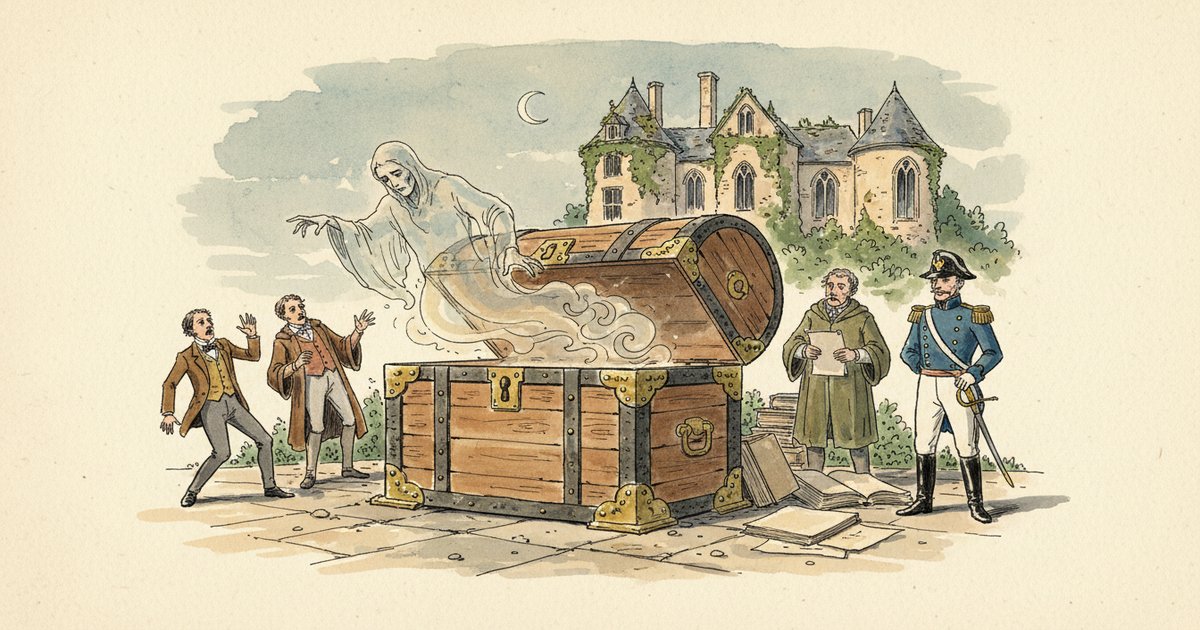
    What makes the Vendée so useful to Hugo as a setting is that it was, by 1874, still contested political territory in France. Republicans remembered it as a royalist insurgency crushed in the name of progress. Conservatives remembered it as a massacre of faithful Catholics by godless revolutionaries. Historians now estimate that somewhere between 200,000 and 400,000 people died in the region between 1793 and 1796 — a figure that dwarfs the more famous death toll of the Parisian Terror. Hugo had watched France spend the better part of a century arguing about who the villains were. His answer, embedded in the structure of the novel itself, is that the question is the wrong one. The Vendée is not a morality tale about good versus evil. It is a case study in what happens when human beings become fully convinced they are on the right side of history.

    How Hugo Builds a Villain You End Up Respecting

    Lantenac arrives in the novel the way a weather system arrives — before you see him, you feel the pressure change. Hugo spends nearly fifty pages establishing his reputation through other characters’ fear before the Marquis appears in person. When he finally does, he is in his seventies, boarding a ship under fire, giving orders with the calm of a man who has simply decided that nothing frightens him anymore. He executes a deserter without particular cruelty and without particular pleasure. He is not sadistic. He is something more unsettling: entirely committed. Hugo understood that the most dangerous people in revolutions are not the ones who enjoy violence but the ones who regard it as arithmetic.

    This is what makes the burning tower scene so devastating. Lantenac has already condemned the three children to be shot if Gauvain’s Republican forces breach the tower walls — he announced it coldly, as a military calculation. Then the tower catches fire. The children are trapped on an upper floor. Lantenac watches for a moment, and then he goes back. He climbs toward the flames, finds a rope, and lowers the children down one by one. Hugo does not explain it. He does not give Lantenac an interior monologue about a sudden change of heart. The man simply acts, as if the calculus that had governed everything else momentarily stopped running. That gap — between the ideology and the instinct — is where Hugo locates the entire argument of the novel.

    Why This Translation?

    For most English readers, Ninety-Three has been available only in Victorian-era translations that carry all the stiffness of their moment — sentences that heave and creak, dialogue that sounds like parliament rather than people. This new translation restores what those versions muffled: Hugo’s rhythm, which moves like weather, fast and then slow, intimate and then vast; his capacity to make a military campaign feel as immediate as a conversation in a dark room. It is a book that rewards being read in a version that actually sounds like a novel. Ninety-Three: A New Translation is available now in paperback — the right way to meet the last thing Hugo had left to say.

    The specific problem with nineteenth-century English renderings of Hugo is that his prose operates on two registers simultaneously: the oratorical and the intimate. He can move from a panoramic description of a battlefield — the kind of elevated, almost biblical sweep that was his signature — directly into a single soldier noticing that his boots have worn through. When Victorian translators hit the oratorical passages, they amplified them into something approaching parody. When they hit the intimate passages, they formalized them into stiffness. The translation we recommend holds both registers in the same sentence the way Hugo intended, so that the grandeur never loses its human scale. That balance is not easy to achieve, and it is exactly what makes Ninety-Three readable today rather than merely admirable.

    Translation Landscape

    Ninety-Three (Penguin Classics, trans. Adèle Dorange and Christine Donougher) — The 2024 Penguin Classics edition — the first major new English translation in over a century. Donougher is among the most trusted translators of nineteenth-century French prose (her Zola and Les Misérables are benchmarks). This is the standard scholarly edition going forward.

    Ninety-Three (Carroll & Graf, trans. Aline Delano (revised ed.)) — The Delano translation from 1874, revised and still the most commonly found older paperback. Period-accurate voice; the oratorical passages can tip into parody, but the Vendée battle sequences hold up. Acceptable if the Penguin edition is unavailable.

    What Makes This Novel Feel Different From the Rest of Hugo

    Readers who come to Ninety-Three after Les Misérables or The Hunchback of Notre-Dame sometimes report a surprise: it feels tighter. Not shorter — it is still Hugo, and Hugo is never spare — but more compressed in its moral argument. Les Misérables is a cathedral of a book, built to contain everything Hugo believed about poverty, law, love, and the nature of goodness. Ninety-Three is more like a proof. It sets up three figures — the implacable old Royalist, the idealistic young Republican, the merciless commissar — and runs them through a series of situations designed to find the exact point at which ideology breaks and the human being underneath it shows through. Every chapter is doing work. There are no lengthy digressions about the Paris sewer system here.

    This compression also means the emotional impact arrives faster and harder. By the time Hugo reaches the final confrontation between Cimourdain and Gauvain — the surrogate father forced to authorize the execution of the surrogate son — readers who have spent a hundred pages watching their relationship have very little distance left. Cimourdain is not a monster. He is a man who believes, completely and without self-deception, that the Revolution requires this. His suicide in the novel’s final lines is not the act of a villain who has been defeated. It is the act of a man for whom the cause and the person were the same thing, and now both are gone. Hugo gives him no redemption. He gives him only honesty. After a lifetime of writing, that restraint is the mark of a writer who has nothing left to prove.

    Frequently Asked Questions

    What is the best English translation of Ninety-Three by Victor Hugo?

    For modern readers, the best place to start is Ninety-Three: A New Translation, a contemporary rendering that strips away the archaic phrasing found in Victorian-era editions while preserving Hugo’s intensity and rhetorical power. Unlike nineteenth-century translations that can feel stiff or dated, this version reads as living prose, making Hugo’s portrait of the French Revolution’s most savage year fully accessible to a twenty-first-century audience without sacrificing literary fidelity.

    Is Ninety-Three worth reading in 2026?

    Yes. Hugo’s final novel speaks directly to questions that have not gone away: what justifies political violence, whether idealism survives contact with war, and how ordinary people behave when history forces an impossible choice. The 1793 Vendée uprising is the setting, but the moral vertigo at the novel’s core is permanent. Ninety-Three: A New Translation makes that argument easier to hear by removing the language barrier that causes many readers to abandon older editions.

    How does Ninety-Three compare to The Hunchback of Notre-Dame?

    Both novels show Hugo using a single, charged historical moment as a lens for universal themes, but they pull in opposite directions. The Hunchback of Notre-Dame is architectural and symbolic, built around a cathedral and the fatal weight of beauty and deformity. Ninety-Three is kinetic and ideological, driven by revolution, counter-revolution, and a climax of stunning moral ambiguity. Readers who want Hugo’s lyrical grandeur should start with Hunchback; readers who want his political urgency will find Ninety-Three the more gripping experience. Both are available in modern accessible translations at classicsretold.com.

    What should I read after Ninety-Three?

    Two titles pair naturally with it. The Hunchback of Notre-Dame: A New Translation in Modern Accessible English returns you to Hugo’s France from a different angle, trading revolutionary terror for medieval pageantry and the tragedy of outcasts in a rigid society. If you want to move from Hugo to the broader French Romantic tradition, The Three Musketeers: A New Translation in Modern Accessible English by Alexandre Dumas delivers the same era’s swashbuckling energy with relentless pace and wit. Both are available at classicsretold.com.

    Was Ninety-Three Victor Hugo’s last novel?

    Yes. Hugo published Ninety-Three in 1874, when he was seventy-one years old, and it was the last novel he completed. He lived another eleven years, dying in 1885 at eighty-three, but spent that final decade primarily writing poetry and attending to his enormous public legacy rather than returning to long fiction. The novel carries the weight of a final statement — its refusal to offer easy consolation feels like the deliberate choice of a writer who knew he was done arguing and wanted to leave the most honest version of what he believed.

    How historically accurate is Ninety-Three?

    Hugo was scrupulous about the broad strokes of the Vendée uprising — the geography of the bocage, the guerrilla tactics of the Chouans, the role of the Committee of Public Safety — while inventing his central characters wholesale. Lantenac, Gauvain, and Cimourdain are fictional, but the military and political machinery surrounding them is drawn from Hugo’s extensive research into the period. He was particularly careful about the Revolutionary calendar and the specific military campaigns of 1793, which gives the novel an atmosphere of documented reality even when its moral argument is entirely his own invention.

    Recommended Edition
    Ninety-Three — Victor Hugo
    Modern English translation

    Kindle →Paperback →

    More from Victor Hugo
    The Hunchback of Notre-DameLes Misérables - Volume 1The Last Day of a Condemned ManLes Misérables - Volume 3

    This post contains affiliate links. As an Amazon Associate, we earn from qualifying purchases.

  • Stendhal Best Translation (2026 Modern Edition) | Classics Retold

    Stendhal Best Translation (2026 Modern Edition) | Classics Retold

    He wrote a 300-page treatise on love in 1822 — a taxonomy of desire, a field guide to the heart — and sold seventeen copies in ten years. The woman who inspired it, Métilde Dembowski, refused to see him alone. She suspected he was taking notes. She was right.

    1890 Public Domain

    “M. de Renal was a tall man, with an open countenance and a straight nose; his whole air spoke of a certain provincial dignity, which he endeavoured to combine with a degree of ease and elegance. He was very well pleased with himself, and his wife was afraid of him.”

    2026 Modern Translation

    M. de Rênal carried himself like a man accustomed to deference — straight-backed, composed, wearing his provincial authority the way other men wore a watch chain. His wife had learned, early in their marriage, not to disagree with him in public.

    Read the Modern Translation →

    That gap — between Stendhal’s analytical detachment and his helpless, humiliating surrender to feeling — is where his fiction lives. The short stories he wrote in the 1830s, including those gathered in The Chest and the Ghost (and other Stories), are not the work of a man who had figured love out. They are the work of a man who had failed at it repeatedly and learned to render that failure with a surgeon’s eye and a gambler’s nerve. The thesis is uncomfortable: Stendhal understood desire precisely because he could never stop being destroyed by it.

    The stories circle what he called la chasse au bonheur — the pursuit of happiness — a phrase that sounds like a motto and reads like a wound. His characters pursue happiness the way a moth pursues a lamp: with complete commitment and no expectation of survival. A woman betrays the man she loves to keep him near. A police chief uses the machinery of justice to eliminate a rival. Desire in these pages is never decorative. It is the lever that moves everything else.

    What makes these stories more than clever period pieces is the precision of the emotional diagnosis. Stendhal’s characters don’t suffer vaguely. They suffer in ways that are embarrassingly specific — the particular humiliation of being seen through by the person you’re trying to impress, the exact mathematics of jealousy, the way hope and pride fight each other inside the same chest at the same moment. He had catalogued all of it in De l’Amour, and now, in fiction, he could show it moving.

    The Man Who Needed a Pseudonym to Tell the Truth

    Henri Beyle was born in Grenoble in 1783, hated it, left as fast as he could, followed Napoleon across half of Europe, and spent the rest of his life trying to get back to Italy. He adopted the pen name Stendhal — borrowed, improbably, from a small Prussian town — because anonymity was the only condition under which he felt free to write honestly. He used over a hundred pseudonyms in his lifetime. The proliferation wasn’t eccentricity. It was strategy: a man with that many masks is a man who understood that the self is also a performance, and that audiences matter.

    The years he spent as French consul in Civitavecchia, from 1831 until his death in 1842, are the direct context for these stories. The posting was a backwater — he called it a tomb — but it gave him access to Italian archives, and in those archives he found records of crimes of passion from the Renaissance: confessions, execution orders, accounts of desire curdled into violence. He didn’t merely adapt them. He read them as confirmation of everything he already believed: that passion is the only authentic response to existence, and that society’s job is to punish it. Every biographical fact about Stendhal bends back toward the same question: what does a person do when what they want most is also what the world most forbids?

    The answer, for Stendhal, was write it down. De l’Amour, the treatise, gave him the theory. The stories gave him the cases. And the distance of fiction — characters with Spanish names, Italian settings, plots borrowed from dusty chronicles — gave him permission to say what direct confession couldn’t.

    There is one detail from Civitavecchia worth sitting with. Stendhal’s consular duties were minimal and he loathed them. But the boredom had a productive edge: with nothing urgent to do, he read obsessively, drafted constantly, and sent long letters back to Paris describing his intellectual loneliness with such wit that his correspondents saved them. The man who looked most like a minor bureaucrat gathering dust in a coastal town was, simultaneously, writing the stories that would be pulled out of obscurity a century after his death and recognized as something close to masterpieces. He had predicted as much — he famously expected to be read around 1880, then revised the estimate to 1935. He was, characteristically, both right and wrong at the same time.

    The Shortest Distance Between Two People Is a Complication

    What distinguishes these stories from other Romantic-era fiction is their refusal of sentiment. Stendhal does not romanticize passion — he dissects it. In “The Chest and the Ghost,” desire operates through a gothic frame that he deploys not for atmosphere but for irony: the supernatural is cover for very natural appetites, and the story’s real horror is not the ghost but the calculation behind the haunting. In “Recollections of an Italian Gentleman,” a man’s memory becomes a form of obsession — the past not as nostalgia but as a trap that the present keeps springing. The characters believe they are pursuing happiness. The reader watches them pursue their own undoing with total lucidity about everything except themselves.

    That gap — between what characters know and what they cannot stop doing — is where Stendhal’s irony sharpens into something that cuts. These are not tragedies. They’re something colder: portraits of intelligent people who see clearly and act anyway, because what else is there to do? The prose moves the way his best fiction always does — fast, specific, no decoration — and the translation we recommend here earns its place by preserving that velocity. Too many versions of Stendhal slow him down, soften the edges, turn his directness into period furniture. This one doesn’t. The sentences land.

    The structure of “The Chest and the Ghost” is worth examining closely, because it shows exactly how Stendhal works. He sets up what looks like a supernatural mystery — a chest, a ghost, whispered rumors in a provincial household — and then, sentence by sentence, withdraws the gothic scaffolding until you’re left staring at something much more unsettling: two people who want each other and have decided that deception is preferable to honesty. The ghost was always a pretense. The chest was always a prop. The performance of fear was always a performance of desire. Stendhal doesn’t announce this revelation; he just stops holding the curtain up and lets you work it out. It takes about three seconds. Then you go back and reread the opening paragraph and realize he told you everything on page one.

    What These Stories Owe to The Red and the Black

    Readers who come to The Chest and the Ghost from The Red and the Black will recognize the machinery immediately. Julien Sorel, the carpenter’s son who claws his way into Parisian society through a combination of brilliance and calculated charm, is the novel-length version of every protagonist in these stories: someone who understands the rules of the game well enough to play, but whose actual feelings keep breaking through the strategy at the worst possible moments. The stories are shorter and more compressed, but the emotional logic is identical. A character decides to want something. The wanting takes over. The strategy collapses. What’s left is either comedy or catastrophe, depending on which way the final scene turns.

    The Red and the Black was published in 1830, just as Stendhal was being packed off to Civitavecchia. The stories in this collection are what came after — after the novel, after the exile, after whatever hope he still harbored about his own romantic prospects had finished evaporating. That context matters. The novel has Julien’s ambition driving the engine, and ambition at least has the dignity of a clear direction. The stories are quieter and more claustrophobic. The characters want things they can’t name. That unnamed quality is where Stendhal gets most interesting, and most true.

    Why These Stories Have Been Missing from English

    The question of which Stendhal reaches English readers has always been shaped by which Stendhal publishers thought would sell. The Red and the Black and The Charterhouse of Parma have never gone out of print. The shorter fiction — the novellas, the Italian chronicles, the stories collected here — has had a much more irregular history in translation. Some pieces appeared in Victorian anthologies with the kind of bowdlerizing footnotes that turn irony into earnest moralizing. Others simply weren’t translated at all, which is how two of the stories in this collection arrive as English-language debuts. Two stories that Stendhal completed, that have sat in French editions for nearly two centuries, that no one had previously thought worth the effort of translation. That is either a remarkable oversight or a remarkable opportunity, depending on your perspective. The edition featured here treats it as the latter.

    The implication is worth spelling out: if you have read Stendhal in English before — even carefully, even devotedly — you have read an incomplete Stendhal. These aren’t footnotes. These are stories in which his characteristic obsessions appear in concentrated form, without the sprawl of a novel to dilute them. Reading them fills in a gap you probably didn’t know was there.

    Why This Translation?

    Several of these stories have rarely appeared in English at all — two are making their English-language debut here — which means that even committed readers of Stendhal have been missing part of the picture. The Chest and the Ghost (and other Stories) isn’t a sampler for newcomers, though it works as one. It’s the late Stendhal: the consul in his tomb by the sea, pulling Renaissance crime records out of dusty folders and finding, in other people’s catastrophes, confirmation of everything he had lived. Read it alongside The Red and the Black if you want context; read it alone if you want proof that short fiction can do everything the novel does, in a fifth of the space. Available now in paperback: pick it up here.

    The specific translation choices matter more with Stendhal than with almost any other French author, because so much of his effect depends on tone. His sentences are short, dry, and often end with a twist that functions like a deadpan punchline — the equivalent of a raised eyebrow. Translate too literally and the eyebrow disappears into wooden phrasing. Translate too freely and you lose the specificity that makes the irony land. The edition featured here threads that needle. Where older translations reach for Victorian dignity, this one reaches for clarity. Where older translations explain the joke, this one trusts the reader to get it. That trust is itself a kind of fidelity to Stendhal, who famously said he wrote for the happy few — by which he meant people sharp enough to read between his lines.

    He never did solve the problem of love. Neither do his characters. That’s what makes them worth reading.

    What is the best English translation of The Chest and the Ghost and other Stories by Stendhal?

    This new translation of Stendhal’s lesser-known short fiction is among the most accessible English editions available. Unlike older Victorian-era renderings that can feel stiff and dated, this modern translation preserves Stendhal’s dry wit and psychological sharpness while reading naturally for contemporary audiences. It is an ideal entry point for readers encountering Stendhal’s shorter work for the first time.

    Is The Chest and the Ghost and other Stories worth reading in 2026?

    Stendhal’s preoccupations — social performance, romantic obsession, the gap between how people present themselves and who they truly are — map cleanly onto modern life. These stories are short, precise, and often darkly funny. In 2026, when irony and self-deception are cultural fixtures, Stendhal reads less like a historical curiosity and more like a sharp observer of human nature who happened to write two centuries ago.

    How does The Chest and the Ghost and other Stories compare to The Charterhouse of Parma?

    The Charterhouse of Parma is expansive — a full novel driven by political intrigue and romantic idealism across hundreds of pages. The Chest and the Ghost and other Stories works in miniature: compact plots, swift reversals, and characters stripped down to a single dominant flaw or desire. Readers who find Stendhal’s novels demanding will discover in these stories a more concentrated version of the same intelligence, and readers already devoted to The Charterhouse of Parma will find here the same psychological acuity operating at close range.

    What should I read after The Chest and the Ghost and other Stories?

    If Stendhal’s cynical wit and romantic irony appealed to you, the natural next step is Victor Hugo’s The Hunchback of Notre-Dame: A New Translation in Modern Accessible English, available at classicsretold.com — it shares the same French Romantic-era atmosphere but turns the emotional register up sharply, trading wit for tragedy and spectacle. For readers who want momentum and adventure alongside the period intrigue, The Three Musketeers: A New Translation in Modern Accessible English, also at classicsretold.com, delivers exactly that without sacrificing literary quality.

    Frequently Asked Questions

    Recommended Edition
    The Chest and the Ghost (and other Stories) — Stendhal
    Modern English translation

    Kindle →Paperback →

    More from Stendhal
    The Charterhouse of ParmaThe Red and the Black

    This post contains affiliate links. As an Amazon Associate, we earn from qualifying purchases.

  • Voltaire Made Fun of God and Survived

    Voltaire Made Fun of God and Survived

    In January 1759, Voltaire smuggled a manuscript out of his estate near Geneva and onto the press. He was sixty-four, officially retired from Paris after two imprisonments and decades of exile, and France’s censors had been watching him for thirty years. The book appeared anonymously. Within weeks it had been condemned by the Paris parlement, banned in Geneva, and reprinted in a dozen pirated editions across Europe. Everyone knew who wrote it. Voltaire denied it absolutely. He called Candide “a little piece of schoolboy nonsense.”

    That denial is the whole argument in miniature. Voltaire did not write to liberate France through solemn manifestos. He liberated it by making things funny — so obviously, so irreversibly funny that the authorities looked ridiculous trying to stop them. Candide alone is barely a hundred pages. It kills a man, resurrects him, kills him again, and makes you laugh every time. The thesis of this collection is not that Voltaire was wise. It is that he was dangerous, and the weapon was a grin.

    The works gathered in The Voltaire Collection: Vol. 1Candide, Zadig, Micromégas, and the philosophical tales — show that weapon in full. These are not museum pieces. They are dispatches from a man who understood that ridicule outlasts argument, that a well-aimed joke survives a bonfire, and that laughter, properly deployed, is the one thing a censor cannot burn without looking exactly as stupid as the joke said he was.

    The Man Who Made Exile His Office

    François-Marie Arouet was born in Paris in 1694 and spent most of his life being punished for it. He adopted the pen name Voltaire around age twenty-four — likely to distance himself from a father who disapproved of his writing — and almost immediately earned eleven months in the Bastille for verses mocking the Regent of France. The Bastille gave him time to finish his first tragedy. He emerged with a completed play and a sharper tongue.

    When he was exiled to England in 1726 after a beating arranged by the Chevalier de Rohan (who took offense at Voltaire’s wit and had better connections), Voltaire spent three years reading Locke, watching Newton’s funeral, and absorbing the idea that a society could run on reason rather than inherited rank. His Letters on the English, published in 1733, told France exactly what England had figured out. It was banned immediately. This matters because every major text in this collection is the work of a man who had learned, through repeated physical consequence, that ideas are dangerous — and who kept writing anyway, faster, sharper, and funnier each time.

    He eventually settled at Ferney, just inside the Swiss border, close enough to France to influence it and close enough to Geneva to flee. He ran the estate like a small kingdom: manufacturing watches, hosting philosophers, writing six thousand letters, and producing a stream of anonymous pamphlets and tales that flooded France at a rate no censor could contain. The geography was the philosophy. He built himself a position from which he could not be easily silenced, then refused to be silent.

    The scale of what Ferney represented is worth pausing on. By the 1760s, Voltaire was not merely writing from safety — he was actively campaigning. The Calas affair of 1762, in which a Protestant merchant was tortured and executed by the Catholic authorities of Toulouse on fabricated charges of murdering his son, drove Voltaire into a three-year public campaign that ultimately resulted in the verdict being overturned. He did not write a pamphlet and move on. He wrote dozens, coordinated letter campaigns across Europe, and lobbied anyone with power who would listen. It worked. The Calas family was exonerated in 1765. That is the man behind the jokes in this collection — someone who understood that wit was not a hobby but a lever, and who pulled it hard enough to actually move things.

    What the Lisbon Earthquake Gave Voltaire

    On the morning of November 1, 1755 — All Saints’ Day — an earthquake struck Lisbon and killed somewhere between thirty and sixty thousand people in minutes. Many of them were in church. The fires and tsunami that followed destroyed most of what the earthquake had left standing. It was the deadliest natural disaster Europe had seen in recorded memory, and it landed directly in the middle of an ongoing philosophical debate about whether God’s creation was, as Leibniz had argued, the best of all possible worlds. If this was the best possible world, people asked, what exactly would a worse one look like?

    Voltaire wrote a poem about the earthquake almost immediately, and four years later he folded the disaster into Candide with characteristic precision. Candide and Pangloss arrive in Lisbon just as the earthquake hits. Pangloss explains to a sailor, as bodies are pulled from rubble around them, that this is all part of the general good. The sailor responds by getting drunk. Pangloss is shortly arrested by the Inquisition and hanged — partly, the text explains, because the Lisbon theologians had concluded that a public auto-da-fé was the best available method of preventing future earthquakes. Voltaire does not argue against this. He simply describes it. The joke and the horror occupy the same sentence, and the reader does the work of understanding what that juxtaposition means. Candide is not a response to Leibniz. It is a response to Lisbon, with Leibniz held up as exhibit A for why optimism is not just wrong but indecent in the face of what actually happens.

    What the Tales Actually Do

    Candide opens with its hero being expelled from a castle — a paradise built entirely on a lie — and proceeds to destroy every philosophical comfort available to an eighteenth-century optimist. The character Pangloss, who insists that everything happens for the best in this best of all possible worlds, watches his student suffer earthquake, war, inquisition, slavery, and shipwreck, and keeps explaining it away. Voltaire gives Pangloss the most logical arguments and the most obviously wrong conclusions. The cruelty is precise: the philosophy is never answered directly, only illustrated until it collapses under the weight of what actually happens to people. The final line — “we must cultivate our garden” — arrives not as consolation but as the only honest alternative to nonsense. Do the work in front of you. The world does not have a good explanation.

    Zadig is quieter but no less lethal, tracking a man in ancient Babylon whose good judgment consistently ruins his life while stupidity and flattery are rewarded around him. Micromégas sends an alien of enormous size to examine human beings and finds them, after much effort, philosophically negligible but very pleased with themselves. Each tale works the same muscle: it makes the reader laugh at a system, then leaves the reader sitting with what the laughter has uncovered. A good translation matters here precisely because the timing has to land. Voltaire’s comedy is structural — the joke is in the sentence’s shape, the way a monstrous thing is described in the mildest possible register — and a flat rendering turns satire into summary. The translation we recommend keeps the blade where Voltaire left it.

    The episode in Micromégas that sticks longest is near the end, when the giant alien, having traveled across galaxies to study humanity, finally communicates with a group of philosophers on a ship. He is charmed by their intelligence and curiosity. He promises them a book that will explain the meaning of everything. When the book arrives, the philosophers open it to find only blank pages. Voltaire published this in 1752. The joke is about systems of thought that promise total explanation and deliver nothing verifiable — but it is delivered so gently, so apparently without malice, that the reader laughs before registering what exactly has just been described. That is the method, repeated across every tale in this collection: the form is a gift, the content is a charge.

    Why the Satire Still Has Teeth

    It would be convenient to read Candide as a period piece — a document of eighteenth-century arguments about theology and optimism that no longer apply. That reading does not survive contact with the text. The targets are specific enough to be historical but general enough to be current: the bureaucrat who enforces rules he knows to be absurd, the intellectual who explains catastrophe as secretly beneficial, the institution that punishes criticism more harshly than the behavior the criticism describes. These figures are not extinct. They are recognizable in any week’s news.

    What keeps the satire alive is not that the targets have survived but that the method has. Voltaire’s technique — describe the outrage in the flattest possible tone, let the reader supply the moral — turns out to be uniquely resistant to the thing it is criticizing. You cannot argue back against a deadpan description. There is nothing to refute. When Pangloss explains, in the aftermath of an auto-da-fé, that the execution of innocent people was “necessary” and that “private misfortunes make the public good,” the reader does not need Voltaire to say the words “this is wrong.” The gap between the claim and what the reader has just witnessed does all the work. That gap is still there, still functional, and still funny — which is to say, still devastating.

    Why This Translation

    Voltaire has been translated often enough that the question is always which version trusts the reader. The best ones render him as he actually wrote: economically, with a dry precision that makes the absurdity visible without explaining it. This collection brings that register into contemporary English without updating the vocabulary into cuteness or softening the ironies into parable. For readers coming to Voltaire for the first time, it is the most direct line to what made these texts genuinely threatening. The Voltaire Collection: Vol. 1 is available in paperback here — the laughter is included, and so is the blade.

    The specific challenge with translating Voltaire is that his sentences do two things at once: they move the story forward and they deliver the joke, usually in the same clause. Older translations — including the widely circulated nineteenth-century versions — tend to let the narrative momentum win, rounding off the irony in the process. The edition featured here holds both. When Pangloss explains that syphilis is a net positive because it allowed Europe to receive chocolate and cochineal from the New World, the sentence has to be delivered with exactly Pangloss’s sincerity and exactly Voltaire’s contempt, simultaneously, without editorializing. Lose either register and the scene flattens into either buffoonery or lecture. This modern English edition keeps the tension in the right place — which means it keeps the joke, and the joke is the argument.

    What is the best English translation of The Voltaire Collection: Vol. 1?

    For readers coming to Voltaire for the first time, The Voltaire Collection: Vol. 1: New Translation stands out as one of the most accessible modern English editions available. Unlike older Victorian-era translations that preserve archaic phrasing at the expense of clarity, this version renders Voltaire’s wit, irony, and philosophical sharpness in natural contemporary prose—making it the practical first choice for general readers, book clubs, and students who want the full force of Voltaire’s voice without a dictionary of antiquated idioms at their side.

    Is The Voltaire Collection: Vol. 1 worth reading in 2026?

    Voltaire wrote against dogmatism, institutional corruption, and willful ignorance—targets that have not gone out of season. The Voltaire Collection: Vol. 1 gathers works that dissect power and credulity with a precision that reads less like historical literature and more like pointed contemporary commentary. In 2026, when misinformation cycles in hours and ideological rigidity shapes public discourse, Voltaire’s core argument—that reason, humility, and skepticism are civic virtues—lands with fresh urgency. This translation makes that argument available to anyone willing to spend an afternoon with it.

    How does The Voltaire Collection: Vol. 1 compare to Candide: A New Translation?

    A standalone Candide: A New Translation gives readers Voltaire’s most famous work in depth, often with scholarly apparatus—footnotes, critical introductions, contextual essays. The Voltaire Collection: Vol. 1 trades that vertical depth for horizontal breadth, presenting Candide alongside other works so readers can see Voltaire’s recurring preoccupations—religious hypocrisy, optimism, the social contract—develop across multiple texts. If you want Candide studied closely, a dedicated edition serves that purpose; if you want to understand Voltaire as a writer rather than a single satirical set-piece, the collection is the stronger choice.

    What should I read after The Voltaire Collection: Vol. 1?

    Readers who enjoy Voltaire’s blend of social critique and narrative momentum tend to move naturally toward other pillars of French and European literature. The Hunchback of Notre-Dame: A New Translation in Modern Accessible English, available at classicsretold.com, offers Victor Hugo’s panoramic vision of Paris—morally complex, richly atmospheric, and equally unsparing toward institutional cruelty. For something faster-paced, The Three Musketeers: A New Translation in Modern Accessible English, also at classicsretold.com, channels the same era’s appetite for adventure, loyalty, and political intrigue. Both are rendered in the same clear modern prose that makes the Voltaire volume so readable.

    Frequently Asked Questions

    Recommended Edition
    The Voltaire Collection — Voltaire
    Modern English translation

    Kindle →Paperback →

    More from Voltaire
    CandideThe Voltaire Collection

  • Captain Nemo Built His Prison Underwater

    Captain Nemo Built His Prison Underwater

    In 1866, ships from a dozen countries reported the same thing: something vast and luminous was moving beneath them. The reports were credible — speeds no living creature could sustain, a phosphorescent wake miles long, impacts that dented iron hulls. The world’s maritime press went briefly mad trying to name the thing. Jules Verne, watching from Paris, did something more useful. He went home and invented it.

    Twenty Thousand Leagues Under the Sea began as a serial in 1869, a year before anyone had descended more than a few hundred feet in anything resembling a controlled vehicle. Verne had seen a model of the French submarine Plongeur at the 1867 Exposition Universelle — a lumbering, compressed-air prototype that managed brief dips in the Seine. From that seed, he built the Nautilus: electrically powered, capable of circling the globe, equipped with a salon hung with paintings and a library of twelve thousand volumes. The working submarines of 1869 could barely stay down for twenty minutes. Verne’s argument, implicit in every page, was that the ocean was not a void. It was a civilization waiting to be entered.

    That argument has never really been answered. We have explored less than twenty percent of the ocean floor. Verne mapped it before we reached it, and in certain essential ways, we still haven’t caught up.

    What makes the novel more than a technical fantasy is the bet Verne makes on his reader: that you will care about a man who refuses to tell you why he is angry. Captain Nemo is introduced as a presence before he is introduced as a person. The Nautilus moves. Aronnax is held captive. And then, eventually, there is the captain — cold, fluent in everything, grieving something he will not name. The mystery of Nemo is not solved by the end of the book. Verne understood that explained grief is grief defused. The opacity is the point.

    The Man Who Turned His Editor’s Rejections into a Career

    Verne was thirty-five when he sold his first novel. Before that: a failed lawyer, a moderately failed playwright, a stockbroker who spent his lunch hours in the Bibliothèque nationale reading scientific journals in fields he had no formal training in — geology, oceanography, astronomy, polar exploration. His first editor rejected the manuscript that would become Five Weeks in a Balloon twice. Verne reportedly told his wife he was going to burn it and try something else. She hid the manuscript. This matters to how Twenty Thousand Leagues reads, because it is a book written by someone who taught himself the science one journal at a time, who had to earn his own authority before he could project it onto a character. Captain Nemo’s serene, absolute expertise — the way he names every organism Aronnax cannot, reads the deep currents the way others read weather — carries the specific confidence of self-made knowledge. Nemo is what Verne wanted to be: the man who had actually read everything.

    The editor who finally said yes was Pierre-Jules Hetzel, and the relationship that followed was one of the defining editorial partnerships of the nineteenth century — and one of the most consequential acts of political censorship in French popular fiction. Hetzel had his own exile to answer for: he had fled France after Louis-Napoleon’s coup in 1851, spending years in Brussels before returning. He understood exactly what Verne was doing with Nemo. And he made Verne pull back. In the original manuscript, Nemo was explicitly a Polish nobleman, his family destroyed by Russian imperial forces, his hatred of nations rooted in a specific historical atrocity. Hetzel judged this too inflammatory — France needed Russian goodwill — and insisted Nemo’s origins be left ambiguous. The wound that drives the entire novel was edited out of the novel. It surfaces only as absence: the portrait of a woman and two children that hangs in Nemo’s quarters, the tears he sheds at a crewman’s underwater burial, the fury that overtakes him when he encounters certain warships. You can feel the missing context in every scene where Nemo almost explains himself and then does not.

    The other biographical fact that reshapes the novel: Verne wrote it in the shadow of the Second Empire, a France where political dissent required careful management. Nemo — whose name is Latin for “no one” — is a man who has renounced nations, a stateless fugitive living beneath the reach of governments. He funds anti-colonial uprisings from the sea floor. He mourns something he refuses to name. When Aronnax presses him about his past, Nemo answers: “I am not what you call a civilized man. I have done with society entirely.” That line did not require literary analysis in 1870. Every French reader knew exactly what it meant.

    A Catalogue That Becomes a Grief

    The novel’s central formal gamble is that it gives you a scientist as narrator. Professor Aronnax catalogs everything — species, depths, temperatures, geological formations, the chemical composition of the water at successive fathoms. Lesser writers deploy this technique to seem authoritative. Verne uses it to build an emotional argument. By the time Aronnax has named three hundred organisms, has stood awestruck in the Nautilus’s observation window watching bioluminescent forests scroll past at four knots, you understand what Nemo understood first: the ocean is not empty. It is fuller than the surface world, more ordered, stranger, more alive. The cataloguing is not pedantry — it is the slow accumulation of a love so large it has no object that can hold it. Aronnax cannot stay. He does not want to leave. The novel’s real tension is not whether the crew will escape Nemo. It is whether Aronnax can survive returning to a world that will never be as interesting again.

    The scene that makes this most visceral is the walk across the ocean floor near the island of Crespo. Nemo leads Aronnax and Conseil out through the Nautilus’s airlock onto the seabed in diving suits, armed with air rifles, hunting for sport but really, you sense, conducting a kind of liturgy. They move through underwater forests that Verne describes as trees of black coral, their branches perfectly still in the absence of current, hung with seaweed the color of garnets. Aronnax reaches for his notebook and realizes he cannot write. He can only watch. The scene lasts for pages and nothing narratively consequential happens in it — no danger, no revelation, no plot development — and yet it is the emotional center of the book, the moment you understand what the novel is actually about. Verne is not writing adventure fiction. He is writing about what it costs to witness something no language is adequate to.

    What Verne understood, and what most adventure fiction refuses to admit, is that wonder has an aftermath. The specific grief of a man who has seen something no one else has seen — and who will spend the rest of his life failing to describe it adequately — is present on every page without ever being stated directly. It surfaces instead in the catalog: one more species, one more coordinate, one more measurement of a world that does not need us to witness it but that becomes, by being witnessed, unbearably precious. The last line of the book arrives like a door closing on a lit room. You are back on the surface, and the surface is not enough.

    Nemo’s Politics: What the Novel Is Actually Arguing

    Readers who approach Twenty Thousand Leagues as a submarine adventure story are not wrong, exactly. The adventure is real and it moves fast. But Verne was doing something more pointed, and the political argument runs underneath the plot the way the Nautilus runs beneath the shipping lanes — invisible from above, but propelling everything.

    Nemo is not simply a man who prefers solitude. He is a man who has made a philosophical decision about civilization and found it wanting. The ocean, in his formulation, belongs to no nation — there are no property rights below the waves, no tariffs, no flags, no armies with jurisdiction over the deep-sea vents. His electricity comes from the sea. His food comes from the sea. He is economically and politically sovereign in a way that no surface-dweller can be. When he surfaces to sink a warship — a scene that genuinely shocked readers in 1870 — Verne is not endorsing terrorism. He is dramatizing what it looks like when a man follows his principles to their logical conclusion without the friction of social compromise. Nemo is what pure sovereignty produces: someone who is both heroic and monstrous, and whose creator refuses to arbitrate between the two. The novel ends without resolving him because Verne knew that resolving him would be dishonest. Some arguments do not have answers. Some men cannot be absorbed back into the world they have rejected.

    Why This Translation?

    The original English translations of Verne are notoriously damaged goods — the 1872 Mercier Lewis version dropped twenty-five percent of the text, mistranslated the scientific terminology throughout, and smoothed away Nemo’s political edges into something safer for Victorian readers. What Verne actually wrote was more precise, more strange, and considerably more radical than most English readers have ever encountered. This new translation works from the original French, restores the excised passages, and renders Verne’s technical vocabulary accurately while keeping the prose moving at the pace he intended — urgent, specific, alive. If you read Twenty Thousand Leagues in school and found it slow, you were probably reading the wrong book.

    One concrete example of what the Mercier Lewis cuts cost you: the Atlantis sequence. When the Nautilus glides over the submerged ruins of what Nemo identifies as the lost continent, Verne gives Aronnax a full geological and architectural inventory — basalt columns, granite foundations, the outlines of temples and harbors visible through the submarine’s lights. Lewis reduced this to a paragraph. In the complete French text, it runs for several pages, and the effect is cumulative: by the time Aronnax has catalogued the drowned city in enough detail to almost map it, you feel the weight of everything that has been lost, not just to the ocean but to history, to time, to the indifference of the surface world. That passage is one of Verne’s most arresting pieces of writing. Most English readers have never read it. The translation we recommend puts it back where it belongs.

    Further reading: More books by Jules Verne · Explore French Literature

    What is the best English translation of Twenty Thousand Leagues Under the Sea?

    For readers who want the full depth of Verne’s original vision without the archaic phrasing that plagues older Victorian-era editions, Twenty Thousand Leagues Under the Sea: A New Translation in Modern Accessible English is the strongest choice available today. Earlier translations—particularly the widely circulated Mercier Lewis version—cut significant passages and introduced errors that distorted Verne’s scientific detail and narrative voice. This modern translation restores the complete text and renders it in clear, contemporary English that doesn’t require a 19th-century reading vocabulary to enjoy.

    Is Twenty Thousand Leagues Under the Sea worth reading in 2026?

    Yes—and more so than many readers expect. Verne wrote Captain Nemo as a figure of radical independence, grief, and moral ambiguity that feels entirely contemporary. The novel’s tension between wonder and unease aboard the Nautilus, its meditation on freedom versus isolation, and its portrait of a man who has renounced the surface world all resonate sharply in an era defined by surveillance, disconnection, and technological anxiety. The modern accessible translation removes the one barrier that kept earlier readers at arm’s length: the stiff, dated prose of Victorian editions.

    How does Twenty Thousand Leagues Under the Sea compare to The Mysterious Island: A New Translation in Modern Accessible English?

    The Mysterious Island is in many ways a companion piece—it revisits Captain Nemo at the end of his life and ties up threads left open in Twenty Thousand Leagues. Where Twenty Thousand Leagues is driven by mystery and the claustrophobic grandeur of the deep ocean, The Mysterious Island is a survival story with an ensemble cast, broader in scope and warmer in tone. Readers who respond to Nemo’s enigmatic presence in the first book will find his reappearance in The Mysterious Island genuinely moving. Both modern accessible translations use consistent contemporary English, so the transition between the two books is seamless.

    What should I read after Twenty Thousand Leagues Under the Sea?

    If you want to stay in the world of 19th-century adventure translated into clean, modern English, two titles from the classicsretold.com catalog are natural next reads. The Three Musketeers: A New Translation in Modern Accessible English by Alexandre Dumas delivers the same propulsive plotting and larger-than-life characters, with the added pull of political intrigue and swashbuckling action set in 17th-century France. If you prefer something with more psychological weight, The Hunchback of Notre-Dame: A New Translation in Modern Accessible English by Victor Hugo is a dense, rewarding novel about justice, beauty, and social cruelty—every bit as ambitious as Verne at his best.

    Frequently Asked Questions

    Recommended Edition
    Twenty Thousand Leagues Under the Sea — Jules Verne
    Modern English translation

    Kindle →Paperback →

    More from Jules Verne
    The Mysterious IslandThe Lighthouse at the End of the World

  • Proust Wrote Swann’s Way While Dying

    Proust Wrote Swann’s Way While Dying

    In 1909, Marcel Proust sat down in a cork-lined bedroom in Paris and began writing a sentence. It ran for several pages. He was describing the experience of waking up, of not knowing where or when you are, of feeling the whole architecture of identity collapse and slowly reassemble itself from nothing but sensation. By the time he died in 1922, he had written 3,000 pages and had not quite finished. The sentence, in a sense, was still going.

    Swann’s Way is the first volume of that sentence. It begins with a man lying in the dark, half-asleep, and it ends with him standing in the street remembering a love affair that destroyed his youth and noticing, with the cold precision of a surgeon, that the woman was not even his type. Everything in between is an argument about time — not time as a calendar records it, but time as the nervous system does: associative, recursive, occasionally merciless. The thesis Proust is running is audacious: that voluntary memory lies, that the past is only genuinely recovered when the body is ambushed by it, and that literature is the only instrument sensitive enough to catch this happening in real time.

    That is what makes Swann’s Way unlike anything else in the canon. Not its length. Not its famous sentences. Its argument.

    The Man Who Built a Cathedral to Stay Indoors

    Proust was born in 1871 to a prominent Paris physician father and a Jewish mother whose family connections opened doors into the upper bourgeoisie. He was brilliant, asthmatic, socially ravenous, and constitutionally unsuited to health. His childhood summers in Illiers — fictionalized as Combray — gave him the landscape of Swann’s Way: the church, the two walks, the hawthorns in bloom, the kitchen smell of a house where time moved differently than in Paris. When his mother died in 1905, he began a grief-driven retreat that accelerated into the cork-lined room on Boulevard Haussmann. He had the room lined to keep out noise and dust. He worked at night. He barely left.

    The isolation wasn’t eccentricity for its own sake. Proust needed silence because he was attempting something that required absolute concentration: to reconstruct, with total fidelity, the precise texture of consciousness moving through time. His asthma forced him inward; his grief demanded it stay there. The result is a novel written from the inside of a mind that has nothing left to do but remember — and has learned, through suffering, to distrust everything memory presents without the body’s confirmation.

    What the biographical record also shows is how ferociously social Proust had been before he retreated. Through the 1890s he haunted the salons of the Faubourg Saint-Germain, cultivating friendships with aristocrats, artists, and socialites with the same systematic devotion he later gave to prose. He attended the premiere of Pelléas et Mélisande. He fought a duel, badly, over a newspaper squib. He was present at the height of the Dreyfus Affair and watched his own social world split along antisemitic lines that cut close to home. None of this was wasted. The Guermantes, the Verdurins, the entire ecosystem of performance and snobbery in the novel — Proust assembled it from live specimens, observed over decades with a naturalist’s patience and a wounded insider’s eye.

    He died of pneumonia in November 1922, correcting proofs in bed. The final volumes were published posthumously. He had spent the last years of his life writing death — his narrator’s slow understanding that time had passed and could not be recovered except in the one way that mattered, which was this: the book itself.

    What the Madeleine Actually Does

    Everyone knows the madeleine. What most people don’t know is that Proust uses it as a trap. The narrator dips a madeleine into lime-blossom tea, and something unlocks — not a postcard memory, not a nostalgic haze, but a full sensory resurrection so complete it produces joy disproportionate to any deliberate act of remembering. He spends several pages analyzing why. He is not being indulgent. He is making his case: that the past locked in involuntary memory is the only past that remains entirely real, and that the self who recovers it is, for that moment, standing outside time. The madeleine is not a warmth-and-cookies moment. It is a philosophical proof-of-concept.

    The rest of Swann’s Way tests and complicates the proof. The Combray section, written in the long loose rhythms of total recall, gives us childhood as a place where the geometry of two afternoon walks still structures the whole moral universe. “Swann in Love,” the novella nested inside the novel, shifts tense and distance to show us Swann’s obsession with Odette from close enough to feel the shame of it — a man applying the machinery of aesthetic appreciation to a woman who returns none of it, watching himself do it, unable to stop. What Proust shows in that section, with a flatness that verges on cruelty, is that romantic suffering is a form of solipsism: Swann is not in love with Odette, he is in love with his own capacity to suffer over Odette. The reader recognizes this. The recognizing is uncomfortable.

    What is easy to miss, first time through, is the structural cunning behind the madeleine episode’s placement. It comes early, before Combray has been described at all — which means that everything which follows, all two hundred pages of hawthorns and church steeples and Aunt Léonie’s bedroom, arrives as the content of that unlocked memory. We are not reading a novel that occasionally stops for flashbacks. We are inside the flashback from almost the first page. Proust has arranged it so that the reader experiences involuntary memory rather than simply being told about it — the sensation of a whole lost world rushing back, warm and complete, delivered not by effort but by a cup of tea.

    The World Proust Was Writing About — and Against

    To read Swann’s Way without knowing what Belle Époque Paris looked and smelled like is to miss half its tension. The world Proust depicts is one of extraordinary social rigidity dressed up as elegance: aristocratic families whose names opened every door, bourgeois families desperate to pass through those doors, and artists and aesthetes like Swann hovering uncomfortably between both worlds. Proust knew this system from both sides. His father was respected but not noble; his mother was Jewish in a city where that still cost something. He watched people perform their social identities with the anxious precision of actors who know they can be written out of the play.

    The Dreyfus Affair — the 1894 military scandal in which a Jewish officer was falsely convicted of treason, dividing France into bitterly opposed camps for over a decade — runs underneath the novel like a fault line. Proust was a Dreyfusard, one of the early signatories of Émile Zola’s open letter demanding justice. Several of the aristocratic characters in the cycle are implicitly or explicitly anti-Dreyfusard, and the reader who knows this watches Proust’s narrator navigate their drawing rooms with a doubled awareness: enchanted by the glamour, clear-eyed about the ugliness beneath it. The social comedy is never quite detached from the social indictment.

    How the Sentences Actually Work

    The reputation of Proust’s sentences precedes them so noisily that many readers brace for difficulty before they’ve read a word. The reality is more interesting than the warning. A Proustian sentence doesn’t drift; it accumulates. It begins with an observation, then qualifies that observation, then notices what the qualification implies, then follows that implication somewhere unexpected, and then, having arrived somewhere no shorter sentence could have reached, closes. The length is the point — not as an aesthetic preference but as a mimetic strategy. Consciousness doesn’t move in short declarative bursts. It moves exactly the way those sentences do.

    A useful test case is the passage where the narrator describes the church at Combray. It begins as architectural description and ends as a meditation on time — the building old enough to have absorbed centuries of the town’s life into its stones, so that looking at it feels like looking at duration itself made solid. The sentence carrying this idea runs through several subordinate clauses that keep adjusting the angle of approach, each one getting slightly closer to something that a direct statement couldn’t capture. By the end, you have not been told what the church means. You have experienced the process of working it out. That is the technique in miniature. Multiplied across 3,000 pages, it becomes something that changes how you read everything else.

    Why This Translation (translated by David Petault)

    Translation is the central problem with Proust in English. The sentences need to hold their shape — their long, breath-consuming, subordinate-clause-stacking shape — without collapsing into parody or ironing themselves into clarity Proust never intended. The translation we recommend takes those sentences seriously as formal objects, preserving their characteristic rhythm while keeping them navigable for a reader encountering Proust for the first time. If you’ve been putting Proust off because you’re not sure you have the patience, this is the edition to start with — and it’s available here in paperback.

    The translation question matters more for Proust than for almost any other novelist in the European canon, because the style is the argument. Earlier English versions — C.K. Scott Moncrieff’s celebrated rendering, revised by Terence Kilmartin and then D.J. Enright — are magnificent in their own right but carry the slightly elevated, slightly formal diction of their respective periods. They can make Proust feel more ceremonial than he is in French, where the long sentences exist against a conversational baseline that keeps them from feeling monumental. The edition featured here is calibrated for a contemporary English reader: the syntax stays long and sinuous where it needs to, but the diction breathes, and the occasional flash of dry wit — Proust is funnier than his reputation suggests — lands cleanly rather than being buried under period upholstery.

    A word on the patience question: you don’t need more of it than usual. You need a different kind. Proust doesn’t ask you to endure; he asks you to slow down to the speed of a mind actually thinking. Once you match that speed, the length stops being a problem. The only difficulty is that when it’s over, ordinary prose feels slightly impoverished by comparison.

    Further reading: More books by Marcel Proust · Explore French Literature

    What is the best English translation of Swann’s Way (In Search of Lost Time Vol. 1)?

    For readers approaching Proust for the first time, a modern accessible translation of Swann’s Way is the strongest choice. Unlike older Victorian-era renderings that preserve the opacity of the original French syntax at the expense of readability, this new translation prioritizes clarity without sacrificing the novel’s famous lyrical depth. The long, sinuous sentences are kept intact but made navigable, so the prose breathes rather than baffles. Readers who previously bounced off Proust’s opening pages often find this version the one that finally lets them through.

    Is Swann’s Way (In Search of Lost Time Vol. 1) worth reading in 2026?

    Yes — arguably more so now than in previous decades. Proust’s central preoccupation, the way memory shapes identity and distorts time, maps directly onto contemporary anxieties about attention, nostalgia, and what we lose when we stop being still. The Combray section alone, with its meditation on involuntary memory triggered by the madeleine, reads less like a literary curiosity and more like a precise phenomenological report on the modern mind. A clean, modern translation removes the period-piece friction and lets the novel’s psychological acuity hit without delay.

    How does Swann’s Way (In Search of Lost Time Vol. 1) compare to Pleasures and Days: A New Translation?

    Both belong to the same Proustian world, but they serve different purposes. Pleasures and Days is early Proust — a collection of sketches, prose poems, and short fiction that reads as a rehearsal for the grand themes he would later develop in full. Swann’s Way is where those themes crystallize into sustained narrative: obsessive love, social performance, the architecture of memory. Readers who want to understand what Proust was building toward should start with Swann’s Way. Pleasures and Days rewards those who return to it after finishing the larger work, when its sketches can be read as seeds rather than standalone pieces.

    What should I read after Swann’s Way (In Search of Lost Time Vol. 1)?

    If you want to stay inside Proust’s seven-volume cycle, the next step is Within a Budding Grove. But if you’re ready to shift from interior monologue to plot-driven momentum, two titles from the classicsretold.com catalog translate that appetite into immediate satisfaction. The Three Musketeers: A New Translation in Modern Accessible English delivers everything Swann’s Way withholds — pace, action, camaraderie — in a version stripped of archaic diction. Alternatively, The Hunchback of Notre-Dame: A New Translation in Modern Accessible English offers the same nineteenth-century French literary milieu as Proust but through Hugo’s architectural spectacle and social fury. Both are available in editions edited specifically to keep modern readers reading.

    Frequently Asked Questions

    Recommended Edition
    Swann’s Way (In Search of Lost Time Vol. 1) — Marcel Proust
    Modern English translation

    Kindle →Paperback →

    More from Marcel Proust
    Pleasures and DaysIn the Shadow of Young Girls in Flower (In Search of Lost Time Vol. 2)