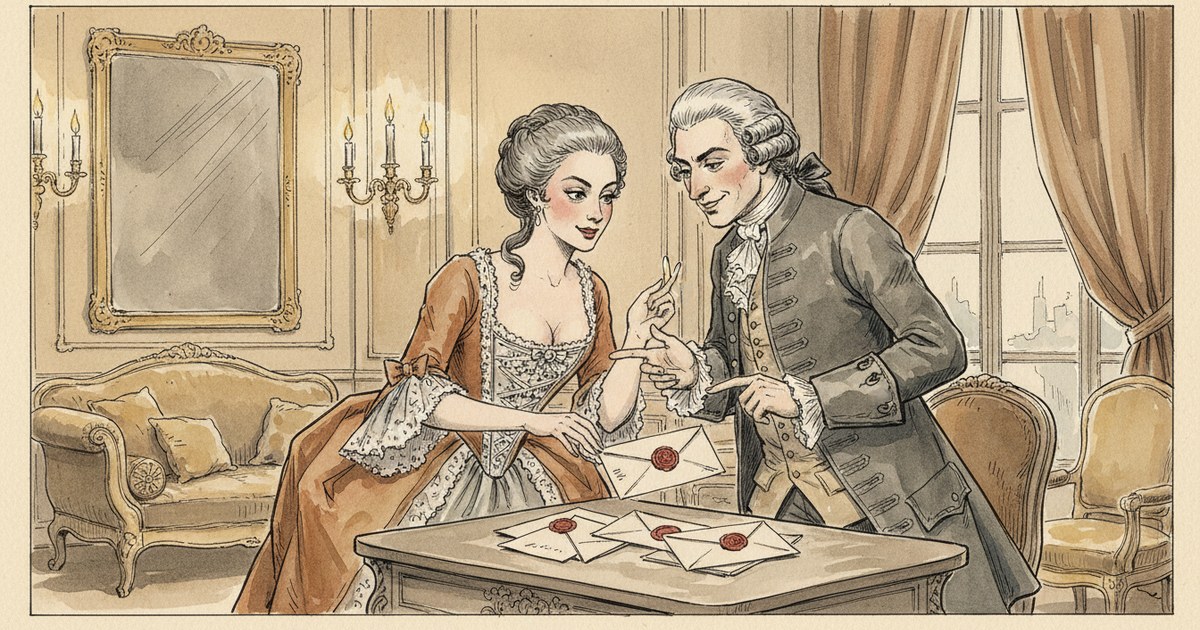
Choderlos de Laclos wrote Les Liaisons Dangereuses in 1782 and was never fully forgiven for it. The novel — told entirely in letters — follows two aristocrats, the Vicomte de Valmont and the Marquise de Merteuil, as they scheme to seduce, ruin, and discard people for sport. It caused a scandal on publication. It has never stopped causing one.
The question most readers arrive with is not whether to read it, but which translation to read it in.
What the Novel Actually Is
This is not a romance. It is a novel about power — specifically, about two people who have decided that other people’s feelings are raw material to be processed for entertainment. Valmont and Merteuil are brilliant, charming, and entirely without scruple. The letters they write to each other are some of the most coldly intelligent prose in French literature. The letters they write to their victims are almost unbearably manipulative.
Laclos spent his career as a military engineer, and the novel has an engineer’s precision. Every letter is placed deliberately. The reader always knows more than any single character. The effect is not suspense — it is dread. Consider Letter 48, in which Valmont writes to Merteuil at the very moment he is composing a tender declaration to Madame de Tourvel — using her back as his writing desk. He describes the scene to Merteuil with amused detachment while the woman beneath him believes herself the object of his most sincere feeling. Laclos does not editorialize. He simply shows you the letter, and the information it contains is enough to make your skin crawl.
The Man Who Wrote One Book
Pierre-Ambroise-François Choderlos de Laclos was born in Amiens in 1741 into a family of minor nobility — respectable enough to access aristocratic circles, not grand enough to dominate them. He spent two decades as a garrison officer, stationed in provincial towns, doing the unglamorous administrative work of the French military while the courtly world he observed went about its glittering business at a distance. That outsider’s proximity matters. Les Liaisons Dangereuses is not the work of someone who was part of that world; it is the work of someone who watched it very carefully and had opinions.
Laclos wrote one novel. He spent years working on a treatise on women’s education that was never finished, served in the Revolutionary wars, and died in 1803 having published essentially nothing else. Les Liaisons Dangereuses is his entire literary legacy, which gives it a strange completeness — there is no early Laclos, no late Laclos, just this one perfect machine of a book. He lived long enough to see the world his novel described destroyed by revolution, and then to serve the republic that replaced it. Napoleon eventually made him a general. Whether Laclos found any irony in that — a man who had written the most devastating portrait of the ancien régime, rewarded by its successor — the historical record does not say.
The Best Translation to Read
The two translations most commonly recommended are P.W.K. Stone (Penguin Classics) and Douglas Parmée (Oxford World’s Classics). Both are reliable. The Stone translation has been in print since 1961 and remains the most widely read; it’s accurate, clear, and carries the formal register of the original without becoming stiff. The Parmée translation is slightly more contemporary in rhythm and better suited to readers who find Stone’s prose dated.
For most readers, the translation we recommend is Stone. The formal, slightly elevated prose actually serves the novel — Valmont and Merteuil speak in a register that marks them as people who have turned language into a weapon. A more colloquial translation softens that edge. The test is simple: read Merteuil’s Letter 81 in both versions. In Stone, her self-description — the account of how she trained herself to suppress every visible emotion, to read rooms, to perform sincerity on demand — lands with the cold weight it requires. The register is that of a manifesto delivered in a drawing room. In more contemporary versions, it risks reading like self-help. Stone keeps the distance that Laclos built into the character, and that distance is the point.
Where It Sits in the Canon
It influenced Stendhal. It influenced Flaubert. The cold precision of Madame Bovary’s irony has Laclos behind it. If you read Laclos and then go back to Flaubert, you’ll see the debt immediately. What Flaubert learned from Laclos is not subject matter but method: the idea that a narrator can be entirely absent — that the prose can efface itself so completely that the reader is left alone with the characters and their self-delusions, with no authorial hand to guide the verdict. Laclos achieves this through the epistolary form itself; Flaubert would spend his whole career trying to achieve the same effect in continuous prose.
The novel also has a quieter but significant relationship with Rousseau. Julie, ou la Nouvelle Héloïse — published twenty years earlier and also an epistolary novel — was the defining sentimental counterpoint to everything Laclos was doing. Rousseau believed that letters revealed the authentic self; Laclos spent 175 letters demonstrating that they do nothing of the kind. The two novels are, in a sense, in direct argument with each other, and understanding that argument explains why Madame de Tourvel — the virtuous woman Valmont pursues and destroys — is written with such uncomfortable sympathy. She is the Rousseauian reader, destroyed by her faith in authenticity.
The World It Came From
France in 1782 was seven years from revolution, though nobody knew it yet. The aristocratic leisure class — the world Valmont and Merteuil inhabit — was defined above all by time: time to write letters, to receive them, to read them aloud, to parse them for hidden meaning, to compose replies that concealed as much as they revealed. The letter was not merely a communication technology; it was the primary medium through which that class conducted its social and erotic life. Relationships were built in correspondence. Reputations were made and destroyed by what was written, forwarded, withheld. Laclos did not choose the epistolary form because it was fashionable — though it was — he chose it because it was the form in which his characters actually lived.
This is why the novel felt so dangerous when it appeared. Contemporary readers did not experience it as fiction in the way we might today. The letters read like letters they could have received, from people they might have known. Laclos claimed, in a preface dripping with irony, that he was merely the editor of a real correspondence. Nobody fully believed him; many were not entirely sure. The scandal was not that the book described depravity — libertine literature was abundant in 18th-century France — but that it described depravity with such recognizable specificity. It was not a warning. It was a mirror held up to a class that preferred its mirrors flattering.
The speed of the novel’s notoriety was itself remarkable. Within weeks of publication it was being read in the salons it depicted — the same aristocratic women who recognized the social world on every page were passing it between each other under their shawls. Several readers attempted to identify the real people behind the characters, and at least one candidate for “the real Merteuil” was proposed in Parisian society within the year. Laclos denied everything with the practiced innocence of a man who had written a 400-page argument for the unreliability of all stated positions.
What People Get Wrong
Readers who come to the novel via the 1988 film — Glenn Close, John Malkovich, the costumes, the heat — often find the book colder than expected. That is not a flaw. The film is a story of passion; the novel is a story of geometry. Valmont and Merteuil do not lose control because they feel too much. They lose control because they have constructed a system so intricate that it eventually turns on its architects. The seductions in the novel are less erotic than tactical. Reading it, you are less a voyeur than an analyst watching a campaign unfold — which is precisely the effect Laclos intended.
The second misreading is more consequential: the assumption that Merteuil is simply a villain. She is not. She is the only character in the novel who has thought seriously about what she is doing and why. Letter 81 — the letter in which she explains, to Valmont, how she constructed herself from nothing, how she taught herself to read faces and master her own, how she became what she is through deliberate self-creation — is one of the most remarkable pieces of writing in 18th-century French literature. It is a philosophical autobiography delivered as a weapon. Merteuil is monstrous, yes. She is also the most fully realized intelligence in the book, and Laclos knows it. The novel’s moral universe does not simply punish her for being powerful. It punishes her for existing in a world that had no legitimate place for what she was.
The third misreading — less common but worth naming — is to read Cécile de Volanges, the young convent-educated girl Merteuil and Valmont jointly destroy, as simply naive. She is naive, yes, but she is also fifteen years old, has been educated in deliberate ignorance of the world she is about to enter, and is surrounded by adults whose interest in her well-being is performative at best. Her letters, which start out cheerful and girlish and grow increasingly confused and frightened, track a very specific kind of harm. Laclos gives her enough interiority that her destruction doesn’t feel like furniture. It feels like a crime the reader watched happen and did nothing to stop.
Who Should Read It
Anyone who has read Stendhal, Flaubert, or Balzac and wants to understand where they came from. Anyone interested in how the epistolary form can be used not just as a narrative device but as a structural argument — the form of letters is the point; it creates the information asymmetry that makes the novel work. Anyone who finds the aristocratic world of 18th-century France fascinating and wants to see it at its most predatory.
It is not a long book. The Penguin edition runs to about 400 pages, but it reads faster than that — the letters pull you forward. It is also, despite everything, frequently very funny. Valmont’s accounts of his own maneuvers have the self-satisfied comedy of someone who is absolutely certain he is the cleverest person in any room — a certainty the novel methodically dismantles, but which produces some genuinely sharp comedy on the way down. Reading Laclos is not a grim experience. It is an exhilarating one, with a slow-building sense of doom underneath.
If You Liked This
The natural companions are novels about intelligence turned predatory. Stendhal’s The Red and the Black takes the same engine — manipulation as a form of sport, ambition dressed as seduction — and runs it through the post-Napoleonic social climb; Julien Sorel is a provincial Valmont with worse odds. Flaubert’s Sentimental Education (not Bovary — the disillusionment arc here is harder and more systemic) shows what happens when that same cold clarity turns inward and hollows out its subject entirely. And Henry James’s The Portrait of a Lady is the anglophone version of the same problem: characters who treat other people as objects to be arranged, and one woman who slowly understands that she has been arranged. These books talk to each other. Reading them in sequence is its own education.
Frequently Asked Questions
Is Dangerous Liaisons worth reading?
Yes, without qualification. It is one of the most precisely constructed novels in the Western canon — a book that uses form and content as a single argument. If you have any interest in how psychological manipulation works, how power operates through language, or simply in prose that never wastes a sentence, it belongs on your list.
Is Les Liaisons Dangereuses appropriate for young readers?
It depends on the reader, not the age. The novel contains seduction, sexual manipulation, and the deliberate destruction of a young woman’s reputation and sanity. None of it is graphic by contemporary standards — this is 18th-century French prose, not modern literary fiction — but the themes are adult and the psychological content is genuinely dark. Mature teenagers who read seriously will handle it; it is not a book for younger adolescents.
Which is better — the 1988 film or the book?
They are doing different things. The film, directed by Stephen Frears with a screenplay by Christopher Hampton, is an excellent adaptation that translates the novel’s cruelty into something warmer and more visceral. The book is colder, more structural, and ultimately more disturbing — because it never lets you forget that you are watching a system operate, not a passion unfold. Read the book first. The film rewards you differently once you know how the machine is supposed to work.
How long does it take to read Les Liaisons Dangereuses?
The Penguin Classics edition runs to roughly 400 pages, but the epistolary format moves faster than continuous prose — letters are short, the transitions are abrupt, and the forward pull is strong. Most readers finish it in four to six hours of focused reading, spread across two or three sittings. It does not drag.
Why did Les Liaisons Dangereuses cause such a scandal in 1782?
The scandal was not simply about content — libertine fiction was widely available in 18th-century France — but about recognizability. The social world Laclos depicted was specific enough that contemporaries attempted to identify real people behind the characters, and the novel’s formal device (Laclos claiming to be merely an editor of genuine letters) blurred the line between fiction and document in a way that felt threatening. It was suppressed after the Revolution as a product of aristocratic decadence, then again under Napoleon on different grounds. The book has spent most of its existence being banned by someone.
Is there a connection between Les Liaisons Dangereuses and Cruel Intentions?
Yes, direct and credited. Roger Kumble’s 1999 film Cruel Intentions is a loose adaptation that transposes the story to a Manhattan prep school milieu, with Sebastian Valmont (Ryan Phillippe) and Kathryn Merteuil (Sarah Michelle Gellar) replacing the French aristocrats. The core structure — a wager over a seduction, letters used as instruments of power, a system that destroys its architects — is preserved almost intact. Hampton’s 1988 screenplay (which became both the Frears film and a stage play) was also separately adapted as Valmont by Miloš Forman in 1989, meaning the novel generated two major films in a single year, which is itself a measure of how much material it contains.
If Laclos interests you, the natural next steps are Stendhal’s The Red and the Black and Flaubert’s Madame Bovary — both available in modern English translations from Classics Retold.

Leave a Reply