French literature from the eighteenth through the twentieth century is the deepest single tradition in world fiction. Not the oldest, not the most exported, but the deepest — in the sense that its preoccupations compound across generations, each century rewriting the one before. Voltaire dismantles optimism; Hugo restores it through sheer force of feeling; Flaubert arrives to dismantle everything Hugo built; Proust watches the wreckage and decides to memorize it. The tradition is a long argument with itself.
Most English readers encounter it badly. A Madame Bovary assigned in survey courses. A film adaptation of Les Misérables with the barricade scenes cut short. A translation of Candide that irons out the jokes. These reading guides exist to correct that — to return the books to the specific quality of attention they were written to demand.
Translation is not a secondary concern when it comes to French literature — it is the primary one. The French sentence is architectural. Its irony is structural, built into the grammar itself; its wit depends on rhythm, on the precise position of a word, on a cadence that arrives half a beat later than you expect. When a translator flattens that rhythm in pursuit of plain English readability, what disappears is not decoration but meaning. Voltaire’s jokes stop being jokes. Flaubert’s sentences, which in French feel like controlled detonations, become merely correct. Proust’s digressions, which in French spiral outward with unmistakable intentionality, begin to seem like failures of discipline. The difference between a good and a bad translation of a French novel is not a matter of nuance. It is the difference between the book and something that shares its plot.
Classics Retold exists to solve that problem. We do not produce translations — we read them, compare them, and identify the editions that honour the original with enough fidelity and enough courage to make genuine demands on an English reader. For every book in this guide, we have selected the translation we recommend on the basis of close reading: sentence by sentence, scene by scene. Where the translation question is genuinely contested — where two strong editions make different and defensible choices — we say so. The goal is not to tell you what to think about these books. It is to make sure you are reading the right version before you start thinking at all.
Where to Start
If you have never read French literature seriously, start with Voltaire. Candide is ninety pages, ruthlessly constructed, and funnier than anything its century produced in English. From there, Hugo’s Les Misérables — not the abridged edition — for the full experience of nineteenth-century romantic amplitude. Then Flaubert, who wrote in direct reaction to Hugo’s sentimentality, and whose prose style remains the most influential in any language. Proust is for later, when you have built up the patience the novel requires and rewards.
- Candide — where the tradition begins
- Les Misérables — the definitive Romantic novel
- Madame Bovary — the definitive Realist novel
- In Search of Lost Time — when you’re ready
The Enlightenment and Its Discontents
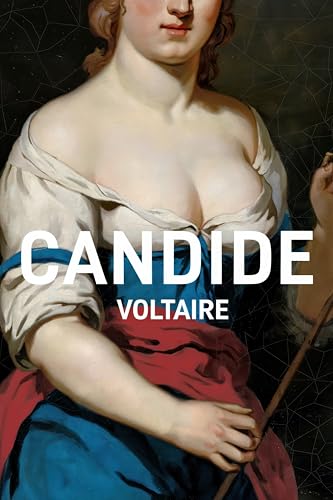
Voltaire published Candide in 1759 and insisted, despite all evidence, that he had nothing to do with it. The denial was tactical — the book was immediately banned in Geneva, Paris, and Rome — but it also pointed to something real about the text. Candide is not quite a novel. It is a philosophical proposition disguised as an adventure story, and the disguise is so complete that the proposition hits harder than it would have if delivered directly.
The proposition is this: Leibnizian optimism — the doctrine that we live in the best of all possible worlds — is not merely wrong but obscene. Voltaire had watched the Lisbon earthquake of 1755 kill sixty thousand people and seen theologians argue that the deaths must serve some divine purpose. Candide is his answer. Our reading guide on Candide examines what makes the novel’s comedy so precise — and why it has outlasted every earnest philosophical treatise of its century.
The scene that crystallises the book’s method comes near the end, when Candide and his battered companions finally acquire a small plot of land outside Constantinople and Pangloss, still incorrigible, still insisting that everything has worked out for the best, prepares to deliver another metaphysical lecture. Candide cuts him off with the novel’s most famous line: il faut cultiver notre jardin — we must cultivate our garden. In context, it is not a counsel of contentment. It is a counsel of exhaustion. Voltaire’s joke is that the only reasonable response to the best of all possible worlds is to stop talking about it and grow vegetables.


The Romantics
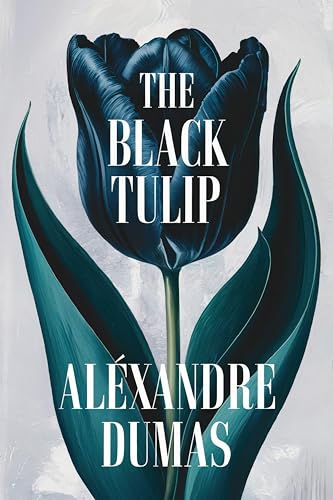
The nineteenth century produced three novelists whose ambitions were essentially architectural. Hugo wanted to build cathedrals out of language. Dumas wanted to construct machines of pure narrative pleasure. Stendhal, the quietest of the three, wanted to dissect the psychology of ambition with the precision of a surgeon who was also, privately, in love with his subject.
Hugo wrote Les Misérables over the course of twenty years, publishing it in 1862 when he was in political exile. Our guide to Les Misérables addresses the novel as what it actually is: an act of political witness that happens to be a great story. His earlier novel, The Hunchback of Notre-Dame, is formally tighter — a book about the cathedral as much as the people inside it.
What abridged editions always cut — and what their cuts reveal about a fundamental misreading of Hugo’s intentions — are the digressions: the long chapter on the Paris sewer system, the extended meditation on the Battle of Waterloo, the history of the Petit-Picpus convent. These are not interruptions to the story. They are Hugo’s argument that Jean Valjean’s suffering cannot be understood without understanding the entire structure that produced it. The sewer is where the city’s waste goes, and the sewer is also where Valjean carries a dying man to safety. Hugo’s digressions are always doing two things at once. Abridged editions do neither.
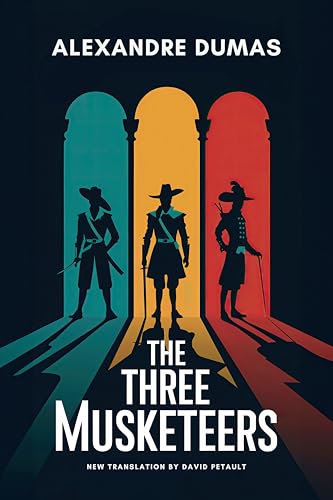
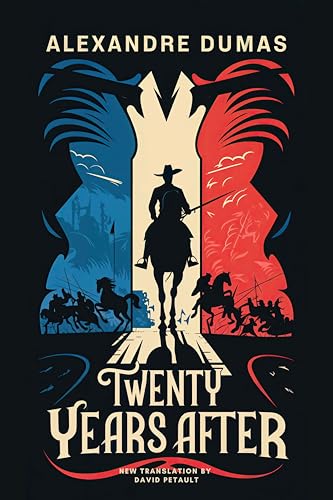
Dumas operates in a different register entirely. The Three Musketeers has been pedagogized into tedium by school curricula — treated as entertainment for children, which it isn’t. The novel is a study in loyalty, masculine friendship, and the gap between idealism and political reality. It is also, page for page, one of the most propulsive narratives ever written in any language.
The scene that demonstrates what Dumas is actually doing comes in the early chapters, when d’Artagnan arrives in Paris from Gascony — poor, provincial, riding a horse described as bright yellow and valued at three écus — and proceeds within a single afternoon to schedule duels with all three musketeers by offending each of them in rapid succession. It is comic, but it is also a precise psychological portrait: d’Artagnan is so determined to prove himself that he cannot stop provoking people. The bravado is real, but so is the desperation underneath it. Dumas understood that those two things are usually the same thing.
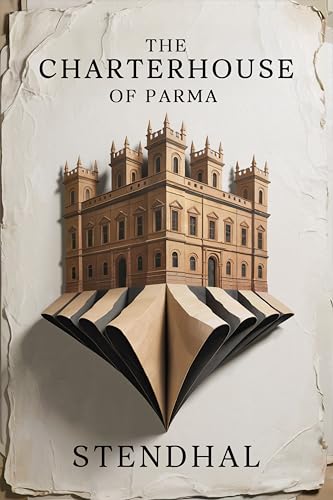
Stendhal’s The Red and the Black is perhaps the first genuinely modern novel — the first to concern itself with the inner life of a social climber in a way that produces neither condemnation nor endorsement, only understanding.
Stendhal based his protagonist Julien Sorel partly on a real case: a young seminarian named Antoine Berthet who shot a former employer in church in 1827 and was guillotined the following year. What interested Stendhal was not the crime but the decades of resentment and thwarted ambition that preceded it — the way a society that claimed to reward merit in fact rewarded birth, and what that contradiction did to the psychology of a brilliant young man who had absorbed the promise and then discovered the reality. Julien Sorel is not sympathetic exactly. But Stendhal makes sure you understand him completely, and understanding is more unsettling than sympathy.
Realism and Its Aftermath
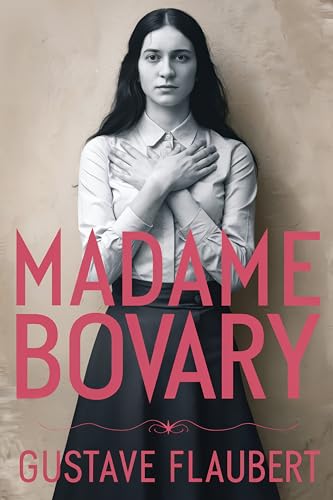
Flaubert hated the Romantics. He hated their sentimentality, their grandiosity, their willingness to let feeling substitute for precision. Madame Bovary, published in 1857 and immediately prosecuted for obscenity, is the rebuttal. Emma Bovary has been formed by Romantic fiction — she expects her life to feel the way novels feel — and the book watches her discover that it doesn’t. Our guide to Madame Bovary focuses on the novel’s temporal compression and on what Flaubert’s famous prose style actually does on the sentence level.
Flaubert spent five years writing Madame Bovary and was known to work for an entire week on a single page, reading each completed sentence aloud to test its rhythm. The result is a prose style in which every word is doing precisely the work assigned to it and nothing else — a style in which the famous authorial impersonality is itself a form of cruelty. The agricultural fair scene, in which Rodolphe seduces Emma while a pompous official delivers a speech about the virtues of manure and livestock management below their window, is the novel’s masterwork: irony operating on three levels simultaneously, without Flaubert once indicating which level you should be attending to.
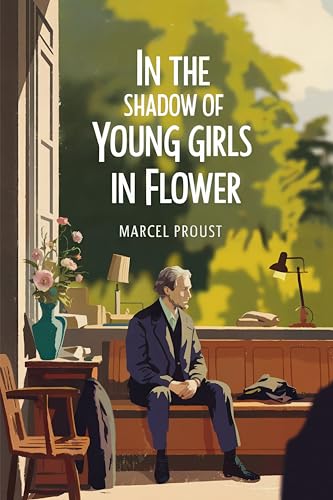
Proust arrives fifty years after Flaubert and appears at first to be everything Flaubert opposed — discursive, associative, apparently formless. But the surface is deceptive. In Search of Lost Time is as ruthlessly constructed as Candide, its architecture just harder to see from inside a single volume. Our reading guide to In Search of Lost Time addresses the question English readers always ask first: how to begin, and whether to finish.
The madeleine passage — in which the narrator dips a small cake into tea and is overwhelmed by a memory he cannot immediately identify — is the most famous moment in the novel, and it is also, for most readers, the first encounter with what Proust is actually doing. The passage is not about nostalgia. It is about the difference between voluntary memory, which is willed and therefore approximate, and involuntary memory, which arrives unbidden and is therefore true. Proust’s entire seven-volume structure rests on that distinction. Every digression, every extended meditation on jealousy or art or the nature of time, is an elaboration of what happened when the madeleine dissolved in the tea. Once you understand that, the length stops feeling like an indulgence.
The Twentieth Century
If the nineteenth century in French literature was the century of the social novel — of class, ambition, and the machinery of power — the twentieth century turned inward. Its great subjects were consciousness, absurdity, freedom, and what a human being owes to a world that has given no indication of owing anything in return. The writers who defined this period were not primarily academic philosophers, though several of them wrote philosophy as well as fiction. They were novelists who understood that the felt experience of an idea — the way it lands in the body, in the moment of reading — is not the same as the idea argued in the abstract, and that fiction could do something philosophy could not.
Albert Camus published The Stranger in 1942 and The Plague in 1947, and the two novels together constitute a sustained examination of what it means to live without guaranteed meaning. The Stranger opens with one of the most destabilising sentences in any language: “Mother died today. Or maybe yesterday, I don’t know.” The flatness is the point. Meursault, the novel’s narrator, is not callous — he is honest in a way that the social world around him cannot accommodate, and the novel is the story of how that world punishes him for it. What makes Camus genuinely difficult — and genuinely irreducible to a philosophical position — is that Meursault is neither a hero nor a warning. He is simply a consciousness, registering experience with more accuracy than comfort allows. The Plague works on a larger scale: an Algerian city quarantined by an epidemic becomes an image of occupied France, and the question of whether to resist — and how, and at what cost — is distributed across a cast of characters who answer it differently and with equal plausibility. Camus did not believe in God and did not believe in despair. The space between those two refusals is where both novels live.
Antoine de Saint-Exupéry’s The Little Prince, published in 1943, is the best-selling French-language book ever written and almost certainly the most consistently misread. It is shelved in the children’s section because it has illustrations and a child as its central figure. It belongs there about as accurately as Gulliver’s Travels does. Saint-Exupéry was a pioneering aviator who had survived multiple crashes across three continents, had reported on the Spanish Civil War, and had watched France fall to Nazi occupation. When he sat down to write The Little Prince, he was in exile in New York, estranged from his wife, drinking heavily, and struggling with injuries from a crash that had left him in chronic pain. He knew, with some certainty, that he would not survive the war. The little prince who has left his small planet, who carries with him the memory of a single rose he loved and perhaps loved inadequately — this is a book about grief and exile and the things we fail to protect until it is too late. Saint-Exupéry disappeared over the Mediterranean in July 1944, on a reconnaissance mission, and was never found. The novel’s ending is not a fantasy. It is a farewell.
Simone de Beauvoir published The Second Sex in 1949, and the book changed how the twentieth century thought about women, freedom, and what it means to become a person rather than simply be assigned one. Its opening argument — “One is not born, but rather becomes, a woman” — is the sentence around which the entire analysis pivots. De Beauvoir’s claim is that femininity is not a natural condition but a historical and cultural construction, and that the construction has been so thorough, so embedded in language and law and literature, that most women have participated in their own confinement without being able to name it. The Second Sex is philosophy, but it is also literary criticism, anthropology, and personal testimony, and the combination produces a book that is harder to dismiss than any purely abstract argument could be. It was immediately scandalised in France and immediately translated into English, where it had an equally immediate and lasting effect. Beauvoir belongs in any account of French literature not merely as a feminist thinker but as a writer whose prose, even in translation, carries the peculiar force of someone who has thought something through to its end and is no longer willing to be polite about the conclusions.
The Novel of Ideas
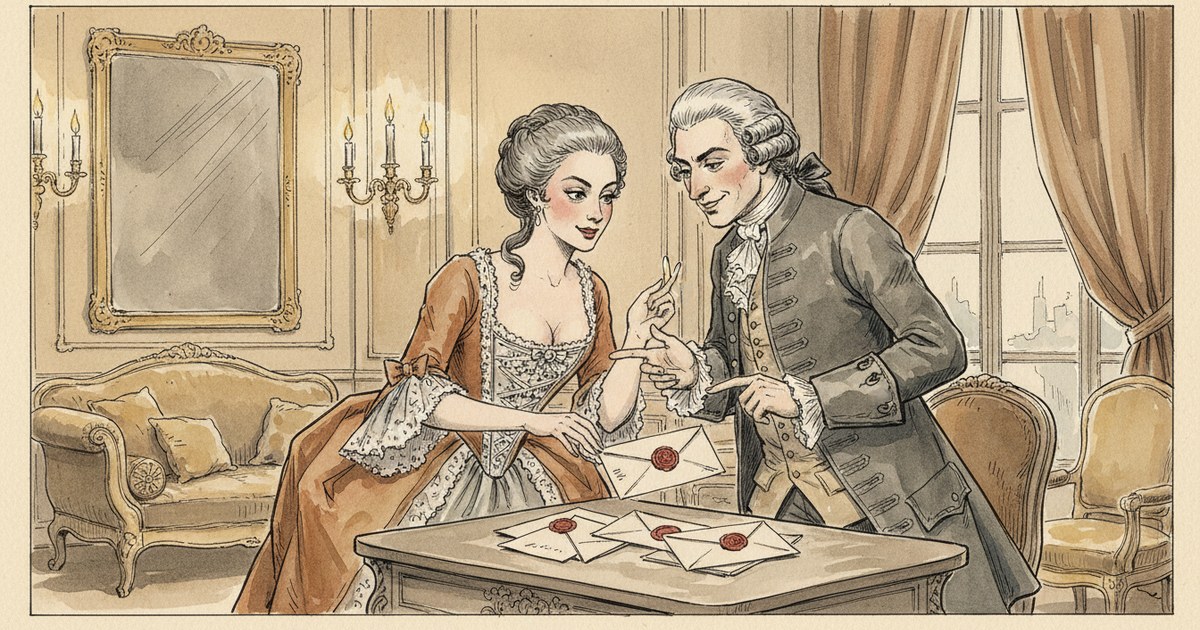
Laclos’s Les Liaisons Dangereuses, published in 1782, seven years before the Revolution, is an epistolary novel about aristocrats who weaponize seduction. It caused a scandal on publication and has never stopped causing one. The translation question — which English edition to trust — is one the guide addresses directly, because the wrong translation turns Laclos’s surgical prose into drawing-room gossip.
What makes the novel genuinely disturbing — more disturbing than its reputation as a tale of aristocratic wickedness would suggest — is that the Marquise de Merteuil and the Vicomte de Valmont are not simply villains. They are the two most intelligent people in the book, and their letters reveal a clarity about power, desire, and social performance that the novel’s more virtuous characters entirely lack. The Marquise in particular is writing, across her letters, a sustained feminist analysis of the society that has made seduction her only available form of power. Laclos, writing seven years before the Revolution, understood that an aristocracy rotten enough to produce Merteuil was an aristocracy that had already lost its justification. The guillotine arrives, historically, a decade after the last letter.
Jules Verne is almost never read as the political writer he was. 20,000 Leagues Under the Sea is usually packaged as an adventure novel for young readers. But Captain Nemo is a figure of anti-colonial rage, and the Nautilus is a utopian project — a society of one, built in deliberate exile from the world above. Our guide to Jules Verne’s Political Vision recovers what the bowdlerized English translations have long suppressed.
In later Verne novels — particularly The Mysterious Island, which reveals Nemo’s full history — we learn that he is Prince Dakkar, an Indian nobleman whose family was massacred by British colonial forces during the 1857 rebellion. The Nautilus, read in this light, is not a marvel of technology. It is a weapon of mourning. Every time Nemo sinks a warship, he is answering a specific historical atrocity. The original English translations, produced by publishers nervous about offending British readers, softened or erased this context entirely. They turned a novel about colonial violence into a Victorian adventure story. The difference between those two books is not a matter of translation style. It is a matter of whether the book is allowed to mean what it means.
The tradition these writers belong to is not merely literary. It is argumentative, adversarial, and deeply concerned with how power organizes itself and how fiction might resist that organization. Reading French literature in good translation is not an act of cultural tourism. It is engagement with a conversation that has been going on for three hundred years and is not finished.
How to Read French Literature
French literature rewards method. It is not a tradition you can dip into randomly and expect to get full value from — the books talk to each other too directly, and missing the conversation means missing a significant part of what each individual book is doing. A few practical principles will help.
On your first pass through the tradition, read chronologically. Start with Voltaire, move through Hugo and Stendhal and Flaubert, arrive at Proust and then Camus. The sequence is not arbitrary — each writer is, consciously or not, arguing with the one before, and reading in order means you arrive at those arguments already equipped to understand them. After your first pass, read thematically: all the novels of ambition together (Stendhal, Balzac, Flaubert), all the novels of political witness together (Hugo, Camus, de Beauvoir). The tradition looks different from each angle, and both angles are useful.
Never read an abridged Hugo. This is not a suggestion — it is the minimum condition for reading Hugo at all. The digressions in Les Misérables are not interruptions to the story. They are the story’s argument about why the story matters. An abridged Les Misérables is a novel about an escaped convict and an obsessed policeman. The unabridged version is a novel about the entire structure of nineteenth-century French society and why it produces escaped convicts and obsessed policemen in the first place. These are different books. One of them is Hugo.
For Proust, the only workable approach is full commitment to the first volume. Swann’s Way is long, and it does not apologize for its length, but it is also — once you have adjusted to its rhythms — one of the most pleasurable reading experiences in the tradition. Commit to it entirely before deciding whether to continue. Do not read the first fifty pages and make a judgment. The novel earns its length, but it does not earn it immediately — it earns it retrospectively, in the way that a piece of music earns its opening bars only once you have heard the whole. If you reach the end of Swann’s Way and are not compelled to continue, that is a legitimate response. But make the decision from there, not from the middle.
Finally: always check who translated the edition you are buying before you buy it. This is not optional. A Madame Bovary translated in 1886 is a different book from one translated in 2010 — not because the French has changed, but because English has, and because translation reflects the assumptions of its moment as much as it reflects the original. Nineteenth-century translators of Flaubert routinely softened his irony and cleaned up his prose because they found his indifference to moral judgment unsettling. Their translations are not wrong exactly, but they are translations of a different Flaubert — a more comfortable one. The translator matters as much as the edition. The reading guides on this site name the translation we recommend for every book covered, and explain the reasoning. Use that information before you start.










Frequently Asked Questions
What is the best French novel to read first?
Candide by Voltaire is the ideal entry point into French literature for almost every reader. At roughly ninety pages, it is short enough to finish in a single sitting, but its comedy, its philosophical precision, and its controlled fury give you an immediate sense of what distinguishes French literary culture from English — the willingness to treat ideas as weapons and to make wickedly good jokes with them at the same time. Every major theme of the tradition — the problem of suffering, the corruption of institutions, the gap between what societies claim and what they do — is present in miniature.
Which French authors should every reader know?
Six authors form the spine of the tradition: Voltaire, whose Candide established the French novel as a vehicle for philosophical argument; Victor Hugo, whose ambition and emotional force defined the Romantic century; Gustave Flaubert, whose prose style became the template for literary realism in every language; Marcel Proust, who pushed the novel further into consciousness than anyone before or since; Albert Camus, who made existential philosophy feel like lived experience rather than academic argument; and Simone de Beauvoir, whose The Second Sex changed not just French literature but the intellectual history of the twentieth century. Any serious reader of the tradition will eventually need all six.
Does translation quality really matter for French literature?
For French literature specifically, translation quality matters more than for almost any other tradition, because so much of what makes French writing French is carried in its rhythm, its irony, and its wit — all of which are structural, not decorative, and all of which are the first things to collapse in a careless translation. Voltaire’s jokes depend on timing; Flaubert’s moral vision is embedded in sentence cadence; Proust’s digressions mean something different depending on whether they read as deliberate spirals or mere looseness. A poor translation of a Russian novel may blunt its emotional force. A poor translation of a French novel can invert its meaning entirely.
How is French literature different from English literature?
French literature is more argumentative, more willing to treat the novel as a vehicle for ideas rather than simply for story, and more interested in the relationship between fiction and political reality. Where English literature has tended — with significant exceptions — toward character, psychology, and social observation conducted at close range, French literature has more consistently asked large questions: about the nature of freedom, the legitimacy of institutions, the relationship between the individual and history. This is not a difference of quality but of orientation. French novels are, on the whole, more interested in being right about something than in being liked, and that adversarial quality is part of what makes the tradition so permanently alive.
This post contains affiliate links. As an Amazon Associate, we earn from qualifying purchases.


You must be logged in to post a comment.