
Here’s the post:
She is not watching the faces. She is watching the hands. Mrs. C., a composed English widow of sixty-seven, has been telling her story for forty years, and the moment she begins, you understand why she cannot stop. It was Monte Carlo, sometime around 1880. She had developed the habit her late husband taught her: reading gamblers not by their expressions but by what their hands betrayed at the roulette table. “Everything can be seen in those hands,” she says. “Those who are covetous by their clawing, the profligate by their relaxation, the calculating by their steadiness, the desperate by their trembling.” She was watching, the way you do when you are recently widowed and have nothing left to want, when a pair of young hands appeared at the table — white-knuckled, shaking, half-mad with hunger — and she was lost.
Stefan Zweig’s Twenty-Four Hours in the Life of a Woman is a novella about what happens in the hours that follow. But that description undersells it. The book is really about what happens in the forty years after those hours — how one day of reckless moral action can calcify into the defining fact of a life, the thing a woman carries everywhere and tells no one, until finally she tells a stranger. Zweig’s thesis, pressed close beneath the surface of his elegant sentences, is this: a single impulse toward goodness — the decision to try to save someone — can destroy you just as thoroughly as any sin. And the cruelest part is that you will spend the rest of your life unable to decide whether it was worth it.
The book was published in 1927, the same year Zweig was at the height of his fame, the most translated living author in the world. It appeared inside a collection called Verwirrung der Gefühle — Confusion of Feelings — which is the most honest possible title any writer has ever given his collected work. The frame story places Mrs. C.’s confession inside a broader social scandal: a married Frenchwoman at a seaside pension has run off with a man she met three days prior, and the other guests are arguing about whether she should be condemned or understood. An unnamed narrator argues for understanding. Mrs. C. pulls him aside. She has something to say.
What makes that frame more than a narrative convenience is the specific way Zweig loads the debate. The other guests at the pension deliver their verdicts with the speed of people who have never once surprised themselves — the kind of certainty that only comes from having never been genuinely tested. Mrs. C. listens, and her silence says everything. She knows what happens to a person when the moment of testing actually arrives. She also knows that the person who emerges from it is not the person who walked in, and that explaining the gap to anyone who hasn’t felt it is essentially impossible. That is why she’s been carrying this story alone for four decades. And that is why, when she finally speaks, she cannot quite stop.
There is also something quietly devastating in the detail that she chooses to tell a stranger rather than anyone she knows. The narrator is not her priest, not her doctor, not a friend of thirty years. He is simply a man who argued for understanding at the dinner table, which is the minimum qualification Mrs. C. requires. That Zweig makes this the threshold — one moment of public sympathy, and the floodgates open — tells you everything about how isolated she has been inside her own correctness. The confession is not catharsis. It is the sound of a pressure valve that has been sealed for four decades finally finding the smallest possible crack.
The Man Who Understood Too Much
Zweig was born in Vienna in 1881 into the sort of comfortable Jewish bourgeois family that produced writers the way other families produced lawyers — almost inevitably, and with mild concern. Vienna in the late Habsburg era was a city organized around surfaces: the correct café, the correct coat, the correct degree of emotional restraint. What Zweig absorbed from that world, and spent his entire career quietly dismantling, was the fiction that restraint protects you. His great subject — across novellas, biographies, memoirs — was always the moment when the surface cracks. Not the scandal itself, but the interior pressure that precedes it. He was, at his core, a psychologist who chose fiction as his instrument.
That interest in inner life sharpened as his own world came apart. In 1934, the Nazis burned his books in Germany. He fled Austria in 1935, then London, then New York, then finally Petrópolis, a small hill town in Brazil, where he and his wife Lotte took their lives together in February 1942 — the night of Carnival, the city full of noise and light. He had written in his farewell letter that his spiritual homeland, Europe, had destroyed itself, and he could not rebuild himself in a new world. This matters to how his fiction reads. Zweig understood, at the cellular level, what it means to build an entire life around a vanished moment. His Mrs. C. is not an abstraction. She is a precise portrait of the person Zweig was becoming.
He was also, and this is the biographical detail that changes everything, a man professionally obsessed with female interiority at a time when almost no one thought it worth serious attention. His notebooks record hundreds of conversations with women, careful and attentive, during an era when a woman’s crisis was generally attributed to nerves. Mrs. C.’s story could not have been written by someone who didn’t genuinely believe that the interior life of a sixty-seven-year-old English widow was as vast and worth excavating as anything in Freud’s casebook.
Zweig and Freud were, in fact, neighbors of a kind — both Viennese, both preoccupied with the forces that move beneath social comportment, and personally acquainted. Zweig delivered a eulogy at Freud’s funeral in 1939. That proximity is not incidental to the fiction. Where Freud wanted to name and categorize what drives people, Zweig wanted to dramatize the moment before naming was possible — the instant when a person acts without yet understanding why. Mrs. C. cannot fully explain her decision to follow the young gambler out of the casino. She can only describe what his hands looked like, and trust that the narrator will understand the rest. Zweig believed he would. He believed we all would.
There is one more biographical thread worth pulling. By 1927, Zweig had already written novellas about chess obsession, about a doctor destroyed by a single moral failure in colonial Malaya, about a woman who loves a man across two decades without his knowledge. What links them all is a fascination with monomania — the way a single experience can colonize a person’s entire inner life, crowding out everything else until the person and the obsession are indistinguishable. Mrs. C. is Zweig’s most controlled study of that process, and the control itself is part of the point. She is not raving. She is precise, composed, almost clinical in the way she reconstructs the day. That is exactly what forty years of private obsession produces: a person who has rehearsed the story so many times it has become perfectly smooth, with all the rough edges worn down — and all the feeling locked inside the smoothness.
The Twenty-Four Hours That Last a Lifetime
What Mrs. C. does during her single day is precise and devastating: she follows the young Polish gambler, pulls him back from the edge of catastrophe, accompanies him through a night of near-ruin and miraculous recovery at the tables, sleeps with him — a decision she describes with neither shame nor bravado, only the flat accuracy of a woman reporting a fact — and then, the next morning, watches him walk back into the casino and lose everything she helped him win. She had believed, for the span of about eighteen hours, that she could save him. She was wrong. The book does not moralize about this. It simply shows her face in the moment she understands.
What makes the novella last — what makes it feel, at barely ninety pages, more substantial than most novels — is that Zweig keeps the moral weight distributed precisely, without letting anyone off. The young gambler is not a villain. Mrs. C. is not a fool. The narrator does not know what to make of her story, and neither do we. Zweig wrote at a speed that can feel dangerous, sentences that arrive at their point before you’ve braced for it, and the effect in this book is something close to vertigo. You come to the final page and realize: the day she is describing is not the worst thing that happened to her. The worst thing is that she survived it, intact and changed and entirely alone with what she now knows about herself.
There is one detail Zweig plants early that only registers fully on a second reading. When Mrs. C. first sees the young man’s hands at the roulette table, she notices they do not belong to the rest of him — they move with a ferocity that his face, still boyish, has not yet earned. She is drawn to that gap. It is the gap between what a person appears to be and what they are actually capable of, and Mrs. C., who has spent twenty years being the composed, contained English widow, recognizes it because she contains the same gap herself. The entire novella is the story of what happens when that gap closes, for a single day, and then widens again permanently.
The ending deserves mention without being spoiled in full. Zweig gives Mrs. C. one final piece of information — delivered almost as an afterthought, as these things always are — that reframes everything she has told us. It does not explain the young gambler. It does not absolve him or condemn him. It simply adds a fact that Mrs. C. had not known during those twenty-four hours, which means she made her decisions in ignorance, which means the question of whether she was right becomes permanently unanswerable. Zweig understood that the most honest ending for this story was not resolution but the permanent suspension of judgment. That is also, incidentally, where he leaves the reader: holding the weight of the story with no verdict to set it down on.
What Monte Carlo Actually Was
It is worth pausing on the setting, because Zweig chose it with precision. The Casino de Monte-Carlo opened in 1863, and by the 1880s it had become one of the defining institutions of European leisure — a place where the aristocracy and the newly wealthy could shed their ordinary identities for an afternoon and pretend that fate was a wheel that spun impartially. Suicide on the casino steps was common enough that Monaco’s government reportedly paid newspapers not to report it. The gambler who loses everything is not a melodramatic invention; he was a fixture of the place, recognized and unremarked upon. When Mrs. C. follows the young Pole out of that building, she is not doing something unusual in the context of Monte Carlo. What is unusual is what she decides it means.
Zweig was intimately familiar with that world. He traveled widely across Europe during his most productive years, staying in grand hotels, moving through exactly the kind of cosmopolitan resort culture that forms the backdrop of the novella. He knew what a gambling room looked and smelled like at two in the morning, what the faces of the desperate looked like under chandelier light, and crucially, what the faces of the bystanders looked like — the people who watched and did nothing, because nothing was the correct social response. Mrs. C. breaks with that world the moment she moves toward the young man. That is the moral rupture the book is built on, and it lands harder if you understand that in 1880 Monte Carlo, her intervention was genuinely transgressive — not romantic or brave, but strange and slightly alarming.
The casino also functions as Zweig’s most economical symbol. Roulette is, structurally, a machine for generating the illusion of pattern where none exists — gamblers lean forward convinced they have spotted a streak, a tendency, a logic in the spinning wheel, and the wheel ignores them entirely. Mrs. C. is doing the same thing with the young man. She reads his hands, reads his posture, reads the hunger in his face, and constructs a narrative in which she can be the variable that changes his outcome. The casino’s great lesson — that no outside force can alter what the wheel will do — is the lesson Zweig has set her up to learn. That he delivers it in a setting where everyone around her is making the same mistake, and losing, gives the story a layer of dark structural irony that you absorb before you consciously notice it.
Why This Translation?
Zweig wrote in a German that is formal without being stiff, urgent without being breathless — a difficult combination to preserve in English, where those two qualities tend to pull in opposite directions. Older translations of this novella sometimes tip toward the Victorian: the sentences grow heavy with subordinate clauses, and Mrs. C. begins to sound like a woman dictating a letter rather than confessing to a stranger. The translation we recommend here corrects for that tendency without overcorrecting into contemporary flatness. The prose stays close to Zweig’s rhythms — the long, building sentences that arrive at their emotional point like a door finally opening — while shedding the archaic diction that creates distance where Zweig intended proximity.
The test of any Zweig translation is how it handles his free indirect discourse — the technique by which a narrator slides, without announcement, into a character’s interior voice. In this novella, Mrs. C.’s reported speech and her remembered thoughts blur into each other at crucial moments, and the seam should be invisible. In the editions that handle this well, you finish a paragraph and realize you have been inside Mrs. C.’s head without being told. That is the effect Zweig engineered, and it is the effect the translation we recommend delivers.
There is one specific passage where the quality of the translation becomes unmistakable: the scene in which Mrs. C. waits outside the young gambler’s hotel room in the early hours of the morning, listening to the silence on the other side of the door. Zweig stretches that silence across nearly a full page, loading each sentence with a different quality of dread. A flat or hurried translation collapses the sequence; the reader registers that something tense is happening but doesn’t feel the duration of it. The edition featured here holds the pace Zweig set — the sentences arrive slowly, they complete themselves slowly, and by the end of the passage you have been standing in that corridor with Mrs. C. long enough to understand exactly what she was willing to risk. That is the translation doing its job. Pick up the paperback here — and give yourself an afternoon for it, because once Mrs. C. starts talking, you will not want to be the one who stops her.
Also worth reading
How to Read This Book (and When to Stop)
Ninety pages sounds like an afternoon, and it is — but it is a specific kind of afternoon, the kind where you look up at the end and realize it has gone dark outside and you haven’t moved. The novella’s structure rewards reading in a single sitting precisely because Zweig designed it as a confession: Mrs. C. begins talking and does not stop, and interrupting her — putting the book down, coming back tomorrow — breaks the spell in a way that isn’t true of longer novels. The frame device reinforces this. The narrator is listening in real time, and Zweig keeps reminding you of that by returning occasionally to the physical setting — the room, the lamp, the night outside — which creates the sensation of sitting across from Mrs. C. yourself. Stop reading, and you have left the room. Stay, and you are her only witness.
What you will notice, particularly on a second read, is how precisely Zweig controls what Mrs. C. remembers and what she skips. She is exacting about the young man’s hands, his coat, the specific green of the felt on the roulette table, but vague about her own face in those moments — what she looked like, what anyone watching her might have seen. This is not carelessness. A woman who has spent forty years composing the story of her worst day will have made choices, conscious or not, about which details to inhabit and which to observe from a distance. The gaps in Mrs. C.’s narrative are as carefully placed as everything else. Reading for them is one of the pleasures the book offers on return.
Frequently Asked Questions
What is the best English translation of Twenty-Four Hours in the Life of a Woman?
The modern English edition featured here is among the most readable currently available, prioritizing natural prose rhythms over the stiff Victorian register that burdens some older versions. It handles Zweig’s free indirect discourse — the technique of sliding silently into a character’s interior voice — with particular care, which matters enormously in a book where the distance between reported speech and private thought is the whole point. Readers who found earlier translations airless or over-formal will notice the difference immediately.
Is Twenty-Four Hours in the Life of a Woman worth reading in 2026?
Yes. The novella’s central preoccupation — how a single unguarded moment can rewrite a life — has lost none of its force. Zweig’s portrait of Mrs. C., a composed widow undone by a stranger’s hands at a roulette table, is as psychologically acute now as when it was written in 1927. In an era saturated with surface-level character studies, Zweig’s deep interior focus feels rare and necessary. The book is short; the effect is not.
How does Twenty-Four Hours in the Life of a Woman compare to The Stefan Zweig Collection – Volume 1: A New Translation?
Twenty-Four Hours is a single sustained narrative — one woman, one confession, one moral crisis. The Stefan Zweig Collection – Volume 1 offers breadth instead of depth, gathering several of Zweig’s finest shorter works so readers can trace the patterns across his obsessions: passion, shame, the violence of memory. If Twenty-Four Hours is Zweig at his most concentrated, Volume 1 is Zweig in full range. Readers who finish the novella wanting more of the same intensity will find it rewarded and expanded in the Collection.
What should I read after Twenty-Four Hours in the Life of a Woman?
Start with The Stefan Zweig Collection – Volume 1: A New Translation, available at classicsretold.com. It includes several works that share the novella’s obsessive emotional register and will deepen your sense of what Zweig was doing across his career. After that, The Stefan Zweig Collection – Volume 2: A New Translation extends the journey further, covering a wider arc of his output. Both volumes use the same modern translation approach, so the reading experience remains consistent.

Hugo Made the Terror About Forgiveness
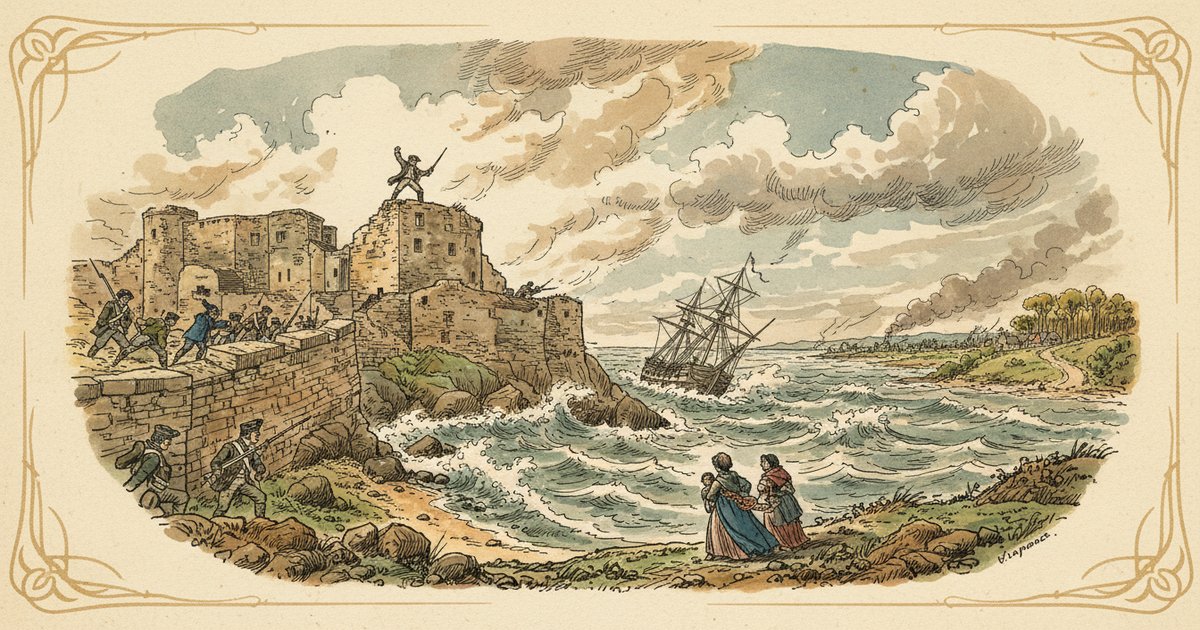
In the spring of 1794, a Republican officer named Gauvain makes a decision that costs him his head. He has captured the Royalist leader Lantenac — the man who burned villages and shot prisoners, the embodiment of the counter-revolution — and then, after watching Lantenac risk his life to pull three children from a burning tower, he opens the cell door and lets him walk free. Mercy over doctrine. The human gesture over the iron logic of revolution. His superior and surrogate father, the priest-turned-commissar Cimourdain, cannot save him. The morning of the execution, as the guillotine falls, Cimourdain shoots himself through the heart.
Victor Hugo did not invent this dilemma. By the time he published Ninety-Three in 1874, he had lived inside it for decades — watched the Paris Commune’s insurgents die by the thousands on the streets he’d walked as a young man, buried a son in 1871 and another in 1873, and spent nineteen years in political exile for refusing to bend to Napoleon III. He knew exactly what ideological certainty costs the people who love you. The novel is usually described as his reckoning with the French Revolution. It is more precisely a reckoning with the question that obsessed him at the end of his life: what do we owe each other when the cause is real and the cost is human?
Ninety-Three is his answer. It is not comfortable. It is not optimistic. But it is the most honest thing he ever wrote.
The Man Who Outlived Almost Everyone He Loved
Hugo was forty when his daughter Léopoldine drowned with her husband in the Seine in 1843. He learned about it from a newspaper, sitting in a café. He did not publish a novel for fifteen years. When the losses resumed in the 1870s — his wife Adèle gone in 1868, his son Charles in 1871, his son François-Victor in 1873 — he was in his seventies, back in Paris after the exile, watching the Republic he’d sacrificed his career for consume itself in the Commune’s bloody reprisals. These are not incidental biographical details. They are the pressure system that shaped every sentence of Ninety-Three.
What this accumulated grief produced, paradoxically, was not a book of despair but one of ferocious moral argument. Hugo had always been a political writer — he’d been a peer of France, a member of the National Assembly, a man who gave speeches on the floor of parliament about the abolition of the death penalty. But Ninety-Three is where politics stops being abstract. Gauvain is young, idealistic, beloved. Cimourdain, who mentored him from boyhood, believes in the Revolution with the totality of a man who has replaced God with a cause. The father-and-surrogate-son dynamic is not an accident; Hugo had buried two sons. He understood what it means to outlive the people you shaped.
The biographical detail that changes how the book reads is the exile itself. Nineteen years on Guernsey and Jersey, forced to watch France from a distance while Louis-Napoleon consolidated power — Hugo knew what it meant to be correct about history and still lose. That knowledge is everywhere in the Vendée sections, in the way he renders both the Royalist guerrillas and the Republican columns with equal moral weight, refusing the easy consolation of a clean villain.
There is a passage early in the novel — before the armies are even properly introduced — where a Republican sergeant named Radoub finds the three children alone in a forest clearing, starving, the youngest still nursing at their dead mother’s breast. He picks them up without ceremony and carries them back to his battalion, which votes, collectively and without irony, to adopt them. It is a moment of almost absurd tenderness dropped into the middle of a war narrative. Hugo puts it there deliberately. He wants you to know what the soldiers are capable of before he shows you what the war will require of them. The grief in the novel is not decorative; it is structural.
The War That History Forgot to Make Simple
The Vendée counter-revolution of 1793 is not a story most readers arrive at knowing. The guillotine, the Jacobins, Robespierre’s Terror — these have iconic weight. The civil war in the bocage of western France, where peasants with scythes fought Republican columns through sunken lanes and dense forests, is less tidy, less photogenic, and therefore largely unknown outside France. Hugo chose it precisely because it resists simplification. The Royalist Marquis de Lantenac leads men who murder prisoners and burn farms. The Republicans march under a banner of liberation while also shooting Royalist civilians. Nobody gets to be purely right. The war grinds on because both sides believe they are saving something essential about France.
Hugo’s genius in Ninety-Three is the pivot the novel makes at its exact center. Three small children — separated from their mother in the war’s chaos, caught between the armies — become the novel’s moral fulcrum. When they are trapped in a burning tower, it is Lantenac, the Royalist butcher, who turns back to save them. A single human reflex undoes his ideology. And it is Gauvain — the young Republican, the novel’s moral hero — who cannot then send Lantenac to the guillotine for all the others he killed. The chain of mercy runs downward until it destroys him. Hugo does not frame this as tragedy or as triumph. He frames it as the truth about human beings: that we are, at our best, ungovernable by our own systems.
What makes the Vendée so useful to Hugo as a setting is that it was, by 1874, still contested political territory in France. Republicans remembered it as a royalist insurgency crushed in the name of progress. Conservatives remembered it as a massacre of faithful Catholics by godless revolutionaries. Historians now estimate that somewhere between 200,000 and 400,000 people died in the region between 1793 and 1796 — a figure that dwarfs the more famous death toll of the Parisian Terror. Hugo had watched France spend the better part of a century arguing about who the villains were. His answer, embedded in the structure of the novel itself, is that the question is the wrong one. The Vendée is not a morality tale about good versus evil. It is a case study in what happens when human beings become fully convinced they are on the right side of history.
How Hugo Builds a Villain You End Up Respecting
Lantenac arrives in the novel the way a weather system arrives — before you see him, you feel the pressure change. Hugo spends nearly fifty pages establishing his reputation through other characters’ fear before the Marquis appears in person. When he finally does, he is in his seventies, boarding a ship under fire, giving orders with the calm of a man who has simply decided that nothing frightens him anymore. He executes a deserter without particular cruelty and without particular pleasure. He is not sadistic. He is something more unsettling: entirely committed. Hugo understood that the most dangerous people in revolutions are not the ones who enjoy violence but the ones who regard it as arithmetic.
This is what makes the burning tower scene so devastating. Lantenac has already condemned the three children to be shot if Gauvain’s Republican forces breach the tower walls — he announced it coldly, as a military calculation. Then the tower catches fire. The children are trapped on an upper floor. Lantenac watches for a moment, and then he goes back. He climbs toward the flames, finds a rope, and lowers the children down one by one. Hugo does not explain it. He does not give Lantenac an interior monologue about a sudden change of heart. The man simply acts, as if the calculus that had governed everything else momentarily stopped running. That gap — between the ideology and the instinct — is where Hugo locates the entire argument of the novel.
Why This Translation?
For most English readers, Ninety-Three has been available only in Victorian-era translations that carry all the stiffness of their moment — sentences that heave and creak, dialogue that sounds like parliament rather than people. This new translation restores what those versions muffled: Hugo’s rhythm, which moves like weather, fast and then slow, intimate and then vast; his capacity to make a military campaign feel as immediate as a conversation in a dark room. It is a book that rewards being read in a version that actually sounds like a novel. Ninety-Three: A New Translation is available now in paperback — the right way to meet the last thing Hugo had left to say.
The specific problem with nineteenth-century English renderings of Hugo is that his prose operates on two registers simultaneously: the oratorical and the intimate. He can move from a panoramic description of a battlefield — the kind of elevated, almost biblical sweep that was his signature — directly into a single soldier noticing that his boots have worn through. When Victorian translators hit the oratorical passages, they amplified them into something approaching parody. When they hit the intimate passages, they formalized them into stiffness. The translation we recommend holds both registers in the same sentence the way Hugo intended, so that the grandeur never loses its human scale. That balance is not easy to achieve, and it is exactly what makes Ninety-Three readable today rather than merely admirable.
Translation Landscape
Ninety-Three (Penguin Classics, trans. Adèle Dorange and Christine Donougher) — The 2024 Penguin Classics edition — the first major new English translation in over a century. Donougher is among the most trusted translators of nineteenth-century French prose (her Zola and Les Misérables are benchmarks). This is the standard scholarly edition going forward.
Ninety-Three (Carroll & Graf, trans. Aline Delano (revised ed.)) — The Delano translation from 1874, revised and still the most commonly found older paperback. Period-accurate voice; the oratorical passages can tip into parody, but the Vendée battle sequences hold up. Acceptable if the Penguin edition is unavailable.
Also worth reading
What Makes This Novel Feel Different From the Rest of Hugo
Readers who come to Ninety-Three after Les Misérables or The Hunchback of Notre-Dame sometimes report a surprise: it feels tighter. Not shorter — it is still Hugo, and Hugo is never spare — but more compressed in its moral argument. Les Misérables is a cathedral of a book, built to contain everything Hugo believed about poverty, law, love, and the nature of goodness. Ninety-Three is more like a proof. It sets up three figures — the implacable old Royalist, the idealistic young Republican, the merciless commissar — and runs them through a series of situations designed to find the exact point at which ideology breaks and the human being underneath it shows through. Every chapter is doing work. There are no lengthy digressions about the Paris sewer system here.
This compression also means the emotional impact arrives faster and harder. By the time Hugo reaches the final confrontation between Cimourdain and Gauvain — the surrogate father forced to authorize the execution of the surrogate son — readers who have spent a hundred pages watching their relationship have very little distance left. Cimourdain is not a monster. He is a man who believes, completely and without self-deception, that the Revolution requires this. His suicide in the novel’s final lines is not the act of a villain who has been defeated. It is the act of a man for whom the cause and the person were the same thing, and now both are gone. Hugo gives him no redemption. He gives him only honesty. After a lifetime of writing, that restraint is the mark of a writer who has nothing left to prove.
Frequently Asked Questions
What is the best English translation of Ninety-Three by Victor Hugo?
For modern readers, the best place to start is Ninety-Three: A New Translation, a contemporary rendering that strips away the archaic phrasing found in Victorian-era editions while preserving Hugo’s intensity and rhetorical power. Unlike nineteenth-century translations that can feel stiff or dated, this version reads as living prose, making Hugo’s portrait of the French Revolution’s most savage year fully accessible to a twenty-first-century audience without sacrificing literary fidelity.
Is Ninety-Three worth reading in 2026?
Yes. Hugo’s final novel speaks directly to questions that have not gone away: what justifies political violence, whether idealism survives contact with war, and how ordinary people behave when history forces an impossible choice. The 1793 Vendée uprising is the setting, but the moral vertigo at the novel’s core is permanent. Ninety-Three: A New Translation makes that argument easier to hear by removing the language barrier that causes many readers to abandon older editions.
How does Ninety-Three compare to The Hunchback of Notre-Dame?
Both novels show Hugo using a single, charged historical moment as a lens for universal themes, but they pull in opposite directions. The Hunchback of Notre-Dame is architectural and symbolic, built around a cathedral and the fatal weight of beauty and deformity. Ninety-Three is kinetic and ideological, driven by revolution, counter-revolution, and a climax of stunning moral ambiguity. Readers who want Hugo’s lyrical grandeur should start with Hunchback; readers who want his political urgency will find Ninety-Three the more gripping experience. Both are available in modern accessible translations at classicsretold.com.
What should I read after Ninety-Three?
Two titles pair naturally with it. The Hunchback of Notre-Dame: A New Translation in Modern Accessible English returns you to Hugo’s France from a different angle, trading revolutionary terror for medieval pageantry and the tragedy of outcasts in a rigid society. If you want to move from Hugo to the broader French Romantic tradition, The Three Musketeers: A New Translation in Modern Accessible English by Alexandre Dumas delivers the same era’s swashbuckling energy with relentless pace and wit. Both are available at classicsretold.com.
Was Ninety-Three Victor Hugo’s last novel?
Yes. Hugo published Ninety-Three in 1874, when he was seventy-one years old, and it was the last novel he completed. He lived another eleven years, dying in 1885 at eighty-three, but spent that final decade primarily writing poetry and attending to his enormous public legacy rather than returning to long fiction. The novel carries the weight of a final statement — its refusal to offer easy consolation feels like the deliberate choice of a writer who knew he was done arguing and wanted to leave the most honest version of what he believed.
How historically accurate is Ninety-Three?
Hugo was scrupulous about the broad strokes of the Vendée uprising — the geography of the bocage, the guerrilla tactics of the Chouans, the role of the Committee of Public Safety — while inventing his central characters wholesale. Lantenac, Gauvain, and Cimourdain are fictional, but the military and political machinery surrounding them is drawn from Hugo’s extensive research into the period. He was particularly careful about the Revolutionary calendar and the specific military campaigns of 1793, which gives the novel an atmosphere of documented reality even when its moral argument is entirely his own invention.
You might also enjoy


This post contains affiliate links. As an Amazon Associate, we earn from qualifying purchases.
Tolstoy Wrote Resurrection to Save His Soul
Now I have enough. Let me write this.
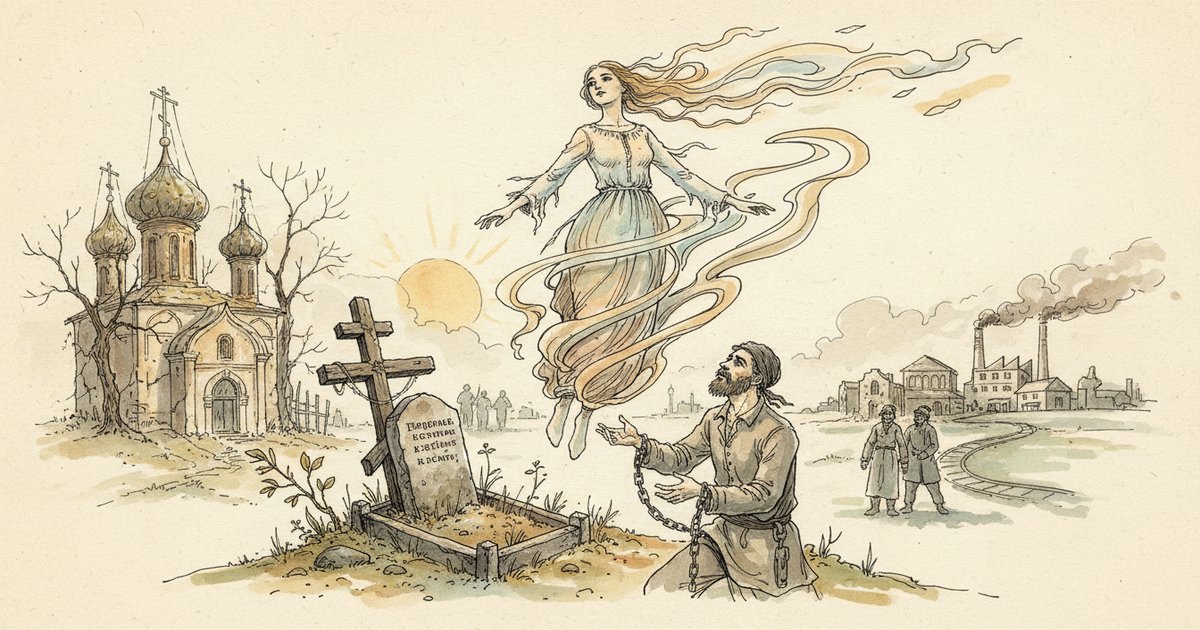
In the spring of 1898, Leo Tolstoy sat down to finish a novel he had been avoiding for a decade. He was seventy years old. He had written War and Peace and Anna Karenina. He had renounced his copyrights, given away his estate, and scandalized his wife by sleeping on a peasant’s cot. And still the story that Anatoly Koni had told him years earlier — about a nobleman who seduces an orphan girl, abandons her, and then finds her on trial before his own jury — would not leave him alone. Because it was not just Koni’s story. Tolstoy had done something very like it himself. Before his marriage, he seduced a household serf named Masha, got her dismissed, and watched her disappear into a life he never inquired after. He told his biographer this near the end of his life, calling it one of the two crimes he could never forget. Resurrection is the novel he built around the second one.
This is what separates Resurrection from virtually everything else in the Russian canon: it is a confession that does not know how to stop. Tolstoy’s thesis — the one driving every courtroom scene, every Siberian march, every argument between Nekhlyudov and his own reflection — is that guilt is not a feeling to be managed but a debt to be paid. Not metaphorically. Literally. The novel’s moral engine is the question of what a man actually owes when he has destroyed someone’s life. And Tolstoy, unlike his hero, already knew the answer was more than he had paid.
That the novel got written at all was partly an accident of solidarity. Tolstoy rushed it to completion to raise money for the Dukhobors, a pacifist Christian sect facing Tsarist persecution, and sold the rights to fund their emigration to Canada. He generated enough to send them — and in the process got himself excommunicated from the Russian Orthodox Church in 1901. The institution he spent three hundred pages indicting returned the favor by declaring him anathema. He framed the letter.
The Man Who Needed to Be Punished
Tolstoy was born in 1828 into the Russian nobility and spent his twenties doing what Russian noblemen did: gambling, drinking, keeping serfs, fighting in the Caucasus, and writing with extraordinary precision about all of it. His early diaries record his seductions with the same forensic clarity he brought to battle scenes — which is to say, he watched himself sin and took careful notes. This habit of self-observation, which makes Boyhood and Sevastopol Sketches so uncomfortable to read, is exactly what makes Resurrection so devastating. Nekhlyudov is not a villain Tolstoy invented. He is a Tolstoy he remembered.
The spiritual crisis Tolstoy underwent in his fifties — documented in A Confession, published 1882 — didn’t arrive as an abstract philosophical event. It arrived as a reckoning. He looked at his life, at the serfs he had owned and the women he had used, and concluded that the class system that had made him comfortable was a crime he had been participating in since birth. After that crisis, every major work he produced was an argument: against the Church, against property, against violence, against the comfortable numbness of his own caste. Resurrection is where the argument gets a body — specifically, Katyusha Maslova’s body, in a Siberian prison, still alive despite everything Nekhlyudov set in motion.
That biographical fact — that Tolstoy was writing against his own past — changes every scene. When Nekhlyudov squirms in his velvet theater seat while Katyusha marches in chains through the mud two miles away, the discomfort is not fictional. It is Tolstoy’s. He knew that seat. He had been comfortable in it for thirty years before he finally found it intolerable.
What the Novel Actually Does to You
Resurrection opens with Nekhlyudov called to jury duty, recognizing the defendant, and feeling — not guilt yet, but the precise, nauseating sensation of being caught. The book’s first hundred pages track his self-justifications with a detail that is almost clinical: how he tells himself she won’t remember, that she’s made her choices, that the system is unjust and therefore his individual guilt is diffuse. Tolstoy spent fifty years developing the ability to transcribe moral evasion from the inside, and here he turns it on a character who shares his original sins. The effect is not comfortable. By the time Nekhlyudov decides to follow Katyusha to Siberia — not to save her, exactly, but because he has no other way to live with himself — the reader has already seen every exit he considered and rejected.
What Katyusha gives him is not forgiveness. That is the novel’s sharpest move. She doesn’t want his guilt, his proposals, or his conscience. She wants to be left alone to become someone else. The resurrection of the title is not Nekhlyudov’s dramatic moral transformation — it is Katyusha’s slow, unwitnessed rebuilding of herself into a person who no longer needs him. Tolstoy, who spent his life writing women he half-understood, got her right. She is the character who survives the novel intact, and she does it by refusing to be anyone’s redemption.
Why This Translation (translated by Sergey Adana)
This 2025 edition brings Resurrection into contemporary English without flattening the moral intensity that makes the novel essential — the dialogue lands with the weight of argument, the courtroom sequences read with the pacing of a thriller, and the Siberian chapters carry the cold they were written to carry. Pick up the paperback here and read the book Tolstoy got excommunicated for finishing.
Also worth reading
“`html
What is the best English translation of Resurrection by Leo Tolstoy?
The 2025 translation of Resurrection is among the most accessible modern English renderings of Tolstoy’s final great novel. Unlike older Victorian-era translations that carry stiff, dated prose, this edition prioritizes natural contemporary English while preserving Tolstoy’s moral intensity and narrative rhythm. Readers who found previous translations slow or archaic will find this version significantly easier to stay with from start to finish.
Is Resurrection by Tolstoy worth reading in 2026?
Yes, without qualification. Resurrection follows a nobleman forced to confront the human wreckage left by his own moral failures—a premise that lands harder in 2026 than Tolstoy could have anticipated. Its critique of institutional religion, corrupt courts, and class indifference reads less like a 19th-century sermon and more like a dispatch from the present. The 2025 translation removes the prose friction that kept many readers at arm’s length, making the novel’s emotional argument easier to absorb.
How does the 2025 translation of Resurrection compare to Anna Karenina: Book I: A New Translation?
Both translations share a commitment to idiomatic modern English over literal fidelity, but they serve different reading experiences. Anna Karenina: Book I is a social novel—dense with character, status anxiety, and domestic drama. Resurrection is leaner and more polemical; Tolstoy wrote it with a specific moral purpose, and that urgency comes through in the prose. Readers who want psychological complexity across a large cast should start with Anna Karenina. Readers who want a single relentless moral argument rendered in clean, propulsive prose should start with Resurrection.
What should I read after the 2025 translation of Resurrection?
The two strongest follow-up reads available at classicsretold.com are The Idiot: A New Translation and The Brothers Karamazov: A New Translation. The Idiot pairs naturally with Resurrection because both novels place a spiritually sincere protagonist inside a society designed to destroy sincerity. The Brothers Karamazov is the deeper commitment—longer, more philosophically demanding—but readers who finish Resurrection hungry for more of that same collision between faith and moral failure will find Dostoevsky’s masterpiece a direct and devastating continuation.
“`
You might also enjoy
See the Difference: Old vs. New Translation




This post contains affiliate links. As an Amazon Associate, we earn from qualifying purchases.
Stendhal Best Translation (2026 Modern Edition) | Classics Retold
He wrote a 300-page treatise on love in 1822 — a taxonomy of desire, a field guide to the heart — and sold seventeen copies in ten years. The woman who inspired it, Métilde Dembowski, refused to see him alone. She suspected he was taking notes. She was right.
That gap — between Stendhal’s analytical detachment and his helpless, humiliating surrender to feeling — is where his fiction lives. The short stories he wrote in the 1830s, including those gathered in The Chest and the Ghost (and other Stories), are not the work of a man who had figured love out. They are the work of a man who had failed at it repeatedly and learned to render that failure with a surgeon’s eye and a gambler’s nerve. The thesis is uncomfortable: Stendhal understood desire precisely because he could never stop being destroyed by it.
The stories circle what he called la chasse au bonheur — the pursuit of happiness — a phrase that sounds like a motto and reads like a wound. His characters pursue happiness the way a moth pursues a lamp: with complete commitment and no expectation of survival. A woman betrays the man she loves to keep him near. A police chief uses the machinery of justice to eliminate a rival. Desire in these pages is never decorative. It is the lever that moves everything else.
What makes these stories more than clever period pieces is the precision of the emotional diagnosis. Stendhal’s characters don’t suffer vaguely. They suffer in ways that are embarrassingly specific — the particular humiliation of being seen through by the person you’re trying to impress, the exact mathematics of jealousy, the way hope and pride fight each other inside the same chest at the same moment. He had catalogued all of it in De l’Amour, and now, in fiction, he could show it moving.
The Man Who Needed a Pseudonym to Tell the Truth
Henri Beyle was born in Grenoble in 1783, hated it, left as fast as he could, followed Napoleon across half of Europe, and spent the rest of his life trying to get back to Italy. He adopted the pen name Stendhal — borrowed, improbably, from a small Prussian town — because anonymity was the only condition under which he felt free to write honestly. He used over a hundred pseudonyms in his lifetime. The proliferation wasn’t eccentricity. It was strategy: a man with that many masks is a man who understood that the self is also a performance, and that audiences matter.
The years he spent as French consul in Civitavecchia, from 1831 until his death in 1842, are the direct context for these stories. The posting was a backwater — he called it a tomb — but it gave him access to Italian archives, and in those archives he found records of crimes of passion from the Renaissance: confessions, execution orders, accounts of desire curdled into violence. He didn’t merely adapt them. He read them as confirmation of everything he already believed: that passion is the only authentic response to existence, and that society’s job is to punish it. Every biographical fact about Stendhal bends back toward the same question: what does a person do when what they want most is also what the world most forbids?
The answer, for Stendhal, was write it down. De l’Amour, the treatise, gave him the theory. The stories gave him the cases. And the distance of fiction — characters with Spanish names, Italian settings, plots borrowed from dusty chronicles — gave him permission to say what direct confession couldn’t.
There is one detail from Civitavecchia worth sitting with. Stendhal’s consular duties were minimal and he loathed them. But the boredom had a productive edge: with nothing urgent to do, he read obsessively, drafted constantly, and sent long letters back to Paris describing his intellectual loneliness with such wit that his correspondents saved them. The man who looked most like a minor bureaucrat gathering dust in a coastal town was, simultaneously, writing the stories that would be pulled out of obscurity a century after his death and recognized as something close to masterpieces. He had predicted as much — he famously expected to be read around 1880, then revised the estimate to 1935. He was, characteristically, both right and wrong at the same time.
The Shortest Distance Between Two People Is a Complication
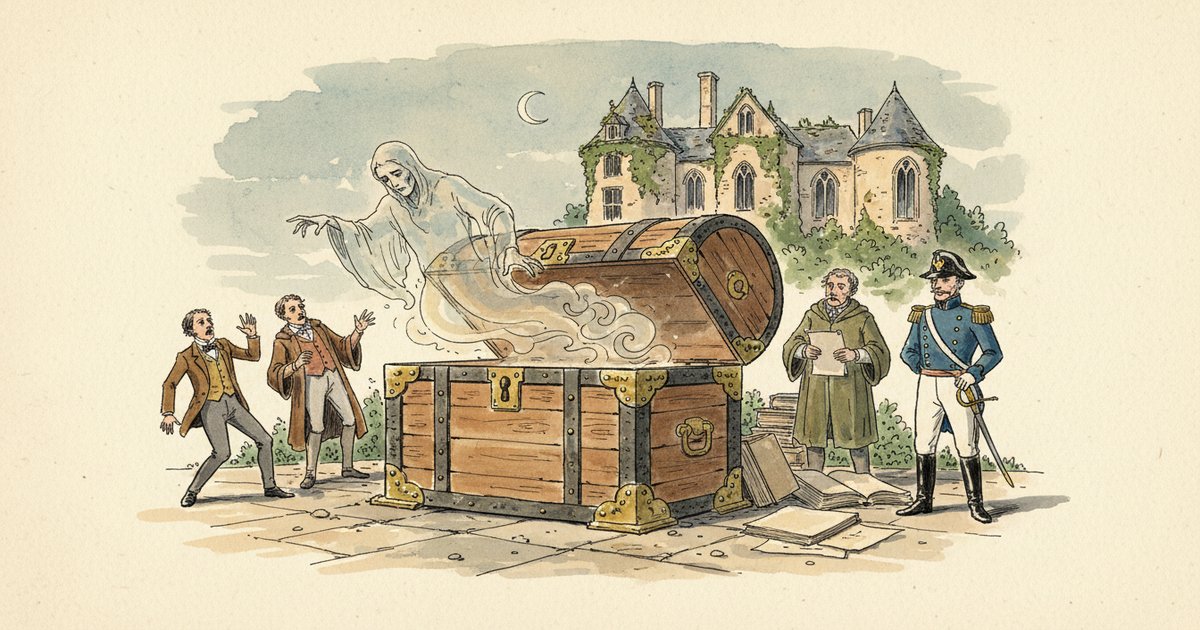
What distinguishes these stories from other Romantic-era fiction is their refusal of sentiment. Stendhal does not romanticize passion — he dissects it. In “The Chest and the Ghost,” desire operates through a gothic frame that he deploys not for atmosphere but for irony: the supernatural is cover for very natural appetites, and the story’s real horror is not the ghost but the calculation behind the haunting. In “Recollections of an Italian Gentleman,” a man’s memory becomes a form of obsession — the past not as nostalgia but as a trap that the present keeps springing. The characters believe they are pursuing happiness. The reader watches them pursue their own undoing with total lucidity about everything except themselves.
That gap — between what characters know and what they cannot stop doing — is where Stendhal’s irony sharpens into something that cuts. These are not tragedies. They’re something colder: portraits of intelligent people who see clearly and act anyway, because what else is there to do? The prose moves the way his best fiction always does — fast, specific, no decoration — and the translation we recommend here earns its place by preserving that velocity. Too many versions of Stendhal slow him down, soften the edges, turn his directness into period furniture. This one doesn’t. The sentences land.
The structure of “The Chest and the Ghost” is worth examining closely, because it shows exactly how Stendhal works. He sets up what looks like a supernatural mystery — a chest, a ghost, whispered rumors in a provincial household — and then, sentence by sentence, withdraws the gothic scaffolding until you’re left staring at something much more unsettling: two people who want each other and have decided that deception is preferable to honesty. The ghost was always a pretense. The chest was always a prop. The performance of fear was always a performance of desire. Stendhal doesn’t announce this revelation; he just stops holding the curtain up and lets you work it out. It takes about three seconds. Then you go back and reread the opening paragraph and realize he told you everything on page one.
What These Stories Owe to The Red and the Black
Readers who come to The Chest and the Ghost from The Red and the Black will recognize the machinery immediately. Julien Sorel, the carpenter’s son who claws his way into Parisian society through a combination of brilliance and calculated charm, is the novel-length version of every protagonist in these stories: someone who understands the rules of the game well enough to play, but whose actual feelings keep breaking through the strategy at the worst possible moments. The stories are shorter and more compressed, but the emotional logic is identical. A character decides to want something. The wanting takes over. The strategy collapses. What’s left is either comedy or catastrophe, depending on which way the final scene turns.
The Red and the Black was published in 1830, just as Stendhal was being packed off to Civitavecchia. The stories in this collection are what came after — after the novel, after the exile, after whatever hope he still harbored about his own romantic prospects had finished evaporating. That context matters. The novel has Julien’s ambition driving the engine, and ambition at least has the dignity of a clear direction. The stories are quieter and more claustrophobic. The characters want things they can’t name. That unnamed quality is where Stendhal gets most interesting, and most true.
Why These Stories Have Been Missing from English
The question of which Stendhal reaches English readers has always been shaped by which Stendhal publishers thought would sell. The Red and the Black and The Charterhouse of Parma have never gone out of print. The shorter fiction — the novellas, the Italian chronicles, the stories collected here — has had a much more irregular history in translation. Some pieces appeared in Victorian anthologies with the kind of bowdlerizing footnotes that turn irony into earnest moralizing. Others simply weren’t translated at all, which is how two of the stories in this collection arrive as English-language debuts. Two stories that Stendhal completed, that have sat in French editions for nearly two centuries, that no one had previously thought worth the effort of translation. That is either a remarkable oversight or a remarkable opportunity, depending on your perspective. The edition featured here treats it as the latter.
The implication is worth spelling out: if you have read Stendhal in English before — even carefully, even devotedly — you have read an incomplete Stendhal. These aren’t footnotes. These are stories in which his characteristic obsessions appear in concentrated form, without the sprawl of a novel to dilute them. Reading them fills in a gap you probably didn’t know was there.
Why This Translation?
Several of these stories have rarely appeared in English at all — two are making their English-language debut here — which means that even committed readers of Stendhal have been missing part of the picture. The Chest and the Ghost (and other Stories) isn’t a sampler for newcomers, though it works as one. It’s the late Stendhal: the consul in his tomb by the sea, pulling Renaissance crime records out of dusty folders and finding, in other people’s catastrophes, confirmation of everything he had lived. Read it alongside The Red and the Black if you want context; read it alone if you want proof that short fiction can do everything the novel does, in a fifth of the space. Available now in paperback: pick it up here.
The specific translation choices matter more with Stendhal than with almost any other French author, because so much of his effect depends on tone. His sentences are short, dry, and often end with a twist that functions like a deadpan punchline — the equivalent of a raised eyebrow. Translate too literally and the eyebrow disappears into wooden phrasing. Translate too freely and you lose the specificity that makes the irony land. The edition featured here threads that needle. Where older translations reach for Victorian dignity, this one reaches for clarity. Where older translations explain the joke, this one trusts the reader to get it. That trust is itself a kind of fidelity to Stendhal, who famously said he wrote for the happy few — by which he meant people sharp enough to read between his lines.
He never did solve the problem of love. Neither do his characters. That’s what makes them worth reading.
Also worth reading
What is the best English translation of The Chest and the Ghost and other Stories by Stendhal?
This new translation of Stendhal’s lesser-known short fiction is among the most accessible English editions available. Unlike older Victorian-era renderings that can feel stiff and dated, this modern translation preserves Stendhal’s dry wit and psychological sharpness while reading naturally for contemporary audiences. It is an ideal entry point for readers encountering Stendhal’s shorter work for the first time.
Is The Chest and the Ghost and other Stories worth reading in 2026?
Stendhal’s preoccupations — social performance, romantic obsession, the gap between how people present themselves and who they truly are — map cleanly onto modern life. These stories are short, precise, and often darkly funny. In 2026, when irony and self-deception are cultural fixtures, Stendhal reads less like a historical curiosity and more like a sharp observer of human nature who happened to write two centuries ago.
How does The Chest and the Ghost and other Stories compare to The Charterhouse of Parma?
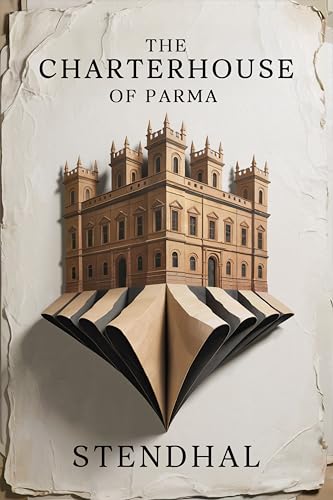
The Charterhouse of Parma is expansive — a full novel driven by political intrigue and romantic idealism across hundreds of pages. The Chest and the Ghost and other Stories works in miniature: compact plots, swift reversals, and characters stripped down to a single dominant flaw or desire. Readers who find Stendhal’s novels demanding will discover in these stories a more concentrated version of the same intelligence, and readers already devoted to The Charterhouse of Parma will find here the same psychological acuity operating at close range.
What should I read after The Chest and the Ghost and other Stories?
If Stendhal’s cynical wit and romantic irony appealed to you, the natural next step is Victor Hugo’s The Hunchback of Notre-Dame: A New Translation in Modern Accessible English, available at classicsretold.com — it shares the same French Romantic-era atmosphere but turns the emotional register up sharply, trading wit for tragedy and spectacle. For readers who want momentum and adventure alongside the period intrigue, The Three Musketeers: A New Translation in Modern Accessible English, also at classicsretold.com, delivers exactly that without sacrificing literary quality.
Frequently Asked Questions


This post contains affiliate links. As an Amazon Associate, we earn from qualifying purchases.
You must be logged in to post a comment.