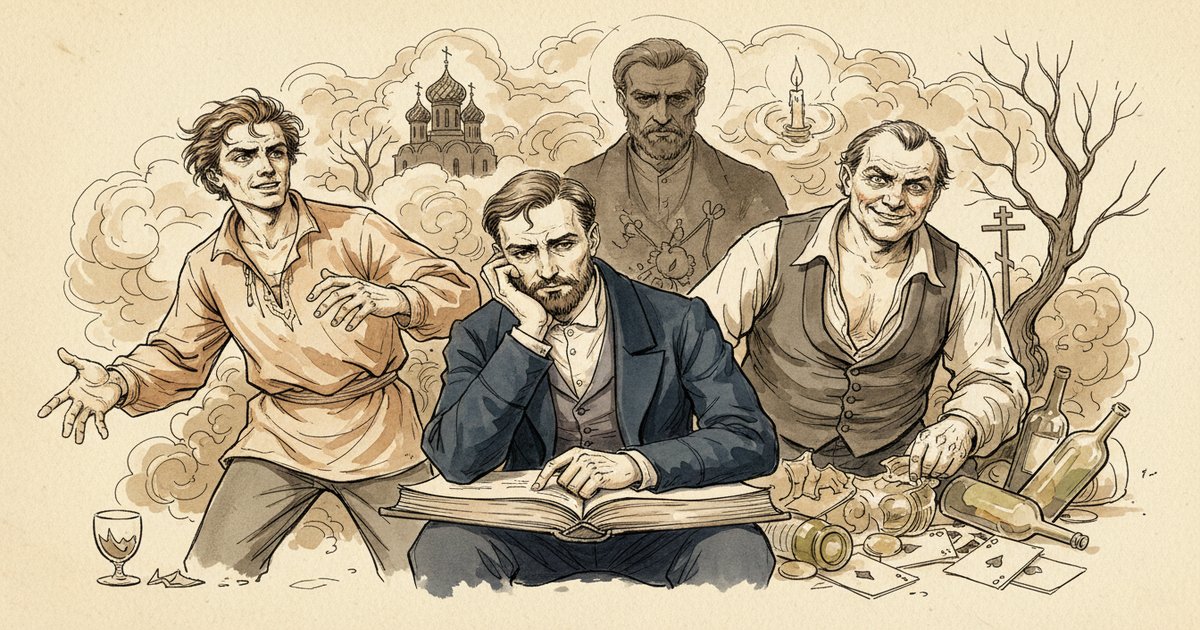
Looking for the best Brothers Karamazov translation? This guide helps you choose between the major English versions by readability, voice, and philosophical depth — so you can start with the edition that actually fits the reader you are.
Find Your Best Dostoevsky Translation
Use this guide to compare readability, fidelity, and modern flow before choosing an edition.
In Book Two of The Brothers Karamazov, a dissolute landowner publicly humiliates his own son in a monastery courtyard, and the son — Alyosha — kneels to kiss his father’s hand. Not in submission. Not in shame. Dostoevsky is careful about this: Alyosha does it without irony, without performance, because he has genuinely decided that this broken, lecherous old man deserves tenderness. Everyone in the scene is embarrassed by the gesture. Alyosha isn’t. That gap — between Alyosha’s response and what every other character thinks is appropriate — is the thesis of the entire novel.
We remember The Brothers Karamazov for Ivan’s rebellion: the Grand Inquisitor speech, the catalog of children’s suffering, the argument that no heaven is worth its price in innocent blood. It is a magnificent argument, and Dostoevsky wrote it knowing he was handing the skeptics their best weapon. But the novel’s real provocation isn’t Ivan. It’s the younger brother standing quietly in the corner, refusing to be tragic about it. The radical move in this book isn’t doubt. It’s Alyosha’s insistence on loving specific people, badly, in person, right now — as an answer to everything Ivan says. Dostoevsky bets the whole novel on that answer landing.
Whether you find it convincing is your business. But the wager is real, the stakes are real, and nearly a hundred and fifty years later no one has quite settled the argument.
The Man Who Gave the Devil His Best Lines
Dostoevsky finished The Brothers Karamazov in 1880, four months before he died. He was sixty, epileptic, perpetually in debt, and had spent four years in a Siberian prison camp for his involvement in a radical reading circle — an experience that destroyed his health and, depending on who you ask, either broke or completed him. He came out of Omsk in 1854 believing in human suffering as a kind of knowledge unavailable to theory. Not because suffering is ennobling — he never said that — but because it puts you in contact with concrete reality in a way that abstractions don’t. Ivan Karamazov is the smartest character in the novel and the most helpless. That’s not an accident. Dostoevsky built Ivan from his own pre-Siberia self and then put him in a room with everything theory cannot fix.
The four brothers map four dispositions Dostoevsky had watched ruin people: sensualism, intellectual pride, cynicism, and — in Alyosha — something he thought might be the only alternative. What made him a novelist rather than a moralist was that he refused to stack the deck. Dmitri’s passion has genuine dignity. Ivan’s arguments are genuinely right, on their own terms. The novel gives every voice its full weight, which is why it reads as crisis rather than sermon, and why readers who come in as Ivan leave unsettled in ways they didn’t expect.
The biographical fact that matters most here: Dostoevsky wrote the novel’s climactic courtroom chapters — where a man is convicted of a crime he didn’t commit, on the basis of reasonable-sounding evidence — while Russian courts were becoming newly famous for their rationalism and procedural fairness. He was writing about what happens when a system is correct and still catastrophically wrong. That is not a nineteenth-century problem.
There is one more biographical thread worth pulling. Dostoevsky had lost a son — his three-year-old boy Alyosha — to an epileptic fit in 1878, just as he was beginning the novel. He gave the dead child’s name to the character he most wanted to defend. That is not a coincidence you can set aside. The tenderness he writes into Alyosha Karamazov has grief in it, and the novel’s argument for love-as-answer carries the particular urgency of a man who had recently been handed a reason to make Ivan’s argument himself and chose not to.
A Novel Built Like a Trap
The surface is a murder plot: old Fyodor Karamazov is found dead, his eldest son Dmitri is the obvious suspect, and the youngest, Alyosha, moves between his brothers trying to hold things together with his hands. But the murder is a container. What Dostoevsky is actually building is a sustained examination of three incompatible responses to the same world: Dmitri who feels everything and understands nothing, Ivan who understands everything and feels nothing useful, and Alyosha who operates by a logic neither of his brothers can access or dismiss.
The novel’s specific achievement — what keeps it from being a philosophical tract — is that it never lets Alyosha win by being right. He wins, when he wins, by being present. There’s a scene where a group of boys have been torturing a dying child, and Alyosha sits with the child’s father, a humiliated army captain, in a moment of such precise attention that the chapter becomes almost unbearable to read. Nothing is resolved. No argument is made. Dostoevsky just shows someone paying full attention to another person’s suffering without trying to explain it away. That — not the Grand Inquisitor, not the courtroom, not the theological debates — is the move the novel is staking everything on.
The trap the novel sets for the reader is this: you arrive expecting Ivan to be the one who unsettles you, and he does, but then Dostoevsky quietly turns the camera. By the final chapters, when Alyosha stands before a group of grieving schoolboys at a graveside and tells them to remember this moment of goodness — this specific afternoon, these specific faces — the novel has shifted what it’s asking. It is no longer asking whether God exists. It is asking whether you are capable of the kind of attention Alyosha is demonstrating right now. Most readers find that second question harder.
The Grand Inquisitor: What It Actually Says
It is worth being precise about Ivan’s argument because it is so often misrepresented. Ivan does not say God doesn’t exist. He says he is “returning the ticket.” He accepts, for the sake of argument, that there may be a divine harmony awaiting humanity at the end of history — a moment of cosmic reconciliation that explains all suffering. His objection is moral, not metaphysical: he refuses to accept any final harmony that is purchased with the suffering of a single tortured child. The Grand Inquisitor chapter that follows is Ivan’s prose poem, in which Christ returns to sixteenth-century Seville, is arrested by the Church, and the Inquisitor explains to him, at length, why humanity cannot bear the freedom Christ came to offer. The Inquisitor’s case is airtight. People want bread and certainty, not the terrifying liberty of choosing good for its own sake. The chapter ends with Christ kissing the old man on the lips and walking out. No argument. No rebuttal. Just a gesture — which is, of course, exactly what Alyosha does throughout the novel. Dostoevsky plants the answer to Ivan’s challenge inside Ivan’s own chapter, and most readers miss it the first time.
Why This Translation (translated by David Petault)?
The challenge with Dostoevsky in English is that his syntax is deliberately ungainly — characters interrupt themselves, loop back, contradict mid-sentence — and translators have often smoothed this into something more tractable and, in doing so, removed the texture that makes the voices distinct. The translation we recommend prioritizes idiosyncrasy over elegance, keeping the rough edges that signal which Karamazov brother is speaking before you’ve seen a dialogue tag. For a novel whose entire argument depends on three voices being genuinely different from each other, that’s not a minor editorial choice. It’s the difference between reading The Brothers Karamazov and reading a summary of it in period costume. The Brothers Karamazov: A New Translation is available in paperback — the version worth sitting with.
The specific test case for any translation of this novel is the Grand Inquisitor chapter, and close behind it is Dmitri’s confession scene in Book Nine, where he is interrogated through the night and the prose has to sustain a kind of feverish, looping energy for thirty pages without collapsing into chaos. In editions that over-tidy Dostoevsky’s Russian into smooth English paragraphs, that chapter reads like a formal deposition. In the edition featured here, it reads like a man talking faster than he can think — which is precisely what Dmitri is doing, and precisely why we believe him even when we know he shouldn’t be believed. That distinction is the whole game.
Also worth reading
How to Actually Read This Book
A practical note, because The Brothers Karamazov has a reputation for being impenetrable that it only partially deserves. The first hundred pages are the hardest. Dostoevsky front-loads the novel with the monastery scenes and the theological debates, and readers who are expecting a nineteenth-century thriller sometimes lose patience before the murder happens. Stick with it. The payoff for that patience is that when the thriller machinery finally kicks in — and it does, hard — you understand exactly what is at stake for each person, which makes the courtroom scenes among the most gripping in all of fiction. A useful heuristic: if you find yourself impatient with the early chapters, read the Grand Inquisitor section (Book Five, Chapter Five) on its own first. It is self-contained enough to work as a standalone piece, and once you have read it you will find you cannot stop thinking about it, which tends to solve the patience problem.
It also helps to know going in that Dostoevsky originally planned The Brothers Karamazov as the first volume of a two-part novel. The second volume — which would have followed Alyosha into adulthood and shown what his particular form of goodness actually produces in the world — was never written. Dostoevsky died before he could begin it. What we have is therefore a novel that ends on a question it was always going to answer in a sequel that doesn’t exist. Alyosha stands at that graveside with the boys, and we don’t know what happens next. Some readers find that unbearable. Most, eventually, find it exactly right.
Frequently Asked Questions
What is the best English translation of The Brothers Karamazov?
For readers coming to Dostoevsky for the first time, the modern translation featured here is an excellent starting point. Unlike older Victorian-era renderings that can feel stiff or archaic, this version prioritizes natural, contemporary English while staying faithful to the emotional intensity and philosophical weight of the original Russian. The dialogue breathes, the characters feel immediate, and the novel’s famous Grand Inquisitor chapter lands with the force Dostoevsky intended.
Is The Brothers Karamazov worth reading in 2026?
The Brothers Karamazov remains one of the most relevant novels ever written. Its central conflicts — faith versus doubt, free will versus determinism, the guilt that binds families together — speak directly to questions readers are still wrestling with today. The murder plot is gripping enough to hold any thriller fan, but underneath it Dostoevsky is asking whether a just God can exist in a world where children suffer. That question has not aged a day.
How does The Brothers Karamazov compare to The Idiot?
Both novels are pinnacles of Dostoevsky’s mature period, but they reward readers differently. The Idiot centers on a single luminous figure — Prince Myshkin — and traces how a genuinely good man is destroyed by a corrupt society. The Brothers Karamazov is broader and more architecturally ambitious: three brothers, a murder, a trial, and a sustained argument about the soul of Russia and the existence of God. Readers who want psychological intimacy often prefer The Idiot; those who want Dostoevsky at full orchestral scale reach for The Brothers Karamazov. Both are available in modern translations at classicsretold.com.
What should I read after The Brothers Karamazov?
Two natural follow-ups are available at classicsretold.com. If you want to stay inside Dostoevsky’s world, The Idiot: A New Translation is the ideal next step — it shares the same moral seriousness and psychological depth, but the pace is more concentrated and the tragedy more personal. If you want to see where Dostoevsky’s mature vision began, Crime and Punishment: A New Translation is essential reading: the story of Raskolnikov’s murder and its psychological aftermath is both the most accessible entry point to Dostoevsky and one of the most gripping crime novels in literary history.
Is The Brothers Karamazov based on a real murder case?
The novel draws on a real case that Dostoevsky encountered while serving in the Siberian prison camp at Omsk: a fellow prisoner named Dmitri Ilyinsky had been convicted of patricide and was widely believed to be innocent. Dostoevsky later discovered that Ilyinsky was indeed wrongly convicted, and the injustice lodged in his memory for decades before becoming the structural engine of the novel. The courtroom chapters — in which compelling circumstantial evidence convicts an innocent man — carry that specific outrage, which is why they still read as something more than plot mechanics.
How long does it take to read The Brothers Karamazov?
At a comfortable reading pace of around thirty to forty pages an hour, most readers finish the novel in fifteen to twenty hours — roughly two to three weeks of evening reading. The pacing is uneven by design: the early monastery sections are dense and slow, while the interrogation and trial chapters in the second half move at something close to thriller speed. Readers who know this going in tend to find the slow opening far less daunting.
You might also enjoy




This post contains affiliate links. As an Amazon Associate, we earn from qualifying purchases.
Leave a Reply