If you are deciding where to begin with Alyosha Karamazov or The Brothers Karamazov, this guide gives you the clearest modern entry point — with translation context, reading guidance, and the best edition for readers who want moral force without mush.
Find Your Best Dostoevsky Translation
Use this guide to compare readability, fidelity, and modern flow before choosing an edition.
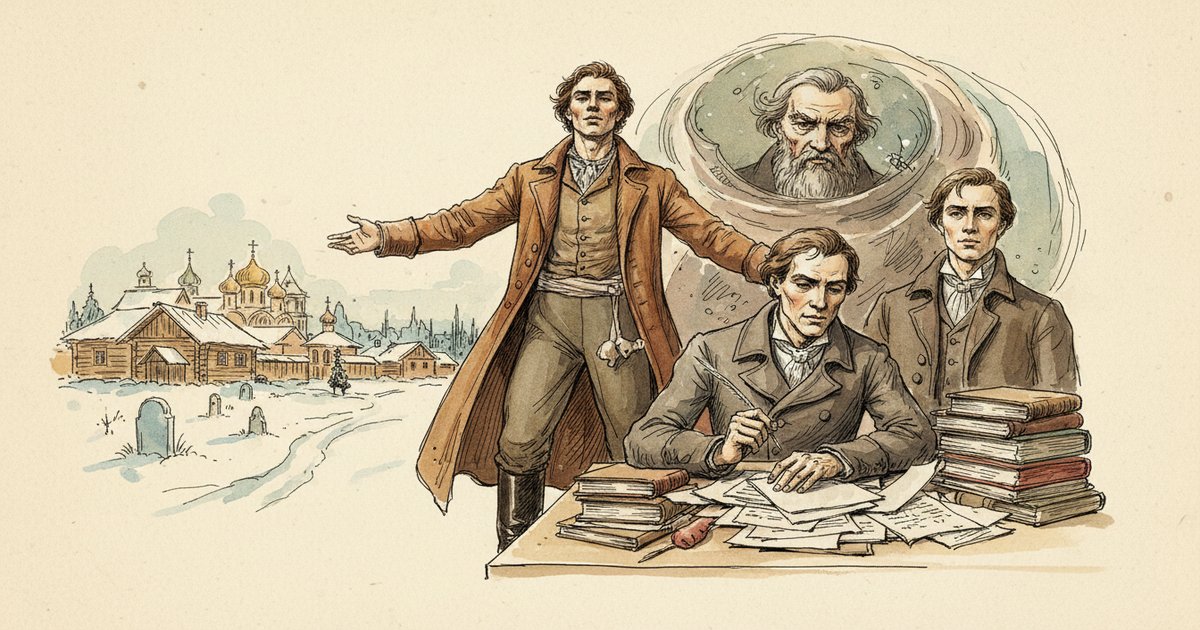
Halfway through The Brothers Karamazov, a boy named Ilyusha Snegiryov throws stones at his schoolmates. He is small and outnumbered and crying while he does it. His father, a broken ex-captain named Snegiryov, has just been dragged through the street by his beard — humiliated in public by Dmitri Karamazov over a debt — and Ilyusha has heard about it and cannot do anything. So he throws stones. One of them catches Alyosha Karamazov in the finger, hard enough to draw blood. And then Ilyusha bites the same finger, slow and deliberate, looking directly at Alyosha while he does it.
Dostoevsky is telling you something in that moment. Alyosha is the novel’s designated saint — gentle, patient, sent into the world by his elder Father Zosima to love it. He means well. He means nothing but well. And none of that keeps a desperate child from biting down.
This is the argument the novel makes, and it makes it without flinching: goodness is not a solution. It is a practice. Alyosha cannot fix his father Fyodor’s lechery, cannot stop his brother Dmitri’s spiral, cannot answer Ivan’s intellectual demolition of God with anything as clean as a counter-argument. What he can do is stay. Listen. Show up again the next day. Dostoevsky spent his life watching Russia argue about whether the soul could be saved by reason, by revolution, or by the Church — and his answer, buried in a young monk who keeps getting things wrong, is that salvation, if it exists at all, is made of something far more ordinary and far more stubborn than any of that.
The Man Who Earned the Right to Write This
Dostoevsky began The Brothers Karamazov in 1878, the year his three-year-old son Alyosha died of epilepsy — the same disease Dostoevsky had suffered since his twenties, possibly triggered by the night he stood in front of a firing squad in 1849 and waited to be shot. The Tsar commuted the sentence at the last moment. Dostoevsky spent the next four years in a Siberian labor camp. He came back changed in every direction: deeper in faith, more broken, more clear-eyed about suffering in a way that reads, even now, as almost unbearable in its accuracy.
That biography is not incidental. The reason Ivan Karamazov’s rebellion against God lands so hard — the famous speech about children’s suffering, which has rattled readers for a hundred and forty years — is that it was written by someone who could not dismiss the argument. Dostoevsky had watched children suffer. He had suffered. He had come out the other side still believing, but belief for him was not comfort. It was a wound that refused to close. Every serene line Father Zosima speaks carries the weight of everything Dostoevsky could not answer, only survive.
He finished the novel in 1880, one year before he died. He had intended a second volume, following Alyosha into the world as an adult. He never wrote it. What remains is a book about preparation — a young man being made, by grief and argument and love, into someone who might one day matter. We never see the day.
Three Brothers, One Unbearable Question
The plot involves a murdered patriarch and the question of which son did it. But the real architecture is philosophical, and it runs on a single question: can a good life be justified without God? Dmitri — passionate, self-destructive, operatically guilty about everything except the one thing he’s accused of — represents the body’s claim on human beings. Ivan represents the mind’s. His “Grand Inquisitor” chapter, in which he imagines Christ returning to sixteenth-century Seville only to be imprisoned by the Church that claims to worship him, is one of the most devastating pieces of prose in the Western canon. The Inquisitor tells Christ that humans cannot bear freedom, that the Church has corrected his mistake by taking it away. Christ says nothing. He kisses the old man on the lips and walks out.
Dostoevsky gives Ivan the best lines and then shows you what Ivan’s logic does to a person who lives inside it. The novel’s answer to the Grand Inquisitor is not a rebuttal. It is Alyosha kneeling in a field at night, weeping, pressing his face to the earth, feeling something break open in him that he cannot name. Dostoevsky does not explain it. He just shows you what the man looks like afterward: someone who has been changed by contact with the world and will now go find Ilyusha Snegiryov and try again.
Why This Translation (translated by David Petault)
Most English readers know The Brothers Karamazov through translations that are either faithful and airless or fluid and slightly wrong — the Russian collapsed into something too tidy, the voices flattened into a single literary register. This 2025 translation restores what matters most: the difference between the way Dmitri talks (loud, lurching, always one sentence from tears) and the way Ivan talks (precise, controlled, cold in a way that reads as grief in disguise) and the way Alyosha talks (plain, direct, almost bare). Dostoevsky built his argument in the gaps between those voices. A translation that blurs them loses the book.
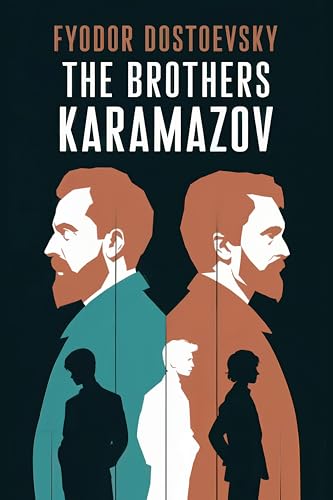
Volume One covers Books 1 through 7 — from the disastrous family reunion at the monastery through Ivan’s rebellion and Alyosha’s breaking point — which is to say it covers everything that makes the novel essential. The paperback is available now. Pick it up here. Read slowly. Ivan’s argument will get inside you. That’s what it’s supposed to do.
Also worth reading
What is the best English translation of The Brothers Karamazov for modern readers?
For readers coming to Dostoevsky in 2025, this new translation of The Brothers Karamazov (Vol. 1, Books 1–7) is one of the most accessible options available. Unlike older Victorian-era translations that preserve archaic syntax at the expense of readability, this 2025 version renders Dostoevsky’s dense psychological prose in natural, contemporary English without softening the novel’s theological weight or dramatic intensity. It is an ideal entry point for first-time readers and a worthwhile revisit for those who struggled with earlier editions.
Is The Brothers Karamazov still worth reading in 2026?
The Brothers Karamazov remains one of the most searching examinations of faith, doubt, guilt, and family dysfunction ever written. The questions Dostoevsky poses — whether God’s existence can justify human suffering, whether a son bears responsibility for a father’s death — are no less urgent in 2026 than they were in 1880. This 2025 translation makes Books 1–7 especially approachable, letting the philosophical arguments in the Grand Inquisitor chapter land with full force on a contemporary audience.
How does The Brothers Karamazov compare to The Idiot as a starting point for Dostoevsky?
Both novels are masterworks, but they demand different things from a reader. The Idiot: A New Translation centers on a single luminous character — Prince Myshkin — and moves through Saint Petersburg society with a more contained emotional scope. The Brothers Karamazov is broader and more philosophically ambitious, juggling three brothers, a murder plot, and Dostoevsky’s full theological vision across multiple volumes. Readers who want immediate emotional immersion often find The Idiot easier to enter; those drawn to ideas and moral argument tend to be more gripped by Karamazov from the start.
What should I read after finishing The Brothers Karamazov (Vol. 1, Books 1–7)?
The most natural next step is The Brothers Karamazov: A New Translation, which continues the complete novel through its devastating conclusion. If you want to stay in Dostoevsky’s world but shift registers entirely, The Idiot: A New Translation — available at classicsretold.com — offers a quieter, more intimate tragedy built around one of literature’s most memorable protagonists. Both are available in modern translations designed with the same clarity and literary care as this volume.
You might also enjoy
See the Difference: Old vs. New Translation



This post contains affiliate links. As an Amazon Associate, we earn from qualifying purchases.
Leave a Reply