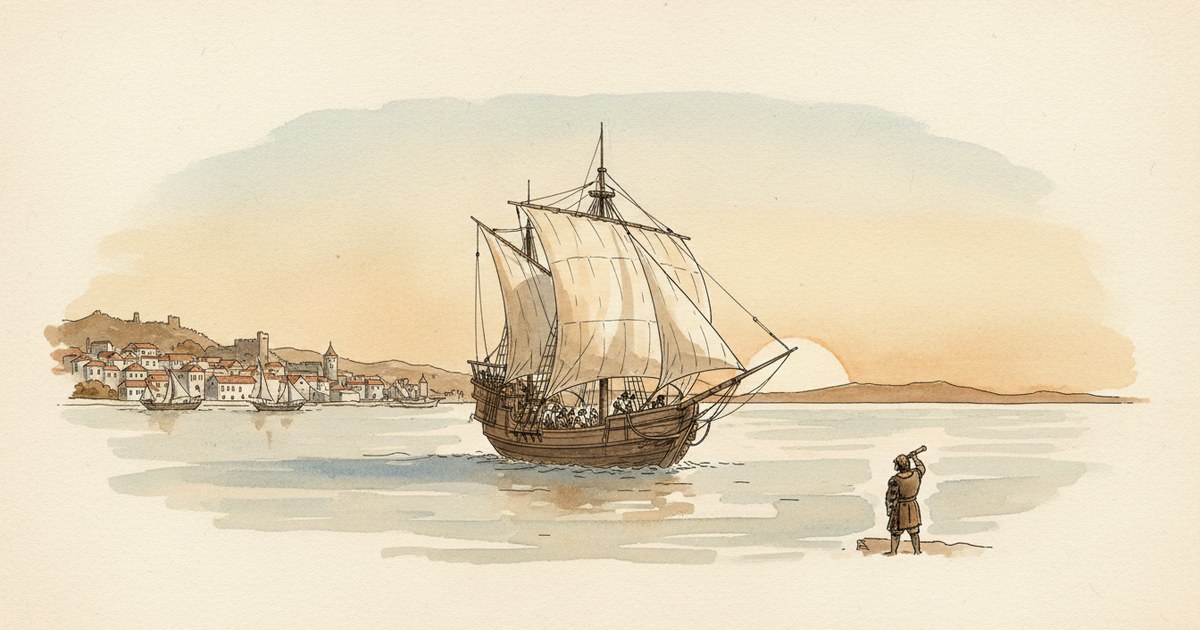
Ferdinand Magellan never saw the strait named after him. He was dead before the Victoria limped back to Seville with eighteen survivors and a hold full of cloves — killed on a Philippine beach in a skirmish that had nothing to do with circumnavigation and everything to do with a local king’s political dispute that Magellan, characteristically, decided was his business. That detail matters: the man who planned the most audacious voyage in human history could not stop himself from dying in a footnote to someone else’s war.
Stefan Zweig spent years with that detail. He turned it over, the way you turn over a stone to see what moves underneath. And what he found — writing in 1938, in exile, watching Europe rehearse its own destruction — was not a story about conquest. It was a story about obsession so total it becomes indistinguishable from self-erasure. Zweig’s thesis is quiet but merciless: Magellan was the voyage. Once the voyage was complete, there was nothing left of the man but the dying.
This is the argument that makes Zweig’s Magellan something other than biography. It is a portrait of a specific kind of human being — the visionary who can only exist in pursuit, who is more alive in a storm off Patagonia than in any room in Lisbon. That Zweig understood this so precisely, at that particular moment in his life, tells you something about what he was writing toward.
The Exile Who Recognized the Obsessive
By the late 1930s, Zweig had lost almost everything a Central European intellectual could lose. Vienna — the city he’d written with the tenderness of a man describing his own face — was gone. His books were burned. He was in London, then Bath, then eventually Brazil, carrying his language in his head like a portable homeland. He wrote the Magellan biography in that period, and it would be too easy to say he was simply projecting. What’s more precise is that exile sharpens your eye for certain things: the cost of total commitment, the loneliness of the person who can only see one direction, the way an idea can consume its owner.
Zweig had made his reputation on psychological portraiture — his Sternstunden der Menschheit, those “decisive moments in history,” had shown he understood that the hinge points of civilization are also the hinge points of individual psychology. What he brought to Magellan was the same scalpel: biographical facts in service of a psychological argument. The Portuguese court dismissing Magellan, King Manuel refusing an audience — Zweig treats these not as political events but as the specific wounds that calcify into obsession. Every door that closes becomes another layer of the armoring that makes Magellan both possible and unreachable.
He wrote from original sources, cross-referencing the accounts of Pigafetta — the chronicler who survived and left the only firsthand record — against the administrative documents of the Casa de Contratación. Zweig was not a careless researcher. The psychological argument is built on an accurate skeleton. That’s what separates Magellan from historical romance: it earns its interpretations.
The Voyage as Character, the Mutiny as Climax
The book’s beating heart is the winter at Port San Julián, where three of Zweig’s five ships mutinied in the dark and cold of a Patagonian April. Magellan’s response was so precise it borders on the algorithmic: he isolated the ships one by one, executed the ringleader, marooned two others, and offered pardons down the chain of command before anyone had time to think. The whole operation took less than a day. Zweig reads this not as military brilliance but as the act of a man for whom the voyage was not a mission but a metabolism — the mutineers weren’t threatening his command, they were threatening his ability to continue existing.
That specificity of reading is what makes Magellan land the way it does. The strait itself — those 373 miles of channel through the southernmost tip of South America, which Magellan spent thirty-eight days navigating while one of his captains defected back to Spain — becomes in Zweig’s hands a psychological passage as much as a geographical one. The man who emerged on the Pacific side was not triumphant. He was depleted. He had spent everything to get through. The rest was momentum.
Why This Translation
The standard English version of Zweig’s Magellan is decades old and it shows — the prose has the slightly formal remove of mid-century translation, competent but cautious, the German sentence architecture left standing rather than rebuilt in English. This new translation strips that scaffolding away and lets Zweig’s own rhythm through: his pacing, his habit of building a paragraph to a single revealing clause, his refusal to let the reader off the hook with easy heroism. The result reads the way Zweig’s essays read — intimate, pressurized, like someone talking to you at close range about something that matters to them. For readers who want to understand what Zweig saw in Magellan, and what Magellan’s story let Zweig say about his own era, this is the version that gets you there. The paperback is available here.
Magellan crossed the Pacific and died before he knew what he’d proven. Zweig finished the book and within four years was dead by his own hand in a rented room in Petrópolis. Two men who went all the way — and the one who understood the cost better was the one watching from the shore.
Also worth reading
Further reading: More books by Stefan Zweig · Explore German Literature
What is the best English translation of Magellan: Conqueror of the Seas by Stefan Zweig?
This modern edition is one of the most accessible English translations of Zweig’s biography of Ferdinand Magellan available today. Unlike older renderings that carry the stiffness of mid-twentieth-century prose, this translation prioritizes clarity and momentum, allowing contemporary readers to experience Zweig’s vivid narrative drive without friction. It is the edition most recommended for readers coming to Zweig for the first time.
Is Magellan: Conqueror of the Seas worth reading in 2026?
Yes. Zweig’s account of Magellan’s circumnavigation is not a dry historical record — it is a psychological portrait of obsession, courage, and institutional betrayal. Those themes have lost none of their weight. In an era saturated with short-form content, Zweig’s sustained, novelistic attention to a single human life reads as a corrective. The story of one man’s refusal to accept the limits of the known world resonates precisely because that refusal is rare in any century.
How does Magellan: Conqueror of the Seas compare to The Stefan Zweig Collection – Volume 1: A New Translation?
Magellan is Zweig operating at full biographical length — a single subject, sustained argument, and cumulative emotional build over several hundred pages. The Stefan Zweig Collection – Volume 1 works differently: it gathers shorter fiction and novellas, showing Zweig’s range as a storyteller rather than his depth as a biographer. Readers who want to understand what Zweig could do with a life should start with Magellan; readers who want to sample his narrative voice across genres will find the Collection a more varied entry point. Both reward close reading.
What should I read after Magellan: Conqueror of the Seas by Stefan Zweig?
The Stefan Zweig Collection – Volume 1: A New Translation is the natural next step. It collects some of Zweig’s most celebrated shorter works and demonstrates how the same psychological intensity he brought to Magellan operates at novella scale. If that leaves you wanting more, The Stefan Zweig Collection – Volume 2: A New Translation continues the series with additional fiction, giving you a thorough grounding in the full arc of Zweig’s literary achievement. Both are available at classicsretold.com.
You might also enjoy





This post contains affiliate links. As an Amazon Associate, we earn from qualifying purchases.
Leave a Reply