The Writer Behind The Stefan Zweig Collection – Volume 5
In 1942, Stefan Zweig sat in a rented room in Petrópolis, Brazil — a resort town in the hills above Rio — and finished a memoir about a world that no longer existed. Two days later, he and his wife Lotte were found dead, a double suicide, their farewell note written in careful, composed prose. He was sixty years old. The man who had once been the most widely translated author on earth, whose novellas sold in millions across thirty languages, who had corresponded with Freud and Rolland and Toscanini, died as a stateless refugee with a temporary visa. That tension — between extraordinary intimacy with civilization and the total loss of it — runs through everything he wrote.
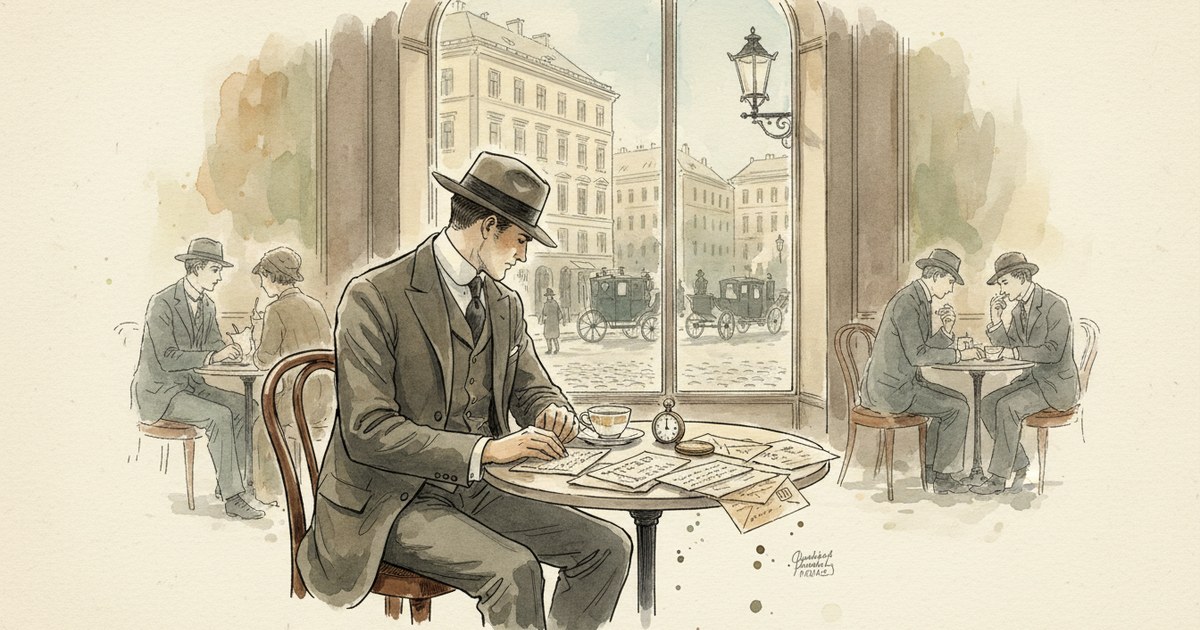
Zweig was born in Vienna in 1881, into the prosperous Jewish bourgeoisie of the Austro-Hungarian Empire. He spent his twenties in Paris absorbing Rodin and Verhaeren, his thirties cementing a reputation as Europe’s premier literary psychologist, and his forties watching the architecture of that culture — coffeehouses, opera seasons, the republic of letters — get systematically dismantled. The Nazis burned his books in 1933. He fled Austria in 1934, settled briefly in Bath, then London, then New York, then finally Brazil. Each address was a smaller room. His autobiography, The World of Yesterday, completed the morning before his death, is among the great elegies in the language.
What made Zweig singular wasn’t scope — he rarely wrote novels — but precision. He was a miniaturist who worked at psychological depth, a writer who could compress an entire moral catastrophe into forty pages and leave you feeling like you’d read a thousand. His novellas strip their characters down to a single obsession — jealousy, compulsive gambling, shame, a fleeting erotic fixation — and follow that obsession to its logical, terrible end. That method came directly from his years studying Freud’s Vienna, where the interior life was understood to be the whole life, and self-deception the engine of most human tragedy.
What Makes The Stefan Zweig Collection – Volume 5 Still Matter
The Stefan Zweig Collection — Volume 5 gathers several of his finest shorter works into a single edition, giving readers access to the full range of his craft: the claustrophobic precision of his psychological novellas, the moral acuity of his character studies, and the almost unbearable sympathy he extends to people who have made irreversible mistakes. These are not comfortable stories. Zweig is not interested in reassurance. His protagonists are people whose inner lives have become prisons — a chess master who fractures under isolation, a woman undone by a single night’s passion, a man whose dignity depends on a secret he cannot keep. The collection’s power comes from accumulation: each story reinforces the sense that Zweig’s subject is always the same thing, approached from a different angle — what it costs a person to live as they are.
What makes this particular volume essential reading is its historical moment. These stories were written as European civilization was proving, conclusively, that it did not deserve the confidence Zweig had placed in it. That context haunts the pages even when the plots are intimate and personal. The chess player trapped in a hotel room by the Gestapo is also Europe trapped in itself. The woman who gives everything for one night is also a culture that exhausted its inheritance on a single catastrophic bet. Zweig never wrote propaganda — he considered didacticism a literary failure — but he couldn’t keep the age out of the work. It’s there in the pressure, in the claustrophobia, in the sense that his characters have no exits left.
Why Read a Modern Translation?
Zweig’s German is deceptively difficult to render in English. His sentences are long, syntactically intricate, emotionally pressurized — built on subordinate clauses that pile up like evidence until the main verb finally lands and the meaning breaks open. Bad translations flatten this into smooth, bloodless prose that loses the very texture his work depends on. the edition linked below of Volume 5 works to preserve that syntactic tension while keeping the language genuinely readable to a contemporary audience — the rhythm breathes, the psychological vocabulary doesn’t feel dated, and the emotional logic of each story stays intact rather than being paraphrased into clarity. For readers coming to Zweig for the first time, this is the version that delivers what the reputation promises.
What is the best English translation of The Stefan Zweig Collection – Volume 5?
the edition linked below uses modern, accessible English that keeps Zweig’s long, coiled sentences intact rather than breaking them into easier units — which is where the psychological pressure lives. It handles his precise emotional vocabulary well, translating terms like Angst and Scham in ways that feel earned rather than clinical, and it preserves the deliberately slow, accumulating pace that makes the final revelations so effective.
Is The Stefan Zweig Collection – Volume 5 worth reading in 2026?
Yes, with some urgency. The collection’s recurring theme — what happens to a person’s interior life under authoritarian surveillance and enforced isolation — reads differently now than it did a decade ago. Zweig’s chess master, broken by solitary confinement and the impossibility of trust, is a precise psychological map of what prolonged state pressure does to a human mind, and that map has not become less relevant. His portrait of how cultural confidence collapses — not all at once, but in increments that each seem survivable — is one of the sharpest available.
How does The Stefan Zweig Collection – Volume 5 compare to Beware of Pity?
Beware of Pity, Zweig’s only full-length novel, operates through accumulation and social obligation — it’s about a young officer who mistakes pity for love and destroys someone with good intentions. The novellas in Volume 5 are more surgical: less interested in social dynamics than in the single interior moment when a person crosses a line they cannot uncross. Where the novel has room to implicate an entire class structure, the shorter works go straight for the nerve — there’s no buffer of plot between the reader and the character’s crisis.
What should I read after The Stefan Zweig Collection – Volume 5?
The natural next step is Zweig’s autobiography, The World of Yesterday, which provides the historical frame for everything in the fiction — you see exactly what world Zweig was mourning and why he couldn’t survive its loss. For readers who want to stay in the novella form, Joseph Roth’s The Radetzky March covers similar Habsburg territory with a different emotional register: where Zweig is psychological and interior, Roth is elegiac and sweeping, and the two together give you the full picture of what was lost in 1918.

This post contains affiliate links. As an Amazon Associate, Classics Retold earns from qualifying purchases. This does not affect our editorial recommendations.
More from Stefan Zweig


Leave a Reply