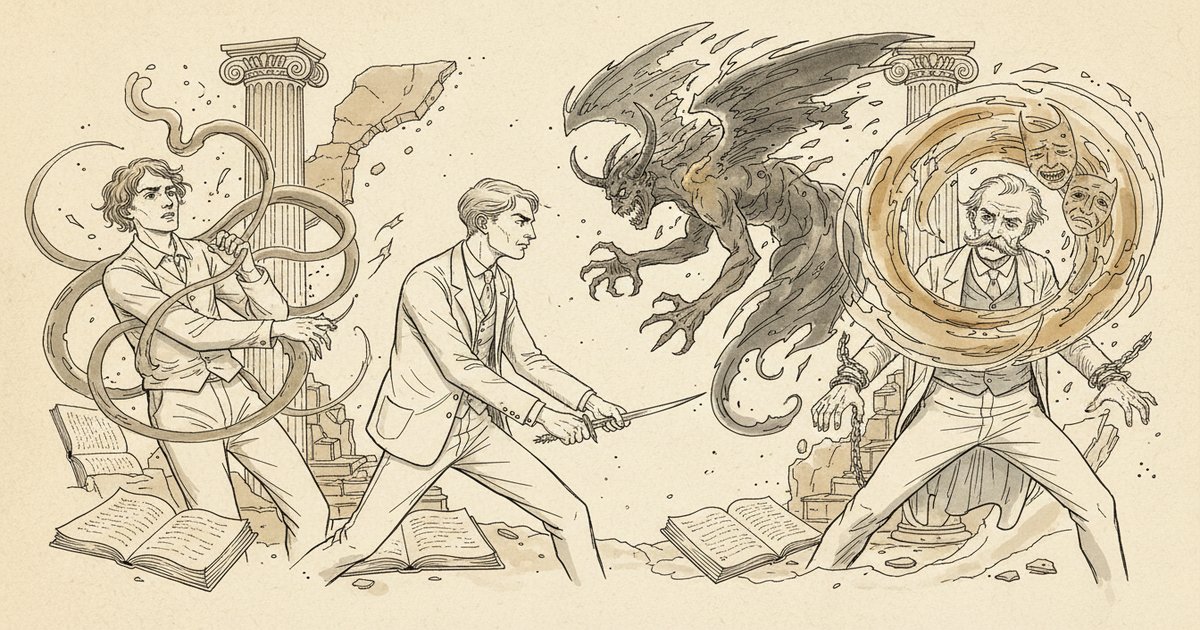
By 1925, Stefan Zweig had already outlived three of the men he most admired. He had watched Europe burn itself down once and was watching the kindling pile up again. It was not nostalgia that drove him to write about Hölderlin, Kleist, and Nietzsche — it was recognition. He had seen what happened to men who felt too much and thought too hard in a world that preferred its geniuses quiet and manageable. These three had not been quiet. They had been consumed.
Zweig’s method in The Struggle with the Demon is not biography as chronicle. It is biography as diagnosis. He opens the Hölderlin section not with a birth date or a family tree but with the observation that Hölderlin spent the last thirty-six years of his life in a tower above the river Neckar, cared for by a carpenter, receiving visitors who spoke to him like a child. A man who had written some of the most ecstatic German verse of the age, reduced to signing his name “Scardanelli” and inventing a death date for himself decades in the future. Zweig does not explain this as tragedy. He argues it was the only possible ending for a man whose entire nervous system was tuned to frequencies human society cannot sustain.
That is the thesis of this book, and it is a bold one: that the demon these three men struggled with was not madness, not fate, not bad luck — but an excess of intensity that is inseparable from the work itself. You cannot have the poems without the tower. You cannot have the plays without the suicide pact at the Wannsee. You cannot have Thus Spoke Zarathustra without the decade of silence in Turin. Zweig refuses the comfortable separation between the art and the wreckage of the life. He insists they are the same thing, running at different voltages.
The Diagnostician Who Knew His Own Symptoms
Zweig was born in Vienna in 1881 into the kind of prosperous Jewish family that produced, in that era, either bankers or artists. He became an artist of a very specific kind: a man who could inhabit other people’s interiority with an almost embarrassing precision. His novels work this way. His biographical essays work this way. Burning Secret, Chess Story, the Balzac biography — all of them are studies in what happens when a person’s inner life outgrows the container their circumstances provide. He was drawn to this subject because he lived it. He watched his world dismantle itself in 1914, reassemble badly, and begin to crack again by the time he finished this book. He fled Austria in 1934. He died by suicide in Brazil in 1942. He knew what it meant to have nowhere left to go.
That biographical fact changes how you read The Struggle with the Demon. When Zweig writes about Kleist — who spent his short life chasing a sense of purpose that kept dissolving, who needed someone to die with him so badly that he spent months searching for a willing companion — Zweig is not writing from the outside. He is writing from the uncomfortable proximity of a man who recognized the logic of it, even if he hadn’t yet reached the end of his own version of it. Every biography Zweig ever wrote was also a self-portrait in borrowed clothes.
And Nietzsche: Zweig traces the arc from the Basel professor who was already cracking under the weight of thoughts he hadn’t yet written down, through the decade of solitary wandering across Switzerland and Italy and France, through the collapse in Turin. What Zweig finds in Nietzsche is not megalomania but an impossible demand the man placed on himself — to think beyond what his contemporaries could bear to think, to write philosophy as if it were a physical event. Nietzsche called his own books dynamite. Zweig takes him at his word, and then asks what it costs to be the person holding the fuse.
Three Men, One Argument, and the Sentences That Prove It
The book does not read like three separate essays bound together. It reads like one sustained argument that happens to require three case studies to make its point. Zweig moves between close reading and psychological portraiture with a fluency that most literary biographers still haven’t matched. When he describes Hölderlin’s late hymns — the ones written after the breakdown had already begun — he notes that the syntax starts to fracture in ways that sound like damage but read like prophecy: the grammar going wrong in exactly the right direction. That is not a vague claim. He shows you the lines. He makes you feel the difference between a mind falling apart and a mind pushing through to something the language hadn’t made room for yet.
The new translation matters because Zweig’s German is not simple. His sentences are long, syntactically ambitious, and emotionally pressurized — they carry the argument in the rhythm, not just the words. A flat translation drains exactly the quality the book is about. This one doesn’t. The English breathes where Zweig breathes, holds where he holds. You get the full current of a writer who believed that prose, like the men he was writing about, should risk going too far.
Why This Translation
The Struggle with the Demon has existed in English before, but not like this. The new translation restores the urgency that previous versions let settle into stateliness — and urgency is the whole point. This is a book about men who could not modulate, written by a man who couldn’t either, and it should feel that way in English. It does. The paperback is available here, and if you have ever found yourself wondering whether the price of certain kinds of greatness is non-negotiable — whether the work and the ruin are actually the same thing at different stages — Zweig has already written the answer, and he did not flinch from it.
Also worth reading
What is the best English translation of The Struggle with the Demon (Hölderlin · Kleist · Nietzsche)?
This new translation of Stefan Zweig’s The Struggle with the Demon is the most accessible English edition available today. Earlier translations, some dating back to the 1920s and 1930s, carry dated phrasing that puts distance between modern readers and Zweig’s intensely intimate prose. This edition restores the urgency and psychological precision that made the original so electrifying, making it the recommended starting point for anyone approaching Zweig’s literary criticism for the first time.
Is The Struggle with the Demon (Hölderlin · Kleist · Nietzsche) worth reading in 2026?
Yes, emphatically. Zweig’s portraits of Hölderlin, Kleist, and Nietzsche are not biographical curiosities — they are studies in the cost of genius, the tension between creative ecstasy and self-destruction, and the impossibility of living at the outermost edge of human feeling. In an era saturated with surface-level content, Zweig’s unflinching attention to interior life reads as both urgent and countercultural. The three subjects remain culturally alive, and Zweig’s method — part psychological essay, part literary portrait — has lost none of its power.
How does The Struggle with the Demon compare to The Stefan Zweig Collection – Volume 1: A New Translation?
The Struggle with the Demon is Zweig the critic and essayist at full intensity — long-form, argumentative, built around three towering German figures. The Stefan Zweig Collection – Volume 1 offers a broader entry point, gathering shorter fiction and novellas that show Zweig’s range as a storyteller rather than a literary analyst. Readers drawn to psychological depth will find both rewarding, but the approach differs sharply: The Demon demands sustained engagement with ideas, while Volume 1 delivers that same psychological acuity through narrative. Most readers benefit from having both.
What should I read after The Struggle with the Demon (Hölderlin · Kleist · Nietzsche)?
The natural next step is The Stefan Zweig Collection – Volume 1: A New Translation, available at classicsretold.com. It collects some of Zweig’s finest shorter fiction and demonstrates how the same obsessions driving his critical essays — compulsion, passion, the psyche under pressure — translate into narrative form. If you want more, The Stefan Zweig Collection – Volume 2: A New Translation, also at classicsretold.com, continues that arc with additional works that round out Zweig’s remarkable range.
You might also enjoy





This post contains affiliate links. As an Amazon Associate, we earn from qualifying purchases.
Leave a Reply