Category: Literary Classics

  • The Danube Was Jules Verne’s Real Final Frontier

    The Danube Was Jules Verne’s Real Final Frontier

    Serge Ladko knows the Danube the way a surgeon knows a body — not as scenery, but as a system with its own logic, its own failure points. He can read a ripple’s depth, hear a sandbar in the way the current changes pitch. He is, by every professional measure that matters on the water, the best pilot working the lower river. None of that saves him when someone decides he is someone else.

    The Danube Pilot opens not on a voyage but on a trap. A man of impeccable standing is caught in the machinery of accusation, misidentification, and bureaucratic certainty — stripped of the one thing that made him legible, his professional authority, because the relevant parties have decided he is a different man entirely. Verne completed the manuscript near the end of his life; his son Michel finished and edited it after Jules’s death in 1905, and it appeared in 1908. You might expect something diminished — a last work handed off to a well-meaning heir. What Verne and Michel delivered instead is the tightest thriller in the Extraordinary Voyages: a novel that dispenses entirely with submarines and balloon voyages and asks a harder question. What happens when the state decides who you are, and you cannot prove otherwise?

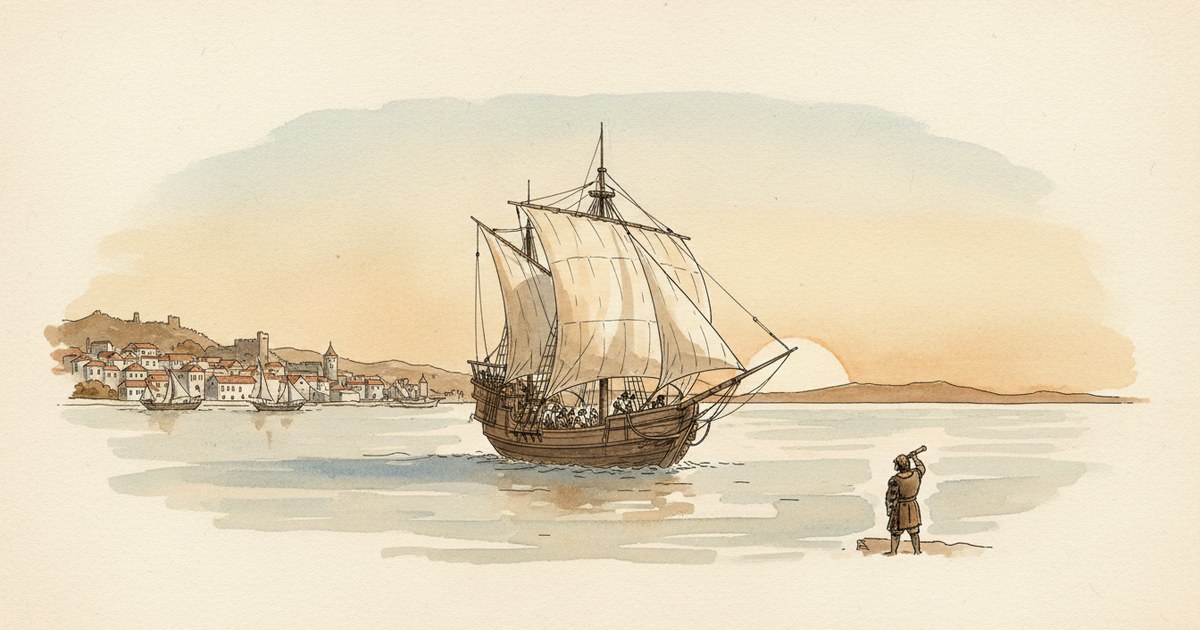
    The choice of the Danube was not geographical convenience. In 1908, the river was governed by the European Danube Commission, a treaty body representing competing imperial interests, running through or alongside the Austro-Hungarian Empire, Romania, Serbia, and Bulgaria. It was a waterway where nationality shifted with the bank you stood on, where identity was both intensely local and constantly subject to external adjudication. A man might be perfectly known in one jurisdiction and a stranger — or a suspect — in the next. Verne chose it because it was a place where being recognized as one thing could, overnight, become legally meaningless.

    The Writer Who Outlasted His Own Genre

    Jules Verne spent most of his career building a specific kind of reader expectation. The Extraordinary Voyages — eighty novels published between 1863 and 1905 — trained generations of readers to expect that technology would be the protagonist. Not a character who uses technology, but technology itself as the engine of plot: the Nautilus, the Albatross, the cannon shell fired at the moon. His publisher Pierre-Jules Hetzel understood this and shaped Verne’s output accordingly. The formula worked. It produced some of the most widely translated fiction of the nineteenth century. It also, by the time Verne reached his seventies, had begun to feel like a cage.

    The later Verne — from the 1880s onward — is a different writer, and reading that period requires unlearning what you think you know about him. His skepticism about technology had grown visible in the work itself. Robur the Conqueror (1886) gave the reader a flying machine and then asked whether the man operating it could be trusted with such power. The Master of the World (1904) revisited the same character and gave a darker answer. The machines were still spectacular. The men behind them had become dangerous. Verne was moving, across the final decade of his career, toward a fiction in which the real threat was not the wilderness or the unknown but the institution — the commission, the court, the administrative body that processes human beings the way a lock processes a ship.

    By the time he was drafting what would become The Danube Pilot, he was nearly blind, working in failing health in Amiens. He had outlived Hetzel, outlived most of the conventions he helped establish, and apparently outlived his patience with spectacle as a substitute for argument. The novel he left behind has no extraordinary machine. The technological marvel is the pilot himself — his knowledge, his precision, his irreplaceable expertise on a dangerous stretch of water — and the book’s central horror is that none of it constitutes proof of anything. What Verne arrived at, near the end, was a story about the limits of competence in the face of institutional power.

    Michel Verne’s role in the final manuscripts remains contested among Verne scholars. He edited, completed, and in some cases substantially revised his father’s late work. Whether The Danube Pilot represents Jules’s vision faithfully or Michel’s interpretation of it is a question that cannot be fully resolved. What can be said is that the book reads with unusual coherence for a posthumous collaboration — the argument is consistent, the pacing deliberate. Whatever Michel’s contribution, the result does not feel like rescue. It feels like completion.

    Competence as a Trap

    The novel’s central situation is this: Serge Ladko, a Danube river pilot of considerable reputation, is mistaken for — or accused of being — a man involved in criminal conspiracy. The accusation is plausible enough, from the investigator’s perspective, to hold. And Ladko’s very precision, his unwillingness to explain himself in terms that might satisfy a bureaucratic examiner, makes him more suspicious rather than less. He is the kind of man who demonstrates competence rather than narrating it. In an official inquiry, that is a liability.

    What Verne constructs around this premise is close to a paranoid thriller. The geography works against Ladko: the river crosses jurisdictions, each with its own authorities, its own records, its own version of who he is. The reader understands, fairly early, that Ladko is not who he is accused of being. The suspense is not about revelation but about mechanism — how does a man who is right prove it in a system designed to process guilt rather than verify innocence? The answer, when it arrives, is not entirely comfortable.

    The specific texture of the accusation matters. This is not mistaken identity in the comic sense — wrong man, hilarious consequences. The error is the kind that systems make when they are optimized for pattern-matching rather than accuracy. Someone whose movements fit the timeline, whose profession placed him at the relevant locations, whose physical description matches closely enough — that person becomes, for institutional purposes, the answer to the question the institution is already asking. Ladko’s tragedy is not that he was in the wrong place. It is that he was exactly the right person in exactly the right place, which made him indistinguishable from his double.

    There is a sequence in the novel where a commission official lays out the case against Ladko with perfect bureaucratic confidence. Every piece of evidence is accurate. Every inference from that evidence is reasonable. The conclusion is entirely wrong. Verne does not editorialize. He simply presents the chain of logic and lets it sit, correctly constructed and catastrophically mistaken. It is the most unsettling passage in the Extraordinary Voyages, and it was written by a man who had spent his career making technology look like salvation.

    The Translation Landscape

    The Danube Pilot has never received the translation attention of Verne’s famous novels. Twenty Thousand Leagues Under the Sea and Around the World in Eighty Days have been translated and retranslated — by Penguin Classics, Oxford World’s Classics, and a range of independent scholars — each generation refining the prose or correcting the distortions of earlier versions. The serious Penguin reader can choose between Frederick Paul Walter’s scholarly apparatus and the older Mercier Lewis version. For the late Verne, no such infrastructure exists. The Danube Pilot has largely circulated in Victorian-era renderings produced in the years immediately after the novel’s French publication — technically functional but tonally remote, written in the stiff register where “said” becomes “rejoined” and every sentence is one clause too long. They convey the plot. They do not convey the novel’s compression.

    Penguin Classics has not produced a standalone edition of this novel. Oxford World’s Classics has not either. The serious reader looking for Le Pilote du Danube in modern English has historically had to choose between aged public-domain texts — often uploaded to Project Gutenberg with no editorial apparatus — or anthologies of late Verne that bundle several novels together with uneven translations and thin scholarly notes. This is not unusual for the lesser-known Extraordinary Voyages: the series runs to eighty novels, and critical infrastructure has accumulated around perhaps a dozen of them. The rest exist in whatever language was available when the copyright first expired, which is to say the language of a different era entirely.

    Why This Translation Reads Differently

    The Classics Retold edition was made for a reader who has not spent years with Victorian prose conventions — which is most readers. The sentence rhythms are contemporary without being colloquial. The interrogation sequences move fast; the river passages have physical weight; and the novel’s central argument — that institutional certainty is its own kind of violence — lands clearly rather than being blunted by period affect. A passage that reads in older versions like reported proceedings reads here like a confrontation. Ladko’s silences register as stubbornness rather than formal restraint. The officials register as dangerous rather than officious. That difference is not stylistic preference. It is what the novel is about.

    This is the translation that gives The Danube Pilot back the tension Verne built into it. For a book that has spent over a century in the margins of the Verne canon, the Classics Retold edition makes the first genuine case for reading it as the serious novel it is — not as a curiosity, not as a fragment, but as the final argument of a writer who had concluded that the most dangerous machinery in human life is not mechanical. The paperback is available on Amazon. If you have read Verne and think you know what he can do, this is the edition that will correct that.

    Is The Danube Pilot really by Jules Verne?

    Jules Verne drafted the novel before his death in 1905, and it was completed and edited by his son Michel Verne, appearing in 1908. The extent of Michel’s revisions is a subject of ongoing debate among Verne scholars, but the core narrative — the river, the pilot, the machinery of misidentification — is Jules’s. The book appears in most scholarly bibliographies of the Extraordinary Voyages as a legitimate, if posthumously published, entry in the series.

    Is this a thriller or an adventure novel?

    It is closer to a thriller than anything else in the Extraordinary Voyages. There is no spectacular technology, no voyage of discovery, no circumnavigation with a wager attached. The tension is generated by bureaucratic misidentification and the impossibility of proving innocence through competence alone. Readers who come expecting Verne’s typical mode will find something quieter, more procedural, and considerably more unsettling.

    Do I need to have read other Verne novels to appreciate this one?

    No. The Danube Pilot stands completely alone. Familiarity with the Extraordinary Voyages may sharpen the sense of how different this novel is from Verne’s earlier work — how deliberately it refuses the formula — but the novel requires no prior reading. It functions as a self-contained thriller with a specific geopolitical setting that the text establishes as it goes.

    What makes the Danube setting significant?

    The Danube in 1908 was governed by the European Danube Commission, a multinational treaty body overseeing navigation rights across Austro-Hungarian, Romanian, Serbian, and Bulgarian territories. Identity and jurisdiction were genuinely contested along the river. Verne used that setting to make bureaucratic misidentification not merely plausible but structurally inevitable: a man could be perfectly known on one bank and a suspect on the other. The geography is not backdrop. It is argument.

    Recommended Edition
    The Danube Pilot — Jules Verne
    Modern English translation

    Kindle →Paperback →

  • Balzac Wrote for His Creditors. It Shows.

    Balzac Wrote for His Creditors. It Shows.

    In 1835, Honoré de Balzac owed roughly 100,000 francs to creditors spread across Paris, and he was writing between midnight and noon to stay ahead of them. He wore a monk’s robe at his desk, worked his way through fifty cups of coffee a night, and published two or three novels a year not because the muse was cooperating but because the alternative was prison. You can feel this in every page.

    His novels are catalogues. Prices, debts, mortgages, the precise social weight of a piece of furniture in a particular arrondissement. In Père Goriot, the boarding house Madame Vauquer runs is described with such accumulating detail — the smell of the dining room, the wallpaper’s pattern, the exact hierarchy of who sits where at table — that it reads less like scene-setting and more like an appraiser’s report. Balzac understood that objects held people in place. He had spent years calculating what he could sell.

    The result is a body of work that does something no other nineteenth-century novelist quite managed: it makes capitalism feel like weather. Not ideology, not critique — just the atmosphere you’re always inside, always calculating against. Rastignac’s cold ambition in Père Goriot, the financial suffocation at the heart of Eugénie Grandet, the obsessive self-destruction running through Lost Illusions — these aren’t moral fables. They’re dispatches from someone who understood, precisely, what it costs to want things in Paris.

    The Man Who Owed Everyone Everything

    Balzac was born in 1799 in Tours, the son of a civil servant who had climbed from peasant stock and never quite forgotten it. His father was obsessive about status, about the gap between what you were and what you could become — tracking it, measuring it, resenting it. Balzac absorbed this so thoroughly that it became his subject. His characters don’t merely want things. They calculate the cost of wanting them, weigh the social leverage of every choice, measure themselves constantly against the room they’re standing in. That didn’t come from books. It came from watching his father keep score.

    When Balzac moved to Paris in his early twenties, his family gave him a two-year allowance to prove himself as a writer. He wrote. He failed. Then he tried business: a printing press, a publishing house, a type foundry. Each venture collapsed, each one adding to a debt that would follow him for the rest of his life. By the time he was thirty, he owed so much to so many people that he was forced to register under false addresses to stay ahead of bailiffs. This is not incidental background. This is why his financial details are so precise. When Grandet opens his account books or Goriot tallies the last of his pasta-manufacturing income, Balzac isn’t performing research — he’s transcribing muscle memory. He knew exactly what a debt felt like in the chest.

    Around 1833, a realization hit him: the novels he’d been writing were not separate books. They were one book — a complete portrait of French society from the Restoration through the July Monarchy, told through recurring characters who aged across volumes and crossed paths without warning. He called the project La Comédie humaine and spent the rest of his life building toward it. Rastignac, who arrives in Père Goriot as a desperate provincial student, reappears in later novels as a cynical government minister. The world doesn’t end when the book does. This is the quality that makes reading one Balzac feel like the beginning of an obligation.

    He died in 1850, five months after finally marrying Ewelina Hańska, a Polish countess he had been writing to for eighteen years. The debts were not fully cleared. He left behind ninety-one novels and stories, and the Comédie humaine still unfinished. The incompleteness matters. Balzac wasn’t building a monument — he was trying to outrun something, and the velocity is what you feel on the page.

    What the Boarding House Knows

    Père Goriot opens with a landlady. Not with Goriot, not with Rastignac — with Madame Vauquer and her establishment on the Rue Neuve-Sainte-Geneviève. Balzac spends pages on the dining room’s smell, the grease on the wainscoting, the exact social meaning of which boarder sits closest to the fire. By the time Goriot himself appears — diminished, confused, paying rent that gets smaller every year — we already understand the economics of his humiliation without being told. The boarding house is a social organism, and Balzac has shown us how it breathes before he shows us what it destroys.

    What’s destroying Goriot is love — specifically the love of a father who has converted everything he owns into the social ambitions of daughters who regard him as a liability. The scene in which he melts down his last piece of silver plate to buy one of them a dress for a ball is not written for sympathy, exactly. It’s written with the precision of an accountant recording a final transaction. That restraint is what makes it unbearable.

    Eugénie Grandet works differently — slower, more suffocating, set not in Paris but in the provincial town of Saumur, where Grandet the miser has amassed a fortune by outlasting everyone around him. The novel’s central image is gold: Grandet counting coins in his locked study, Eugénie watching through a gap in the door, her whole understanding of love forming around that locked room and what’s inside it. When a cousin arrives from Paris and briefly opens her world, we feel the door swinging on its hinge. Then Grandet closes it.

    Across both novels, and through Lost Illusions — where a young poet travels to Paris to become famous and instead learns how the literary marketplace actually functions — Balzac is making the same argument in three different registers: desire is not corrupted by money in nineteenth-century France; desire and money are already the same thing, and the only question is whether you know it yet. Rastignac knows it by the end. Goriot never does. Lucien, in Lost Illusions, learns it too late. The variable isn’t virtue — it’s timing.

    The Translation Landscape

    The dominant English-language Balzac for most of the twentieth century came from Marion Ayton Crawford, whose Penguin Classics translations of Père Goriot and Eugénie Grandet appeared in the 1950s and became the standard classroom texts. Crawford’s versions are readable and accurate, but they carry the idiom of postwar British prose — a flatness that occasionally drains Balzac’s accumulative intensity into something merely competent. The boarding house in Crawford reads like a boarding house. In the original, it reads like a verdict. Older still are the Ellen Marriage translations from the Dent and Everyman editions, produced in the early twentieth century and still circulating on Project Gutenberg — thorough, sometimes faithful, but weighted with Victorian syntax that places a layer of unnecessary distance between the reader and the text. These are the versions most people encounter in free digital editions, and they account for the persistent, mistaken reputation of Balzac as dry.

    More recently, Oxford World’s Classics has offered revised translations of individual titles, and Rayner Heppenstall’s version of Lost Illusions has its admirers among scholars who prize fidelity. None of these has fully solved the central problem: Balzac’s prose is dense the way a city is dense, and it accumulates meaning by accretion. A translator who smooths too eagerly kills the effect; one who preserves every kink of French syntax produces something unreadable in English. Threading that needle requires a translator who has absorbed not just the vocabulary but the rhythm of how Balzac builds a room before he puts anyone in it.

    Why This Translation?

    The Classics Retold edition collects the foundational Balzac texts in a single modern English translation built for current readers — not as a period artifact, not as a classroom supplement. The translation preserves Balzac’s density where density earns its place and moves when he moves. The boarding house still smells. Grandet’s coins still clatter. Rastignac’s final challenge to Paris — standing above the city at dusk in the cemetery, declaring war on it — lands with the force Balzac intended, not the muffled version that arrives through tired prose. For anyone coming to Balzac for the first time, this edition removes the unnecessary obstacles without removing the difficulty that makes the books worth reading.

    The collection is available in paperback through the link below. If you read one Balzac, Père Goriot is where to start — but the point of this volume is that you don’t have to stop there. Goriot ends with Rastignac issuing his challenge to Paris. Lost Illusions begins with someone who hasn’t heard the answer yet. That continuity, across three novels and one modern English translation, is exactly what this edition is built to hold.

    Is this a good place to start with Balzac?

    Yes. Père Goriot is the canonical entry point, and this collection opens with it. It introduces the boarding house world, Rastignac’s ambition, and the social mechanics that run through everything Balzac wrote. You don’t need prior knowledge of nineteenth-century France or the Comédie humaine to follow it. The novel is self-contained, but it also makes you want to keep going — which is precisely what Balzac intended.

    Do the novels in this collection need to be read in order?

    Not strictly, but the sequence matters. Père Goriot introduces characters who recur in later volumes, and reading it first gives those reappearances their proper weight. Eugénie Grandet stands entirely alone — set in the provinces, with no shared characters — and can be read at any point. Lost Illusions is richer if you’ve already watched Rastignac navigate Paris, but it holds together as a standalone novel about the destruction of idealism in a marketplace that has no use for it.

    How does this translation compare to the free versions available online?

    The free versions online — primarily the Ellen Marriage translations from the early 1900s — are accurate but dated. Victorian syntax and idiom create a layer of distance that isn’t in the original French. The Classics Retold edition uses a modern English translation that removes that distance while keeping the density Balzac actually wrote. The difference is audible in the first paragraph of Père Goriot: the boarding house either lands or it doesn’t.

    What is included in Volume 1 of the Balzac Collection?

    Volume 1 brings together three foundational works of the Comédie humaine: Père Goriot, Eugénie Grandet, and Lost Illusions. These three novels represent Balzac at full range — urban and provincial, fast and slow, satirical and devastating. They are the works most frequently taught, most widely discussed, and the ones that make the strongest case for why Balzac belongs in the same conversation as Tolstoy and Dickens.

    Recommended Edition
    The Balzac Collection – Volume 1 — Honoré de Balzac
    Modern English translation

    Kindle →Paperback →

  • The Prince Was a Desperate Job Application

    The Prince Was a Desperate Job Application

    In the winter of 1513, Niccolò Machiavelli was writing letters from a farm outside Florence that described his days with brutal precision: check the bird traps in the morning, argue with woodcutters at the local inn through the afternoon, then change into his best clothes at nightfall and sit at his desk to read the ancients. He called this ritual “entering the courts of old men.” He was forty-three, recently tortured on the strappado — a device that suspended prisoners by the wrists tied behind their back, then dropped them, dislocating the shoulders — and banned from Florence on suspicion of conspiring against the Medici family, who had just retaken the city and ended the republic he had spent fourteen years serving.

    The Prince came out of that winter. Not as a work of political philosophy, exactly — that framing flatters it into abstraction. It was a job application. Machiavelli dedicated it to Lorenzo de’ Medici, and the message beneath the formal dedication was simple: I understand power better than anyone you currently employ. Give me a position. He never got one.

    That context doesn’t diminish the book. It explains why it reads the way it does. The Prince is ruthless, undeceived, and oddly intimate because it was written by a man who had been inside the machinery of the Florentine state, watched it destroyed, survived torture for his association with it, and then sat down to reconstruct exactly how power works and why most rulers misuse it. This isn’t abstraction dressed up as political theory. It’s a diagnosis written by someone who had already been operated on.

    Fourteen Years in the Engine Room

    Machiavelli joined the Florentine chancery in 1498, at twenty-nine, as Second Chancellor — a position with no prestige and enormous responsibility. He drafted the republic’s diplomatic correspondence, handled the logistics of military campaigns, and was sent on missions to Cesare Borgia, Louis XII of France, and the Holy Roman Emperor. For fourteen years he watched how power actually worked, and what he saw was not glory or statecraft. It was men making decisions under pressure, most of them badly, for reasons they either didn’t understand or couldn’t admit to themselves.

    The missions mattered. When Machiavelli spent four months in 1502 watching Cesare Borgia consolidate his grip on the Romagna — including the episode at Sinigaglia where Borgia lured his rebellious captains to a meeting and had them strangled — he wasn’t disgusted. He was taking notes. Borgia became the closest thing The Prince has to a positive model: a man who understood that fortune could be seized, that cruelty deployed decisively was preferable to cruelty dragged out, and that the appearance of virtue mattered more than virtue itself. The fact that Borgia ultimately failed — because his father Pope Alexander VI died at precisely the wrong moment — only sharpened Machiavelli’s thesis about the limits of individual genius against bad timing.

    The republic fell in 1512. Spanish troops restored the Medici; the republic Machiavelli had served was dissolved; he was dismissed, arrested, and put to the strappado on the suspicion of involvement in an anti-Medici conspiracy. He maintained his innocence through the torture — a small and terrible detail the letters confirm — and was released when a general amnesty came through on the election of a Medici pope. He retreated to the farm in Sant’Andrea in Percussina, where his family had property, and spent the next years writing.

    The biography explains the voice. Machiavelli had no academic reputation to protect, no patron yet secured. What he had was fourteen years of firsthand observation and nothing left to lose. The Prince reads like someone who has finally decided to say what he actually thinks — partly because the audience he was writing for might actually use it, and partly because the alternative was arguing with woodcutters for the rest of his life.

    The Architecture of Undeceived Power

    Most political philosophy tells rulers what they should do. The Prince tells them what works. That distinction is the engine of the book’s notoriety, and also its lasting relevance. When Machiavelli writes in Chapter 17 that it is much safer to be feared than loved, when one of the two must be lacking, he isn’t celebrating fear. He’s noting that love is contingent on circumstances while fear, properly maintained, is a more reliable mechanism of control. The argument is empirical before it is moral, which is what makes it feel subversive even now.

    The chapter on Cesare Borgia is where the book’s method is most visible. Machiavelli walks through Borgia’s conquest of the Romagna step by step, including the appointment of Remirro de Orco as the region’s brutal administrator, followed by Remirro’s public execution once the population had grown too resentful — the body “cut in two pieces” left in the piazza at Cesena, to demonstrate that Borgia both controlled order and bore no personal responsibility for the cruelty that had imposed it. Machiavelli describes this as a masterstroke. He means it. The passage is uncomfortable not because it glorifies violence but because the logic is sound.

    The book’s strangest turn comes at the end. After twenty-five chapters of dispassionate analysis — mercenaries, the proper use of cruelty, the management of religion as a political instrument — Machiavelli closes with an exhortation to liberate Italy from foreign domination. The shift in register is jarring: from cold technician to patriot. The most convincing reading is that both registers are sincere. The man who analyzed Borgia with something close to admiration and the man who wanted the Medici to unite Italy were the same man, writing from the same desperate position, hoping the same argument might finally move someone powerful enough to act on it.

    What survives all of this is precision. Machiavelli does not hedge. He makes a claim, supports it with an example, and moves on. There are no qualifications inserted to protect him from criticism; the book proceeds as though its conclusions are obvious once stated. That quality — the refusal of comfortable ambiguity — is why The Prince is still read, still argued over, still assigned to students who find it either liberating or horrifying, often both at once.

    The Translation Landscape

    The scholarly standard for English readers is Harvey Mansfield’s translation for the University of Chicago Press, first published in 1985 and revised in 1998. Mansfield is a political philosopher himself, and his version is precise to the point of stiffness: he preserves the syntax of Machiavelli’s Italian in ways that occasionally require rereading, and his notes are indispensable if you want to understand what Machiavelli is doing with specific classical references. This is the version to read if you’re writing a dissertation on Renaissance political thought. Tim Parks’s translation for Penguin Modern Classics, published in 2009, is the best available reading text from a major press — Parks is a novelist as well as a translator, and his version has a propulsive quality the more scholarly editions lack. He renders the central claim of Chapter 17 as “being feared is far safer than being loved,” which is both accurate and reads as a complete thought rather than a proposition awaiting resolution. The older W.K. Marriott translation from 1908, which is public domain and appears in dozens of cheap reprints and digital editions, has the advantage of being free and the disadvantage of feeling as though it was written for a reader who would never confuse political analysis with impropriety. Marriott’s Machiavelli is stately in ways the original is not.

    The difference between these versions becomes most visible where Machiavelli is being deliberately brutal. In Chapter 8, on those who seize power through crime, Mansfield renders the key phrase as “well-used cruelties” — technically correct, and the irony lands. Parks goes with “carefully managed” cruelties, which is slightly smoother but loses the edge of Machiavelli calling something cruel and useful in the same breath. The Classics Retold edition favors directness: the language is modern without being casual, and the priority throughout is that the argument comes through without resistance. For a first reader who wants to understand what Machiavelli is actually saying — rather than navigate the footnotes of what a classicist thinks he meant — that priority matters more than it might initially seem.

    Why This Translation?

    The case for this edition is simple: Machiavelli’s argument is not difficult. The Italian is lucid, the structure is logical, and the prose is direct to the point of bluntness. What obscures The Prince for modern readers is rarely the ideas — it’s the translation. Versions made for academic use, or carrying the rhetorical habits of earlier centuries, or prioritizing fidelity to Machiavelli’s syntax over clarity in English, put a layer of resistance between the reader and the argument. This translation, available in paperback on Amazon, strips those habits away. The sentences end where they should. The chapter on whether it’s better to be loved or feared reads like a conversation rather than a lecture. The exhortation at the close arrives with the force Machiavelli intended.

    Machiavelli’s genius was for clarity — the kind that makes powerful people uncomfortable because it names what they’re doing and declines to call it anything else. This is the edition to hand someone who has heard about The Prince for years and finally wants to read it without feeling the argument somewhere behind the prose, never quite arriving.

    Is The Prince actually a guide to becoming a tyrant?

    Not exactly. Machiavelli is describing how power works, not prescribing what a ruler should want. Many of the behaviors he analyzes — Borgia’s calculated cruelties, the management of fear, the strategic use of religion — he treats as effective rather than admirable. The rulers who fail in his examples are not those who are too ruthless; they’re the ones who are cruel when unnecessary, or merciful when it will cost them, or who rely on fortune rather than preparation. The book has been read as a how-to manual, a satirical exposure of real political practice, and a work of straightforward political science. What it isn’t is simple advocacy for cruelty.

    Do I need to know Italian Renaissance history to follow the argument?

    No. Machiavelli uses Italian figures — Cesare Borgia, Francesco Sforza, the Medici, the Sforzas of Milan — as examples, but the argument he’s making is about power structures that appear in any era. Most good editions include brief notes identifying who these people were, and the Classics Retold edition is designed for readers coming to the text fresh. The contextual notes are enough to follow the argument without a prior course in fifteenth-century Italian politics.

    How long is The Prince, and how should I read it?

    The core text is short — around 80 to 100 pages depending on the edition, with 26 chapters. It can be read in a single sitting, and Machiavelli’s structure rewards that kind of sustained attention: the argument builds from chapter to chapter, and the abrupt tonal shift in the final chapter hits harder if you’ve moved through the preceding analysis without a long break. The Classics Retold edition preserves that compactness without padding.

    Is this translation suitable for courses and book clubs?

    Yes. The modern prose makes it easier to engage with the argument directly rather than parsing archaic sentence structures — which matters whether you’re analyzing it for a course or discussing it around a table. The translation handles the passages most likely to spark debate — on cruelty, on the role of religion, on fortune and free will in Chapter 25 — in plain language that keeps the focus on what Machiavelli is actually claiming, rather than on the period furniture of how he’s phrasing it.

    Recommended Edition
    The Prince — Niccolò Machiavelli
    Modern English translation

    Kindle →Paperback →

  • Melville Wrote the Whale to Kill God

    Melville Wrote the Whale to Kill God

    Somewhere in the middle of the Atlantic, a one-legged captain drives a nail through a gold coin and into the mainmast of his ship. The coin is the prize for the first man to sight the white whale. But Ahab does not do this to motivate his crew. He does it because he needs witnesses. He is about to say something that no man in 1851 could say in church, in print, or in polite company: that the universe is a mask, that whatever moves behind it does not love us, and that he intends to punch through.

    That speech — “All visible objects, man, are but as pasteboard masks” — is the real thesis of Moby-Dick. Not the chase. Not the whale. The nail going into the wood. Melville wrote this book to make an argument about God, and the argument is that there is nothing there — or worse, something there that does not care. The whale is not a symbol of nature’s indifference. The whale is the face of whatever refuses to be understood, the blankness Ahab cannot accept and cannot stop hunting.

    The book was a disaster when it came out. Reviewers called it a curiosity. It sold fewer than four thousand copies in Melville’s lifetime, earned him roughly fifty dollars in royalties, and helped persuade him to abandon fiction entirely. He spent his last decades as a customs inspector on the New York docks. The most radical theological novel in American literature was written by a man the culture then proceeded to ignore for forty years. He died before the revival. He never knew.

    The Sailor Who Came Back With Too Much to Say

    Herman Melville was twenty years old when he shipped out on a whaling vessel, not for adventure but because his family had gone bankrupt and there was nothing else. His father had died when Melville was twelve, leaving debts and a household that had to be dismantled piece by piece. The sea was not a romantic choice. It was the only open door. What Melville found there — the brutality of the whale hunt, the strange democracy of men thrown together from a dozen nations, eighteen months without land — gave him the raw material for the rest of his life’s work.

    He jumped ship in the Marquesas Islands in 1842 and lived for several weeks among the Typee, a tribe with a reputation, among sailors, for cannibalism. He was not eaten. He was, by his own account, treated well. That experience produced his first two books, Typee and Omoo, adventure narratives that made him briefly famous. The public wanted more South Seas escapism. Melville wanted to write something that would crack the surface of the world. The tension between those two desires runs through everything he produced afterward.

    The friendship that unlocked Moby-Dick was with Nathaniel Hawthorne. They met in 1850, the summer Melville was already deep into a draft of the whale book, and something in Hawthorne’s willingness to look at the dark — at guilt, at ambiguity, at the absence of consolation — gave Melville permission to go further than he had planned. He expanded the manuscript, added the philosophical machinery, turned what might have been a sea adventure into a sustained argument. He dedicated the finished book to Hawthorne. The friendship cooled shortly after. Melville’s letters from those years read like dispatches from a man who had said too much and could not take it back.

    The failure of Moby-Dick broke something in him. Pierre, the novel he wrote next, is furious and nearly unreadable — a deliberate assault on the readers who had misunderstood him. After that, silence, then shorter fiction, then the customs house. The late poems. The manuscript of Billy Budd, unfinished on his desk when he died. He spent forty years living with what he had made, knowing it had not landed, not knowing that it would eventually be recognized as the central work of American literature. That knowledge — the certainty of having written something true and the equal certainty that no one had heard it — shaped the bitterness that runs under every page he wrote after 1851.

    What the Whiteness Is Actually Doing

    Moby-Dick contains chapters on cetology, on the mechanics of rendering blubber, on the history of whale oil as an economic commodity. Readers who bounce off the book usually bounce here. This is a mistake. The technical chapters are not digressions. They are the scaffolding of Melville’s argument: that the world is made of specific, material things, and that any metaphysics worth having has to pass through the specific and the material before it earns the right to generalize. When Ishmael spends six pages on the precise color of the whale’s skin, he is not padding. He is insisting that you look directly at the thing before you decide what it means.

    The chapter titled “The Whiteness of the Whale” is where the book’s theology becomes explicit. Ishmael catalogs everything that makes white terrifying rather than pure: the white bear, the white shark, the white shroud of the Antarctic. His conclusion is that whiteness is frightening not because it signals something malevolent but because it signals nothing at all — it is the color of absence, of the void behind appearances. This is not nihilism as despair. It is nihilism as honest observation. Melville is saying: I looked, and this is what I found. He is not asking you to feel better about it.

    Against this backdrop, Ahab becomes comprehensible rather than simply mad. His rage is not irrational. It is the only rational response to the situation as he understands it: that something took his leg and that something does not care. The hunt is not revenge in any ordinary sense. It is a theological argument conducted with a harpoon — a refusal to accept the universe’s indifference without at least making the indifference acknowledge that someone was there to notice it. He will not look away. That is both his heroism and his ruin.

    What Ishmael survives to tell is not a story of triumph or redemption. He floats on a coffin. The entire crew is gone. The whale is gone. Ahab punched through the mask and found nothing behind it, and the nothing swallowed him whole. Ishmael is left with the account — which is to say, with the book you are holding. The act of bearing witness is the only thing the novel finally endorses. Not answers. Not victory. The willingness to stay in the room while the argument is made.

    The Translation Landscape

    Spanish readers have had access to Moby-Dick for nearly a century, and the translation history reflects the shifting priorities of each era. The most influential Spanish version has long been Enrique Pezzoni’s Argentine translation, first published in the 1960s. Pezzoni was a serious literary critic and his translation is genuinely scholarly — attentive to Melville’s biblical cadences, careful with the cetological vocabulary, faithful to the long Latinate periods that give Ishmael’s narration its weight. It remains available in several editions and is the version most commonly assigned in Latin American universities. Its limitation is precisely its strength: the register is elevated, occasionally archaic, and the reading experience can feel like approaching a monument rather than a living book.

    The Penguin Clásicos edition, which circulates widely in Spain, draws on a translation more attuned to Castilian readers and smooths some of Melville’s deliberate roughness in the service of fluency. For a general reader encountering the book for the first time, it is serviceable. But the smoothing costs something. Melville’s prose is not elegant in the way that word is usually meant — it is powerful, ungainly, capable of sudden beauty in the middle of long technical passages. A translation that makes it flow evenly has made a choice about what the book is, and that choice shapes what the reader encounters.

    Several other versions exist in print, most of them Spanish peninsular translations from the mid-twentieth century that have aged variably. What distinguishes the better Spanish translations of Melville is not vocabulary precision alone but the willingness to preserve his tonal instability — the way the prose can shift in a single paragraph from documentary flatness to pulpit rhetoric to something close to lyric. That instability is not a flaw. It is the book’s nervous system.

    The Classics Retold edition is positioned differently: a modern Spanish translation aimed at readers who want the full force of the original without the archival patina of versions that are themselves now sixty years old. Where Pezzoni’s translation is a classic in its own right, this edition prioritizes immediate contact with the text — the sense that the argument Melville is making is being made now, to you, in language that has not been insulated by time. The theological urgency that makes the book matter does not require period diction. It requires clarity.

    Why This Translation Earns Its Place

    The test of any Melville translation is the Quarterdeck scene. When Ahab drives the nail and delivers his argument to the crew, the rhetoric needs to feel dangerous — not elevated, not theatrical, but actually threatening, the way a real person saying an unsayable thing in a real room feels threatening. A translation that makes the speech sound like literature has already failed. It needs to sound like someone losing patience with the universe. The Classics Retold edition holds that register. The sentences do not perform their profundity. They assert it and move on, the way Ahab does.

    For Spanish-language readers coming to the book for the first time, or returning to it after a version that left them cold, this translation offers what the original offers: a book that is difficult in the right ways and accessible in the ways that matter. The cetology chapters are still long. Ahab is still inexorable. The coffin is still waiting. But the argument arrives whole, with the nail already in the wood and the gold coin catching the light. The Classics Retold edition is available here — for readers ready to look directly at the blankness and not flinch.

    ¿Es Moby-Dick realmente tan difícil de leer?

    It is long and uneven by design, not by accident. The cetological chapters — on whale anatomy, blubber, oil — are deliberate, and once you understand what Melville is doing with them (building the physical world before dismantling it philosophically), they become part of the experience rather than obstacles to it. The narrative line involving Ahab, Ishmael, and the hunt is as propulsive as any sea thriller written in the nineteenth century. Most readers who have struggled with the book encountered it in a translation or edition that did not prepare them for what kind of book it is. It is not a novel in the conventional sense. It is a sustained argument in narrative form. Read it that way and the difficulty becomes the point.

    ¿De qué trata realmente Moby-Dick?

    The surface story is a whaling voyage that ends in catastrophe. The real subject is the question of whether the universe is indifferent to human suffering or actively hostile to it — and whether, in either case, rage is a legitimate response. Ahab believes the white whale is the physical embodiment of whatever refuses to be understood, and he intends to kill it. Ishmael, the narrator, is not sure Ahab is wrong about the whale, but he watches what the certainty costs. The book is a theological argument conducted at sea, with harpoons, and it does not resolve. That is not a failure of the novel. That is its honesty.

    ¿Por qué fracasó Moby-Dick cuando se publicó?

    The 1851 readership wanted Melville to keep writing South Seas adventure — the accessible, entertaining mode of his first two books. Moby-Dick gave them something else entirely: a book that used the adventure framework to make an argument about God that was, at the time, unspeakable in polite American culture. Reviewers did not know what to do with it. Some praised the whale-hunting detail and found the philosophical machinery intrusive. Others were simply baffled. The book sold poorly, Melville’s reputation collapsed, and he spent the last forty years of his life in obscurity. The twentieth-century revival, led in part by D.H. Lawrence and Lewis Mumford, recognized what the nineteenth century had missed: that the book was ahead of its moment by about fifty years.

    ¿Necesito haber leído otras obras de Melville para disfrutar de Moby-Dick?

    No prior Melville is required. The novel is self-contained and Ishmael establishes the world fully from the first page. What helps is knowing, going in, that the book will not behave like a conventional nineteenth-century novel — that the digressions are structural, that the narrator’s reliability is part of the subject, and that the ending is not a resolution but a remainder. Come to it as you would come to an argument: with attention and without the expectation of being comforted.

    Recommended Edition
    Moby Dick — Herman Melville
    Modern English translation

    Kindle →Paperback →

    Frequently Asked Questions

    Why did Melville choose a whale as his symbol for challenging God?

    Whales in the 19th century represented the most powerful and mysterious force in nature that man regularly encountered. By making the white whale both beautiful and terrible, Melville created a perfect stand-in for a God who could be simultaneously worshipped and cursed. The whale’s whiteness specifically evoked both purity and the terrible blankness of an indifferent universe.

    What couldn’t Ahab say in 1851 that Melville was trying to express?

    Ahab voices the heretical idea that if God allows suffering and evil, then God himself might be evil or indifferent to human pain. This was literary blasphemy in antebellum America, where questioning divine goodness could end careers and social standing. Melville used Ahab’s madness as cover to explore these forbidden theological questions.

    Is Ahab speaking for Melville himself?

    Melville gives Ahab the philosophical ammunition but not his endorsement. The novel shows Ahab’s quest as both magnificent and destructive, suggesting Melville understood the appeal of defying cosmic injustice while recognizing its futility. Melville wrote the rebellion he couldn’t live.
    How did contemporary readers react to the book’s religious themes?

    Most reviewers in 1851 either missed the theological rebellion entirely or dismissed the book as too strange and philosophical. The few who caught Melville’s meaning were often scandalized, with some calling it “immoral” and “irreligious.” This critical rejection contributed to Melville’s literary obscurity during his lifetime.

  • Verne Invented Media Horror in the Carpathians

    Verne Invented Media Horror in the Carpathians

    A young Transylvanian count stands at the foot of a ruined castle and hears a dead woman singing. He knows she is dead because he watched her die — on stage, mid-aria, her final note dissolving into collapse. He has spent years grieving her. The villages surrounding the castle know she is dead, which is why they have kept their distance from these walls for a decade, boarding up the gates and staying off the road after dark. And yet the voice drifts from a tower above: precisely her voice, unmistakably her phrasing, note for perfect note. Count Franz de Télek does what any grieving man would do in Transylvania in 1892. He assumes the supernatural.

    Jules Verne holds that frame. He lets it breathe long enough to feel natural, even earned. The villagers’ terror feeds it. The count’s grief feeds it. The novel’s opening chapters move through gothic machinery with what seems like genuine conviction — the crumbling castle, the shepherd who goes missing, the isolation of the Carpathian mountains at dusk. Then Verne dismantles all of it. La Stilla is not haunting the castle. She is playing on a loop, on a phonograph recording that the obsessive Baron Gortz captured during her final performance, while she was still alive, before she knew she was dying. He has been replaying it ever since.

    Published in 1892, five years before Dracula and three years after Edison began marketing the phonograph commercially, The Carpathian Castle is the first novel to treat recorded media as horror. Not science fiction in the adventure sense — no voyage, no expedition, no race against distance. Not gothic in the supernatural sense — no actual haunting, no actual resurrection. Something colder than either: the terror of perfect reproduction, of a voice that keeps performing after its owner is gone. Verne saw the shape of this problem before anyone had language for it, and the novel reads now like a dispatch from a century we have spent the last twenty years living inside.

    The Optimist Who Stopped Believing His Own Argument

    The Verne who wrote The Carpathian Castle was not the Verne who wrote Twenty Thousand Leagues Under the Sea. The early novels — Journey to the Center of the Earth, Around the World in Eighty Days, From the Earth to the Moon — treat technology as liberation and adventure as its own sufficient argument. The scientist-heroes are competent, the machines cooperate, and progress arrives on schedule. That Verne was, in part, a construction. His publisher Pierre-Jules Hetzel had been shaping the work since 1863, cutting anything too dark, steering Verne’s imagination toward the instructive and the optimistic. Hetzel wanted science to be exciting. Verne was not always sure it was safe.

    Hetzel died in 1886. The manuscripts Verne had written after his better instincts and the ones he had already filed away, unpublished, told a different story. Paris in the Twentieth Century, written in 1863 but rejected by Hetzel and not published until 1994, depicts a future of total technological efficiency and complete cultural sterility. The Eternal Adam, published posthumously, ends with civilization erased. The Carpathian Castle appeared in 1892, six years after Hetzel’s death, and it shows Verne working out what he had been thinking all along: that technology is not neutral, that the ability to reproduce something is not the same as preserving it, and that obsession — when given sufficient machinery — becomes indistinguishable from possession.

    The biographical fact that matters here is not that Verne was French or prolific or difficult in his final years, but that he was genuinely troubled by what the phonograph meant. He understood, perhaps before most of his contemporaries, that the recording was not the person — and that this distinction, once it became invisible, once the recording was good enough, would produce a particular kind of madness. Baron Gortz is that madness in pure form: a man who has replaced a dead woman with her own perfect echo and who has ceased to understand the difference. Verne does not frame this as villainous. He frames it as the logical endpoint of grief, given sufficient technology. That is what makes it disturbing rather than merely lurid.

    By the time he finished the novel, Verne was sixty-four, his eyesight failing, his leg permanently injured from a shooting incident with his nephew six years earlier. The utopian confidence of the early Extraordinary Journeys had curdled into something more suspicious. The Carpathian Castle is dedicated to no particular journey and ends in fire. The count is left staring at rubble. Nothing has been learned. Nothing could have been.

    A Voice That Outlasted the Body That Made It

    The structure of the novel is a controlled misdirection. Verne builds the gothic scaffold with enough care that you genuinely follow it — the superstitious villagers, the shepherd who vanishes, the lights seen in the tower, the dread that accumulates around an old ruin. He is working the genre consciously, not naively, which is why the turn hits harder than a simple twist would. By the time we understand what Baron Gortz has done, we have already accepted the frame Verne is dismantling. The gothic atmosphere was never decoration. It was the trap.

    What Gortz has done is this: he loved La Stilla with the total, annihilating devotion that Verne’s obsessives reliably bring to their fixations. When she announced she would leave the stage to marry Count Franz, Gortz’s response was not to accept her departure but to refuse it. He positioned a phonograph apparatus behind the stage curtain during her final performance — the one she intended as her last — and recorded her. She died before the aria ended. Gortz left with the recording. He retreated to the Carpathian castle and has been playing it on a loop for five years, which is why the locals hear a woman’s voice drifting from a building that nobody has entered. He has not preserved her. He has replaced her with the last minutes of her.

    The final movement of the novel adds a layer that anticipates cinema by four years. When Franz finally penetrates the castle, he does not find a recording device alone. He finds a projection — a magic lantern arrangement that throws La Stilla’s image against a wall while her recorded voice fills the room. Gortz has assembled a kind of primitive home theater out of grief and available technology, and it has worked well enough to sustain him for five years. The moment Franz shatters the projection, when the illusion breaks, Gortz’s mind breaks with it. The distinction between the woman and the reproduction was the only thing keeping him functional, and he had long since stopped perceiving it as a distinction at all. Verne published this in 1892. The Lumière brothers held their first paid cinema screening in 1895.

    What the novel earns the right to argue — what all this machinery is in service of — is the question of whether a recording of someone constitutes a relationship with them. Gortz has had five years of what felt, to him, like company. The voice answered nothing, varied nothing, developed nothing. It did not age or tire or change its mind about leaving the stage. It was perfect in the way that only dead things are perfect. Verne understood this as a horror specific to modernity: not the horror of the supernatural, but the horror of sufficiency. The recording is good enough. That is precisely the problem.

    The Translation Landscape

    The Carpathian Castle has not been well served by English translators. The earliest English version, produced in the 1890s from the original French serial, reads as the product of a different century’s assumptions about what translated prose should do — which is to say it is faithful to the sentence and indifferent to the voice. The technical passages, where Verne is careful and specific about how Gortz’s apparatus works, arrive in English as flat exposition. The atmospheric passages, where Verne is deliberately calibrating suspense, flatten further. A key moment in the original — when Gortz first explains, in clinical detail, what the phonograph captured — has a quality of cold pride in the French that the Victorian translation renders as mere explanation. The result is a book that reads like a curiosity rather than an argument.

    A later mid-century translation, which circulated widely in cheap paperback editions through the 1960s and 1970s, is more readable but makes a different error: it smooths out Verne’s tonal shifts, the places where the novel pivots from gothic register to something colder and more clinical. Those pivots are the whole point. When Verne shifts from atmosphere to mechanism, he is doing it deliberately — making you feel the gear-change, the deflation of the supernatural into the merely technical. A translation that blends these registers together loses the novel’s central effect. The Classics Retold edition restores that deliberate unevenness, keeping Verne’s transitions sharp so that the novel’s argument about technology and grief lands with the precision he intended.

    Why This Translation Earns Its Place

    The challenge of translating late Verne is that his prose serves two masters simultaneously: the adventure-fiction tradition that made him famous, and the darker, more skeptical intelligence that his publisher spent twenty years containing. The Carpathian Castle sits at that intersection, and a translator who reads it only as genre fiction will produce genre fiction. This translation reads it as the argument it actually is — which means attending to what Verne is doing when he slows down and when he accelerates, when he withholds and when he specifies. The result is a novel that feels as unsettling now as it must have in 1892, when the phonograph was three years old and no one had yet worked out what it meant to own a dead person’s voice.

    The Classics Retold edition is available in paperback on Amazon. If you have spent any time thinking about what streaming platforms have done to music, or what AI voice cloning is doing to grief, this is the novel that got there first. Verne did not have the technology to be right about the technology. He had something more durable: an understanding of what people do with perfect reproductions of the things they have lost, and why perfect is worse than imperfect, and why the loop never really ends.

    Is The Carpathian Castle science fiction or horror?

    Both, in the way that only late Verne manages. The novel uses the conventions of gothic horror — the ruined castle, the isolated village, the unexplained phenomenon — and then explains everything through technology. The explanation does not dispel the horror; it deepens it. The book sits closer in spirit to a ghost story than to the adventure novels Verne is best known for, but the ghost is a phonograph recording, and that changes everything.

    Do I need to have read other Verne novels first?

    No. The Carpathian Castle is entirely standalone. If anything, coming to it without expectations formed by the adventure novels is an advantage — the novel makes more sense as a response to that earlier optimism, but it does not require familiarity with it. Read it cold and let it be strange on its own terms.

    Why is this novel less well-known than Verne’s other work?

    Partly because it resists the categories Verne is usually filed under. It is not a journey novel, not a boys-own adventure, not straightforwardly celebratory about technology. It belongs to the late, darker Verne that his publisher spent decades containing, and it has never had the marketing apparatus that sustained Twenty Thousand Leagues or Around the World in Eighty Days. The better question is why it is not more famous now, in an era when everything it is about has arrived.

    Where can I buy this translation of The Carpathian Castle?

    The Classics Retold edition is available in paperback on Amazon. It is the edition to read if you want the novel to work as Verne intended — sharp, cold, and precise about exactly how much damage a perfect reproduction can do.

    Recommended Edition
    The Carpathian Castle — Jules Verne
    Modern English translation

    Kindle →Paperback →

  • Julien Sorel Was Right to Be Angry

    Julien Sorel Was Right to Be Angry

    The first time Julien Sorel reaches for Madame de Rênal’s hand in the garden, he has already decided he must do it. Not because he wants her — not yet — but because he’s set himself a test of will. A carpenter’s son hired to tutor the children of the local mayor, he sits beside this woman in the summer dark and tells himself: if the clock strikes ten and I haven’t taken her hand, I am a coward. The clock strikes. He takes it. She doesn’t pull away. This is how Stendhal works: desire arrives as obligation, seduction as self-coercion. In that gap between what Julien feels and what he decides to feel, the whole engine of The Red and the Black runs.

    The novel is about ambition, but the word flattens it. Julien isn’t ambitious the way a politician is ambitious. He is ambitious the way a person is who has been told — by birth, by class, by the accident of when he arrived in history — that his intelligence doesn’t count. Napoleon is gone. The army, which once let talent rise, is closed off. The church remains. So Julien memorizes the entire Latin New Testament, performs piety he doesn’t feel, and moves through the Restoration’s drawing rooms like an actor who has memorized everyone else’s lines. Stendhal’s thesis is blunt, delivered with irony: Julien’s anger is not a defect of character. It is the only rational response to a society that offers mobility as a promise and withdraws it at the door.

    What makes the novel devastating, two centuries on, is that the machinery hasn’t changed — only the costumes. The church has been replaced by other institutions, the Restoration drawing room by other rooms with other dress codes, but the fundamental situation — the outsider who must perform belonging while calculating every move — is as legible now as it was in 1830. Stendhal wrote for readers who hadn’t been born yet. He knew it. The surprise is how few of his heirs have matched the precision.

    The Soldier Who Outlasted His Own Empire

    Henri Beyle was born in Grenoble in 1783, and he never quite forgave it. Provincial, bourgeois, the son of a lawyer he despised — everything Julien Sorel is designed to escape, Beyle had spent his early years escaping too. He remade himself under Napoleon’s campaigns, serving as a cavalry officer in Italy and witnessing, at close range, what a meritocracy looks like when it briefly exists. He crossed into Russia in 1812 with the Grande Armée and watched Moscow burn. That catastrophe is in The Red and the Black not as scene or symbol but as negative space — the shape of a world that had promised everything and delivered ruins. Julien’s universe is what comes after. Beyle knew exactly how that felt.

    He settled eventually on “Stendhal” as his preferred pseudonym — one of over a hundred he used across his life, this one borrowed from a minor Prussian town with no particular significance. The name-switching matters. Beyle understood, before most novelists had the vocabulary for it, that identity is a costume worn with varying degrees of conviction, and that the performance of selfhood is exhausting in exact proportion to how far you’ve traveled from where you started. He also wrote a treatise on desire — On Love, published in 1822 — that introduced the term “crystallization” to describe how infatuation operates: the mind, like a bare branch dipped in a salt mine, coats the object of desire with imagined perfections until the branch itself disappears entirely. That mechanism is the operating system of The Red and the Black. Both Julien and Mathilde love projections, not people. Madame de Rênal is the one who doesn’t.

    Stendhal published the novel in 1830 to modest sales and baffled reviews. He told a friend he expected to be understood around 1880. He was off by about thirty years — it was Zola and the naturalists who first recognized what he’d done — but the prediction itself is characteristic: absolute confidence in his own method, complete indifference to contemporary approval. That detachment produced the novel’s signature quality. Stendhal doesn’t sentimentalize Julien or condemn him. He watches him with the cold attention of a man who has run the same calculations himself and knows exactly where they lead.

    The Logic of a Man Who Watches Himself Think

    The technical achievement of The Red and the Black is the sustained use of free indirect discourse before anyone had named it. Stendhal lives inside Julien’s head — but at a remove. The narration slides between Julien’s perspective and a drier, more ironic intelligence observing him from just outside. “He would show them,” the narrator notes, after some social wound. The “he” is Julien; the irony belongs to Stendhal; the reader inhabits both simultaneously. You root for Julien even as you see him clearly, even as the narrator quietly catalogs every miscalculation. It’s a strange and uncomfortable position, and Stendhal holds you there for three hundred pages.

    The novel’s structure mirrors the title’s opposition. The red is Napoleon, the army, the world where talent was its own credential. The black is the Church, the Restoration, the world where the performance of correct belief matters more than intelligence. Julien moves between them, never fully belonging to either, constantly translating himself for whatever audience he’s performing for at the moment. The two women in his life track this divide precisely: Madame de Rênal, intuitive and genuine, entirely without Parisian irony; and Mathilde de la Mole, daughter of a marquis, historically obsessed, who loves Julien specifically because she has cast him as a Danton-style tragic hero in her private theater. The dangerous moment, which Stendhal builds toward with enormous patience, is when Julien begins to believe her version of him.

    The ending of this novel is famous, discussed in every survey course, and still lands harder than it has any right to. Without the specifics: there is a scene in a courtroom in which Julien, who has spent three hundred pages calibrating every word for maximum effect on whatever audience he faces, finally says exactly what he thinks. He knows what the consequences will be. He says it anyway. It is the one moment in the novel when the gap between what Julien feels and what he decides to feel closes entirely. The sentence Stendhal gives him is not heroic. It is honest — which in this world is the more dangerous choice.

    Tolstoy studied Stendhal’s battle sequences before writing Austerlitz in War and Peace. Dostoevsky read The Red and the Black before writing Raskolnikov. The novel’s fingerprints are on every major work of psychological realism that followed it — but it reads, in good translation, not as a source text or a monument. It reads as a live wire.

    The Translation Landscape

    English readers have several options, and the differences between them matter more than they usually do with French novels — Stendhal’s style is economical and sardonic in a way that collapses under loose handling. Roger Gard’s Penguin Classics translation (1991) is the most widely assigned in universities: it hews close to Stendhal’s syntax and preserves the dry narrative register, though it stiffens in places where the original is offhand, making the ironic distance feel like scholarly distance. Catherine Slater’s Oxford World’s Classics edition comes with excellent period notes and a substantial introduction — genuinely useful for academic readers — but the translation itself runs formal throughout, occasionally leveling the tonal variation that gives the novel its whipsaw quality. Burton Raffel’s Modern Library version (2004) moves in the opposite direction, loosening Stendhal’s sentences into a more colloquial American idiom; it gains in pace what it loses in the precise calibration of social register, and social register is, in this novel, the entire subject.

    The test case is a sentence from the garden scene itself — Julien’s internal monologue in the seconds before he reaches for Madame de Rênal’s hand. In older translations it reads as a man reasoning with himself, working through doubt. In the Classics Retold edition the sentence is stripped to its mechanism: pure behavioral logic, feeling bracketed entirely by will. That’s how Stendhal wrote it. The distinction sounds fine-grained until you’ve absorbed three hundred pages of it, at which point the cumulative effect is everything — because the whole novel turns on whether you experience Julien as calculating or as suffering, and Stendhal’s answer is that there is no difference.

    Why This Translation Belongs on Your Shelf

    The Classics Retold edition was built for exactly the reader who tried The Red and the Black in an older translation and assumed the difficulty was theirs. It wasn’t. Stendhal’s sentences are short and fast; a translation that renders them long and formal lies about the experience of reading him. This edition maintains the ironic gap — that productive distance between Julien’s self-justifying inner voice and the narrator’s cooler intelligence — without hardening it into academic prose. The result is a text that does what Stendhal intended: it makes you complicit in Julien’s calculations even as you see through them. You finish it slightly implicated. That’s the correct response.

    If you haven’t read The Red and the Black, start here. If you read it years ago in a translation that felt like work, start here too. The Classics Retold edition is available in paperback on Amazon — a complete modern English translation that restores the novel’s original speed without sacrificing the precision that makes it last. Stendhal expected to wait for his readers. You don’t have to make him wait any longer.

    Is The Red and the Black difficult to read?

    It’s psychologically demanding but not stylistically difficult — in good translation, the prose moves quickly. The challenge is that Stendhal expects you to hold two registers simultaneously: Julien’s self-justifying inner voice and the narrator’s dry ironic commentary on it. Once you’re tuned to that frequency, the novel becomes hard to set down.

    What does the title mean?

    Stendhal never explained it definitively, which is almost certainly deliberate. The most durable reading: red for the military uniform, the Napoleonic world where talent might have found its proper outlet; black for the cassock, the clerical route the Restoration left open to men of ability. Julien’s entire life is lived in the gap between those two options, belonging fully to neither.

    Should I read The Charterhouse of Parma before or after?

    The Red and the Black first. It’s the earlier and more concentrated novel — Stendhal at his most precise. The Charterhouse is looser, more operatic, written in fifty-two days and never revised; it benefits from having The Red and the Black as a reference point for what Stendhal achieves when he fully tightens the screws.

    Is this translation suitable for academic study?

    The Classics Retold edition is a complete modern English translation of the unabridged text. Students who require substantial scholarly apparatus — detailed period introductions, textual variants, footnotes on Restoration politics — may want to supplement it with the Oxford or Penguin editions. For reading the novel as a novel, this translation is the clearest currently available in English.

    Recommended Edition
    The Red and the Black — Stendhal
    Modern English translation

    Kindle →Paperback →

  • The Apollonian Spirit Is a Beautiful Lie

    The Apollonian Spirit Is a Beautiful Lie

    In January 1872, a twenty-seven-year-old professor of classical philology at Basel submitted a manuscript that his colleagues would spend the next decade trying to discredit. Ulrich von Wilamowitz-Moellendorff, who would become the most important classicist of the age, published a pamphlet within months calling it “a tissue of hallucinations.” Friedrich Nietzsche had committed a specific offense: he had read the Greeks as if they were trying to tell us something true about suffering, and written it up not as philological treatise but as philosophy — worse, as advocacy. University enrollment in his classical studies courses dropped immediately. He never recovered his standing in the field. The Birth of Tragedy cost him his academic career in classics. It also inaugurated an entirely different career, one that would outlast most of the nineteenth century’s scholarly reputations by several centuries.

    The argument is this. Two drives run through all human experience: the Apollonian, which organizes, clarifies, and makes suffering bearable; and the Dionysian, which dissolves, intoxicates, and forces confrontation with what we spend most of our lives avoiding. Western culture, Nietzsche contends, has spent two thousand years pretending the first one won. It didn’t. The Greeks knew this — which is why their greatest art form placed a chorus of ecstatic worshippers at the center of the stage, surrounding the suffering individual, reminding the audience that the hero’s anguish was both particular and universal, meaningless and necessary, all at once. When Oedipus learns what he has done, no Apollonian beauty of form can protect him. The tragic form is precisely that: it doesn’t look away. It stares, and it asks you to find that staring endurable.

    Once Nietzsche shows you the seam, you can’t unsee it. The Apollonian spirit is not civilization’s foundation but its most elegant lie. Every time a culture decides that suffering is an anomaly — something to be solved, smoothed over, or medicated — it makes the choice Nietzsche says the Socratic tradition encoded into philosophy two and a half millennia ago. The Birth of Tragedy is not a historical study of Athenian drama. It is a diagnosis delivered with the urgency of someone who thinks the patient is running out of time.

    The Philologist Who Refused to Stay in His Lane

    Nietzsche was born in 1844 in Röcken, Saxony, the son of a Lutheran pastor who died when Friedrich was four. That early loss was not merely biographical. It left him inside a household organized around faith and music — his mother played piano, his sister sang — without the figure who might have given that framework its doctrinal anchor. He grew up Lutheran in habit and temperament while becoming a disbeliever in fact, and the gap between longing for transcendence and refusing its institutional scaffold runs directly through everything he wrote, including this first book.

    He was prodigiously gifted as a student. Leipzig’s philology faculty passed his name to Basel before he had completed his doctorate; they simply offered him the professorship. He arrived in Switzerland at twenty-four. It was in Basel that he met Wagner, and the friendship became consuming. The Birth of Tragedy is, among other things, a philosophical case for why Wagner’s music drama was the rebirth of Greek tragedy — an argument Nietzsche would later disown with spectacular venom. But in 1872, he meant every word of it, and that sincerity is what gives the book its reckless energy. He wasn’t decorating a position. He was betting his professional life on one.

    His writing has the quality of someone moving fast toward a cliff he can sense but not see. The mental collapse of 1889, the decade of incapacity, the posthumous capture of his manuscripts by his sister Elisabeth — who edited and in some cases falsified them to serve the nationalist ends Nietzsche had explicitly opposed — all of this matters to how he reads. The Birth of Tragedy predates the full velocity of that trajectory, but the urgency is already there: the sense that the argument must land completely, now, because there may not be another chance to make it.

    He taught at Basel for ten years before his health forced resignation. He wrote in bursts, in rented rooms, in physical agony from headaches and deteriorating eyesight. The books that followed — Untimely Meditations, Thus Spoke Zarathustra, Beyond Good and Evil, On the Genealogy of Morality — are all, in different registers, developments of the same uncomfortable recognition this first book reached in 1872: that the stories a civilization tells about itself are not descriptions of how it works but instructions for how to avoid knowing.

    What the Tragic Chorus Actually Does

    The modern reader’s instinct is to skim the chapters on the Dionysian mysteries and get to the philosophy. That’s a mistake. Nietzsche’s central claim is inseparable from its embodied, performative dimension. The chorus in Greek tragedy was not a narrative device. It was a collective body in a state of controlled ecstasy — experiencing something that isolated individuals could not survive. The individual onstage suffers and is destroyed. The chorus endures. What the audience witnesses is not simply the hero’s fall but the friction between principium individuationis — the illusion of the bounded self — and the Dionysian undercurrent that swallows individuals without ceasing. That friction is what produces the cathartic effect Aristotle described and never adequately explained.

    This is what Socrates destroyed, in Nietzsche’s reading. Euripides introduced the reasoning, debating, self-justifying character — drama as argument rather than as ritual — and once dialogue replaced ecstasy at the center of the stage, tragedy became something else. Philosophy convinced itself that human life could be organized toward intelligibility, that suffering was a problem to be solved rather than a mystery to be borne. Nietzsche names this the Socratic optimism that has governed Western thought ever since: the belief that understanding is comfort, that if we can explain the Oedipus myth we have done something useful with it. He thinks we have done the opposite.

    The section on music is the most personally urgent passage in the book. Nietzsche argues that music is the direct expression of the Dionysian — not representation, not symbol, but the thing itself in motion. Words and images, Apollo’s domain, organize experience into something graspable. Music undoes that. The German romantic tradition, and Wagner above all, is for the young Nietzsche the vehicle through which the Dionysian returns to a culture that had spent centuries trying to forget it. He is entirely serious about this. The seriousness is contagious even if you reject the claim.

    Readers coming to this book from Beyond Good and Evil or the Genealogy will find a different register — warmer, more earnest, less aphoristic. Nietzsche later called it “badly written, ponderous, embarrassing,” but what he was disowning was the Wagner enthusiasm, not the core argument. That argument — that beauty requires the full acknowledgment of horror, not its removal — he never abandoned. He just found colder, sharper ways to make it.

    The Translation Landscape

    Walter Kaufmann’s 1967 translation, published by Vintage and bundled with “The Case of Wagner” and “Nietzsche Contra Wagner,” set the standard that most academic courses still use. Kaufmann brings deep philosophical literacy and a fluency that makes the argument accessible; his introduction remains one of the better short orientations to Nietzsche in English. The weakness is a certain period smoothness. The translation domesticates Nietzsche’s abruptness, and some of the aphoristic sharpness gets buffed away in service of readability. Passages that should feel like provocations read instead like considered positions. For coursework and first encounters with the intellectual architecture, Kaufmann is still defensible — but it is Nietzsche at reduced temperature.

    Shaun Whiteside’s Penguin Classics translation (1993) corrects this in places — the prose is less mediated, more willing to let Nietzsche’s syntax be strange when the German is strange. But the scholarly apparatus is thin, which can strand the general reader when the classical allusions pile up. Douglas Smith’s Oxford World’s Classics edition (2000) restores some of that context with a solid critical introduction, though Smith’s English occasionally flattens the rhetorical pitch of Nietzsche’s more incendiary passages, making them sound cooler and more resolved than they are. The Classics Retold edition approaches the text differently: modern sentence rhythms without sacrificing fidelity, with enough contextual support for a reader who is serious but not steeped in nineteenth-century German philosophy. It reads as something written under urgency — which is exactly what the original was.

    Why This Translation Earns Its Place on the Shelf

    The challenge with any Nietzsche translation is tonal range. He moves between lyric, polemic, and analysis sometimes within a single paragraph, and the translator who can hold all three registers without falling into lecture mode is rare. This edition manages it with unusual consistency. Where Kaufmann smooths and Smith occasionally stiffens, this translation leans into the argumentative heat — the sentences feel pressed from urgency rather than organized from above. The result is a Birth of Tragedy that lands as the young provocation it was, not as the classic it has since been carefully canonized into.

    If you are encountering Nietzsche for the first time, this is where to start — not because it is the easiest introduction but because it is the most honest one. The book that nearly ended his academic career, that Wagner praised and the classicists savaged, that Nietzsche himself later tried to qualify with a preface full of embarrassed footnotes — this translation gives you the thing raw, before anyone had time to decide what it meant. The Classics Retold edition is available in paperback here, and it is the edition we recommend for readers who want Nietzsche before he became Nietzsche.

    Is The Birth of Tragedy a good starting point for Nietzsche?

    It is the best starting point. The essential Nietzschean tension — between order and chaos, beauty and horror, the Apollonian lie and the Dionysian truth — appears here in its most concentrated and most energetic form. Later books sharpen individual arguments; this one lays the whole framework in a single gesture, and the earnestness of the young Nietzsche makes the stakes feel higher, not lower.

    Do I need a background in classical studies to read it?

    No. Nietzsche assumes familiarity with Aeschylus, Sophocles, and Euripides, but a well-annotated translation will carry you through the classical references. What the book actually requires is a willingness to take seriously the proposition that Greek tragedy was doing something philosophically urgent — not just aesthetically beautiful — and that the modern world is poorer for having lost whatever it was doing.

    How does The Birth of Tragedy differ from Nietzsche’s later works?

    It is warmer and more earnest than the Nietzsche most readers know from Thus Spoke Zarathustra or Beyond Good and Evil. The aphoristic style hadn’t crystallized yet. This is Nietzsche making a sustained argument — one long bet on a single thesis — rather than the fragmentary, compressed mode of the later books. Both registers are worth reading. They illuminate each other in ways that neither fully anticipates.

    What exactly is the Apollonian and Dionysian distinction?

    Apollo represents the drive toward form, individuation, clarity, and beauty — the illusion that experience can be organized into something coherent and survivable. Dionysus represents the drive toward dissolution, collective ecstasy, and confrontation with the undifferentiated ground beneath individual existence. Nietzsche’s claim is that great art, and Greek tragedy specifically, holds both in tension simultaneously — and that modern Western culture, by systematically suppressing the Dionysian, has made itself shallower than it knows.

    Recommended Edition
    The Birth of Tragedy — Friedrich Nietzsche
    Modern English translation

    Kindle →Paperback →

  • Jules Verne Predicted the Gilded Tech Fortress

    Jules Verne Predicted the Gilded Tech Fortress

    In 1895, Jules Verne imagined a seven-mile-long artificial island powered by twin propellers, governed by its own currency, policed by its own force, and populated exclusively by American billionaires who had decided that civilization was something other people should deal with. They called it Standard Island. They built two rival cities on it. They hired a French string quartet to provide ambient culture. Then, because two billionaires cannot share a steering wheel, they tore it apart.

    Verne called this novel a fantasy. He was describing a failure mode.

    The quartet — four musicians from Paris who get effectively kidnapped onto Standard Island while on tour in California — spend the novel trying to understand what they’ve stumbled into. What they find isn’t paradise. It’s a private nation where the weather is controlled by itinerary, where the population exists to serve two rival fortunes, and where every marvel of engineering is ultimately just a larger arena for a smaller argument. The island moves. The argument doesn’t.

    The Man Who Wrote Satire and Got Filed Under Adventure

    Verne spent most of his career being misread. The Jules Verne of popular mythology is a prophet of gadgets — the man who dreamed up submarines and moon rockets before the engineers arrived. That version isn’t wrong, exactly, but it’s incomplete in a way that flattens everything interesting about him. He was born in Nantes in 1828, the son of a lawyer, and spent his early adulthood in Paris trying to write theater while his father sent money and increasingly pointed letters. The theater didn’t catch. What caught was a friendship with the publisher Pierre-Jules Hetzel, who in 1863 launched Verne’s “Extraordinary Voyages” series — a project that would eventually run to sixty-two novels and define what we now call science fiction.

    Hetzel wanted adventure and optimism. He got both, for a while. But Verne’s relationship to progress was never simple. He was writing in the decades when industrial capitalism was remaking Europe and America at speed, when the robber barons were building their own private worlds — railroads, islands, newspapers — and when the gap between what technology could do and what it was actually being used for had become, if you looked closely, darkly comic. Verne looked closely. By the 1880s and 1890s, his novels had begun to turn. The inventors in his later books are rarely straightforwardly heroic. They are obsessives, oligarchs, monomaniacs. The machines work. The people are another matter.

    That arc matters for Propeller Island because it tells you what register to read it in. This is not the Verne of Phileas Fogg’s clockwork optimism or Captain Nemo’s romantic isolation. The Verne of 1895 had watched the Belle Époque celebrate its own ingenuity for thirty years, and he had conclusions. Standard Island is not a dream of what technology could build. It’s a diagnosis of who would build it and why — and what they would inevitably do with it once the novelty wore off and the old grievances resurfaced.

    He was also writing from experience of the wealthy at close range. His own finances had fluctuated dramatically; he had owned yachts, moved in coastal resort society, watched men of enormous means deploy enormous resources toward ends that were, at bottom, petty. The detail that the billionaires of Standard Island have structured their entire floating civilization around a financial dispute that predates the novel — a quarrel so old neither man fully remembers its origins — is not invented atmosphere. It’s observed behavior, rendered at scale. Verne had been in those rooms.

    The Island That Moves Toward Its Own Destruction

    Propeller Island works as satire because Verne refuses to let the engineering be boring. Standard Island is genuinely, spectacularly imagined — a floating platform the size of a small city, with electric trolleys, concert halls, a controlled climate, and the kind of infrastructure that would be impressive even now. Verne spends real time on how it works, and that specificity is the point: you have to believe in the island before you can understand what a waste it is.

    The two factions — Larboard City and Starboard City, their rivalry rooted in a financial dispute that predates the novel — begin the book in uneasy coexistence and end it in something close to civil war. The quartet, violinists and cellists caught in the middle of someone else’s property dispute, watch the machinery of compromise fail in real time. There is a scene midway through where a vote on the island’s course — its literal compass heading — deadlocks, because the two richest men aboard disagree on the destination. The island cannot move. It sits in the ocean, going nowhere, while its owners argue. That image — an island full of engines, paralyzed — is the novel’s thesis made physical, and Verne has the discipline to let it sit there without explaining it.

    The comedy is real but it never softens the diagnosis. Verne understands that men like this are not villains in the melodramatic sense; they’re men who have been so thoroughly insulated from consequence that the concept no longer fully applies to them. When the island finally comes apart — not giving away how, only that it does — it feels less like a plot twist than like a demonstration. Verne set up a machine and ran it to see what it produced. He seems unsurprised by the result.

    What keeps the novel readable rather than merely clever is the quartet. Their bewilderment is specific and funny: these are men who understand music, who have opinions about concert acoustics and travel schedules, who find themselves aboard a sovereign floating nation with no legal mechanism for leaving. Their helplessness isn’t played for tragedy. It’s played for the particular absurdity of being a professional in the middle of someone else’s crisis — hired for your skills, irrelevant to the actual decisions, completely exposed to the consequences. If that sounds familiar, Verne got there first.

    The Translation Landscape

    Propeller Island has never received the translation attention of Verne’s canonical works. Twenty Thousand Leagues Under the Sea has been translated a dozen times, with major versions from Oxford World’s Classics (William Butcher’s 1998 edition, praised for its fidelity to Verne’s technical register) and Penguin Classics (which has offered multiple editions over the decades, each making different tradeoffs between readability and precision). Around the World in Eighty Days and Journey to the Center of the Earth have fared similarly — there is a living conversation among those translations, versions arguing with each other about voice and accuracy.

    Propeller Island has not had that conversation. The most widely circulated English text is a Victorian-era translation that dates to the novel’s first publication in the 1890s — competent by the standards of its moment, but shaped by a translator working fast and commercially, in a period when the goal was domestication rather than fidelity. Victorian Verne translations regularly softened his irony, smoothed his satirical edges, and occasionally cut passages that struck English publishers as too pointed or too digressive. Reading that text now is like hearing a recording with significant tape hiss: the original is in there, but you’re working around the medium. The deadpan that makes the novel’s comedy land — Verne’s habit of describing catastrophe in the same flat register he uses for engineering specifications — gets buried under period diction that mistakes gravity for authority.

    Wesleyan University Press has done serious scholarly work on Verne’s later novels, including annotated editions that restore cut passages and contextualize the satire historically. Their editions are essential for scholars. They are also, as with most scholarly editions, more apparatus than read: you are aware, as you move through the footnotes, that you are studying a book rather than reading one. For a novel that depends on comic timing, that’s a real cost.

    This modern English translation — the Classics Retold edition — occupies different ground. It aims for clarity without domestication: Verne’s irony intact, his pacing respected, his technical specificity preserved without becoming a technical document. A passage describing Standard Island’s electrical infrastructure, rendered in Victorian English, reads like a patent filing. In this edition, the same passage reads like a man explaining something he finds both impressive and absurd — which is exactly the tone Verne was working in. The satirical register, the one that makes Propeller Island feel contemporary rather than archival, survives the crossing.

    Why This Translation?

    The case for this edition is the case for reading Propeller Island at all, which is stronger than it sounds. This is one of Verne’s most pointed books — sharper than Twenty Thousand Leagues, more focused than The Mysterious Island, and uncannily current in a way his better-known work is not. A novel about billionaires constructing private sovereign infrastructure to escape civic obligation, then destroying it through factional vanity, is not a historical curiosity. It is a working model. The translation serves that model by getting out of its way: clean sentences, Verne’s rhythm, none of the Victorian softening that made older editions feel like a different, blander book.

    The Classics Retold edition is available in paperback. If you read one Verne novel this year that isn’t one of the famous three, make it this one — not because it’s underrated in some sentimental way, but because it is doing something the famous novels are not. Verne spent sixty-two volumes imagining what human ingenuity could build. In Propeller Island, he spent one imagining what human nature would do to it once the engineers went home.

    Is Propeller Island connected to Verne’s other novels?

    It stands completely alone. There are no shared characters or continuing plot threads from the Extraordinary Voyages series. Readers familiar with Verne’s major works will recognize his style and preoccupations immediately, but no prior Verne is required. It is a self-contained satirical novel that can be read first, last, or in isolation from everything else he wrote.

    Is this a children’s book or suitable for younger readers?

    Verne was serialized in a family magazine and his adventure novels have always attracted young readers. Propeller Island is different in tone — drier, more satirical, less propelled by physical danger — but contains nothing inappropriate for older teenagers. Adult readers who encountered Verne as children and never returned will find this novel substantially more interesting than they expect: it is the work of a writer at the end of a long career, with no remaining obligation to be cheerful.

    How long is Propeller Island?

    The novel is mid-length by Verne’s standards — roughly 300 pages in a standard edition. It moves quickly; Verne’s pacing is relentless even when the subject is political comedy rather than physical adventure. Most readers finish it in two or three sittings, and the second half moves considerably faster than the first as the factional conflict accelerates toward its conclusion.

    What genre does Propeller Island belong to?

    It is catalogued under French Literature, with science fiction as its natural subgenre — though “social satire with engineering” is more accurate than either label. The technology Verne describes is speculative but not fantastical; he kept his extrapolations within the visible horizon of 1895 industrial capacity. The novel belongs in the same conversation as Swift’s Gulliver’s Travels or Samuel Butler’s Erewhon — books that construct impossible places specifically to say true things about real ones.

    Recommended Edition
    Propeller Island — Jules Verne
    Modern English translation

    Kindle →Paperback →

  • Dumas Wrote the Sequel Nobody Asked For

    Dumas Wrote the Sequel Nobody Asked For

    D’Artagnan is forty years old, still wearing the same sword, and going nowhere fast. Twenty years after he rode into Paris desperate and penniless and helped save a queen’s honor, he holds a modest rank in the king’s musketeers and no real prospect of advancement. Cardinal Mazarin, the new power in France, barely acknowledges him. Athos has retreated to a country estate. Porthos married a rich widow and is getting fat. Aramis is plotting something ecclesiastical that nobody fully understands. The band that swore “all for one, and one for all” has scattered into middle age, and Dumas opens this sequel by showing us exactly how ordinary heroism looks with the shine worn off.

    The thesis of Twenty Years After is not a comfortable one: loyalty is not enough. The France of 1648 is fracturing along the fault lines of the Fronde — a civil war pitting the parliament and the old nobility against Cardinal Mazarin’s government — and when d’Artagnan and Porthos are recruited by Mazarin to suppress it, they discover that Athos and Aramis are fighting on the other side. Four men who swore a blood oath are now, quite literally, pointing weapons at each other. Dumas doesn’t flinch from the arithmetic. He doesn’t rescue the motto. He asks what it costs when everything your younger self believed turns out to be context-dependent.

    This is also why the book surprises readers who come expecting a swashbuckling encore. The action is here — duels, prison breaks, a desperate crossing to England where the four attempt and fail to save Charles I from the executioner’s block — but the engine running underneath is not adventure. It’s the question of what four men owe each other when their loyalties have diverged and two decades have made strangers of them. That tension doesn’t resolve cleanly, and Dumas is honest enough not to pretend it does.

    The Novelist Who Raided History and Called It Research

    Alexandre Dumas was born in 1802 in Villers-Cotterêts, the son of a Napoleonic general and the grandson of an enslaved Haitian woman and a French marquis. He grew up in a household that had known genuine military glory and then watched it evaporate — his father died young, the family money followed, and Dumas was left with a name that opened some doors and a racial heritage that closed others. He spent his early adulthood copying manuscripts in Paris for the Duc d’Orléans, reading voraciously, writing plays that started to succeed. By his thirties he was one of the most famous writers in France. By his forties, one of the most famous in Europe. He never stopped writing long enough to be careful with money, which meant he never stopped needing to write.

    That biographical fact — the constant financial pressure, the factory-pace output — matters more than it sounds when you’re reading the Musketeer novels. Dumas didn’t write Twenty Years After as a considered return to beloved characters. He wrote it because the first book had created a demand and he had the material, the collaborator (his research partner Auguste Maquet handled the historical architecture), and the creative energy to go deeper into people he already knew. What looks like a sequel is actually a reckoning. A writer who understood what it meant to have been young and ambitious and to have ended up somewhere more complicated was precisely the right person to put d’Artagnan at forty and ask him what the oath is worth now.

    His outsider relationship to French aristocratic culture shapes the novel’s politics in ways that are easy to miss. Dumas understood the Fronde — the revolt of the nobles and the Paris parliament against royal authority — not as a history lesson but as a drama about who gets to claim legitimacy. He was sympathetic to all sides and fully loyal to none, which is precisely how the novel handles its factions. Athos and Aramis fight for the Fronde’s ideals of aristocratic independence. D’Artagnan and Porthos serve the crown out of pragmatism and personal loyalty to a young king. Nobody is simply right. That moral ambiguity didn’t come from academic study; it came from a man who had spent his life reading the room in rooms where he was not quite supposed to be.

    The sheer scale of Dumas’s output — enough text in a lifetime to fill a hundred volumes, produced partly through collaboration — has given literary history an excuse to underrate him. The factory model, the serial publication, the hired research: critics used all of it to suggest he wasn’t quite serious. What they missed is that the serial form didn’t dilute his instincts; it sharpened them. His ear for the chapter-ending hook, for the scene that arrives at precisely the right moment to reset the emotional stakes, for the beat of comedy that makes the next beat of consequence land harder — all of that is craft. Twenty Years After is a long novel that never feels long. That’s not an accident of plot mechanics. It’s a writer who knew exactly what he was doing.

    What the Motto Costs When You’re Forty

    The structural gamble of Twenty Years After is that Dumas gives you two hundred pages to watch d’Artagnan try to reassemble something that doesn’t want to be reassembled. Athos, now the Comte de la Fère, has turned quieter and more principled with age — no longer the elegant drunk of the first novel but something closer to a moral philosopher, and he has decided that Mazarin’s France is not worth his sword. Porthos is cheerfully uncomplicated; he wants a title and will fight whoever Athos tells him to fight. But even Porthos has a dignity now, a settled bourgeois comfort that makes his eventual return to violence feel genuinely costly. Aramis is the most transformed of all, and Dumas handles him with deliberate opacity. You never quite know what Aramis wants. That’s the point. The man who was always plotting something has become entirely plot.

    The English section of the novel — where the four travel to London in a last-ditch attempt to prevent the execution of Charles I — is the emotional core and the moral hinge. They fail. They watch the king die. And in the aftermath, Dumas pulls off something genuinely strange: he makes that failure feel like the truest thing in the book. Four men at the height of their powers, fully reunited, working together with the old fluency — and it isn’t enough. History doesn’t care about competence. It doesn’t reward loyalty. It proceeds on its own logic, and the best you can manage is to have been there, to have tried, to survive the attempt. D’Artagnan walks away from the scaffold carrying knowledge he can’t unfeel. The motto still exists. It just means something different now.

    The comedy — which is everywhere in the first novel — is still present here. Porthos’s vanity, Aramis’s ecclesiastical maneuvering, d’Artagnan’s constant calculation of every room he enters: Dumas doesn’t abandon the tonal register that made the original beloved. But the jokes now sit against darker material, and he doesn’t flag the transition. You laugh, and then three pages later someone is making a decision about which side of a civil war they’re on, and the novel treats both moments with equal seriousness. That tonal management — the refusal to signal when to feel what — is what separates Twenty Years After from the pulp adventure novel it superficially resembles. Dumas understood that life doesn’t come with emotional stage directions. Neither does the book.

    The Translation Landscape

    The available English translations of Twenty Years After sort into two distinct categories: Victorian and modern, and the gap between them is wide. The Victorian translations — most of which have circulated since the 1840s and form the basis of most free ebook versions — are readable in the way that all Victorian prose is readable: steadily, with patience, and with the understanding that characters “exclaim” things every four pages. The dialogue has the cadence of stage melodrama. The humor, which in Dumas depends on precise timing and the dry aside, reads as broad farce. Characters who should feel caustic come across as merely fussy. These translations aren’t wrong, exactly. They’re translations of a different era’s idea of what a French novel should sound like in English.

    Lawrence Ellsworth’s modern translation, published by Pegasus Books in 2021, is a significant step forward. Ellsworth is a committed Dumas scholar — he also translated The Red Sphinx — and his prose has the rhythm of contemporary English without losing period flavor. The dialogue breathes. D’Artagnan’s sardonic edge comes through. If you want a single modern translation with scholarly notes and a reliable introduction to the historical context of the Fronde, Ellsworth is the serious choice. The trade-off is apparatus: the notes and supplementary material can interrupt the reading experience for someone who wants the novel and nothing else, and the physical volume is substantial.

    The Classics Retold edition prioritizes pace over philology. Where Ellsworth is attentive to the texture of the French and to the specific weight of a word Dumas chose, this translation keeps its eye on momentum. The scene in which d’Artagnan first visits Athos at his country estate — finding him transformed, quieter, at a remove from everything they once shared — lands here as a revelation compressed into a single paragraph rather than a gradual accumulation of detail. That’s a translation choice. It’s the right one for a reader who wants to feel what the novel is doing before analyzing how it does it.

    Why Read This Translation?

    Twenty Years After is not a short book, and the version you read shapes the experience considerably. The Victorian translations that dominate free ebook platforms preserve the story but muffle its timing. The Ellsworth translation is authoritative and thorough. The Classics Retold edition is the one to reach for if you want the novel at full speed — the chapter-ending hooks working as designed, the tonal whiplash between comedy and consequence landing cleanly, and the precise moment when d’Artagnan realizes that the oath is not what he thought it was arriving without prose getting in the way. It makes the argument for Dumas that Dumas always deserved.

    This translation is available in paperback on Amazon, and it’s the edition worth keeping on the shelf. Not because it’s the only serious modern translation, but because it reads the way Dumas wrote: fast, committed, and with the understanding that the real subject of the novel is not adventure but what happens to men who were built for crisis once the crisis is over. You can find it here. The chapter where the four men stand at the scaffold in London — reunited at last, and helpless — is alone worth the price of admission.

    Is Twenty Years After as good as The Three Musketeers?

    Different, and in some ways more interesting. The first novel is a masterpiece of momentum — it almost never slows. Twenty Years After is more deliberate, more interested in what middle age does to men who were built for crisis. It asks harder questions and doesn’t answer them cleanly. Readers who want the pure kinetic energy of the original may find it more demanding; readers who want to understand what Dumas was actually arguing about loyalty, time, and political reality will find the sequel indispensable to the first.

    Do I need to read The Three Musketeers before starting this one?

    Yes, and it’s not a hardship. Dumas assumes familiarity with the characters, the shape of their original adventure, and the relationships that make the eventual fracture feel costly. Coming to Twenty Years After cold means missing the weight behind every reunion scene. Read the first novel, then read this one immediately after. The gap between them — what happened in those twenty years, what it did to four people — is the subject of the book.

    What is the Fronde, and how much historical background do I need?

    The Fronde was a series of civil conflicts in France between 1648 and 1653, pitting the parliament and the nobility against Cardinal Mazarin and the regency government of Anne of Austria. Dumas explains enough in the novel that a reader with no prior knowledge can follow the political stakes. A brief skim of the basics before you start will sharpen the reading — knowing that the Fronde actually happened, and roughly how it ended, makes Dumas’s moral ambiguity feel pointed rather than vague. He’s not inventing complexity. He’s finding it in the record.

    Is this a faithful translation of the original French?

    The Classics Retold edition is a modern English translation that prioritizes readability and pace. It renders Dumas’s French accurately while making choices — favoring an English idiom that carries the right weight over a more literal equivalent — that serve the reading experience. Readers who want a translation with extensive scholarly apparatus and closer philological attention should consider the Ellsworth edition alongside this one. Readers who want to be inside the novel, carried by it, will find this translation does exactly that.

    More from Alexandre Dumas

  • Bogdanov Dreamed Communism Before Lenin Banned Him

    Bogdanov Dreamed Communism Before Lenin Banned Him

    In 1908, Alexander Bogdanov sat down and wrote the communist future. Not a pamphlet. Not a manifesto. A novel — set on Mars, detailed enough to include a functioning economy, a healthcare system, and a philosophy of collective work that no Bolshevik faction had yet managed to agree on. He called it Krasnaya Zvezda. Red Star. Lenin read it. He said nothing complimentary. Within a year, Bogdanov had been expelled from the party leadership.

    That sequence — dream the future, get punished for it — is the key to understanding both the man and the book. Bogdanov wasn’t expelled for incompetence. He was expelled because he had a different answer to the central question of the revolution: not just how to seize power, but what kind of human being would emerge on the other side. Lenin wanted the party. Bogdanov wanted the culture. The distinction sounds abstract until you read the novel, at which point it becomes the entire argument.

    What makes Red Star strange to read now is how specifically it fails. Not in the way science fiction usually fails — wrong about technology, wrong about the future’s surface features. Bogdanov was wrong about the wrong things: he imagined a Martian civilization that had solved the production problem and now had to deal with the human problem, the question of whether collective life could actually generate the conditions for individual flourishing. That, it turns out, is still the question. The Soviet century got stuck on it. We are not obviously past it.

    The Bolshevik Who Kept Building After He Lost

    Alexander Bogdanov was born Alexander Malinovsky in 1873, expelled from Moscow State University for political organizing before he’d finished his first year, and completed his medical degree in Kharkiv while working in the margins of every institution he entered. The exile and the improvisation were not accidents. They were a pattern. His whole intellectual life was built around the question of what happens when you can’t rely on existing structures — when the system you inherit is either unavailable or wrong, and you have to construct the alternative yourself.

    He joined the Social Democrats, became one of Lenin’s closest collaborators in the early Bolshevik years, and then became a problem. The break wasn’t political in the narrow sense. It was philosophical. Bogdanov had developed a position he called Empiriomonism — a theory of knowledge arguing that experience was the foundation of reality, that matter and mind weren’t opposites but aspects of a single organized process. Lenin attacked it in a 250-page book, Materialism and Empiriocriticism, in 1909. The attack was also an expulsion. Bogdanov was out. He was thirty-six.

    What he did next matters for how you read the novel. He didn’t retreat. He founded Proletkult — the proletarian culture movement — which at its peak in 1920 enrolled half a million workers in studios and workshops across Russia, teaching them to make art on their own terms rather than receive culture from above. He wrote Tektology, a three-volume general theory of organization that predated cybernetics by three decades and described the structural laws governing all complex systems, from cells to economies. Neither project was subsidized by the party he no longer belonged to. Both were built from scratch, in the margins, the way everything Bogdanov did was built.

    Then he founded the Institute of Blood Transfusion in Moscow in 1926 and conducted eleven experimental transfusions on himself, convinced that exchanging blood across age groups might offer a form of shared physiological rejuvenation. In 1928, the twelfth transfusion killed him. The blood came from a student with malaria and tuberculosis, and Bogdanov died within weeks. The blood transfusion is not a footnote to the novel. In Red Star, written twenty years before his death, Bogdanov’s Martians practice exactly this: they exchange blood across the collective to share vitality, to build biological solidarity alongside economic solidarity. He was not writing metaphor. He was writing what he actually believed was possible. That the experiment killed him does not make the belief absurd. It makes it legible — the work of a man who had decided that if the future was worth imagining, it was worth testing on himself.

    A Utopia With Its Doubts Still In

    Red Star follows Leonid, a Russian revolutionary recruited by a Martian named Menni to travel to Mars and observe its civilization. That is the skeleton. The actual substance of the novel is something closer to a guided tour with a political argument running underneath it the whole time. Bogdanov shows us Martian factories where work is voluntary and rotated — no one locked into a single trade for life. He shows us hospitals where blood is shared across the collective. He shows us communal buildings whose architecture is described with the precision of someone who had thought hard about how physical space shapes human behavior. Every detail is load-bearing. He is not decorating a story. He is modeling a society and insisting you take the model seriously.

    What separates Red Star from Soviet agitprop — even the agitprop that came later and claimed Bogdanov as a precursor — is that the Martians are not perfect and the novel does not pretend they are. They are running out of resources. They face a calculation that the book refuses to make comfortable: to survive long-term, they may need to colonize another planet. Earth is the candidate. The debate among the Martians over whether to displace or exterminate humanity is conducted with genuine philosophical seriousness. One faction argues for elimination on utilitarian grounds, methodically, without villainy. Bogdanov does not resolve the argument with a speech or a convenient plot turn. He lets it sit. A utopia willing to have that argument about itself is doing something most utopias won’t.

    Leonid’s position in all this is unstable in ways that feel deliberate. He is a guest and a specimen, an earthling being shown a future he can barely metabolize. When he falls in love with a Martian woman, the relationship reveals the limits of his own formation more than it tests hers. He is generous, intelligent, and still not free of the habits Earth installed in him — the possessiveness, the status anxiety, the sense that love is a claim rather than an exchange. Bogdanov is making a specific point: the revolutionary individual, however sincere, carries the old world in his nervous system. Culture changes slower than politics. You can seize the means of production on a Tuesday and still be a jealous man by Thursday.

    That is the argument, and it is why the book got Bogdanov expelled. Lenin’s model of the revolution required a vanguard party that would drag history forward through political will. Bogdanov’s model required a transformation of the human being first — a new culture, new habits, new ways of experiencing work and desire and solidarity. The party could not produce that transformation; it could only impose forms on people who remained, underneath, the same. Red Star is a novel about what happens when a society tries to do the harder thing. It is also, read from here, a precise diagnosis of what the Soviet century failed to become.

    The Translation Landscape

    For most of the twentieth century, Red Star was inaccessible to English readers — circulated among specialists, appearing occasionally in bibliographies of early Soviet science fiction without being available to anyone who wasn’t reading Russian. That changed in 1984, when Loren Graham and Richard Stites edited a scholarly edition for Indiana University Press that included both Red Star and its 1912 sequel, Engineer Menni, along with substantial critical apparatus. The Graham-Stites translation remains the academic standard: careful, accurate, and equipped with historical context that a reader new to Bogdanov’s world genuinely needs. Its limitation is the one that afflicts most academic translations — it prioritizes fidelity to the source and to the scholarly record over the rhythms of a reader encountering the prose for the first time. It reads as a document. Bogdanov wrote a novel, and the distinction matters.

    This translation takes a different approach. The sentence-level decisions here favor velocity — Bogdanov’s prose in Russian has an argumentative momentum, a quality of ideas arriving faster than expected, and the translation works to preserve that rather than flatten it for annotation. A passage like Leonid’s first view of the Martian factory floor, which in the Graham-Stites version has the measured pace of an official report, here has the quality of a man struggling to understand something that exceeds his categories. The difference is not in what the sentence says. It is in what it feels like to read it. That distinction is what a literary translation is for. The Graham-Stites edition is essential for scholars. This is the edition for everyone else.

    Why This Translation?

    Red Star has spent most of its life as a curiosity — cited by historians of Soviet culture, admired by scholars of science fiction, rarely read. This edition is designed to change that. The translation is clean enough that a reader with no background in Russian revolutionary politics can enter the novel directly; the introduction supplies the necessary context without front-loading the reading experience with a lecture. Bogdanov wrote for a general audience with urgent intentions. This translation is calibrated to meet that intention rather than enshrine it behind glass.

    The Classics Retold edition is available in paperback here. For readers coming to Bogdanov for the first time — through an interest in the history of socialism, in early science fiction, or simply in the question of what serious political imagination actually looks like when it’s doing serious work — this is the edition to start with. It takes him seriously as a writer. That, given everything he staked on his ideas, is the least the book is owed.

    What is Red Star about?

    Red Star is a 1908 utopian science fiction novel by Russian Bolshevik Alexander Bogdanov. A Russian revolutionary named Leonid is recruited to travel to Mars, where he observes a fully realized communist civilization — collective ownership, voluntary labor, shared healthcare, communal child-rearing — and discovers that even a society that has solved material scarcity must still contend with individual psychology, desire, and moral conflict. The novel doubles as a political argument about what a revolution needs to do to the human being, not just to the economy.

    Is Red Star actually science fiction, or is it mainly political theory?

    It is both, and that tension is the point. Red Star belongs to the tradition of utopian fiction alongside Wells’s A Modern Utopia and Bellamy’s Looking Backward, but it is more argumentative and more honest about internal contradictions than most utopias of its era. It is genuinely readable as a novel — fast, strange, with a protagonist whose limitations are as interesting as the world he moves through. The political theory is embedded in the fiction rather than appended to it.

    What happened to Bogdanov after Red Star?

    He was expelled from the Bolshevik leadership by Lenin in 1909 over philosophical disagreements, then went on to found Proletkult (a mass proletarian arts movement enrolling hundreds of thousands of workers), write Tektology (a general systems theory that prefigured cybernetics by decades), and establish the Institute of Blood Transfusion in Moscow. He died in 1928 from an experimental transfusion he performed on himself — an experiment that directly echoes the collective blood-sharing practices he had imagined for his Martians twenty years earlier.

    How does Red Star differ from Soviet propaganda?

    Fundamentally. Where Soviet propaganda presented the communist future as inevitable and internally harmonious, Red Star gives its Martian utopia genuine moral dilemmas — including a sustained debate about whether to colonize or destroy Earth’s population, conducted without cartoon villainy on either side. Bogdanov was interested in the human problems that would survive a successful revolution, not in celebrating the revolution itself. That is a large part of why Lenin found him inconvenient, and why the novel still reads as a real argument rather than a relic.

    Recommended Edition
    Red Star — Alexander Bogdanov
    Modern English translation

    Kindle →Paperback →

    Frequently Asked Questions

    What exactly is Red Star and why did Bogdanov write it?

    Red Star is a 1908 science fiction novel set on Mars that depicts a fully functioning communist society in vivid detail. Bogdanov wrote it because he believed the Bolshevik movement needed a concrete vision of what post-revolutionary society would actually look like, not just theoretical arguments about overthrowing capitalism.

    How did Bogdanov’s Martian communism differ from Lenin’s revolutionary vision?

    Bogdanov’s Mars operated through voluntary cooperation and scientific rationality rather than party discipline and centralized control. His fictional society prioritized collective decision-making and individual development, while Lenin favored a vanguard party structure that would guide the masses toward revolution.

    Why did Lenin turn against Bogdanov so quickly after Red Star was published?

    Lenin viewed Bogdanov’s detailed alternative vision as a direct challenge to his leadership and ideological authority within the Bolshevik faction. By 1909, Lenin had orchestrated Bogdanov’s expulsion from the party leadership, seeing his philosophical independence as a threat to revolutionary unity.

    What happened to Bogdanov after Lenin banned him from the Bolshevik leadership?

    Bogdanov continued his scientific and literary work outside mainstream Bolshevik politics, founding the Proletarian Culture movement and pursuing his theories about blood transfusion. He died in 1928 during a self-experiment with blood exchange, never reconciling with Lenin or the Soviet system that emerged.