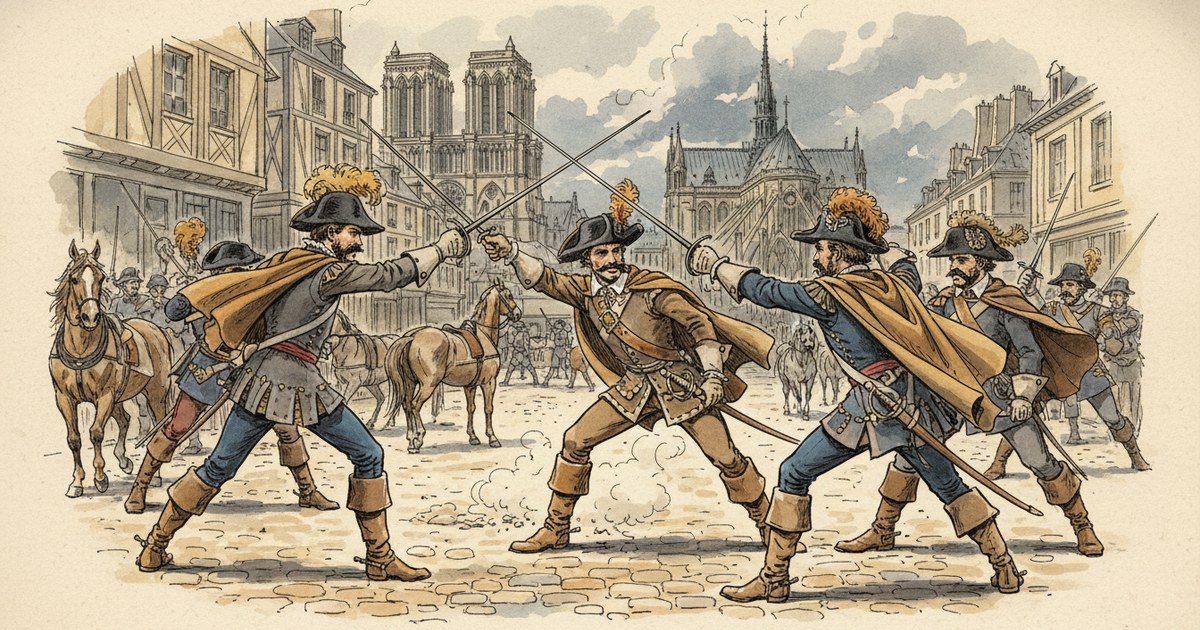
In the opening chapters of The Three Musketeers, d’Artagnan manages, in the span of a single afternoon, to schedule three separate duels with three men he has never met. He bumps into Athos, apologizes badly, and is challenged. He steps on Porthos’s bandolier, offends him, and is challenged again. He laughs at Aramis’s letter, insults his dignity, and is challenged a third time. He then discovers, standing in the dueling ground at dusk, that all three of his opponents are friends—and that he is supposed to fight them one after another. He is eighteen, alone in Paris, and has almost no money. He grins.
That grin is the engine of this novel. Alexandre Dumas wrote The Three Musketeers in 1844 as a serial for Le Siècle, releasing it in weekly installments to a readership that could not get enough. What he understood, with an instinct that bordered on genius, was that readers do not primarily want plot. They want fellowship. They want to be in the room when men who are genuinely good at what they do decide to act together against something larger than themselves. Every sword fight, every midnight ride, every improvised disguise in this book is secondary to the central fact: these four men choose each other, and that choice holds.
The thesis of The Three Musketeers is not that loyalty is noble. It is that loyalty, when it is real and tested and costly, is the only thing that makes any of the rest of it bearable. Dumas argues this through accumulation—scene after scene in which d’Artagnan could walk away, in which any reasonable man would walk away, and does not. The novel earns its famous motto. “All for one and one for all” is not a slogan in this book. It is the outcome of two hundred pages of proof.
The Man Who Arrived in Paris With Nothing and Built Everything
Dumas did not invent d’Artagnan. He became him. In 1822, at twenty years old, Alexandre Dumas arrived in Paris from the provinces with fifty-three francs in his pocket, a letter of introduction he was not sure would be honored, and an absolutely unreasonable confidence in his own abilities. He had taught himself to read from his father’s military dispatches after the general died young, leaving the family in debt and the boy without much formal schooling. Within a decade Dumas was the most famous playwright in France. Within two decades he was the most read novelist in the world. The arc of d’Artagnan’s first year in Paris is not a romance. It is a memoir in disguise.
His father’s story mattered to the book in ways Dumas never stated directly. General Thomas-Alexandre Dumas was the son of a French nobleman and an enslaved woman in Saint-Domingue. He rose to become one of Napoleon’s most celebrated commanders, then fell out of favor, was captured, and died of a slow poisoning in 1806 when Alexandre was four. The boy grew up knowing that his father had been brilliant, loyal, and expendable—that the men in power would use a great soldier and then discard him when he became inconvenient. Cardinal Richelieu in The Three Musketeers is not merely a villain. He is the system that rewards genius only until it becomes a threat. The musketeers survive him not by being stronger but by being ungovernable—by owing their allegiance to each other rather than to any institution that could revoke it.
By the time Dumas wrote The Three Musketeers, he had earned and lost several fortunes. He built the Château de Monte-Cristo, threw open its doors to anyone interesting, and watched it drain him. He wrote with collaborators, most prominently Auguste Maquet, who helped research and structure the historical scaffolding while Dumas supplied the velocity and the voice. Critics used this against him. What they missed was that Dumas’s actual skill was not research—it was pace. He knew exactly how long a scene should breathe before the door opens and everything changes. That instinct is everywhere in The Three Musketeers, and it is his alone.
What the Book Actually Does
The Three Musketeers is set in 1625, the reign of Louis XIII, and the central plot—retrieve the queen’s diamond studs from London before the Cardinal can expose her indiscretion—is almost beside the point. What matters is the machinery Dumas builds around it: the speed at which trust forms between strangers, the way competence recognizes competence, the specific texture of men who are very good at violence but choose, most of the time, not to use it. The book moves like a well-ridden horse. You feel the rhythm before you understand where you’re going.
Milady de Winter arrives in the second half and the novel becomes something else entirely. She is not a plot obstacle. She is a force with her own grievances, her own intelligence, and her own code—and when d’Artagnan encounters her at full power, the cockiness that carried him through the first hundred pages becomes dangerous. Dumas gives her enough that the reader understands her without the book asking you to excuse her. That balance is harder than it looks. Most adventure fiction of this period simply does not manage it.
The scene that earns the most examination is the one readers tend to remember as uncomplicated action: the siege at the Saint-Gervais bastion, where the four musketeers share breakfast under cannon fire to win a bet. Dumas describes the food in careful detail—the wine, the cold chicken, the plates laid out with the enemy approaching—and the effect is not comedy. It is a statement about what these men have decided matters. They have chosen the meal over the cover. They are going to finish it. The reader laughs and understands something real at the same time.
What Dumas knew, and what makes the novel still function after 180 years, is that adventure is not primarily about danger. It is about watching people be excellent together. The duels and the chases and the schemes are the vehicle. The cargo is four men who genuinely enjoy each other’s company, and whose company the reader cannot stop wanting to be in.
The Translation Landscape
The history of The Three Musketeers in English is partly a history of the novel being domesticated into something safer and more decorative than it actually is. The oldest Victorian translations, some dating to the 1840s, captured the incident faithfully enough but ironed out Dumas’s rhythm—the short declarative sentences that follow a long descriptive one like a punch after a feint. They read as though a careful schoolmaster had reviewed them for excess. Robin Buss’s translation for Penguin Classics is considerably better: clear, accurate, and honest about the novel’s darker material. It handles Milady’s storyline without euphemism. If Penguin Classics is what you have, Buss is a sound choice. The weakness is a certain even-handedness that smooths Dumas’s deliberate tonal lurches—the moments where the prose suddenly accelerates or drops into near-silence to signal that something irreversible is about to happen.
Richard Pevear’s translation, published in 2006, brings rigorous attention to the French. Pevear is scrupulous about what Dumas actually wrote rather than what a translator expects Dumas to have meant, and for readers who want fidelity above all else, his version delivers it. The tradeoff is a certain deliberateness of pace in the dialogue exchanges—places where Dumas’s wit lands as a crack of speed in the French and arrives in Pevear’s English as something a beat slower. Both Buss and Pevear are legitimate choices for readers who want a translation that takes the original seriously. What they offer is accuracy. What they do not always offer is propulsion. The modern English translation available through Classics Retold was built around that specific problem: keeping Dumas’s velocity without softening what the novel is actually doing.
Why This Translation?
The case for this edition rests on a single priority: the book should read at the speed Dumas wrote it. The Three Musketeers was serialized—it was designed to be devoured, to end each installment at the precise moment when stopping felt like an injury. A translation that produces elegant sentences at the cost of momentum is solving for the wrong thing. This modern English edition keeps the sentence structure light where Dumas kept it light, and earns its longer passages the same way the original did—by making the reader feel that the length is necessary, that the scene requires it. The result is a version that new readers finish, which is the first obligation of any translation of a novel that was built to be finished.
The paperback edition is available on Amazon. If you have never read The Three Musketeers—if you know the motto but have not watched d’Artagnan actually become the kind of man who deserves to say it—this is the edition to start with. If you read it years ago in a version that felt slow or stiff, this translation is the reason to go back. The grin is still there on the dueling ground at dusk. Everything it promises, the book delivers.
Is The Three Musketeers appropriate for younger readers?
The novel contains dueling, period-accurate political violence, and a villain whose storyline involves serious harm. Most readers handle it comfortably from around age twelve, but parents should know that Dumas does not sanitize Milady de Winter’s arc. The darkness is part of what makes the loyalty of the four musketeers feel like it costs something.
How accurate is The Three Musketeers to real French history?
The framework is historically grounded: Louis XIII, Cardinal Richelieu, the Duke of Buckingham, and the political tensions between France and England are all real. Dumas borrowed the character of d’Artagnan from a seventeenth-century memoir. But he was writing popular serial fiction in 1844, not historiography, and he adjusted timelines, invented incidents, and sharpened historical figures into types. The history is scaffolding. The novel is what Dumas built on top of it.
Do I need to read The Three Musketeers before Twenty Years After or The Vicomte de Bragelonne?
Yes. The Three Musketeers establishes who these men are and what they owe each other. The sequels—particularly Twenty Years After, which is nearly as good—depend entirely on the reader carrying that history forward. The emotional weight of seeing these characters older, more divided, and facing a world that no longer fits them only lands if you have watched them choose each other when they were young.
What makes this translation different from the free public domain versions available online?
The free versions circulating online are almost universally the Victorian-era translations, most from the 1840s through 1890s. They are in the public domain because they are old, not because they are good. Many use archaic diction, restructure Dumas’s sentences for Victorian taste, and handle the novel’s sharper material with period-appropriate evasion. This modern English translation was made specifically for contemporary readers—same story, same fidelity to the original French, built to move the way Dumas intended it to move.
Also worth reading

Leave a Reply