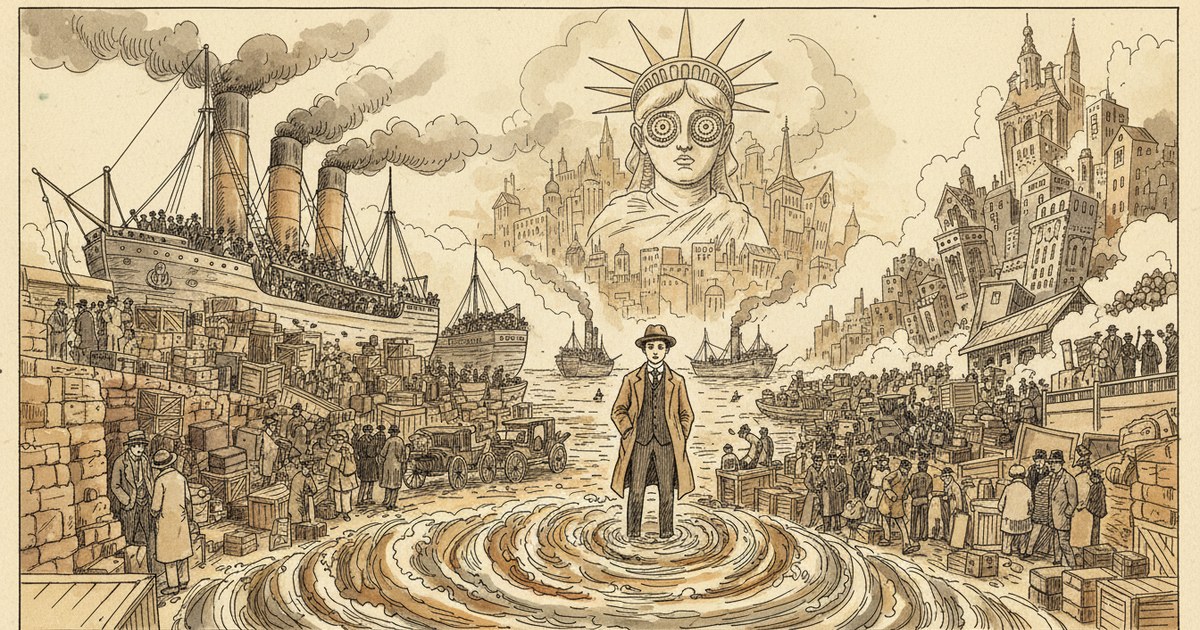
In the first paragraph of Amerika, the Statue of Liberty is holding a sword. Not a torch — a sword. Kafka knew the statue held a torch. He had seen photographs. He made the change deliberately, and Max Brod, who edited the manuscript after Kafka’s death, noted it without correcting it. That detail — the sword where the torch should be — is the entire novel condensed into a single image: America as a place that promises liberation and delivers something sharper.
Karl Rossmann is sixteen years old. He has been sent from Prague to New York in disgrace after a servant girl seduced him and bore his child. His family’s solution was deportation. He arrives in the harbor with almost nothing, goes below deck to retrieve a forgotten umbrella, and immediately gets lost in the corridors of the ship. He hasn’t touched American soil and he is already trapped in a maze not of his making. The rules of the ship’s lower decks are obscure to him. He learns them by breaking them. This is Kafka’s America: a system whose regulations you discover only at the moment of violation.
The thesis running through this novel — left unfinished, unpublished in Kafka’s lifetime, reconstructed from fragments by Brod — is that meritocracy is the cruelest myth a society can sell to its newcomers. Karl Rossmann is not Gregor Samsa. He hasn’t been transformed into anything monstrous. He is simply young, poor, foreign, and without leverage, which in America, Kafka argues, is transformation enough. The novel’s real subject is not a continent. It is the machinery of arbitrary power dressed in the language of fairness.
The Man Who Read About a Country He Never Visited
Kafka never went to America. He never left Central Europe in any meaningful sense — a few trips to Paris, a sanatorium in Italy toward the end of his life, the recurring dream of escape that never quite materialized. What he had instead was a shelf of books about the place and an imagination trained by years of working as an insurance claims officer in Prague, processing the applications of factory workers who had been injured in industrial accidents and were trying to extract compensation from a system designed, through procedural refinement, to deny them.
That job is where the novel lives. Kafka spent his working days watching people who were objectively owed something — money, recognition, remedy — navigate bureaucratic machinery that acknowledged their existence, logged their paperwork, assigned their cases numbers, and then, through a process of technical objection and procedural delay, gave them nothing. He was not cruel. He was a conscientious officer who understood that the machine was not malicious — it was indifferent, and indifference at scale produces the same result as malice. Karl Rossmann doesn’t encounter villains in Amerika. He encounters structures that are perfectly polite about destroying him.
For source material Kafka read Arthur Holitscher’s travel account Amerika: Today and Tomorrow, published in 1912, and Benjamin Franklin’s Autobiography. From Holitscher he took the physical texture — the hotels, the road networks, the disorienting scale of the cities. From Franklin he took the myth: the self-made man, the immigrant who arrives with nothing and earns everything through industry and virtue. Kafka read the Franklin myth not as inspiration but as mechanism. If the logic holds that anyone can rise through merit, then failure is always the failure of the individual. Karl Rossmann is not at fault. He is simply outmaneuvered, at every turn, by people who understand the rules and have no reason to explain them.
Kafka started writing what he called simply “The Stoker” — the first chapter — in 1911. He read it aloud to his friends. They laughed. It was funnier than anything he had written before, quicker, less airless than the pieces that would become The Trial and The Castle. He kept writing through 1912 and then stopped, as he stopped with nearly everything, because the ending he could see — a chapter set in the Nature Theatre of Oklahoma, a vast enterprise promising a place for everyone who comes — felt true to the book’s logic but impossible to finish. Max Brod published the manuscript after Kafka’s death in 1927 under the title Amerika, which Kafka had not chosen. A later scholarly edition restored the title from the manuscript itself: Der Verschollene — The Man Who Disappeared.
What the Book Does That The Trial Doesn’t
The Trial is suffocation from the first page. Amerika is something stranger — it moves, it breathes, it is almost picaresque. Karl Rossmann travels. He meets people. He finds work, loses it, finds different work, loses that too. There is a screw-tightening quality to Josef K.’s story that Amerika deliberately refuses: each time Karl falls, the novel offers a ledge, a kindness, a new beginning. Kafka lets you believe in recovery just long enough to make the next collapse feel like your own failure of imagination.
The stoker chapter, which Kafka published separately and considered his best single piece of prose, is the argument in miniature. Karl befriends a stoker in the ship’s engine room — a man who believes he has been wronged by his superior, a Romanian named Schubal — and helps him bring the grievance before the ship’s captain. A hearing is convened. Witnesses are called. Karl’s own uncle, wealthy, American, whom he didn’t know existed, appears among the spectators. The stoker argues his case with passionate conviction and some evidence. And then, almost without anyone deciding anything, the room’s attention drifts. The captain moves on. The uncle approaches Karl. The stoker’s case simply stops being heard. No verdict. No adjournment. The ship docks. The stoker vanishes from the novel permanently. That is all Kafka needs to say about justice.
What Kafka understood about power is that it rarely says no outright. It just stops listening. The novel is structured around this: characters who are enormously verbose about their authority and their fairness and their reasonableness, and who, at the decisive moment, simply do something else. Karl’s uncle takes him in, establishes clear rules for his stay, and one evening — because Karl was a guest at a party he’d been told to avoid, and stayed past midnight — writes him a letter of expulsion. The letter is warm. It is meticulous. It is absolute. The uncle does not shout or threaten. He closes the door and that is the end of Karl’s life in New York.
There is a housekeeper named Brunelda who appears late in the surviving manuscript and dominates every scene she occupies — enormous, exhausted, imperious, unable to stand without assistance. She is helplessness as power: she needs constant attendance and exerts complete control over the two men who provide it. In her Kafka managed something almost impossible, a figure who is simultaneously victim of her own condition and tyrant within her immediate sphere. She is too specific, too grotesquely physical, too uncomfortable to laugh at cleanly, to be reduced to what she represents. She is simply there, needing everything, giving nothing, impossible to leave.
The Translation Landscape
Kafka wrote in German that is precise, formal, and deliberately flat. That flatness is load-bearing. It creates the gap between the events — which are often appalling — and the bureaucratic register in which they are recorded, and it is that gap where the novel’s particular dread lives. A translation that allows the prose to become expressive, to inflect toward the emotional tone the reader might expect, collapses the gap and with it the effect. Getting the flatness right without making the English feel inert is the central problem for any translator of this novel.
The Edwin and Willa Muir translation, published in 1938, was the first English version and remained standard for decades. It is dated now — their Amerika reads as a period piece, the prose occasionally ornate in ways that work against Kafka’s particular blankness, the diction carrying a slight mustiness that wasn’t a problem in 1938 and increasingly is now. It remains historically important and is largely unavoidable in the scholarship, but it is hard to recommend over later versions for a first reading. Michael Hofmann’s translation, published by Penguin under the title The Man Who Disappeared, is the benchmark of the modern English versions. Hofmann is a poet as well as a translator, and his ear for cadence is exact. He makes Kafka sound contemporary without making him sound casual — a genuinely difficult achievement. Where Hofmann occasionally smooths a compound sentence that Kafka left deliberately ungainly, Mark Harman’s translation for Schocken — Amerika: The Missing Person — preserves the friction. Harman is more literal in approach, scrupulous about Kafka’s tendency toward what feels like legal precision in syntax. The choice between Hofmann and Harman is a legitimate one depending on whether you want the more musical or the more exacting version of the same novel.
Why This Translation?
This translation, the edition Classics Retold has selected, addresses that central problem of flatness by keeping the prose plain at the sentence level while building rhythm across paragraphs, so that the cumulative weight of Karl’s reversals arrives with more force than any single sentence could carry. The scene where Karl is fired from the Hotel Occidental — publicly, before the assembled staff, accused in front of everyone of a violation he barely understands — is handled without italics, without a swelling of the prose toward the tragic. The translation simply records what happens, in the order it happens, and the restraint is exactly right. When the prose doesn’t tell you how to feel, you feel it more.
This edition is available in paperback here. If you have read The Trial and think you know what Kafka sounds like, Amerika will revise that. It is funnier, faster, and stranger in its unfinishedness — the Oklahoma chapters have a quality almost of improvisation, a last-reel brightness, and because Kafka never wrote past them the novel ends not in darkness but in suspension, which may be worse. Start with the stoker. Pay attention to the moment the room stops listening, because it happens so quickly, and so politely, that you might miss it — which is precisely what Kafka intended.
Frequently Asked Questions
What kind of reader should start with Kafka Never Saw America. He Understood It.?
Readers interested in Franz Kafka and strong literary stakes will find Kafka Never Saw America. He Understood It. a good entry point because it combines narrative momentum with a clear thematic payoff.
Is Kafka Never Saw America. He Understood It. difficult to read today?
Not especially. The challenge is usually tone and context, not plot. A modern translation helps the book feel immediate without flattening its historical texture.
Why choose this translation of Kafka Never Saw America. He Understood It.?
The best reason is clarity without loss of character. A strong translation preserves the author’s pressure, rhythm, and emotional temperature while removing needless stiffness.
What should readers notice most in Kafka Never Saw America. He Understood It.?
Pay attention to how the book builds its tension through scene, voice, and moral pressure rather than summary. That is usually where the work still feels most alive.



Leave a Reply