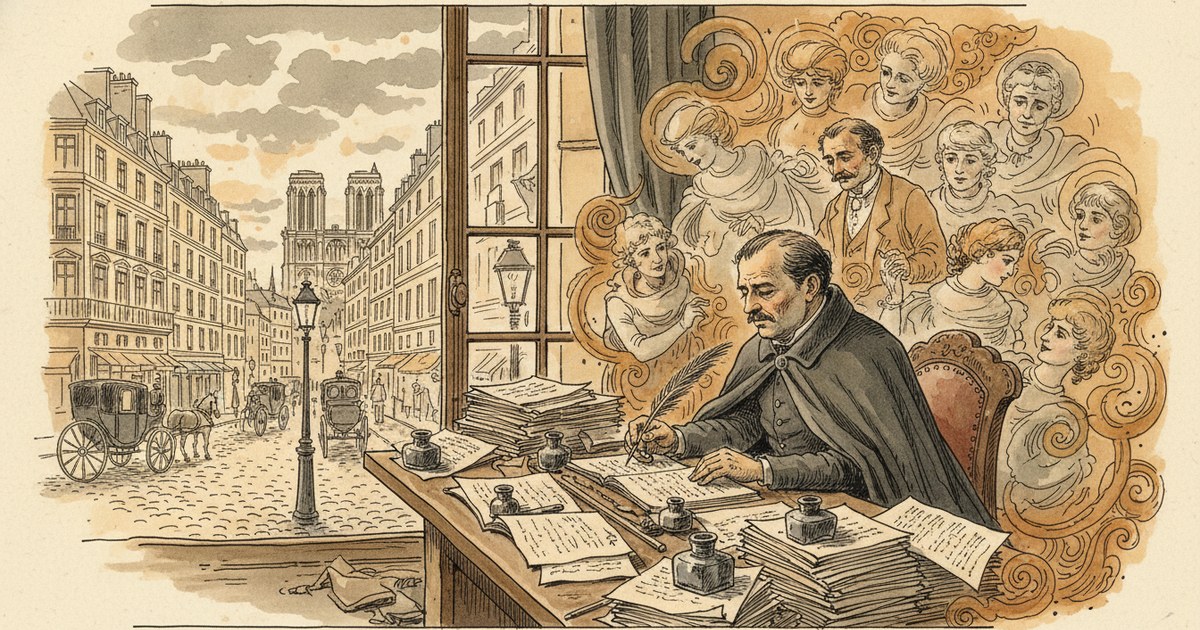
Balzac wrote at night, in a monk’s robe, at a desk covered in manuscript pages and empty coffee cups. He slept four hours. He wrote fifteen. He kept himself upright on coffee — fifty cups a day by some accounts — and when his body gave out in August 1850, he was fifty-one years old, his heart badly enlarged, his legs so swollen he could barely walk. He had spent thirty years running from creditors, reinventing himself in print, promising Ewelina Hańska in Ukraine a Paris house worthy of a countess, all of it funded by the next manuscript and the one after that. He died two months after he finally married her. He had just moved into the house.
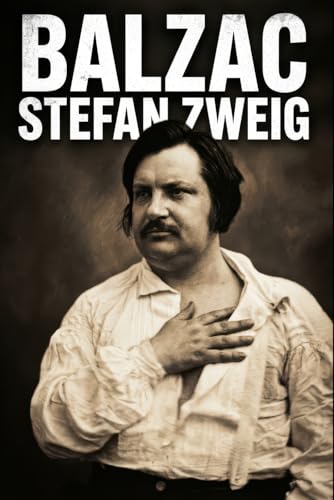
Stefan Zweig opens his biography here: not with the childhood in Tours, not with the failed law apprenticeship, but with the engine. The obsession first. By the time you are two pages in, it is clear that Zweig is not writing a conventional literary life. He is trying to explain what it costs to become Balzac — and what it costs to be the kind of writer who cannot stop. That these questions were not abstract for Zweig makes the book something more than biography. It makes it a document of self-recognition, written by a man who was looking into a mirror he did not entirely want to see.
Zweig finished this manuscript in late 1941, in Petrópolis, Brazil, having fled Austria, then London, then New York. On February 22, 1942, he and his wife Lotte took their lives together. The biography was published in German in 1946, edited posthumously by Richard Friedenthal. The fact that Zweig did not survive to see it in print is not a piece of sad context — it is the frame through which every sentence about Balzac’s self-destruction must be read.
The Biographer Who Recognized the Disease
Zweig was born in Vienna in 1881, the son of a wealthy Jewish textile manufacturer, which gave him the financial independence to become exactly the kind of European cosmopolitan that the twentieth century was designed to destroy. He built one of the finest private libraries in Austria, traveled compulsively, corresponded with Freud and Romain Rolland and Richard Strauss, and by the 1920s was among the most widely translated writers in the German language. His novellas — Chess Story, The Post-Office Girl, Beware of Pity — are models of psychological compression. His biographies are something else: long, architectured arguments about how exceptional people are consumed by their own natures or by history.
His subjects form a typology. Fouché, the survivor, who bent with every political wind and outlasted everyone. Mary Queen of Scots, the romantic, destroyed by a character she could not moderate. Erasmus, the humanist, crushed between Luther and Rome because he refused to choose a side. In each case Zweig is interested in the relationship between a person’s defining quality and their undoing — how the thing that made them remarkable also made them fragile. Balzac fits this pattern, but he is the fullest version of it, because Balzac’s defining quality was creative will so extreme it read as pathology.
The biographical detail that unlocks Zweig’s angle: he began serious work on this book after being forced out of Austria in 1934. Everything that follows was written in exile — the chapters on Balzac’s Paris composed in cities Zweig was only passing through. A man writing about a man who never left Paris, who turned even his debts into fictional material, who died in the apartment he had fantasized about for two decades. There is something in the distance between Zweig’s displacement and Balzac’s furious rootedness that sharpens every observation into argument.
Zweig understood obsession from the inside. He wrote the Balzac biography the way Balzac wrote novels: fast, driven, against the clock. By 1941, Zweig had watched everything he had built — the Vienna library, the European network of writers and artists, the idea of a cosmopolitan civilization that transcended national borders — vanish completely. Balzac had spent his life running from creditors. Zweig spent his last years running from something larger. The biography is, quietly, a meditation on what you do when the thing you’ve been outrunning finally catches you.
Nearly a Hundred Novels, All of Them Overdue
Zweig’s central argument is that La Comédie humaine — nearly a hundred novels and stories, more than two thousand named characters, an entire society rendered in systematic detail — cannot be explained by talent alone. What produced it was a specific, unrepeatable combination of ambition, debt, and a constitution that could sustain punishment no sane person would voluntarily accept. Balzac did not write in spite of his financial chaos; he wrote because of it. The creditors provided the pressure. Without the pressure, there might not have been the books.
Zweig is specific about the mechanism, and this specificity is what separates the biography from hagiography. Balzac would draft a novel quickly, send a rough manuscript to the printer, receive proofs, and then rewrite — not corrections, but wholesale reconceptions, in the margins. Publishers charged him for each round of typesetting. He went through seven or eight proof cycles on some books. The costs compounded the debts. The debts demanded more books. It was not a sustainable system; it was a permanent emergency that he had learned to live inside. Zweig traces this not with pity but with something closer to awe and alarm in equal measure.
The book’s strongest passages are on what Zweig calls Balzac’s “double life”: the public figure who projected wealth and success he did not have — the extravagant dinners, the planned silver mines, the Sardinian estate that existed only in prospectuses — and the nocturnal writer who actually funded it. Every promise Balzac made to Ewelina Hańska across eighteen years of correspondence, every guarantee of a Paris house and a life commensurate with her title, was underwritten by manuscripts. By books he had not yet written. By coffee and four hours of sleep.
Zweig does not editorialize about this excessively. He lays it out, piece by piece, and lets the accumulation do the work. By the time he reaches Balzac’s final years — the house finally purchased, Ewelina finally arrived, Balzac too ill to enjoy any of it — the reader has been made to understand the mechanism so thoroughly that the ending feels not like tragedy but like physics. This is what Zweig does best: he makes the outcome feel inevitable without making it feel dismissible.
The Translation Landscape
Zweig’s Balzac has had a difficult English-language history. Published posthumously in German in 1946, it appeared in an English translation shortly afterward, but that edition went out of print and spent decades as a library curiosity — well-regarded among Zweig scholars, essentially unavailable to general readers. For most of the late twentieth century, if you wanted to read it in English, you hunted for a copy. That inaccessibility kept the book marginal in Anglophone literary culture in a way that distorted Zweig’s reputation: the novellas stayed in print, the biographies mostly didn’t, and readers who knew Chess Story often had no idea this book existed.
The older English translation, where findable, is serviceable but dated in its rhythms. Zweig’s German prose has a particular architecture — long sentences that build analytical momentum through subordinate clauses, then break into short declarative statements when he wants to land a point. The structure is not ornamental; it is argumentative. Translations that break his longer sentences into shorter ones to read more smoothly in English lose the pressure those sentences are designed to create. A passage in an earlier translation describing Balzac’s proof-correction method reads as biographical summary. In this new translation, the same passage reads as diagnosis. The difference is in how the sentence is allowed to accumulate before it resolves.
Readers who know Zweig through the Pushkin Press editions — the novellas, or the Fouché biography, or the memoir The World of Yesterday — will find this translation consistent with that contemporary approach to his prose: the sentences are given their length, the register stays elevated without becoming stiff, and the moments of sudden directness are not smoothed over. The translation does not try to make Zweig sound like a contemporary writer. It makes him sound like himself.
Why This Translation?
The argument for this edition is not only that it restores an unavailable book to print, though that matters in itself. The argument is that it translates Zweig’s prose in a way that serves his actual purpose, which is to make Balzac’s creative self-destruction comprehensible as a lived system rather than a colorful anecdote. That requires the sentences to work the way Zweig built them. When they do, the biography stops being a historical curiosity and becomes what it was always meant to be: a serious account of what extreme ambition looks like from the inside, written by someone with first-hand knowledge of the subject.
the edition linked below is available in paperback here. If you have read the novellas and want to see what Zweig could do at full length, this is the answer. If you have read Balzac and want to understand how it was possible, this is also the answer. But the reason to read it — the reason it stays with you — is simpler than either of those: Zweig finished writing about a man who worked himself to death, put down his pen, and did not survive to see the book published. That fact does not explain the biography. It completes it.
Frequently Asked Questions
What kind of reader should start with Balzac Wrote Himself to Death?
Readers interested in Stefan Zweig and strong literary stakes will find Balzac Wrote Himself to Death a good entry point because it combines narrative momentum with a clear thematic payoff.
Is Balzac Wrote Himself to Death difficult to read today?
Not especially. The challenge is usually tone and context, not plot. A modern translation helps the book feel immediate without flattening its historical texture.
Why choose this translation of Balzac Wrote Himself to Death?
The best reason is clarity without loss of character. A strong translation preserves the author’s pressure, rhythm, and emotional temperature while removing needless stiffness.
What should readers notice most in Balzac Wrote Himself to Death?
Pay attention to how the book builds its tension through scene, voice, and moral pressure rather than summary. That is usually where the work still feels most alive.


Leave a Reply