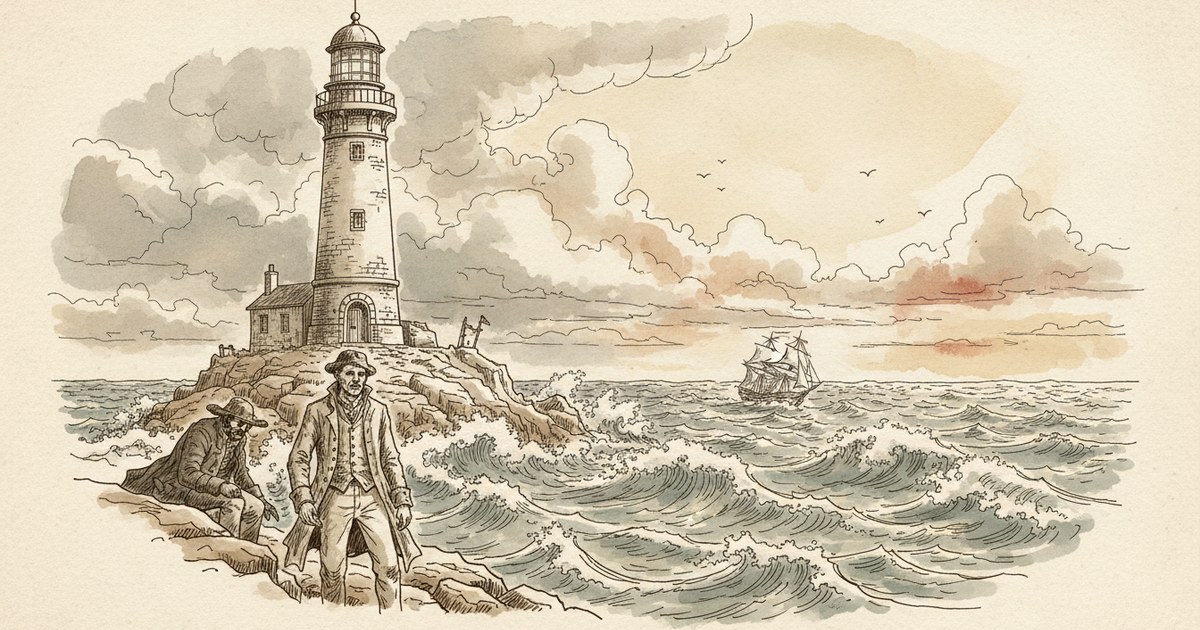
Three men are already alone when the trouble starts. They have been dropped on a bare island off Cape Horn to keep a light burning for ships pushing through one of the worst passages on earth. The station is new. The work is simple in theory: tend the lantern, watch the sea, endure the wind. But Verne does not treat isolation as a noble test of character. He treats it as a condition predators know how to exploit.
That is the first thing The Lighthouse at the End of the World corrects for readers who still think of Jules Verne as the cheerful engineer of impossible journeys. This is not the Verne of ingenious contraptions and buoyant discovery. This is a late Verne novel stripped to rock, weather, greed, and fear. Its power comes from how little romance it allows the setting. The island is not sublime scenery. It is a workplace at the edge of the map, and once violence enters it, the book becomes a study in how thin civilization looks when there is no audience to perform it for.
The bandits who come ashore are not calculating strategists. They are opportunists who recognize an advantage and press it. Verne gives them no ideology and no grievance — only appetite, and the cover of geography. Against them, one surviving lighthouse keeper named Vasquez must decide whether keeping the light burning is worth the exposure it costs him. That tension — visibility as both duty and danger — turns the novel from a survival story into something close to an argument about what infrastructure requires of the individuals who maintain it.
The Novelist of Progress, Minus the Comfort
Verne grew up in Nantes, within earshot of the Loire estuary, watching ships work their way out toward the Atlantic. His father, a lawyer, intended him for the bar. Verne stayed in Paris and wrote plays instead — and then, eventually, the novels that made him one of the most translated writers in history. That early conflict between institutional expectation and personal conviction runs quietly through all his work. His heroes are people who go where the map says nothing is.
For thirty years, the going was cheerful. His publisher Pierre-Jules Hetzel shaped the Voyages Extraordinaires series into optimistic adventure: Journey to the Centre of the Earth, Twenty Thousand Leagues Under the Sea, Around the World in Eighty Days. These are books in love with what technology can open up. Danger arrives, but it arrives inside an architecture of curiosity. The world gets larger. The reader gets to come along.
Then Hetzel died in 1886. That same year, Verne’s nephew Gaston, in the grip of a psychotic episode, shot him in the foot with a pistol. Verne walked with a limp for the rest of his life. The late novels that followed — Propeller Island, Master of the World, The Lighthouse at the End of the World — show a writer no longer interested in machinery as salvation. He was still interested in systems. But now he wanted to show what happens when systems are turned against the people they were built to protect. The biographical fact is not incidental: a man who spent decades writing about the transformative power of modern infrastructure, then watched a member of his own family use a pistol on him at close range, had earned the right to be less sanguine about progress.
The Lighthouse was published in 1905, the year Verne died at seventy-seven. Scholars have debated how much of the final text was revised by his son Michel, but the novel’s cold tone reads as Verne’s own: he had spent forty years cataloguing the technologies that bind civilization together, and spent his last decade examining what it looks like when those technologies are simply extinguished. The lighthouse is the purest expression of that reversal. Instead of a machine conquering nature, here is a machine that someone wants dark — because a dark passage means wrecked ships, and wrecked ships mean salvage rights. The light is civilization’s claim on chaos. The bandits’ goal is to put it out.
A Room You Cannot Leave and a Light You Cannot Let Die
The novel’s structure is spare to the point of austerity. Three keepers arrive. Two die early. Vasquez — the one who survives — spends most of the book hiding on an island occupied by men who would kill him if they knew he was there. The plot is almost geometrically simple: one man, one duty, one mortal obstacle. What prevents it from reading as adventure-story mechanics is Verne’s insistence on the physical weight of everything. The cold is not atmospheric. The fog is not mood-setting. They are operational problems Vasquez has to solve if the light is going to burn at all.
There is a sequence midway through the novel where Vasquez must reach the lighthouse tower without being seen. Verne gives you the approach in granular detail — the angle of approach, the timing, the cover provided by a specific rock formation, the sound the door makes. None of it is thrilling in the conventional sense. It is methodical, almost procedural, and that procedural quality is exactly the point. Keeping a light burning for strangers at sea is not romantic when you are the one doing it in the dark with armed men hunting you. Verne makes you feel the cost of what routine maintenance requires when the routine has been destroyed.
What lifts the novel above a siege narrative is the question it refuses to answer directly: why does Vasquez keep doing it? He is not being watched. He has no way to call for help. He could go dark and survive. Verne never gives him a speech about duty. He just keeps showing Vasquez moving toward the light — calculating his exposure, paying the cost, repeating the act. The argument is made entirely through action, and it lands harder for that restraint. The reader supplies the meaning because Verne refuses to.
The bandits, for their part, are not villains the way Verne usually draws villains. They have no diabolical scheme. They want to wreck ships and strip the cargo. They are efficient and amoral and almost boring in their purposefulness. That boredom is the point. Verne understood that ordinary greed, given enough geographic cover, does not need to be dramatic to be devastating. The island provides the cover. The rest follows automatically.
The Translation Landscape
Most English readers who have encountered The Lighthouse at the End of the World have done so through one of the early public-domain versions produced in the years immediately following Verne’s death — translations from Sampson Low or Arco that prioritized fidelity to plot over any attention to Verne’s prose rhythm. These versions are serviceable as story delivery systems. As reading experiences, they flatten the novel’s austerity into something merely plain. Verne’s sentences in the original French are short, load-bearing, and deliberate; the early English versions tend toward the bureaucratic, and the cumulative effect is a book that feels less taut than it actually is. The tension Verne built into his pacing simply does not survive the transfer.
More recent scholarly translations — including the critically annotated editions produced for the Wesleyan University Press Verne series, which has worked to recover the serious literary Verne from beneath decades of adventure-fiction marketing — treat the prose more carefully and restore some of the compression Verne intended. These editions are valuable for readers who want footnotes and critical apparatus alongside the text. What they sometimes trade away is forward momentum; annotation creates pauses that a novel this spare cannot always absorb. the edition linked below aims at different territory: a reading experience that feels immediate and unobstructed, where the sentence does its work without announcing itself. A passage like Vasquez timing his approach to the lantern room reads in this translation the way Verne wrote it — as a clock ticking, not a description of a clock ticking.
Why This Translation?
The case for the edition linked below comes down to register. Verne wrote The Lighthouse at the End of the World in plain, controlled French — not elevated prose, not literary performance, but the language of a man who had spent decades writing about practical problems and practical solutions. A translation that reaches for elegance misses the point. This translation does not reach for elegance. It reaches for clarity, and in a novel where the drama lives in logistics and physical detail — the angle of a rock face, the timing of a door, the weight of wind against a man trying not to be seen — that is exactly the right call. The sentences land with the weight Verne intended.
The edition is available in paperback and priced for readers rather than collectors. If you have been meaning to encounter the late Verne — the Verne after the optimism ran out, after the foot injury and the dead publisher and the long reckoning with what progress actually costs — this is a clean, unadorned way in. The paperback edition is available here. The book is short enough to read in an afternoon and dense enough to stay with you considerably longer than that.
Is The Lighthouse at the End of the World a children’s book?
Not in any meaningful sense. Verne is routinely shelved with adventure fiction for young readers because of his early novels, but this late novel is grim and spare. Two of the three lighthouse keepers die in the opening section. The violence is not graphic, but it is not softened either. Adult readers who come to it expecting the buoyancy of Around the World in Eighty Days will find something considerably darker and more unforgiving.
How does this book compare to Verne’s more famous novels?
Twenty Thousand Leagues Under the Sea and Around the World in Eighty Days are novels of expansion — the world getting larger, systems working more or less as intended. The Lighthouse at the End of the World runs in the opposite direction: a single man, a single duty, a shrinking perimeter. It is closer in feeling to a siege novel than to anything Verne wrote in his prime. Readers who know only the famous works should treat this as a companion piece to them — the same obsession with infrastructure and modern systems, but stripped of every reassurance.
Is the translation faithful to the original French?
This translation works directly from Verne’s French text, preserving the structure and pacing of the original. The aim throughout is readable English that carries the weight of the source material — not a paraphrase, not a literary re-imagining, but a translation that trusts Verne’s prose to do its own work once it crosses the language boundary.
Where is the novel set, and does the location matter?
The novel is set on Isla de los Estados — Staten Island in English, a real island at the southeastern tip of South America, east of Tierra del Fuego. The Argentine government built a lighthouse there in 1884, the year before Verne began writing. The geographical specificity is load-bearing: this is not a symbolic nowhere. The island is real, the passage is real, and the danger ships faced rounding Cape Horn was real and ongoing. Verne was writing about an actual problem that actual infrastructure was built to solve — which is precisely what gives the novel its particular, unromantic weight.
Also worth reading

Leave a Reply