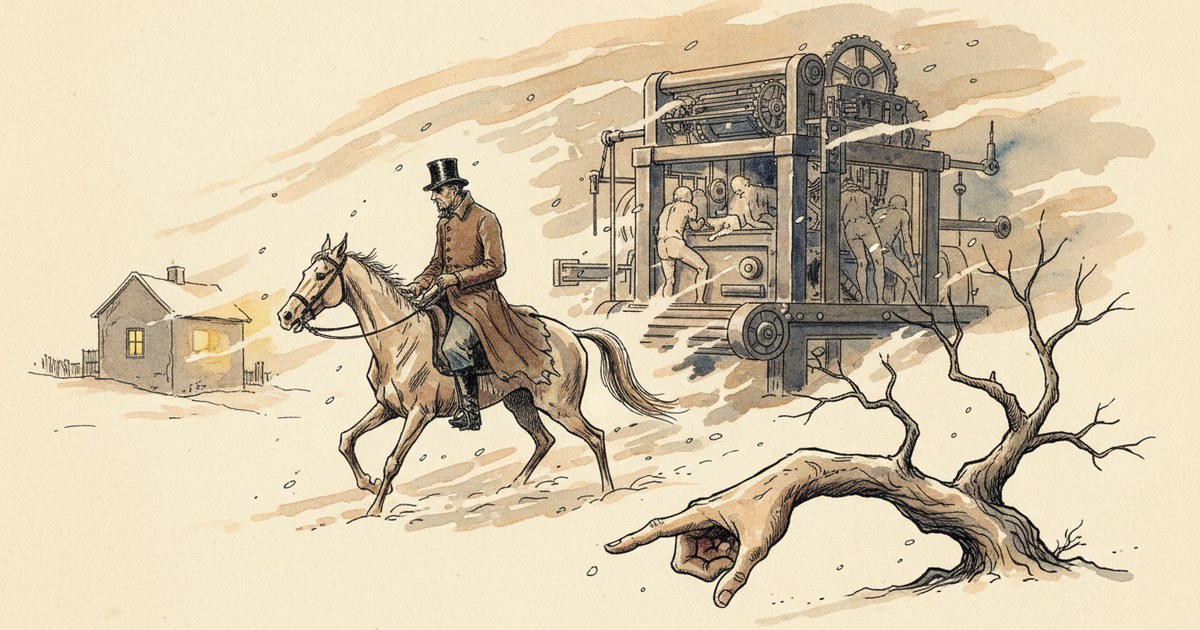
The condemned man in Kafka’s “In the Penal Colony” doesn’t know what crime he committed. The officer operating the execution machine — a baroque contraption of needles, gears, and reciprocating harrows — explains this calmly, as though it were a design feature rather than an oversight. “He would have learned it on his body.” The machine is built to inscribe the violated law into flesh over twelve hours, the condemned man finally reading his sentence through the wounds. This is Kafka’s system in its purest form: not that justice is blind, but that it sees in a direction you cannot follow.
Three stories anchor this collection — “In the Penal Colony,” “The Judgment,” and “A Country Doctor” — and each runs the same mechanism. Authority asserts itself. The subject engages. The punishment lands before anyone has named the crime. In “The Judgment,” Georg Bendemann’s father sentences him to death by drowning, and Georg — a grown man, an engaged man, a man who has been running his father’s business — goes and does it. No trial. No resistance. Just a sprint to the bridge. What Kafka understood, more clearly than almost any writer of the twentieth century, is that systems of power don’t require your cooperation to destroy you. They only require your belief that they are legitimate.
This translation brings these three stories together in a modern English rendering that strips away the fustian elegance earlier versions mistook for Kafka’s register. His prose is not ornate. It is precise and flat, and the flatness is load-bearing — it is exactly where the horror lives.
The Insurance Clerk Who Wrote His Nightmares Down
Kafka spent his working days at the Workers’ Accident Insurance Institute in Prague, processing claims from men who had lost fingers in unguarded threshing machines, hands in sawmills, eyes in foundries. He was good at it — promoted, respected, productive. He came home and wrote stories about men destroyed by mechanisms they could neither name nor refuse. This is not coincidence. The bureaucratic machinery in his fiction has the same quality as the paperwork on his desk: exhaustive, self-referential, indifferent to human cost. He didn’t import that quality from a library. He watched it function every morning.
His father, Hermann, was a self-made merchant who wore his success like body armor and used it as a weapon against his son with reliable consistency. The “Letter to His Father” — which Kafka wrote and never sent — runs to forty-five pages. “The Judgment” compresses the same material into seventeen pages and a death sentence. When the father rises from his sickbed to pronounce Georg condemned, the scene works not because it is surreal but because it is emotionally exact. That sudden reversal — the invalid transformed into judge — is what living under certain kinds of fathers feels like. The biography doesn’t explain the story so much as the story explains the biography.
He was engaged twice, broke it off both times. He wrote in German, lived his whole life in Prague — then part of the Austro-Hungarian Empire — and spent years producing fiction he mostly refused to publish. He handed the manuscript of “In the Penal Colony” to his publisher in 1919 as if presenting evidence for a crime he hadn’t committed yet. He died of tuberculosis in 1924, at forty, asking Max Brod to burn everything. Brod refused. We are all reading what Kafka didn’t want us to read — which may be the most Kafkaesque fact about Kafka.
The Machine That Writes, The Father Who Sentences, The Doctor Who Cannot Leave
“In the Penal Colony” is the most formally complete and the hardest to read. A traveling explorer arrives to witness an execution. The officer — the machine’s last true believer — explains the apparatus with a collector’s pride: the Bed, where the condemned man is strapped; the Harrow, which cuts; the Designer, which controls what the Harrow writes. The condemned man doesn’t know what he’s being executed for. The officer considers this entirely acceptable: “He would have learned it on his body.” Over the story’s course, the machine’s status shifts from instrument to subject, and the ending — when the mechanism turns on its own priest — is one of the most formally devastating passages in modernist fiction.
“The Judgment” is shorter and more compressed. Georg writes a letter to an old friend in Russia, mentioning his engagement. His father, apparently frail, apparently confused, apparently grateful — suddenly isn’t. The story pivots on a single exchange in the father’s darkened room, and by the time you understand what’s happening, Georg is already at the bridge. Kafka wrote this story in one sitting, from ten in the evening to six in the morning, and noted in his diary that only this way — writing as a complete opening of the body — could a story be made. The urgency is still on the page, intact.
“A Country Doctor” is stranger and more dream-like than either. A doctor is called out in winter, his horse dead. A groom appears from the pigsty with two horses. The doctor goes — he always goes — but the groom stays behind with Rosa, the doctor’s young servant, and what happens next is stated in two plain sentences. The doctor knows. He goes anyway. The story is about what it costs to be responsible, and how responsibility can become a trap that devours the person who accepts it. The doctor ends the story naked, wandering the winter plains on a horse he cannot control: “A false alarm on the night bell, once answered — it cannot be made good, not ever.”
Across all three stories, the mechanism is identical: the moment you engage with the system — by submitting, by showing up, by accepting its premises — you have already lost. This is Kafka’s thesis, and it is precise rather than pessimistic. He is not saying that life is bleak. He is saying that certain structures are engineered so that compliance is the trap.
The Translation Landscape
The Muir translations — Willa and Edwin Muir, working through the 1930s and 1940s — are where most English readers first encounter Kafka, and they are not bad translations. They are translations shaped by their moment: slightly elevated in register, occasionally imprecise, inclined toward a smoothness that rounds off Kafka’s deliberate edges. When a passage should feel clinical and airless, the Muir version can turn elegiac. The fog rolls in where Kafka left a bare room. Their Kafka is readable, sometimes very good, and occasionally wrong in ways that matter to the whole project.
Michael Hofmann’s translations of Kafka’s longer prose — particularly “The Man Who Disappeared” — are notably sharper than the Muir standard: more attentive to German syntax, less inclined to rescue the reader from discomfort Kafka intended. Stanley Corngold’s scholarly work, especially on “The Metamorphosis,” is precise and exhaustively annotated, though the editorial apparatus can make the text feel managed rather than experienced. The Oxford World’s Classics editions offer reliable utility without ever quite committing to an interpretive bet. Each of these approaches takes Kafka’s German seriously; where they diverge is in how much they trust the English reader to tolerate plainness without mistaking it for poverty.
This modern English translation takes a different position. Where earlier versions describe the Harrow in “In the Penal Colony” with terms that carry a faint Gothic warmth, this rendering keeps the clinical register Kafka intended: the officer’s speech sounds like a user manual because Kafka wrote it as one. The horror comes from the precision, not from atmosphere layered on top of it. A translator who reaches for beauty where Kafka chose plainness is not being faithful to the text — they are revising the horror into something more palatable.
Why This Translation?
What distinguishes this edition is its commitment to flatness as an interpretive choice rather than a limitation. Kafka’s German is not lyrical — it is administrative. The sentences move like a filing system: orderly, complete, chilling in their completeness. The condemned man does not feel; he is processed. The doctor does not despair; he reports. Getting that register right in English requires resisting the translator’s instinct to beautify, and this translation resists it consistently enough that the stories land the way they were meant to — as the closest thing Kafka wrote to documentation.
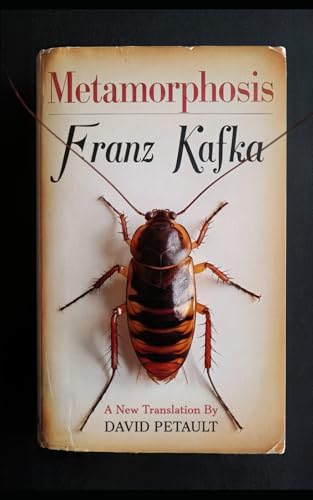
For readers coming to these stories for the first time, this edition is available in paperback and offers the cleanest entry point: no Victorian elevation, no editorial smoothing, no sense that the translator was more interested in the music than the meaning. A bureaucrat who died at forty, who asked for his manuscripts burned, who spent his career processing the damage that machines do to men — he became the defining writer of the century that followed him because he saw something the century couldn’t yet name. The machine is still running. Kafka just left us the blueprints.
Frequently Asked Questions
What kind of reader should start with Kafka’s Justice Works in Reverse?
Readers interested in Franz Kafka and strong literary stakes will find Kafka’s Justice Works in Reverse a good entry point because it combines narrative momentum with a clear thematic payoff.
Is Kafka’s Justice Works in Reverse difficult to read today?
Not especially. The challenge is usually tone and context, not plot. A modern translation helps the book feel immediate without flattening its historical texture.
Why choose this translation of Kafka’s Justice Works in Reverse?
The best reason is clarity without loss of character. A strong translation preserves the author’s pressure, rhythm, and emotional temperature while removing needless stiffness.
What should readers notice most in Kafka’s Justice Works in Reverse?
Pay attention to how the book builds its tension through scene, voice, and moral pressure rather than summary. That is usually where the work still feels most alive.

Leave a Reply