On November 4, 1838, a fifty-five-year-old French diplomat checked into a Paris apartment, ordered his secretary to take dictation, and told everyone else to leave him alone. Fifty-two days later — on December 26, the day after Christmas — he stopped talking. The manuscript of The Charterhouse of Parma was finished. Henri Beyle, who had published novels before without causing much stir, handed the world one of the most admired books in the French language, then went back to being a minor consul in a dusty Italian port town.
The speed is not a curiosity. It is the whole argument of the book made flesh. The Charterhouse of Parma is a novel about what happens when energy, desire, and intelligence are forced to live inside the suffocating machinery of politics and power — and the fifty-two-day composition was Stendhal doing exactly what his hero Fabrice del Dongo never quite manages: moving before the world can stop him. Balzac, who had no shortage of his own genius to protect, read it and declared it “the most significant novel of his time.” Tolstoy read the Waterloo chapters and rewrote his own understanding of war. Hemingway acknowledged the debt. Henry James called it one of the dozen best novels ever written. None of them were being polite.
The thesis is simple and devastating: passion is real; the world is not — or not in the way that romantics need it to be. Fabrice del Dongo spends the entire novel trying to live as though Napoleonic glory is still available, as though love is cleanly accessible to those who want it badly enough. Italy disagrees. The petty court of Parma, the ministerial intrigues, the prison tower above the plain — these are Stendhal’s argument that the machinery of society grinds hardest against precisely those who refuse to become machines themselves.
The Man Who Loved Italy More Than France
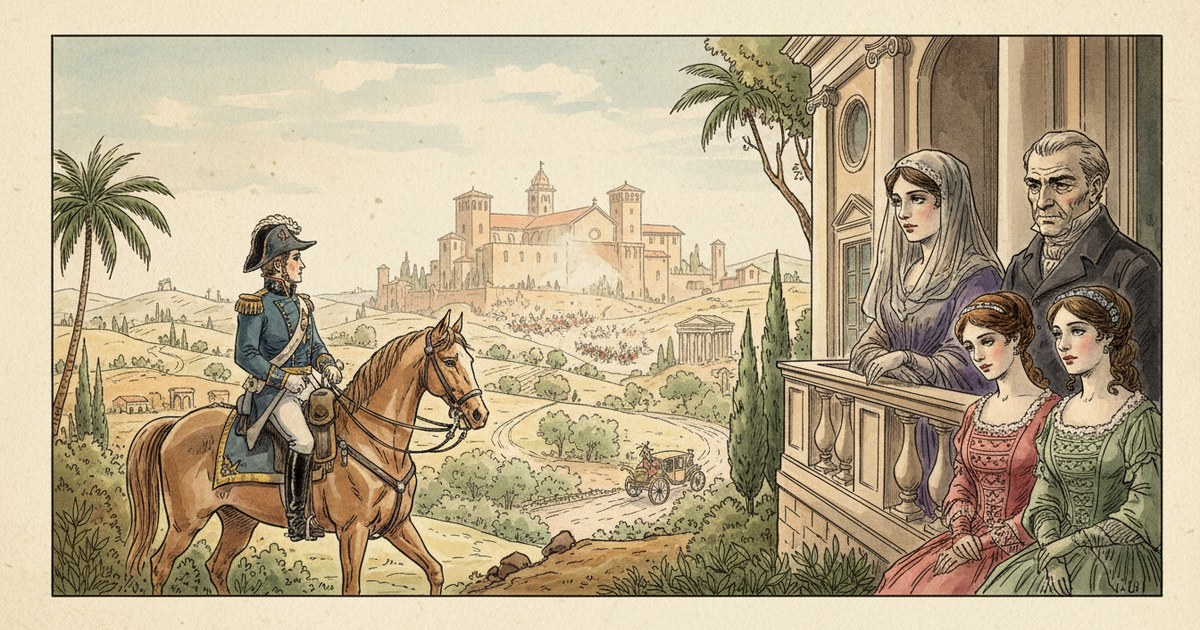
Henri Beyle was born in Grenoble in 1783 and spent the rest of his life in flight from it. As a teenager he joined Napoleon’s Italian campaigns and rode into Milan with the army — experiencing, he later said, the happiest weeks of his existence. The Charterhouse of Parma opens with exactly this moment, in what may be the most exhilarated first chapter in nineteenth-century fiction: French soldiers arriving in a city that embraces them, a population drunk on liberation, music in the streets. That Stendhal lived this scene before he wrote it is not incidental. The joy in those pages is the joy of a real twenty-year-old’s memory, and it sets the novel’s whole register — pleasure is possible, the world can open — before the machinery of Restoration politics closes back in.
He used over 170 pen names across his life, settling on “Stendhal” — borrowed from a German provincial town, for reasons he never explained — for the work that lasted. The disguise was constitutional. He was a Bonapartist and republican surviving in the Restoration, a man of appetite and intelligence employed as a minor bureaucrat, in love serially and unrequitedly. In 1822 he published a theoretical study of romantic passion called De l’Amour, which introduced his concept of crystallization: the process by which a lover coats the beloved in imagined perfection until the real person disappears. It is the operating system of his fiction. Fabrice doesn’t fall in love with Clélia Conti so much as crystallize her — and the novel knows this, and finds it both beautiful and doomed.
By 1838, Beyle was serving as consul in Civitavecchia, a minor Roman port he hated, grinding through customs paperwork while the Italy he loved sat just out of reach. Paris was leave. The Charterhouse was written on leave. That it poured out in fifty-two days says something about what happens when a man finally gets to the page he has been carrying for decades. The novel is not sloppy — it is fluent in the way that only happens when a writer already knows the territory. Stendhal had been living among courts, informers, ministers, and romantic obsessives his entire adult life. He was not inventing a world. He was reporting on it.
He died in 1842, on a Paris street, of a stroke. He had written in his diary: “I am fifty years old. Could it be true? And I am not fifty yet in the life I have lived.” This is the novel’s complaint too. Life keeps happening at the wrong speed, in the wrong register, inside institutions built to exhaust energy rather than honor it.
The Battle Nobody Sees, the Prison Nobody Wants to Leave
Stendhal’s Waterloo sequence is probably the most influential battle description in all of fiction, and it works precisely because it refuses to be a battle description. Fabrice del Dongo, seventeen years old, rides toward Waterloo expecting the epic confrontation of his imagination — the Napoleon of legend, the charge, the moment of historical clarity. What he finds is mud, confusion, a woman selling brandy from a cart, soldiers stealing his horse, an accusation of spying. He hears cannons. He sees men fall. He returns afterward not knowing whether he was actually present at the battle. “Was this a real battle?” he asks. “Was this Waterloo?” Stendhal’s answer is that history happens in fog, that heroism is mostly a story told after the fact, and that the gap between experience and narrative is where the novel lives. Tolstoy read those chapters and drew directly on their technique for War and Peace.
The second great set piece inverts everything. Fabrice, imprisoned in the Farnese Tower on a trumped-up charge, has every reason to despair. Instead he discovers from his cell window a view of Clélia Conti tending her birds in the aviary below. He falls in love across distance and height. The prison becomes, absurdly, the most alive he has ever been — because in the tower there is no court intrigue, no ministerial calculation, no role to play. Only the window, the birds, and Clélia. Stendhal has the nerve to insist that this is not an irony but the truth: constraint can produce freedom if the thing you love is inside the constraint with you. That Fabrice eventually escapes and finds the world outside smaller than his cell is the novel’s most devastating joke.
Around Fabrice, the book builds an entire political ecosystem described with the affectionate contempt of someone who spent years navigating one. Count Mosca — brilliant, pragmatic, self-aware enough to know exactly how compromised he is — loves the Duchess Gina Sanseverina with the helplessness of a man who understands everything except how to stop. Gina, Fabrice’s aunt, loves Fabrice with an intensity the novel declines to fully name. The court of Parma is a miniature of every European government of the period: petty, paranoid, capable of genuine cruelty over nothing. Stendhal doesn’t satirize it. He describes it with precision, and the precision is enough.
The Translation Landscape
English readers have had options since C.K. Scott Moncrieff’s 1925 translation — the same Scott Moncrieff who gave us the standard Proust. His Charterhouse is readable, and for its era admirably direct, but it carries the weight of Edwardian prose habits that slow Stendhal’s characteristic velocity. Passages that should cut land softly. The comedy, which in French has a dry, almost offhand quality, tips toward elaborateness in Moncrieff’s hands. It remains historically significant; it no longer reads as the best option available.
Richard Howard’s 1999 version for the Modern Library is widely considered the gold standard, and for good reason. Howard keeps Stendhal’s ironic detachment intact without academicizing it. The sentences move. The Waterloo chapter, in Howard, reads at exactly the right speed — fast enough to feel like chaos, controlled enough to feel designed. John Sturrock’s 2006 Penguin Classics version is clean and accurate and slightly bloodless: more useful for close reading than for the sustained pleasure this novel demands. Sylvia Raphael’s Oxford World’s Classics edition is scholarly and reliable, with useful notes, but the prose sometimes sacrifices momentum for literalness, which works against a novelist whose style is essentially the delivery mechanism of the joke.
Why This Translation?
the edition linked below of The Charterhouse of Parma brings the novel into contemporary English without flattening Stendhal’s ironic distance or domesticating his French idiom into something merely smooth. Where earlier translations sometimes chose safety — a reliable word, a conventional syntax — this edition makes choices that honor the novel’s speed. Stendhal wrote in fifty-two days because he was following something; a translation that feels labored defeats that. the edition linked below moves the way the novel was written: fast, precise, and committed to the irony rather than hedging against it.
For readers coming to The Charterhouse of Parma for the first time, this translation offers what matters most: entry into the novel’s actual world, not a scholarly mediation of it. The Waterloo sequence lands. The prison tower lands. The Duchess Gina’s grief in the final pages lands. This edition is available in paperback for readers ready to meet one of the great novels of the French language on its own terms. Stendhal’s argument — that passion is the realest thing in a world engineered to make passion impractical — comes through with the clarity those fifty-two days of dictation were reaching for. Read it at the speed it was written.
Is The Charterhouse of Parma difficult to read?
It is long — around 500 pages in most editions — and Stendhal’s narrative assumes you can track a large cast navigating Italian court politics. But the prose itself is not difficult. Stendhal writes with unusual clarity and pace for a nineteenth-century novelist, and a good modern translation makes the novel accessible without simplifying it. Most readers find it absorbing rather than demanding.
Does this novel need to be read alongside Stendhal’s other work?
The Charterhouse of Parma stands completely alone. It shares a sensibility with The Red and the Black — romantic ambition in collision with social machinery — but different characters, a different setting, and a different emotional register. Read either one first. Most readers who begin with The Charterhouse find it the more immediately pleasurable of the two.
What makes the Waterloo sequence so celebrated?
Stendhal depicts the Battle of Waterloo entirely from inside the confusion of a participant who has no commanding view of what is happening. There are no heroic charges, no clarifying moments of decision — only noise, mud, and a woman selling brandy from a cart. Tolstoy read it and drew directly on its technique for the battle sequences in War and Peace. It is the first modern war narrative: war as it is experienced, not as it is narrated.
Where does The Charterhouse of Parma fit in the French literature canon?
It sits at the foundation of the French realist novel, alongside Balzac and ahead of Flaubert, though Stendhal’s tone is more ironic and less exhaustive than either. His influence runs through Tolstoy and James and into the twentieth century — Proust, who admired Stendhal’s psychological precision, is difficult to imagine without it. For a first encounter with French literary fiction, it is one of the most rewarding entry points: serious without being solemn, long without feeling slow.
Also worth reading

Leave a Reply