In Père Goriot, there is a moment near the end when the old man is dying in a rented room and his two daughters — both wealthy, both dressed for a ball — do not come. He has given them everything, divided his fortune between them over decades, melted down his wife’s silverware to fund their social climbing, and now he is calling for them from a filthy cot in the Maison Vauquer while his fellow boarders listen through the wall. Balzac does not editorialize. He simply records it. That restraint is the whole point: the scene is so precisely observed that no commentary could improve it.
Balzac spent his entire career arguing one thesis, and he spent it with the obsessive patience of a scientist: money is not a backdrop to human life in modern society — it is the structure of it. Every relationship, every marriage, every act of generosity or cruelty, runs on an economic logic that most people pretend isn’t there. His great cycle, La Comédie Humaine, built from nearly a hundred novels and stories over three decades, is the most sustained attempt in literary history to map exactly how capital shapes character. To read him is to have that argument made on you — not explained, but demonstrated, scene by scene, until you cannot stop seeing it.
The Balzac Collection, Volume 1 brings together key works from across that cycle in a modern English translation that renders his prose with the speed and clarity it deserves. This is not a difficult author made accessible — Balzac was always a popular novelist, read on train journeys and in drawing rooms, and the best translations honor that velocity. What this edition gives you is a Balzac who moves.
The Man Who Owed Everyone and Understood Everything
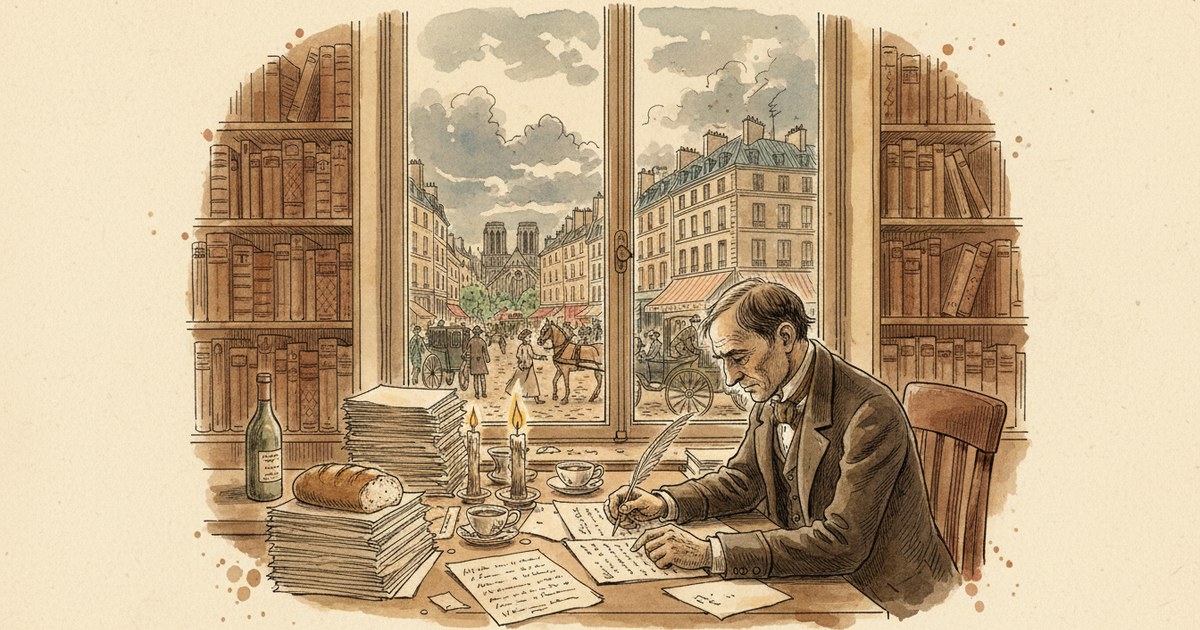
Honoré de Balzac was born in Tours in 1799, the son of a civil servant who’d reinvented himself after the Revolution, and he spent most of his adult life in a state of catastrophic debt. This is not incidental. By his mid-twenties he had launched a printing business that collapsed, leaving him with obligations that would take the rest of his life to service. He wrote to pay them down. He wrote at night, by candlelight, sustained by coffee, sometimes eighteen hours at a stretch, producing at a pace that still seems physically impossible. Between 1829 and 1850 he published roughly ninety novels and novellas. The debt was the engine.
What that situation gave him — besides the obvious urgency — was an encyclopedic, visceral, firsthand knowledge of how money moves. He knew creditors, bailiffs, moneylenders, notaries, speculators. He understood the specific humiliation of owing a small sum and the specific freedom of owing a large one. When he writes a character calculating whether an inheritance can be leveraged against a debt to fund a marriage that will unlock a better inheritance still, he is not imagining that calculation. He is writing it from memory. The moral architecture of La Comédie Humaine rests on a foundation of personal embarrassment that he converted, methodically, into social theory.
He was also a compulsive observer of surfaces. The cut of a coat, the quality of a carpet, the precise age at which a Parisian woman’s face begins to show the cost of her ambitions — Balzac catalogued these things the way a naturalist catalogues specimens. He had read his Geoffroy Saint-Hilaire and took seriously the idea that the social world obeyed laws as deterministic as those governing animal species. The title La Comédie Humaine was a deliberate echo of Dante, but the project was more Linnaean than theological: a complete taxonomy of the human types produced by post-revolutionary French society, organized by milieu, class, and appetite.
He died in 1850, a few months after finally marrying the Polish countess he had courted for nearly two decades. He was fifty-one. Victor Hugo, who visited him in his final hours, wrote that he died “at the moment when he was beginning to see the infinite.” The remark is characteristically Romantic and characteristically beside the point. Balzac had been seeing the infinite — the infinite calculation behind every social gesture — since his first debt came due.
What a Hundred Characters Chasing the Same Thing Looks Like
The novels collected in Volume 1 operate as Balzac’s clearest demonstration of his thesis. Père Goriot is the keystone: a Lear transposed to a boarding house, organized around the question of what a father’s love costs when it is expressed entirely in money. Eugène de Rastignac arrives in Paris from the provinces, naive and ambitious, and watches Goriot — a former pasta merchant who made his fortune during the revolutionary grain shortages — unmake himself in real time for daughters who have learned to see him only as a source. The novel ends with Rastignac standing over Goriot’s pauper’s grave, looking down at the lights of Paris. “Now it’s just the two of us,” he says to the city. He has understood the lesson.
That lesson is not cynical, exactly — or rather, it is not only cynical. What makes Balzac so difficult to dismiss is that he renders the characters who are destroyed by the economic logic of his world with the same precision he uses for the ones who master it. Goriot is not a fool. He is a man whose love took the only form available to him, and that form had a price. The novel doesn’t argue that he should have loved differently. It argues that a society organized around inheritance and social position will extract exactly this price from exactly this kind of love, reliably, every time.
Eugénie Grandet, also in this volume, turns the same lens on provincial wealth. Grandet is a miser — but again, not a cartoon. He is a man in whom the logic of capital has replaced every other instinct so completely that the reader watches it happen with something closer to horror than contempt. When Eugénie’s cousin arrives from Paris and she gives him her gold — her entire hoard, her only inheritance — the gesture is simultaneously the most generous act in the novel and a sentence she will spend decades serving. Balzac does not editorialize here either. The trap closes on her slowly enough that you can see every individual mechanism.
The shorter pieces in the collection extend the argument into new registers — satire, grotesque, near-farce. Balzac understood that the same economic logic that produces tragedy in a boarding house produces comedy in a notary’s office, and he moved between modes without losing the analytical thread. The cumulative effect of reading these works together, as this edition allows, is not exhaustion but accumulation: you begin to see the architecture he was building, the recurring characters who drift between novels, the social world that coheres across hundreds of pages into something with the density of lived experience.
The Translation Landscape
Balzac has been translated into English continuously since the 1830s, and the range in quality is enormous. The Victorian and Edwardian versions — Ellen Marriage’s translations for Dent, many of which circulate freely on Project Gutenberg — have a certain period charm but impose a rhetorical heaviness that muffles Balzac’s pace. His sentences move fast and hit hard; the older translations tend to drape them in subordinate clauses and careful qualification, producing a Balzac who reads like a man speaking very slowly in a crowded room. These versions have their place as historical documents. They are not the versions to read.
The Penguin Classics edition of Eugénie Grandet, translated by M.A. Crawford, is more serviceable — accurate, competent, the kind of translation that does its job without calling attention to itself. The Oxford World’s Classics Père Goriot, translated by Olivia McCannon, is genuinely strong: she handles the novel’s tonal shifts well and resists the temptation to soften Balzac’s blunter passages. Burton Raffel’s Modern Library translations have their advocates — he’s a skilled literary translator and the prose reads cleanly — though some critics find that his choices occasionally smooth away the roughness that gives Balzac his sociological texture, the sense of a narrator who is also, always, a witness.
The Classics Retold edition approaches the problem differently. Where older translations treated Balzac’s density as something to be managed — parceled out carefully, with footnotes — this translation treats it as velocity. The prose in the Goriot boarding house scenes reads with the compression of a short story; the longer descriptive passages move without the feeling of obligation that can make Victorian-era Balzac translations feel like inventory lists. A key test passage is the introduction of the Maison Vauquer at the opening of Père Goriot — a sustained catalog of décor and smell that establishes the moral atmosphere of the entire novel. In older translations it tends to read as scene-setting. Here, it reads as evidence: every detail placed like an exhibit in a prosecution.
Why This Translation?
The practical answer is that this edition gives you the most important works in a single volume, in prose that doesn’t ask you to fight it. Balzac should feel urgent. He should feel, at moments, like someone explaining something important that everyone around you has agreed not to say. The Classics Retold edition of The Balzac Collection, Volume 1 produces that experience. You can find it on Amazon — the paperback is here — and for a reader coming to Balzac for the first time, it is the right starting point: enough of the cycle to understand what he was building, in a translation that moves at his actual speed.
The deeper reason is that Balzac is one of the few nineteenth-century novelists whose central argument gets more accurate as time passes. The society he was mapping — built on inherited capital, on the marriage market as a financial instrument, on the way that money determines not just what you do but who you are permitted to become — did not end in 1850. It reconfigured. Rastignac’s challenge to Paris from the edge of a pauper’s grave still lands because the city he was addressing is still standing, still lit, still making the same demands. A translation that lets you feel the urgency of that challenge is not a luxury. It is the minimum requirement.
What books are included in The Balzac Collection, Volume 1?
Volume 1 centers on the foundational novels of La Comédie Humaine, including Père Goriot and Eugénie Grandet, along with shorter works from the cycle. Together they represent Balzac’s core argument about money, ambition, and social structure in post-revolutionary France.
Do I need to have read Balzac before to enjoy this collection?
No. Père Goriot is the standard entry point to La Comédie Humaine for good reason: it introduces the recurring character of Rastignac and states Balzac’s thesis as clearly as he ever states it. Starting here, with this collection, is the standard approach.
How does Balzac compare to other 19th-century French novelists like Flaubert or Zola?
Flaubert is more controlled and more self-consciously literary; Zola more systematically naturalistic. Balzac is faster and messier than either — more interested in the mechanics of money than in style, more willing to let a scene run past elegance in order to land its point. The three are often read together as a sequence, but Balzac comes first chronologically and argumentatively.
Is this a good edition for book clubs?
Yes, particularly for groups interested in the relationship between literature and economics, or in how social class operates. Père Goriot and Eugénie Grandet both turn on decisions that are easy to identify and hard to judge cleanly, which generates better discussion than novels with cleaner moral lines.
Also worth reading

Leave a Reply