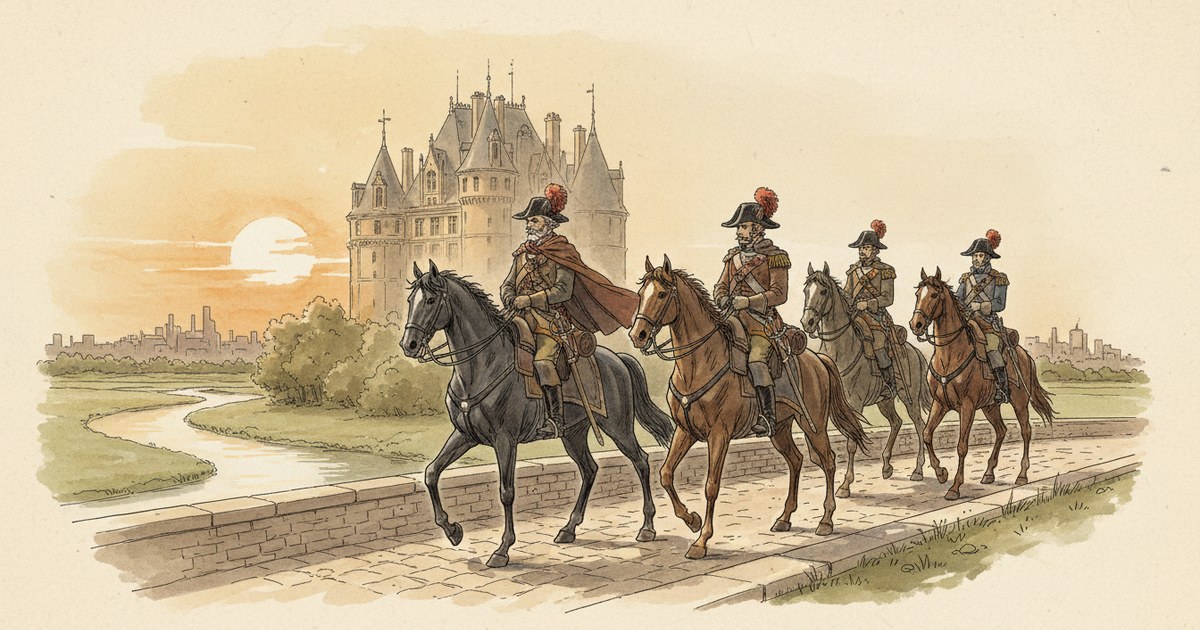
D’Artagnan is forty years old, still wearing the same sword, and going nowhere fast. Twenty years after he rode into Paris desperate and penniless and helped save a queen’s honor, he holds a modest rank in the king’s musketeers and no real prospect of advancement. Cardinal Mazarin, the new power in France, barely acknowledges him. Athos has retreated to a country estate. Porthos married a rich widow and is getting fat. Aramis is plotting something ecclesiastical that nobody fully understands. The band that swore “all for one, and one for all” has scattered into middle age, and Dumas opens this sequel by showing us exactly how ordinary heroism looks with the shine worn off.
The thesis of Twenty Years After is not a comfortable one: loyalty is not enough. The France of 1648 is fracturing along the fault lines of the Fronde — a civil war pitting the parliament and the old nobility against Cardinal Mazarin’s government — and when d’Artagnan and Porthos are recruited by Mazarin to suppress it, they discover that Athos and Aramis are fighting on the other side. Four men who swore a blood oath are now, quite literally, pointing weapons at each other. Dumas doesn’t flinch from the arithmetic. He doesn’t rescue the motto. He asks what it costs when everything your younger self believed turns out to be context-dependent.
This is also why the book surprises readers who come expecting a swashbuckling encore. The action is here — duels, prison breaks, a desperate crossing to England where the four attempt and fail to save Charles I from the executioner’s block — but the engine running underneath is not adventure. It’s the question of what four men owe each other when their loyalties have diverged and two decades have made strangers of them. That tension doesn’t resolve cleanly, and Dumas is honest enough not to pretend it does.
The Novelist Who Raided History and Called It Research
Alexandre Dumas was born in 1802 in Villers-Cotterêts, the son of a Napoleonic general and the grandson of an enslaved Haitian woman and a French marquis. He grew up in a household that had known genuine military glory and then watched it evaporate — his father died young, the family money followed, and Dumas was left with a name that opened some doors and a racial heritage that closed others. He spent his early adulthood copying manuscripts in Paris for the Duc d’Orléans, reading voraciously, writing plays that started to succeed. By his thirties he was one of the most famous writers in France. By his forties, one of the most famous in Europe. He never stopped writing long enough to be careful with money, which meant he never stopped needing to write.
That biographical fact — the constant financial pressure, the factory-pace output — matters more than it sounds when you’re reading the Musketeer novels. Dumas didn’t write Twenty Years After as a considered return to beloved characters. He wrote it because the first book had created a demand and he had the material, the collaborator (his research partner Auguste Maquet handled the historical architecture), and the creative energy to go deeper into people he already knew. What looks like a sequel is actually a reckoning. A writer who understood what it meant to have been young and ambitious and to have ended up somewhere more complicated was precisely the right person to put d’Artagnan at forty and ask him what the oath is worth now.
His outsider relationship to French aristocratic culture shapes the novel’s politics in ways that are easy to miss. Dumas understood the Fronde — the revolt of the nobles and the Paris parliament against royal authority — not as a history lesson but as a drama about who gets to claim legitimacy. He was sympathetic to all sides and fully loyal to none, which is precisely how the novel handles its factions. Athos and Aramis fight for the Fronde’s ideals of aristocratic independence. D’Artagnan and Porthos serve the crown out of pragmatism and personal loyalty to a young king. Nobody is simply right. That moral ambiguity didn’t come from academic study; it came from a man who had spent his life reading the room in rooms where he was not quite supposed to be.
The sheer scale of Dumas’s output — enough text in a lifetime to fill a hundred volumes, produced partly through collaboration — has given literary history an excuse to underrate him. The factory model, the serial publication, the hired research: critics used all of it to suggest he wasn’t quite serious. What they missed is that the serial form didn’t dilute his instincts; it sharpened them. His ear for the chapter-ending hook, for the scene that arrives at precisely the right moment to reset the emotional stakes, for the beat of comedy that makes the next beat of consequence land harder — all of that is craft. Twenty Years After is a long novel that never feels long. That’s not an accident of plot mechanics. It’s a writer who knew exactly what he was doing.
What the Motto Costs When You’re Forty
The structural gamble of Twenty Years After is that Dumas gives you two hundred pages to watch d’Artagnan try to reassemble something that doesn’t want to be reassembled. Athos, now the Comte de la Fère, has turned quieter and more principled with age — no longer the elegant drunk of the first novel but something closer to a moral philosopher, and he has decided that Mazarin’s France is not worth his sword. Porthos is cheerfully uncomplicated; he wants a title and will fight whoever Athos tells him to fight. But even Porthos has a dignity now, a settled bourgeois comfort that makes his eventual return to violence feel genuinely costly. Aramis is the most transformed of all, and Dumas handles him with deliberate opacity. You never quite know what Aramis wants. That’s the point. The man who was always plotting something has become entirely plot.
The English section of the novel — where the four travel to London in a last-ditch attempt to prevent the execution of Charles I — is the emotional core and the moral hinge. They fail. They watch the king die. And in the aftermath, Dumas pulls off something genuinely strange: he makes that failure feel like the truest thing in the book. Four men at the height of their powers, fully reunited, working together with the old fluency — and it isn’t enough. History doesn’t care about competence. It doesn’t reward loyalty. It proceeds on its own logic, and the best you can manage is to have been there, to have tried, to survive the attempt. D’Artagnan walks away from the scaffold carrying knowledge he can’t unfeel. The motto still exists. It just means something different now.
The comedy — which is everywhere in the first novel — is still present here. Porthos’s vanity, Aramis’s ecclesiastical maneuvering, d’Artagnan’s constant calculation of every room he enters: Dumas doesn’t abandon the tonal register that made the original beloved. But the jokes now sit against darker material, and he doesn’t flag the transition. You laugh, and then three pages later someone is making a decision about which side of a civil war they’re on, and the novel treats both moments with equal seriousness. That tonal management — the refusal to signal when to feel what — is what separates Twenty Years After from the pulp adventure novel it superficially resembles. Dumas understood that life doesn’t come with emotional stage directions. Neither does the book.
The Translation Landscape
The available English translations of Twenty Years After sort into two distinct categories: Victorian and modern, and the gap between them is wide. The Victorian translations — most of which have circulated since the 1840s and form the basis of most free ebook versions — are readable in the way that all Victorian prose is readable: steadily, with patience, and with the understanding that characters “exclaim” things every four pages. The dialogue has the cadence of stage melodrama. The humor, which in Dumas depends on precise timing and the dry aside, reads as broad farce. Characters who should feel caustic come across as merely fussy. These translations aren’t wrong, exactly. They’re translations of a different era’s idea of what a French novel should sound like in English.
Lawrence Ellsworth’s modern translation, published by Pegasus Books in 2021, is a significant step forward. Ellsworth is a committed Dumas scholar — he also translated The Red Sphinx — and his prose has the rhythm of contemporary English without losing period flavor. The dialogue breathes. D’Artagnan’s sardonic edge comes through. If you want a single modern translation with scholarly notes and a reliable introduction to the historical context of the Fronde, Ellsworth is the serious choice. The trade-off is apparatus: the notes and supplementary material can interrupt the reading experience for someone who wants the novel and nothing else, and the physical volume is substantial.
The Classics Retold edition prioritizes pace over philology. Where Ellsworth is attentive to the texture of the French and to the specific weight of a word Dumas chose, this translation keeps its eye on momentum. The scene in which d’Artagnan first visits Athos at his country estate — finding him transformed, quieter, at a remove from everything they once shared — lands here as a revelation compressed into a single paragraph rather than a gradual accumulation of detail. That’s a translation choice. It’s the right one for a reader who wants to feel what the novel is doing before analyzing how it does it.
Why Read This Translation?
Twenty Years After is not a short book, and the version you read shapes the experience considerably. The Victorian translations that dominate free ebook platforms preserve the story but muffle its timing. The Ellsworth translation is authoritative and thorough. The Classics Retold edition is the one to reach for if you want the novel at full speed — the chapter-ending hooks working as designed, the tonal whiplash between comedy and consequence landing cleanly, and the precise moment when d’Artagnan realizes that the oath is not what he thought it was arriving without prose getting in the way. It makes the argument for Dumas that Dumas always deserved.
This translation is available in paperback on Amazon, and it’s the edition worth keeping on the shelf. Not because it’s the only serious modern translation, but because it reads the way Dumas wrote: fast, committed, and with the understanding that the real subject of the novel is not adventure but what happens to men who were built for crisis once the crisis is over. You can find it here. The chapter where the four men stand at the scaffold in London — reunited at last, and helpless — is alone worth the price of admission.
Is Twenty Years After as good as The Three Musketeers?
Different, and in some ways more interesting. The first novel is a masterpiece of momentum — it almost never slows. Twenty Years After is more deliberate, more interested in what middle age does to men who were built for crisis. It asks harder questions and doesn’t answer them cleanly. Readers who want the pure kinetic energy of the original may find it more demanding; readers who want to understand what Dumas was actually arguing about loyalty, time, and political reality will find the sequel indispensable to the first.
Do I need to read The Three Musketeers before starting this one?
Yes, and it’s not a hardship. Dumas assumes familiarity with the characters, the shape of their original adventure, and the relationships that make the eventual fracture feel costly. Coming to Twenty Years After cold means missing the weight behind every reunion scene. Read the first novel, then read this one immediately after. The gap between them — what happened in those twenty years, what it did to four people — is the subject of the book.
What is the Fronde, and how much historical background do I need?
The Fronde was a series of civil conflicts in France between 1648 and 1653, pitting the parliament and the nobility against Cardinal Mazarin and the regency government of Anne of Austria. Dumas explains enough in the novel that a reader with no prior knowledge can follow the political stakes. A brief skim of the basics before you start will sharpen the reading — knowing that the Fronde actually happened, and roughly how it ended, makes Dumas’s moral ambiguity feel pointed rather than vague. He’s not inventing complexity. He’s finding it in the record.
Is this a faithful translation of the original French?
The Classics Retold edition is a modern English translation that prioritizes readability and pace. It renders Dumas’s French accurately while making choices — favoring an English idiom that carries the right weight over a more literal equivalent — that serve the reading experience. Readers who want a translation with extensive scholarly apparatus and closer philological attention should consider the Ellsworth edition alongside this one. Readers who want to be inside the novel, carried by it, will find this translation does exactly that.
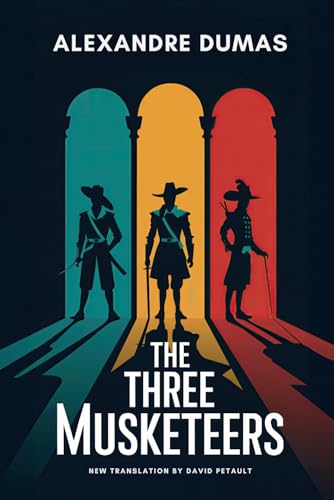
Also worth reading
Leave a Reply