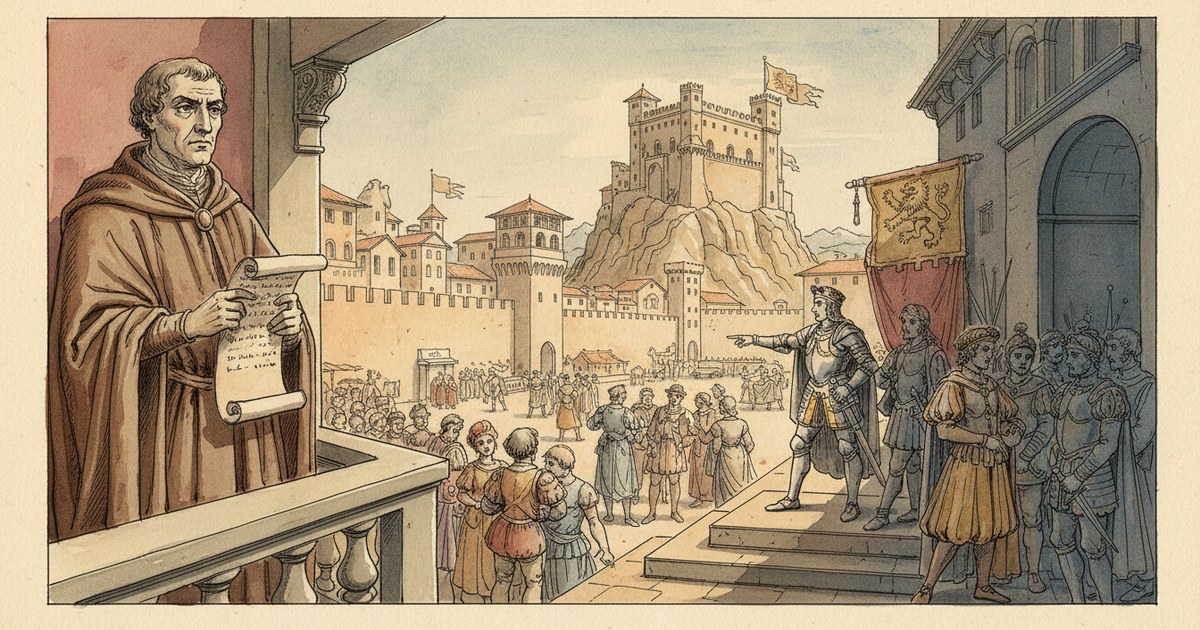
In the winter of 1513, Niccolò Machiavelli was writing letters from a farm outside Florence that described his days with brutal precision: check the bird traps in the morning, argue with woodcutters at the local inn through the afternoon, then change into his best clothes at nightfall and sit at his desk to read the ancients. He called this ritual “entering the courts of old men.” He was forty-three, recently tortured on the strappado — a device that suspended prisoners by the wrists tied behind their back, then dropped them, dislocating the shoulders — and banned from Florence on suspicion of conspiring against the Medici family, who had just retaken the city and ended the republic he had spent fourteen years serving.
The Prince came out of that winter. Not as a work of political philosophy, exactly — that framing flatters it into abstraction. It was a job application. Machiavelli dedicated it to Lorenzo de’ Medici, and the message beneath the formal dedication was simple: I understand power better than anyone you currently employ. Give me a position. He never got one.
That context doesn’t diminish the book. It explains why it reads the way it does. The Prince is ruthless, undeceived, and oddly intimate because it was written by a man who had been inside the machinery of the Florentine state, watched it destroyed, survived torture for his association with it, and then sat down to reconstruct exactly how power works and why most rulers misuse it. This isn’t abstraction dressed up as political theory. It’s a diagnosis written by someone who had already been operated on.
Fourteen Years in the Engine Room
Machiavelli joined the Florentine chancery in 1498, at twenty-nine, as Second Chancellor — a position with no prestige and enormous responsibility. He drafted the republic’s diplomatic correspondence, handled the logistics of military campaigns, and was sent on missions to Cesare Borgia, Louis XII of France, and the Holy Roman Emperor. For fourteen years he watched how power actually worked, and what he saw was not glory or statecraft. It was men making decisions under pressure, most of them badly, for reasons they either didn’t understand or couldn’t admit to themselves.
The missions mattered. When Machiavelli spent four months in 1502 watching Cesare Borgia consolidate his grip on the Romagna — including the episode at Sinigaglia where Borgia lured his rebellious captains to a meeting and had them strangled — he wasn’t disgusted. He was taking notes. Borgia became the closest thing The Prince has to a positive model: a man who understood that fortune could be seized, that cruelty deployed decisively was preferable to cruelty dragged out, and that the appearance of virtue mattered more than virtue itself. The fact that Borgia ultimately failed — because his father Pope Alexander VI died at precisely the wrong moment — only sharpened Machiavelli’s thesis about the limits of individual genius against bad timing.
The republic fell in 1512. Spanish troops restored the Medici; the republic Machiavelli had served was dissolved; he was dismissed, arrested, and put to the strappado on the suspicion of involvement in an anti-Medici conspiracy. He maintained his innocence through the torture — a small and terrible detail the letters confirm — and was released when a general amnesty came through on the election of a Medici pope. He retreated to the farm in Sant’Andrea in Percussina, where his family had property, and spent the next years writing.
The biography explains the voice. Machiavelli had no academic reputation to protect, no patron yet secured. What he had was fourteen years of firsthand observation and nothing left to lose. The Prince reads like someone who has finally decided to say what he actually thinks — partly because the audience he was writing for might actually use it, and partly because the alternative was arguing with woodcutters for the rest of his life.
The Architecture of Undeceived Power
Most political philosophy tells rulers what they should do. The Prince tells them what works. That distinction is the engine of the book’s notoriety, and also its lasting relevance. When Machiavelli writes in Chapter 17 that it is much safer to be feared than loved, when one of the two must be lacking, he isn’t celebrating fear. He’s noting that love is contingent on circumstances while fear, properly maintained, is a more reliable mechanism of control. The argument is empirical before it is moral, which is what makes it feel subversive even now.
The chapter on Cesare Borgia is where the book’s method is most visible. Machiavelli walks through Borgia’s conquest of the Romagna step by step, including the appointment of Remirro de Orco as the region’s brutal administrator, followed by Remirro’s public execution once the population had grown too resentful — the body “cut in two pieces” left in the piazza at Cesena, to demonstrate that Borgia both controlled order and bore no personal responsibility for the cruelty that had imposed it. Machiavelli describes this as a masterstroke. He means it. The passage is uncomfortable not because it glorifies violence but because the logic is sound.
The book’s strangest turn comes at the end. After twenty-five chapters of dispassionate analysis — mercenaries, the proper use of cruelty, the management of religion as a political instrument — Machiavelli closes with an exhortation to liberate Italy from foreign domination. The shift in register is jarring: from cold technician to patriot. The most convincing reading is that both registers are sincere. The man who analyzed Borgia with something close to admiration and the man who wanted the Medici to unite Italy were the same man, writing from the same desperate position, hoping the same argument might finally move someone powerful enough to act on it.
What survives all of this is precision. Machiavelli does not hedge. He makes a claim, supports it with an example, and moves on. There are no qualifications inserted to protect him from criticism; the book proceeds as though its conclusions are obvious once stated. That quality — the refusal of comfortable ambiguity — is why The Prince is still read, still argued over, still assigned to students who find it either liberating or horrifying, often both at once.
The Translation Landscape
The scholarly standard for English readers is Harvey Mansfield’s translation for the University of Chicago Press, first published in 1985 and revised in 1998. Mansfield is a political philosopher himself, and his version is precise to the point of stiffness: he preserves the syntax of Machiavelli’s Italian in ways that occasionally require rereading, and his notes are indispensable if you want to understand what Machiavelli is doing with specific classical references. This is the version to read if you’re writing a dissertation on Renaissance political thought. Tim Parks’s translation for Penguin Modern Classics, published in 2009, is the best available reading text from a major press — Parks is a novelist as well as a translator, and his version has a propulsive quality the more scholarly editions lack. He renders the central claim of Chapter 17 as “being feared is far safer than being loved,” which is both accurate and reads as a complete thought rather than a proposition awaiting resolution. The older W.K. Marriott translation from 1908, which is public domain and appears in dozens of cheap reprints and digital editions, has the advantage of being free and the disadvantage of feeling as though it was written for a reader who would never confuse political analysis with impropriety. Marriott’s Machiavelli is stately in ways the original is not.
The difference between these versions becomes most visible where Machiavelli is being deliberately brutal. In Chapter 8, on those who seize power through crime, Mansfield renders the key phrase as “well-used cruelties” — technically correct, and the irony lands. Parks goes with “carefully managed” cruelties, which is slightly smoother but loses the edge of Machiavelli calling something cruel and useful in the same breath. the edition linked below favors directness: the language is modern without being casual, and the priority throughout is that the argument comes through without resistance. For a first reader who wants to understand what Machiavelli is actually saying — rather than navigate the footnotes of what a classicist thinks he meant — that priority matters more than it might initially seem.
Why This Translation?
The case for this edition is simple: Machiavelli’s argument is not difficult. The Italian is lucid, the structure is logical, and the prose is direct to the point of bluntness. What obscures The Prince for modern readers is rarely the ideas — it’s the translation. Versions made for academic use, or carrying the rhetorical habits of earlier centuries, or prioritizing fidelity to Machiavelli’s syntax over clarity in English, put a layer of resistance between the reader and the argument. This translation, available in paperback on Amazon, strips those habits away. The sentences end where they should. The chapter on whether it’s better to be loved or feared reads like a conversation rather than a lecture. The exhortation at the close arrives with the force Machiavelli intended.
Machiavelli’s genius was for clarity — the kind that makes powerful people uncomfortable because it names what they’re doing and declines to call it anything else. This is the edition to hand someone who has heard about The Prince for years and finally wants to read it without feeling the argument somewhere behind the prose, never quite arriving.
Is The Prince actually a guide to becoming a tyrant?
Not exactly. Machiavelli is describing how power works, not prescribing what a ruler should want. Many of the behaviors he analyzes — Borgia’s calculated cruelties, the management of fear, the strategic use of religion — he treats as effective rather than admirable. The rulers who fail in his examples are not those who are too ruthless; they’re the ones who are cruel when unnecessary, or merciful when it will cost them, or who rely on fortune rather than preparation. The book has been read as a how-to manual, a satirical exposure of real political practice, and a work of straightforward political science. What it isn’t is simple advocacy for cruelty.
Do I need to know Italian Renaissance history to follow the argument?
No. Machiavelli uses Italian figures — Cesare Borgia, Francesco Sforza, the Medici, the Sforzas of Milan — as examples, but the argument he’s making is about power structures that appear in any era. Most good editions include brief notes identifying who these people were, and the edition linked below is designed for readers coming to the text fresh. The contextual notes are enough to follow the argument without a prior course in fifteenth-century Italian politics.
How long is The Prince, and how should I read it?
The core text is short — around 80 to 100 pages depending on the edition, with 26 chapters. It can be read in a single sitting, and Machiavelli’s structure rewards that kind of sustained attention: the argument builds from chapter to chapter, and the abrupt tonal shift in the final chapter hits harder if you’ve moved through the preceding analysis without a long break. the edition linked below preserves that compactness without padding.
Is this translation suitable for courses and book clubs?
Yes. The modern prose makes it easier to engage with the argument directly rather than parsing archaic sentence structures — which matters whether you’re analyzing it for a course or discussing it around a table. The translation handles the passages most likely to spark debate — on cruelty, on the role of religion, on fortune and free will in Chapter 25 — in plain language that keeps the focus on what Machiavelli is actually claiming, rather than on the period furniture of how he’s phrasing it.
Also worth reading

Leave a Reply