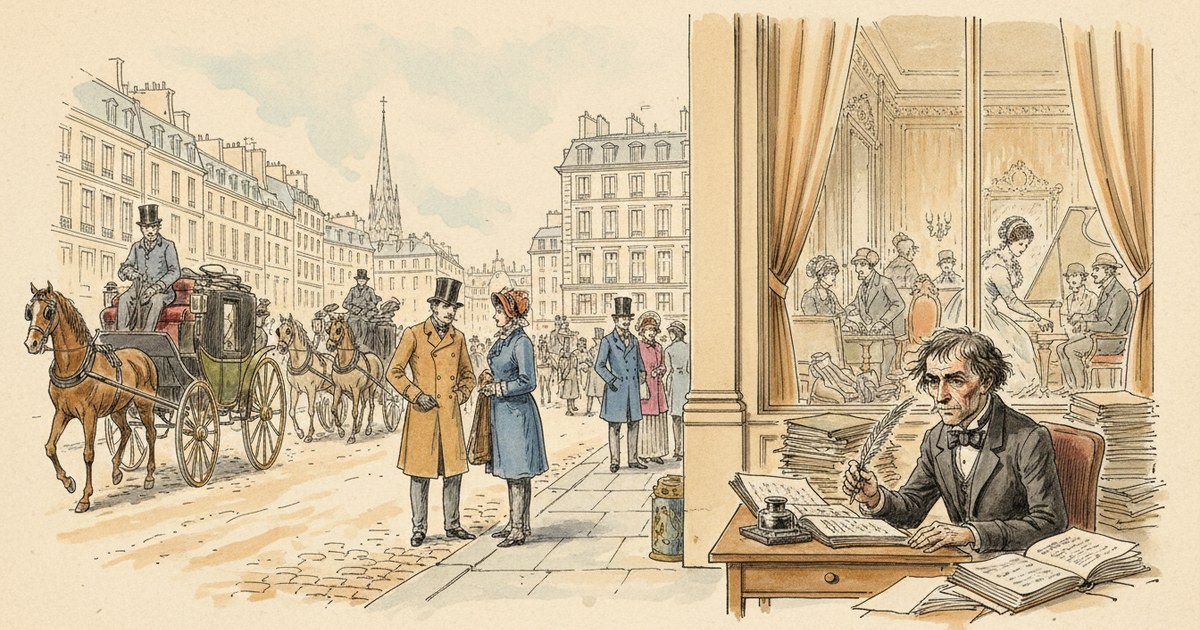
In 1835, Honoré de Balzac owed roughly 100,000 francs to creditors spread across Paris, and he was writing between midnight and noon to stay ahead of them. He wore a monk’s robe at his desk, worked his way through fifty cups of coffee a night, and published two or three novels a year not because the muse was cooperating but because the alternative was prison. You can feel this in every page.
His novels are catalogues. Prices, debts, mortgages, the precise social weight of a piece of furniture in a particular arrondissement. In Père Goriot, the boarding house Madame Vauquer runs is described with such accumulating detail — the smell of the dining room, the wallpaper’s pattern, the exact hierarchy of who sits where at table — that it reads less like scene-setting and more like an appraiser’s report. Balzac understood that objects held people in place. He had spent years calculating what he could sell.
The result is a body of work that does something no other nineteenth-century novelist quite managed: it makes capitalism feel like weather. Not ideology, not critique — just the atmosphere you’re always inside, always calculating against. Rastignac’s cold ambition in Père Goriot, the financial suffocation at the heart of Eugénie Grandet, the obsessive self-destruction running through Lost Illusions — these aren’t moral fables. They’re dispatches from someone who understood, precisely, what it costs to want things in Paris.
The Man Who Owed Everyone Everything
Balzac was born in 1799 in Tours, the son of a civil servant who had climbed from peasant stock and never quite forgotten it. His father was obsessive about status, about the gap between what you were and what you could become — tracking it, measuring it, resenting it. Balzac absorbed this so thoroughly that it became his subject. His characters don’t merely want things. They calculate the cost of wanting them, weigh the social leverage of every choice, measure themselves constantly against the room they’re standing in. That didn’t come from books. It came from watching his father keep score.
When Balzac moved to Paris in his early twenties, his family gave him a two-year allowance to prove himself as a writer. He wrote. He failed. Then he tried business: a printing press, a publishing house, a type foundry. Each venture collapsed, each one adding to a debt that would follow him for the rest of his life. By the time he was thirty, he owed so much to so many people that he was forced to register under false addresses to stay ahead of bailiffs. This is not incidental background. This is why his financial details are so precise. When Grandet opens his account books or Goriot tallies the last of his pasta-manufacturing income, Balzac isn’t performing research — he’s transcribing muscle memory. He knew exactly what a debt felt like in the chest.
Around 1833, a realization hit him: the novels he’d been writing were not separate books. They were one book — a complete portrait of French society from the Restoration through the July Monarchy, told through recurring characters who aged across volumes and crossed paths without warning. He called the project La Comédie humaine and spent the rest of his life building toward it. Rastignac, who arrives in Père Goriot as a desperate provincial student, reappears in later novels as a cynical government minister. The world doesn’t end when the book does. This is the quality that makes reading one Balzac feel like the beginning of an obligation.
He died in 1850, five months after finally marrying Ewelina Hańska, a Polish countess he had been writing to for eighteen years. The debts were not fully cleared. He left behind ninety-one novels and stories, and the Comédie humaine still unfinished. The incompleteness matters. Balzac wasn’t building a monument — he was trying to outrun something, and the velocity is what you feel on the page.
What the Boarding House Knows
Père Goriot opens with a landlady. Not with Goriot, not with Rastignac — with Madame Vauquer and her establishment on the Rue Neuve-Sainte-Geneviève. Balzac spends pages on the dining room’s smell, the grease on the wainscoting, the exact social meaning of which boarder sits closest to the fire. By the time Goriot himself appears — diminished, confused, paying rent that gets smaller every year — we already understand the economics of his humiliation without being told. The boarding house is a social organism, and Balzac has shown us how it breathes before he shows us what it destroys.
What’s destroying Goriot is love — specifically the love of a father who has converted everything he owns into the social ambitions of daughters who regard him as a liability. The scene in which he melts down his last piece of silver plate to buy one of them a dress for a ball is not written for sympathy, exactly. It’s written with the precision of an accountant recording a final transaction. That restraint is what makes it unbearable.
Eugénie Grandet works differently — slower, more suffocating, set not in Paris but in the provincial town of Saumur, where Grandet the miser has amassed a fortune by outlasting everyone around him. The novel’s central image is gold: Grandet counting coins in his locked study, Eugénie watching through a gap in the door, her whole understanding of love forming around that locked room and what’s inside it. When a cousin arrives from Paris and briefly opens her world, we feel the door swinging on its hinge. Then Grandet closes it.
Across both novels, and through Lost Illusions — where a young poet travels to Paris to become famous and instead learns how the literary marketplace actually functions — Balzac is making the same argument in three different registers: desire is not corrupted by money in nineteenth-century France; desire and money are already the same thing, and the only question is whether you know it yet. Rastignac knows it by the end. Goriot never does. Lucien, in Lost Illusions, learns it too late. The variable isn’t virtue — it’s timing.
The Translation Landscape
The dominant English-language Balzac for most of the twentieth century came from Marion Ayton Crawford, whose Penguin Classics translations of Père Goriot and Eugénie Grandet appeared in the 1950s and became the standard classroom texts. Crawford’s versions are readable and accurate, but they carry the idiom of postwar British prose — a flatness that occasionally drains Balzac’s accumulative intensity into something merely competent. The boarding house in Crawford reads like a boarding house. In the original, it reads like a verdict. Older still are the Ellen Marriage translations from the Dent and Everyman editions, produced in the early twentieth century and still circulating on Project Gutenberg — thorough, sometimes faithful, but weighted with Victorian syntax that places a layer of unnecessary distance between the reader and the text. These are the versions most people encounter in free digital editions, and they account for the persistent, mistaken reputation of Balzac as dry.
More recently, Oxford World’s Classics has offered revised translations of individual titles, and Rayner Heppenstall’s version of Lost Illusions has its admirers among scholars who prize fidelity. None of these has fully solved the central problem: Balzac’s prose is dense the way a city is dense, and it accumulates meaning by accretion. A translator who smooths too eagerly kills the effect; one who preserves every kink of French syntax produces something unreadable in English. Threading that needle requires a translator who has absorbed not just the vocabulary but the rhythm of how Balzac builds a room before he puts anyone in it.
Why This Translation?
the edition linked below collects the foundational Balzac texts in a single modern English translation built for current readers — not as a period artifact, not as a classroom supplement. The translation preserves Balzac’s density where density earns its place and moves when he moves. The boarding house still smells. Grandet’s coins still clatter. Rastignac’s final challenge to Paris — standing above the city at dusk in the cemetery, declaring war on it — lands with the force Balzac intended, not the muffled version that arrives through tired prose. For anyone coming to Balzac for the first time, this edition removes the unnecessary obstacles without removing the difficulty that makes the books worth reading.
The collection is available in paperback through the link below. If you read one Balzac, Père Goriot is where to start — but the point of this volume is that you don’t have to stop there. Goriot ends with Rastignac issuing his challenge to Paris. Lost Illusions begins with someone who hasn’t heard the answer yet. That continuity, across three novels and one modern English translation, is exactly what this edition is built to hold.
Is this a good place to start with Balzac?
Yes. Père Goriot is the canonical entry point, and this collection opens with it. It introduces the boarding house world, Rastignac’s ambition, and the social mechanics that run through everything Balzac wrote. You don’t need prior knowledge of nineteenth-century France or the Comédie humaine to follow it. The novel is self-contained, but it also makes you want to keep going — which is precisely what Balzac intended.
Do the novels in this collection need to be read in order?
Not strictly, but the sequence matters. Père Goriot introduces characters who recur in later volumes, and reading it first gives those reappearances their proper weight. Eugénie Grandet stands entirely alone — set in the provinces, with no shared characters — and can be read at any point. Lost Illusions is richer if you’ve already watched Rastignac navigate Paris, but it holds together as a standalone novel about the destruction of idealism in a marketplace that has no use for it.
How does this translation compare to the free versions available online?
The free versions online — primarily the Ellen Marriage translations from the early 1900s — are accurate but dated. Victorian syntax and idiom create a layer of distance that isn’t in the original French. the edition linked below uses a modern English translation that removes that distance while keeping the density Balzac actually wrote. The difference is audible in the first paragraph of Père Goriot: the boarding house either lands or it doesn’t.
What is included in Volume 1 of the Balzac Collection?
Volume 1 brings together three foundational works of the Comédie humaine: Père Goriot, Eugénie Grandet, and Lost Illusions. These three novels represent Balzac at full range — urban and provincial, fast and slow, satirical and devastating. They are the works most frequently taught, most widely discussed, and the ones that make the strongest case for why Balzac belongs in the same conversation as Tolstoy and Dickens.
Also worth reading

Leave a Reply