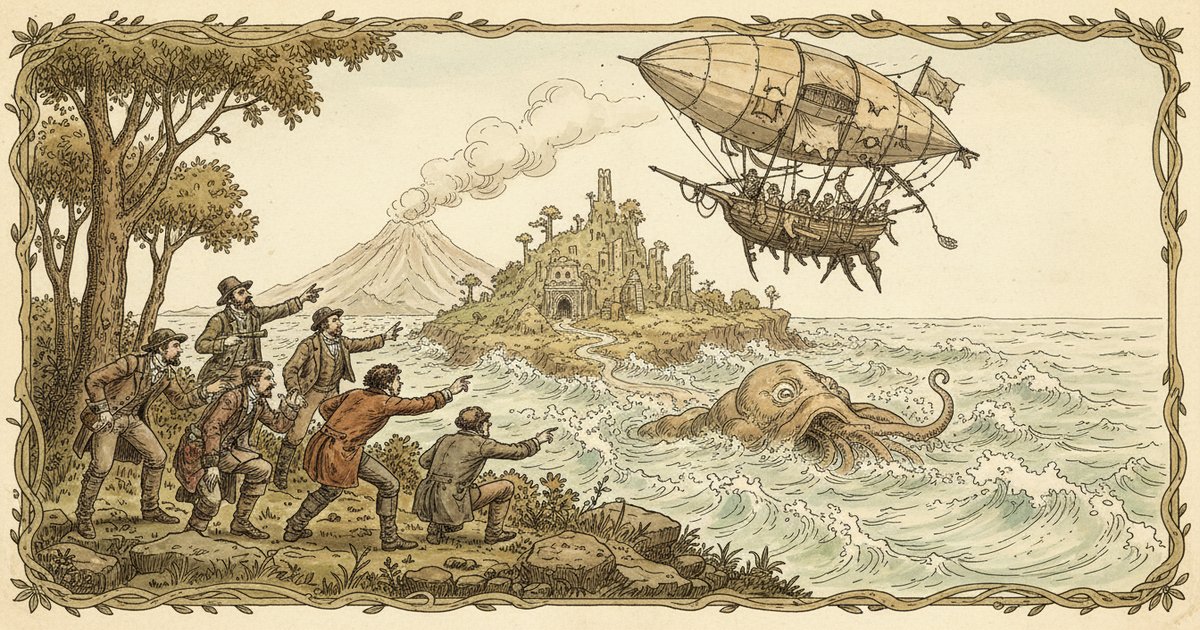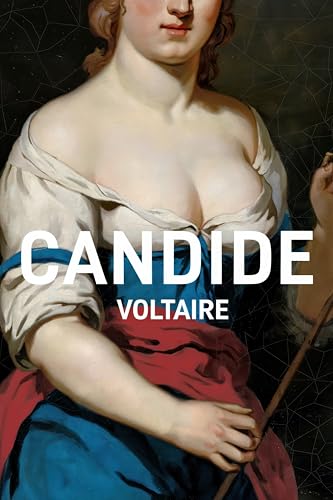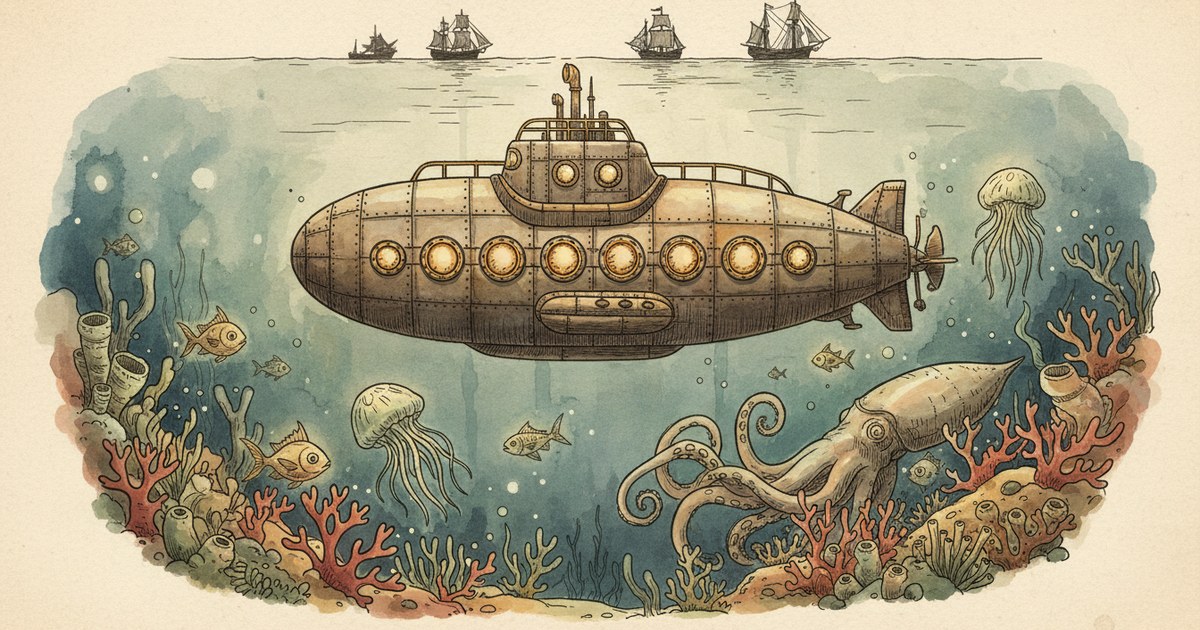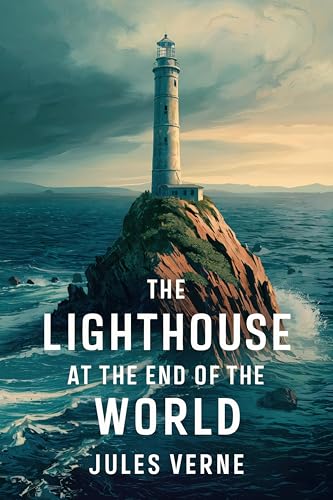
In 1866, ships from a dozen countries reported the same thing: something vast and luminous was moving beneath them. The reports were credible — speeds no living creature could sustain, a phosphorescent wake miles long, impacts that dented iron hulls. The world’s maritime press went briefly mad trying to name the thing. Jules Verne, watching from Paris, did something more useful. He went home and invented it.
Twenty Thousand Leagues Under the Sea began as a serial in 1869, a year before anyone had descended more than a few hundred feet in anything resembling a controlled vehicle. Verne had seen a model of the French submarine Plongeur at the 1867 Exposition Universelle — a lumbering, compressed-air prototype that managed brief dips in the Seine. From that seed, he built the Nautilus: electrically powered, capable of circling the globe, equipped with a salon hung with paintings and a library of twelve thousand volumes. The working submarines of 1869 could barely stay down for twenty minutes. Verne’s argument, implicit in every page, was that the ocean was not a void. It was a civilization waiting to be entered.
That argument has never really been answered. We have explored less than twenty percent of the ocean floor. Verne mapped it before we reached it, and in certain essential ways, we still haven’t caught up.
What makes the novel more than a technical fantasy is the bet Verne makes on his reader: that you will care about a man who refuses to tell you why he is angry. Captain Nemo is introduced as a presence before he is introduced as a person. The Nautilus moves. Aronnax is held captive. And then, eventually, there is the captain — cold, fluent in everything, grieving something he will not name. The mystery of Nemo is not solved by the end of the book. Verne understood that explained grief is grief defused. The opacity is the point.
The Man Who Turned His Editor’s Rejections into a Career
Verne was thirty-five when he sold his first novel. Before that: a failed lawyer, a moderately failed playwright, a stockbroker who spent his lunch hours in the Bibliothèque nationale reading scientific journals in fields he had no formal training in — geology, oceanography, astronomy, polar exploration. His first editor rejected the manuscript that would become Five Weeks in a Balloon twice. Verne reportedly told his wife he was going to burn it and try something else. She hid the manuscript. This matters to how Twenty Thousand Leagues reads, because it is a book written by someone who taught himself the science one journal at a time, who had to earn his own authority before he could project it onto a character. Captain Nemo’s serene, absolute expertise — the way he names every organism Aronnax cannot, reads the deep currents the way others read weather — carries the specific confidence of self-made knowledge. Nemo is what Verne wanted to be: the man who had actually read everything.
The editor who finally said yes was Pierre-Jules Hetzel, and the relationship that followed was one of the defining editorial partnerships of the nineteenth century — and one of the most consequential acts of political censorship in French popular fiction. Hetzel had his own exile to answer for: he had fled France after Louis-Napoleon’s coup in 1851, spending years in Brussels before returning. He understood exactly what Verne was doing with Nemo. And he made Verne pull back. In the original manuscript, Nemo was explicitly a Polish nobleman, his family destroyed by Russian imperial forces, his hatred of nations rooted in a specific historical atrocity. Hetzel judged this too inflammatory — France needed Russian goodwill — and insisted Nemo’s origins be left ambiguous. The wound that drives the entire novel was edited out of the novel. It surfaces only as absence: the portrait of a woman and two children that hangs in Nemo’s quarters, the tears he sheds at a crewman’s underwater burial, the fury that overtakes him when he encounters certain warships. You can feel the missing context in every scene where Nemo almost explains himself and then does not.
The other biographical fact that reshapes the novel: Verne wrote it in the shadow of the Second Empire, a France where political dissent required careful management. Nemo — whose name is Latin for “no one” — is a man who has renounced nations, a stateless fugitive living beneath the reach of governments. He funds anti-colonial uprisings from the sea floor. He mourns something he refuses to name. When Aronnax presses him about his past, Nemo answers: “I am not what you call a civilized man. I have done with society entirely.” That line did not require literary analysis in 1870. Every French reader knew exactly what it meant.
A Catalogue That Becomes a Grief
The novel’s central formal gamble is that it gives you a scientist as narrator. Professor Aronnax catalogs everything — species, depths, temperatures, geological formations, the chemical composition of the water at successive fathoms. Lesser writers deploy this technique to seem authoritative. Verne uses it to build an emotional argument. By the time Aronnax has named three hundred organisms, has stood awestruck in the Nautilus’s observation window watching bioluminescent forests scroll past at four knots, you understand what Nemo understood first: the ocean is not empty. It is fuller than the surface world, more ordered, stranger, more alive. The cataloguing is not pedantry — it is the slow accumulation of a love so large it has no object that can hold it. Aronnax cannot stay. He does not want to leave. The novel’s real tension is not whether the crew will escape Nemo. It is whether Aronnax can survive returning to a world that will never be as interesting again.
The scene that makes this most visceral is the walk across the ocean floor near the island of Crespo. Nemo leads Aronnax and Conseil out through the Nautilus’s airlock onto the seabed in diving suits, armed with air rifles, hunting for sport but really, you sense, conducting a kind of liturgy. They move through underwater forests that Verne describes as trees of black coral, their branches perfectly still in the absence of current, hung with seaweed the color of garnets. Aronnax reaches for his notebook and realizes he cannot write. He can only watch. The scene lasts for pages and nothing narratively consequential happens in it — no danger, no revelation, no plot development — and yet it is the emotional center of the book, the moment you understand what the novel is actually about. Verne is not writing adventure fiction. He is writing about what it costs to witness something no language is adequate to.
What Verne understood, and what most adventure fiction refuses to admit, is that wonder has an aftermath. The specific grief of a man who has seen something no one else has seen — and who will spend the rest of his life failing to describe it adequately — is present on every page without ever being stated directly. It surfaces instead in the catalog: one more species, one more coordinate, one more measurement of a world that does not need us to witness it but that becomes, by being witnessed, unbearably precious. The last line of the book arrives like a door closing on a lit room. You are back on the surface, and the surface is not enough.
Nemo’s Politics: What the Novel Is Actually Arguing
Readers who approach Twenty Thousand Leagues as a submarine adventure story are not wrong, exactly. The adventure is real and it moves fast. But Verne was doing something more pointed, and the political argument runs underneath the plot the way the Nautilus runs beneath the shipping lanes — invisible from above, but propelling everything.
Nemo is not simply a man who prefers solitude. He is a man who has made a philosophical decision about civilization and found it wanting. The ocean, in his formulation, belongs to no nation — there are no property rights below the waves, no tariffs, no flags, no armies with jurisdiction over the deep-sea vents. His electricity comes from the sea. His food comes from the sea. He is economically and politically sovereign in a way that no surface-dweller can be. When he surfaces to sink a warship — a scene that genuinely shocked readers in 1870 — Verne is not endorsing terrorism. He is dramatizing what it looks like when a man follows his principles to their logical conclusion without the friction of social compromise. Nemo is what pure sovereignty produces: someone who is both heroic and monstrous, and whose creator refuses to arbitrate between the two. The novel ends without resolving him because Verne knew that resolving him would be dishonest. Some arguments do not have answers. Some men cannot be absorbed back into the world they have rejected.
Why This Translation?
The original English translations of Verne are notoriously damaged goods — the 1872 Mercier Lewis version dropped twenty-five percent of the text, mistranslated the scientific terminology throughout, and smoothed away Nemo’s political edges into something safer for Victorian readers. What Verne actually wrote was more precise, more strange, and considerably more radical than most English readers have ever encountered. This new translation works from the original French, restores the excised passages, and renders Verne’s technical vocabulary accurately while keeping the prose moving at the pace he intended — urgent, specific, alive. If you read Twenty Thousand Leagues in school and found it slow, you were probably reading the wrong book.
One concrete example of what the Mercier Lewis cuts cost you: the Atlantis sequence. When the Nautilus glides over the submerged ruins of what Nemo identifies as the lost continent, Verne gives Aronnax a full geological and architectural inventory — basalt columns, granite foundations, the outlines of temples and harbors visible through the submarine’s lights. Lewis reduced this to a paragraph. In the complete French text, it runs for several pages, and the effect is cumulative: by the time Aronnax has catalogued the drowned city in enough detail to almost map it, you feel the weight of everything that has been lost, not just to the ocean but to history, to time, to the indifference of the surface world. That passage is one of Verne’s most arresting pieces of writing. Most English readers have never read it. The translation we recommend puts it back where it belongs.
Also worth reading
Further reading: More books by Jules Verne · Explore French Literature
What is the best English translation of Twenty Thousand Leagues Under the Sea?
For readers who want the full depth of Verne’s original vision without the archaic phrasing that plagues older Victorian-era editions, Twenty Thousand Leagues Under the Sea: A New Translation in Modern Accessible English is the strongest choice available today. Earlier translations—particularly the widely circulated Mercier Lewis version—cut significant passages and introduced errors that distorted Verne’s scientific detail and narrative voice. This modern translation restores the complete text and renders it in clear, contemporary English that doesn’t require a 19th-century reading vocabulary to enjoy.
Is Twenty Thousand Leagues Under the Sea worth reading in 2026?
Yes—and more so than many readers expect. Verne wrote Captain Nemo as a figure of radical independence, grief, and moral ambiguity that feels entirely contemporary. The novel’s tension between wonder and unease aboard the Nautilus, its meditation on freedom versus isolation, and its portrait of a man who has renounced the surface world all resonate sharply in an era defined by surveillance, disconnection, and technological anxiety. The modern accessible translation removes the one barrier that kept earlier readers at arm’s length: the stiff, dated prose of Victorian editions.
How does Twenty Thousand Leagues Under the Sea compare to The Mysterious Island: A New Translation in Modern Accessible English?
The Mysterious Island is in many ways a companion piece—it revisits Captain Nemo at the end of his life and ties up threads left open in Twenty Thousand Leagues. Where Twenty Thousand Leagues is driven by mystery and the claustrophobic grandeur of the deep ocean, The Mysterious Island is a survival story with an ensemble cast, broader in scope and warmer in tone. Readers who respond to Nemo’s enigmatic presence in the first book will find his reappearance in The Mysterious Island genuinely moving. Both modern accessible translations use consistent contemporary English, so the transition between the two books is seamless.
What should I read after Twenty Thousand Leagues Under the Sea?
If you want to stay in the world of 19th-century adventure translated into clean, modern English, two titles from the classicsretold.com catalog are natural next reads. The Three Musketeers: A New Translation in Modern Accessible English by Alexandre Dumas delivers the same propulsive plotting and larger-than-life characters, with the added pull of political intrigue and swashbuckling action set in 17th-century France. If you prefer something with more psychological weight, The Hunchback of Notre-Dame: A New Translation in Modern Accessible English by Victor Hugo is a dense, rewarding novel about justice, beauty, and social cruelty—every bit as ambitious as Verne at his best.
Frequently Asked Questions

Proust Wrote Swann’s Way While Dying
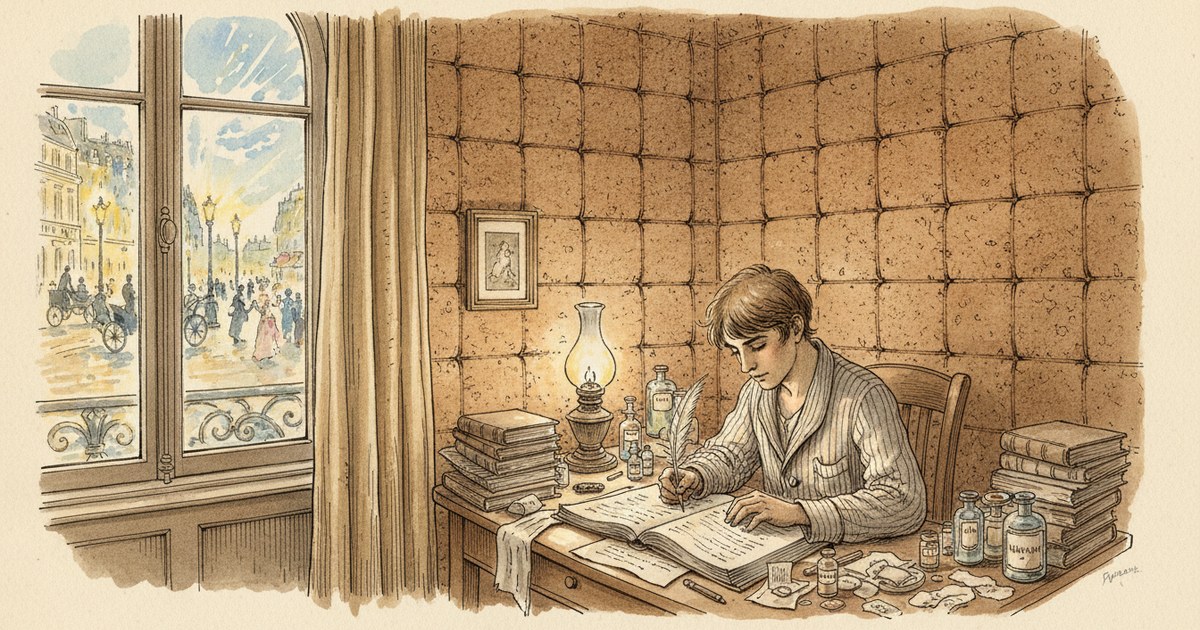
In 1909, Marcel Proust sat down in a cork-lined bedroom in Paris and began writing a sentence. It ran for several pages. He was describing the experience of waking up, of not knowing where or when you are, of feeling the whole architecture of identity collapse and slowly reassemble itself from nothing but sensation. By the time he died in 1922, he had written 3,000 pages and had not quite finished. The sentence, in a sense, was still going.
Swann’s Way is the first volume of that sentence. It begins with a man lying in the dark, half-asleep, and it ends with him standing in the street remembering a love affair that destroyed his youth and noticing, with the cold precision of a surgeon, that the woman was not even his type. Everything in between is an argument about time — not time as a calendar records it, but time as the nervous system does: associative, recursive, occasionally merciless. The thesis Proust is running is audacious: that voluntary memory lies, that the past is only genuinely recovered when the body is ambushed by it, and that literature is the only instrument sensitive enough to catch this happening in real time.
That is what makes Swann’s Way unlike anything else in the canon. Not its length. Not its famous sentences. Its argument.
The Man Who Built a Cathedral to Stay Indoors
Proust was born in 1871 to a prominent Paris physician father and a Jewish mother whose family connections opened doors into the upper bourgeoisie. He was brilliant, asthmatic, socially ravenous, and constitutionally unsuited to health. His childhood summers in Illiers — fictionalized as Combray — gave him the landscape of Swann’s Way: the church, the two walks, the hawthorns in bloom, the kitchen smell of a house where time moved differently than in Paris. When his mother died in 1905, he began a grief-driven retreat that accelerated into the cork-lined room on Boulevard Haussmann. He had the room lined to keep out noise and dust. He worked at night. He barely left.
The isolation wasn’t eccentricity for its own sake. Proust needed silence because he was attempting something that required absolute concentration: to reconstruct, with total fidelity, the precise texture of consciousness moving through time. His asthma forced him inward; his grief demanded it stay there. The result is a novel written from the inside of a mind that has nothing left to do but remember — and has learned, through suffering, to distrust everything memory presents without the body’s confirmation.
What the biographical record also shows is how ferociously social Proust had been before he retreated. Through the 1890s he haunted the salons of the Faubourg Saint-Germain, cultivating friendships with aristocrats, artists, and socialites with the same systematic devotion he later gave to prose. He attended the premiere of Pelléas et Mélisande. He fought a duel, badly, over a newspaper squib. He was present at the height of the Dreyfus Affair and watched his own social world split along antisemitic lines that cut close to home. None of this was wasted. The Guermantes, the Verdurins, the entire ecosystem of performance and snobbery in the novel — Proust assembled it from live specimens, observed over decades with a naturalist’s patience and a wounded insider’s eye.
He died of pneumonia in November 1922, correcting proofs in bed. The final volumes were published posthumously. He had spent the last years of his life writing death — his narrator’s slow understanding that time had passed and could not be recovered except in the one way that mattered, which was this: the book itself.
What the Madeleine Actually Does
Everyone knows the madeleine. What most people don’t know is that Proust uses it as a trap. The narrator dips a madeleine into lime-blossom tea, and something unlocks — not a postcard memory, not a nostalgic haze, but a full sensory resurrection so complete it produces joy disproportionate to any deliberate act of remembering. He spends several pages analyzing why. He is not being indulgent. He is making his case: that the past locked in involuntary memory is the only past that remains entirely real, and that the self who recovers it is, for that moment, standing outside time. The madeleine is not a warmth-and-cookies moment. It is a philosophical proof-of-concept.
The rest of Swann’s Way tests and complicates the proof. The Combray section, written in the long loose rhythms of total recall, gives us childhood as a place where the geometry of two afternoon walks still structures the whole moral universe. “Swann in Love,” the novella nested inside the novel, shifts tense and distance to show us Swann’s obsession with Odette from close enough to feel the shame of it — a man applying the machinery of aesthetic appreciation to a woman who returns none of it, watching himself do it, unable to stop. What Proust shows in that section, with a flatness that verges on cruelty, is that romantic suffering is a form of solipsism: Swann is not in love with Odette, he is in love with his own capacity to suffer over Odette. The reader recognizes this. The recognizing is uncomfortable.
What is easy to miss, first time through, is the structural cunning behind the madeleine episode’s placement. It comes early, before Combray has been described at all — which means that everything which follows, all two hundred pages of hawthorns and church steeples and Aunt Léonie’s bedroom, arrives as the content of that unlocked memory. We are not reading a novel that occasionally stops for flashbacks. We are inside the flashback from almost the first page. Proust has arranged it so that the reader experiences involuntary memory rather than simply being told about it — the sensation of a whole lost world rushing back, warm and complete, delivered not by effort but by a cup of tea.
The World Proust Was Writing About — and Against
To read Swann’s Way without knowing what Belle Époque Paris looked and smelled like is to miss half its tension. The world Proust depicts is one of extraordinary social rigidity dressed up as elegance: aristocratic families whose names opened every door, bourgeois families desperate to pass through those doors, and artists and aesthetes like Swann hovering uncomfortably between both worlds. Proust knew this system from both sides. His father was respected but not noble; his mother was Jewish in a city where that still cost something. He watched people perform their social identities with the anxious precision of actors who know they can be written out of the play.
The Dreyfus Affair — the 1894 military scandal in which a Jewish officer was falsely convicted of treason, dividing France into bitterly opposed camps for over a decade — runs underneath the novel like a fault line. Proust was a Dreyfusard, one of the early signatories of Émile Zola’s open letter demanding justice. Several of the aristocratic characters in the cycle are implicitly or explicitly anti-Dreyfusard, and the reader who knows this watches Proust’s narrator navigate their drawing rooms with a doubled awareness: enchanted by the glamour, clear-eyed about the ugliness beneath it. The social comedy is never quite detached from the social indictment.
How the Sentences Actually Work
The reputation of Proust’s sentences precedes them so noisily that many readers brace for difficulty before they’ve read a word. The reality is more interesting than the warning. A Proustian sentence doesn’t drift; it accumulates. It begins with an observation, then qualifies that observation, then notices what the qualification implies, then follows that implication somewhere unexpected, and then, having arrived somewhere no shorter sentence could have reached, closes. The length is the point — not as an aesthetic preference but as a mimetic strategy. Consciousness doesn’t move in short declarative bursts. It moves exactly the way those sentences do.
A useful test case is the passage where the narrator describes the church at Combray. It begins as architectural description and ends as a meditation on time — the building old enough to have absorbed centuries of the town’s life into its stones, so that looking at it feels like looking at duration itself made solid. The sentence carrying this idea runs through several subordinate clauses that keep adjusting the angle of approach, each one getting slightly closer to something that a direct statement couldn’t capture. By the end, you have not been told what the church means. You have experienced the process of working it out. That is the technique in miniature. Multiplied across 3,000 pages, it becomes something that changes how you read everything else.
Why This Translation (translated by David Petault)
Translation is the central problem with Proust in English. The sentences need to hold their shape — their long, breath-consuming, subordinate-clause-stacking shape — without collapsing into parody or ironing themselves into clarity Proust never intended. The translation we recommend takes those sentences seriously as formal objects, preserving their characteristic rhythm while keeping them navigable for a reader encountering Proust for the first time. If you’ve been putting Proust off because you’re not sure you have the patience, this is the edition to start with — and it’s available here in paperback.
The translation question matters more for Proust than for almost any other novelist in the European canon, because the style is the argument. Earlier English versions — C.K. Scott Moncrieff’s celebrated rendering, revised by Terence Kilmartin and then D.J. Enright — are magnificent in their own right but carry the slightly elevated, slightly formal diction of their respective periods. They can make Proust feel more ceremonial than he is in French, where the long sentences exist against a conversational baseline that keeps them from feeling monumental. The edition featured here is calibrated for a contemporary English reader: the syntax stays long and sinuous where it needs to, but the diction breathes, and the occasional flash of dry wit — Proust is funnier than his reputation suggests — lands cleanly rather than being buried under period upholstery.
A word on the patience question: you don’t need more of it than usual. You need a different kind. Proust doesn’t ask you to endure; he asks you to slow down to the speed of a mind actually thinking. Once you match that speed, the length stops being a problem. The only difficulty is that when it’s over, ordinary prose feels slightly impoverished by comparison.
Also worth reading
Further reading: More books by Marcel Proust · Explore French Literature
What is the best English translation of Swann’s Way (In Search of Lost Time Vol. 1)?
For readers approaching Proust for the first time, a modern accessible translation of Swann’s Way is the strongest choice. Unlike older Victorian-era renderings that preserve the opacity of the original French syntax at the expense of readability, this new translation prioritizes clarity without sacrificing the novel’s famous lyrical depth. The long, sinuous sentences are kept intact but made navigable, so the prose breathes rather than baffles. Readers who previously bounced off Proust’s opening pages often find this version the one that finally lets them through.
Is Swann’s Way (In Search of Lost Time Vol. 1) worth reading in 2026?
Yes — arguably more so now than in previous decades. Proust’s central preoccupation, the way memory shapes identity and distorts time, maps directly onto contemporary anxieties about attention, nostalgia, and what we lose when we stop being still. The Combray section alone, with its meditation on involuntary memory triggered by the madeleine, reads less like a literary curiosity and more like a precise phenomenological report on the modern mind. A clean, modern translation removes the period-piece friction and lets the novel’s psychological acuity hit without delay.
How does Swann’s Way (In Search of Lost Time Vol. 1) compare to Pleasures and Days: A New Translation?
Both belong to the same Proustian world, but they serve different purposes. Pleasures and Days is early Proust — a collection of sketches, prose poems, and short fiction that reads as a rehearsal for the grand themes he would later develop in full. Swann’s Way is where those themes crystallize into sustained narrative: obsessive love, social performance, the architecture of memory. Readers who want to understand what Proust was building toward should start with Swann’s Way. Pleasures and Days rewards those who return to it after finishing the larger work, when its sketches can be read as seeds rather than standalone pieces.
What should I read after Swann’s Way (In Search of Lost Time Vol. 1)?
If you want to stay inside Proust’s seven-volume cycle, the next step is Within a Budding Grove. But if you’re ready to shift from interior monologue to plot-driven momentum, two titles from the classicsretold.com catalog translate that appetite into immediate satisfaction. The Three Musketeers: A New Translation in Modern Accessible English delivers everything Swann’s Way withholds — pace, action, camaraderie — in a version stripped of archaic diction. Alternatively, The Hunchback of Notre-Dame: A New Translation in Modern Accessible English offers the same nineteenth-century French literary milieu as Proust but through Hugo’s architectural spectacle and social fury. Both are available in editions edited specifically to keep modern readers reading.
Frequently Asked Questions

Hugo Built Notre-Dame. The Church Burned It Down.
In 1482, the Cathedral of Notre-Dame de Paris had a problem: nobody cared about it. The building was crumbling, its statues defaced, its portals encrusted with grime. Medieval architecture was considered barbaric—the word “Gothic” was itself an insult. City planners had been chipping away at the old stone for years, adding windows here, tearing out chapels there. Then Victor Hugo sat down and wrote a novel. Within a decade, restoration had begun. Within a generation, Viollet-le-Duc had given Notre-Dame its iconic spire—a spire that never existed before Hugo’s book made the cathedral impossible to ignore.
That’s the peculiar violence of Hugo’s achievement. He didn’t describe Notre-Dame. He manufactured its aura. He made it so densely inhabited by Quasimodo’s longing and Frollo’s damnation and Esmeralda’s doomed grace that the stones themselves became emotional architecture. When the roof burned in April 2019, the shock that went around the world wasn’t grief for a medieval building. It was grief for a place Hugo had made sacred. The Church, which had spent centuries treating the cathedral as a utility, was saved—twice over—by a novel it would not have endorsed.
That’s the thesis Hugo earns: literature can do what institutions cannot. A building survives because a story made it matter. The Hunchback of Notre-Dame is not a love story, not really, and it’s barely a gothic melodrama. It’s an argument—sustained, furious, and occasionally dazzling—that beauty has a right to exist and that power, whether clerical or civil, destroys beauty at its own peril.
The Man Who Loved Buildings More Than He Loved People
Hugo was twenty-nine when he published Notre-Dame de Paris in 1831, and he was already angry. The July Revolution had just toppled Charles X; the Romantics were fighting with the Classicists over the soul of French literature; Haussmann hadn’t yet taken a sledgehammer to medieval Paris, but the intention was visible. Hugo had been documenting condemned buildings since he was a teenager, sketching doorways and towers and gargoyles the way another young man might sketch girls. He understood that architecture was text—that the cathedral was a book in stone, written by anonymous hands over three centuries, and that erasing it was a form of censorship.
His obsessive, forty-page chapter on the cathedral—a chapter that stops the novel dead in its tracks and that every publisher since 1831 has considered cutting—is not a digression. It’s the argument. Hugo believed that the printing press had made cathedrals obsolete as repositories of meaning, but he also believed that made them more precious, not less. The chapter exists because he understood that his novel was itself an act of restoration, that words could do what mortar couldn’t. That self-awareness shapes everything that follows: the deformed bell-ringer who loves beauty he can never possess, the archdeacon who hoards knowledge until it devours him, the dancer who is all surface and no safety. Each character is a theory about what happens when a society fails to protect the things it creates.
The biographical fact that matters here isn’t Hugo’s politics or his exile or his legendary appetite for other people’s wives. It’s that he spent a decade watching Paris consume itself and decided the best weapon against forgetting was to make you love a specific gargoyle on a specific tower at a specific hour of the morning. That precision—that refusal to be vague about beauty—is why the novel still works.
What the Book Actually Does to You
The Hunchback of Notre-Dame is structurally strange in ways that modern readers aren’t warned about. The first hundred pages are a carnival—chaotic, comic, almost Dickensian in their appetite for grotesque detail. Quasimodo doesn’t appear until you’ve already been lost in the crowd for a while, and when he does appear, crowned Pope of Fools and pelted with garbage, the shift in register is so violent it lands like a fist. Hugo wants you to have laughed before he makes you ashamed of laughing.
What the novel does with Frollo is more disturbing than anything in its reputation suggests. He is not simply a villain. He is a man who has spent his life in the disciplined pursuit of understanding and has arrived, methodically, at evil. His obsession with Esmeralda isn’t passion—it’s the final, logical destination of a mind that has learned to treat other people as problems to be solved. Hugo renders his descent not with horror-movie theatrics but with the flat, clinical patience of someone who has watched intelligent men ruin everything they touch in the name of certainty. The scene where Frollo watches Esmeralda from a window—wanting her and wanting her destroyed in the same moment—is one of the more honest portraits of a particular kind of masculine damage that nineteenth-century literature produced. It hasn’t aged. That’s the uncomfortable part.
Why This Translation
Hugo’s French is beautiful and it is also relentless—long sentences that accumulate pressure like water behind a dam, passages of architectural description that demand patience, slang and street Latin and ecclesiastical terminology layered into the same paragraph. Most Victorian translations preserved the grandeur and lost the energy, producing a Hugo who sounds like he’s delivering a sermon. This new translation keeps the drive. The sentences breathe. Quasimodo’s inner life is rendered with the plainness it deserves—not poeticized, not sentimentalized, just present—and Frollo’s monologues retain the cold intelligence that makes him genuinely frightening rather than merely theatrical. If you’ve tried Hugo before and found him airless, try again here. The cathedral is still standing. Get the paperback or the ebook edition here.
Notre-Dame burned, and within hours a billion dollars in donations had materialized to rebuild it. Hugo would have found that both gratifying and insufficient. You can restore the stones. The question his novel keeps asking—what a society destroys when it destroys what it finds inconvenient—doesn’t have a restoration fund.
Translation Landscape
Notre-Dame de Paris (Penguin Classics Deluxe, trans. Julie Rose) — The most complete modern English rendering. Rose keeps Hugo’s archaic register where it matters and his speed where it counts. The Deluxe edition includes the full “This Will Kill That” chapter and Hugo’s preface — material that abridged Victorian editions quietly dropped.
Notre-Dame de Paris (Penguin Classics, trans. John Sturrock) — Sturrock’s 1978 translation remains solid and widely available. It normalises Hugo’s more extravagant sentences, which some readers prefer; others find it loses the novel’s gothic excess. Reliable for classroom or casual reading.
Also worth reading
Further reading: More books by Victor Hugo · Explore French Literature
What is the best English translation of The Hunchback of Notre-Dame for modern readers?
For readers who want Hugo’s full vision without the friction of archaic language, The Hunchback of Notre-Dame: A New Translation in Modern Accessible English is the strongest current option. Victorian-era translations preserve a certain grandeur but frequently lose general readers in dense, stilted phrasing. This modern translation retains Hugo’s dramatic sweep, dark romanticism, and architectural obsession while rendering the prose in clear, natural English — making it the practical choice for anyone coming to the novel for the first time or returning after an abandoned attempt.
Is The Hunchback of Notre-Dame worth reading in 2026?
Yes, and arguably more so now than in quieter eras. Hugo’s novel is built on themes that have not aged out: institutional cruelty dressed in the language of order, the scapegoating of people who look or live differently, and the gap between the city’s official face and what happens in its shadows. Quasimodo, Esmeralda, and Frollo are not period curiosities — they are recognizable types. The Hunchback of Notre-Dame: A New Translation in Modern Accessible English removes the language barrier that kept many readers at arm’s length, making it easier than ever to engage with a novel that still has things to say.
How does The Hunchback of Notre-Dame compare to Ninety-Three as an introduction to Victor Hugo?
Ninety-Three: A New Translation is Hugo at his most concentrated — a tight, war-driven narrative set during the Terror, with a moral argument that arrives with the force of a verdict. The Hunchback of Notre-Dame: A New Translation in Modern Accessible English is the opposite in almost every structural sense: sprawling, cathedral-scaled, more interested in atmosphere and character study than in plot efficiency. Readers who want to understand Hugo’s range should read both, but The Hunchback of Notre-Dame is the better entry point — it shows the full repertoire of his ambition, from grotesque comedy to genuine tragedy, before Ninety-Three demonstrates what he could do when he stripped everything back.
What should I read after The Hunchback of Notre-Dame?
The most direct next step is The Three Musketeers: A New Translation in Modern Accessible English, available at classicsretold.com. It shares the same French Romantic era and the same appetite for spectacle, moral stakes, and characters who are larger than life — but trades Hugo’s tragic register for Dumas’s propulsive, conspiratorial energy. If you want something that moves in a completely different direction while staying within the classicsretold.com catalog, Swann’s Way (In Search of Lost Time Vol. 1): A New Translation offers the opposite of Hugo’s exteriors: Proust turned entirely inward, making it a useful counterweight after the grand, outward drama of Notre-Dame.
You might also enjoy
See the Difference: Old vs. New Translation
This post contains affiliate links. As an Amazon Associate, we earn from qualifying purchases.

D’Artagnan Never Becomes a Musketeer
There is a moment, somewhere in the first fifty pages of The Three Musketeers, when a young Gascon with an ugly horse and an uglier temper manages to schedule three separate duels with three separate men before noon on the same day — and then discovers that all three are friends. Any other writer would have turned this into a disaster. Dumas turns it into the founding of a brotherhood. That whiplash — catastrophe becoming camaraderie in a single paragraph — is the whole engine of the book, and nobody has ever done it better.
We think we know this story. The films have made sure of that: swashbuckling, capes, a few sword fights, Porthos being loud. But the novel is something stranger and more furious than any of its adaptations have admitted. It is a book about loyalty tested to breaking point, about political power and who it actually crushes, about a woman (Milady de Winter) who is easily the most dangerous intelligence in France — and who the heroes ultimately murder for it. If you came to The Three Musketeers through Hollywood, you have been lied to, pleasantly, for years. The real thing is wilder, darker, funnier, and more morally uncomfortable than any movie had the nerve to show you.
The question is whether you can get to the real thing. Most English translations have stood between you and Dumas like a well-meaning chaperone — correct, a little stiff, quietly draining the energy from a prose style that in the original runs like a man late for a duel. This new translation is the argument that you don’t have to settle for that anymore.
The Man Who Wrote Faster Than History Could Keep Up
Alexandre Dumas was born in 1802 in Villers-Cotterêts, a provincial town north of Paris, the son of a general and the grandson of a Haitian enslaved woman named Marie-Cessette Dumas, whose surname his father took. That lineage mattered — it shaped how Dumas was received, dismissed, and eventually written out of the literary canon that his contemporaries grudgingly admitted he dominated. He arrived in Paris at twenty with almost nothing: a letter of introduction, a gift for penmanship, and an appetite for theatre, history, and argument that never once dimmed.
He taught himself to write by reading everything. He crashed the Romantic movement just as it was cresting, watched Victor Hugo storm the Comédie-Française with Hernani, and understood immediately what the age wanted: drama, sensation, color, speed. His plays made him famous first. Then, in 1844, two things happened almost simultaneously: The Three Musketeers began its serialization in Le Siècle, and The Count of Monte Cristo began in Journal des Débats. Within twelve months, he had written two of the most-read novels in the history of French literature. He was doing it, by his own account, while running a salon, directing a theatre, entertaining half of Paris, and spending money at a rate that alarmed everyone who watched.
He worked with collaborators — Auguste Maquet most famously on the Musketeers novels — and this has been used against him ever since, as though collaboration were a form of cheating rather than the normal condition of serialized popular fiction in the 1840s. What Maquet provided was historical scaffolding: the research, the period detail, the document in the Bibliothèque nationale that seeded the idea. What Dumas provided was everything else: the dialogue, the pace, the characters who leap off the page still breathing. No one reading Athos’s scene with Milady at the inn — arguably the most quietly devastating confrontation in the entire novel — has ever wondered who actually wrote it.
Four Men, One Impossible Standard of Friendship
The Three Musketeers does something that very few adventure novels have ever managed: it makes you believe in the friendship before it earns it. D’Artagnan arrives in Paris broke and ridiculous, and within two chapters he is fighting alongside men he met hours ago as though they have known each other for a decade. It should feel false. It doesn’t, because Dumas understands that some alliances are legible the moment they form — that certain people recognize each other instantly, and that recognition is its own kind of intimacy. The book is, underneath everything else, a study in what it means to be the kind of person others will run toward trouble alongside.
But Dumas is too honest a novelist to leave it there. Each musketeer carries a private grief that the camaraderie doesn’t cure — only, occasionally, lightens. Athos drinks because of a wound so old he can barely name it. Aramis wants God and keeps choosing pleasure instead, with a scholar’s ability to justify anything. Porthos wants status with the same naked hunger he’d be mortified to admit. These are not decorative character details. They are the load-bearing walls. And when Milady de Winter enters the novel — cool, brilliant, and catastrophically wronged by the very men the book is asking you to cheer for — Dumas quietly places a crack in the foundation that he never quite bothers to repair. He doesn’t want it repaired. He wants you to feel it.
Why This Translation, and Why Now
Every generation of readers deserves a Three Musketeers that doesn’t make them work against the prose to get to the story. Older English versions — some of them produced in the Victorian era by translators who treated Dumas’s propulsive rhythm as something to be calmed down — have given generations of readers an experience closer to a museum diorama than to a novel. The language sits behind glass. This new translation removes the glass. The dialogue runs fast and natural. The action sequences have the kinetic clarity they have in French — you always know where everyone’s sword is. And the novel’s considerable humor, which is often the first casualty of a cautious translation, arrives intact: dry, sudden, and perfectly placed.
The paperback edition includes a translator’s note and a short historical preface that locates the novel in its actual moment — Louis XIII’s France, Richelieu’s shadow over everything, a kingdom that ran on patronage and whispered favors — without turning the book into homework. You get enough context to understand the stakes. Then you get out of the way and let Dumas run. That is, ultimately, the only correct approach to this novel. It has been making readers miss sleep for a hundred and eighty years. This translation earns its place in that lineage.
Somewhere in the second half of this book, d’Artagnan will do something that costs him more than he bargained for, and the four men will end up on the wrong side of a wall at dawn, with enemies on three sides and an argument about honor that could only happen between people who have staked everything on each other. You will not want to put it down. The eighteenth century read it that way. The nineteenth did too. There is no good reason for the twenty-first to be any different.
Translation Landscape
The Three Musketeers (Oxford World’s Classics, trans. David Coward) — The definitive annotated edition. Coward’s notes illuminate the historical scaffold Dumas built under his fiction — the real Richelieu, the real Buckingham, the actual geography of the siege of La Rochelle — without ever slowing the read. The standard choice if you want to understand the novel as well as enjoy it.
The Three Musketeers (Penguin Classics, trans. Richard Pevear) — Pevear’s 2006 translation prioritises pace and fidelity over contextual apparatus. The dialogue has an easy, modern rhythm. Lighter on annotation than Coward, which for many readers is a feature: you get the story without the scholarly frame. The lower-friction entry point.
Also worth reading
Further reading: More books by Alexandre Dumas · Explore French Literature
What is the best English translation of The Three Musketeers?
For readers coming to Dumas for the first time, or returning after years away, The Three Musketeers: A New Translation in Modern Accessible English is the strongest choice available today. Older Victorian-era translations carry the rhythm of a different century — stiff syntax, archaic diction, passages that slow rather than propel. This modern translation preserves the pace, wit, and swashbuckling energy Dumas intended while removing the friction that causes readers to abandon the book mid-chapter. Every line is rendered in natural contemporary English without sacrificing fidelity to the original French.
Is The Three Musketeers worth reading in 2026?
The novel’s core tensions — loyalty versus self-interest, individual honor against institutional power, the cost of ambition — are not period concerns. Athos, Porthos, Aramis, and d’Artagnan are drawn with enough psychological complexity that modern readers recognize them immediately. The plot moves at a speed most contemporary thrillers struggle to match. Reading The Three Musketeers: A New Translation in Modern Accessible English in 2026 means encountering that story without the barrier of outdated language, which is the single most common reason readers bounce off classic literature before it has a chance to work on them.
How does The Three Musketeers compare to Twenty Years After?
The Three Musketeers: A New Translation in Modern Accessible English is pure momentum — a young man arrives in Paris with nothing, befriends three of the finest swordsmen in France, and is swept into a conspiracy involving the Queen’s diamonds and Cardinal Richelieu. The stakes feel personal and immediate. Twenty Years After (The Three Musketeers Sequel): A New Translation in Modern Accessible English is a darker, more elegiac book. The musketeers are older, the friendships tested, and Dumas allows himself to write about loss and disillusionment in ways the first novel never requires. Both translations apply the same modern accessible standard, so moving from one to the other is seamless. If you want exhilaration, start with the first. If you want Dumas at his most emotionally complex, the sequel delivers it.
What should I read after The Three Musketeers?
Two titles make natural follow-ons. If you want to stay inside nineteenth-century Paris and push deeper into the world Dumas inhabited, The Hunchback of Notre-Dame: A New Translation in Modern Accessible English — available at classicsretold.com — is the obvious next step. Hugo and Dumas are inseparable figures of French Romanticism, and this translation applies the same accessibility-first approach, making Hugo’s dense, cathedral-obsessed prose fully readable without gutting its grandeur. If you’re ready to move into the twentieth century and want something more interior and layered, Swann’s Way (In Search of Lost Time Vol. 1): A New Translation, also at classicsretold.com, is the place to go. The pace is entirely different from Dumas — meditative rather than propulsive — but the translation makes Proust approachable in a way no prior English edition has managed.
You might also enjoy
This post contains affiliate links. As an Amazon Associate, we earn from qualifying purchases.


You must be logged in to post a comment.